Search This Blog

Wednesday, January 24, 2024

Saudi Regime Opens First-Ever Liquor Store... For Non-Muslim Foreigners Only

 Saudi Arabia has since its birth as a modern nation-state been known for its especially rigid form of Islam, called Wahhabism, which is enforced by its largely independent hardline Sharia courts and feared 'morality police' who lurk menacingly on city street corners, ready to mete out corporal punishment the moment Koranic law codes are transgressed, from hand-holding among young couples to women going out without a family chaperone, to drinking long forbidden alcohol. 

Yet it has also long been a kingdom of contradictions, known for its hard-partying set of billionaire princes and their lavish private jet/yacht/French Riviera luxury chateau high society jetsetting life-styles. In Saudi society it remains an open secret that the royal elite partake of indulgences considered "haram" behind closed doors or while traveling abroad, and most especially booze

A non-alcoholic cocktail "bar" in Riyadh. Getty Images

Typically, western workers and oil execs - for example the local expat community in the energy industry - live in their own walled communities that are set apart from daily Saudi society. In these "suburb-style" Aramco compounds it is well-known that alcohol is discreetly consumed. 

But Reuters has reported in a new exclusive on Wednesday that the kingdom's strict prohibition on selling and consuming alcohol is about to the change. Of course, it will be a 'limited' loosening up, but it's hugely significant nonetheless: "Saudi Arabia is preparing to open its first alcohol store in the capital Riyadh which will serve exclusively non-Muslim diplomats, according to a source familiar with the plans and a document," the report says.

Obviously this will only act in a 'for foreigners only' kind of way, but the bin Salman regime is still touting this as part of a broader "reform" plan

Customers will have to register via a mobile app, get a clearance code from the foreign ministry, and respect monthly quotas with their purchases, said the document, which was seen by Reuters.

The move is a milestone in the kingdom's efforts, led by Saudi Crown Prince Mohammed bin Salman, to open the ultra-conservative Muslim country for tourism and business as drinking alcohol is forbidden in Islam.

It will be interesting to see what these monthly quantity limits will be. The individual quotas could in the end be so restrictive that this whole initiative will perhaps prove just symbolic in the end, meant merely to generate some positive PR for a 'reforming' MbS in Western headlines. Here's a summary of the proposed restrictions:

  • Thirsty envoys would need to register beforehand and receive clearance by the government
  • No one under 21 will be allowed in the store and "proper attire is required" at all times inside
  • Drinkers will not be able to send a proxy, such as a driver
  • Monthly limitations would be enforced, the statement said.
Saudi Arabia's hardline clerical establishment & "morality police" not happy... via RTRS

Diplomats and foreign embassy staff already had their long relied upon workarounds in place, as for years officials with diplomatic passports could bring their secure "pouches" through airports, which authorities weren't allowed to pry into based on diplomatic immunity and protections.

Under current/prior laws, expats could face deportation or steep fines if caught with alcohol. As for Saudis themselves, they would be subject to hundreds of lashes as well as hefty monetary penalties.

https://www.zerohedge.com/geopolitical/saudi-arabia-opens-first-ever-liquor-store-non-muslim-foreigners-only

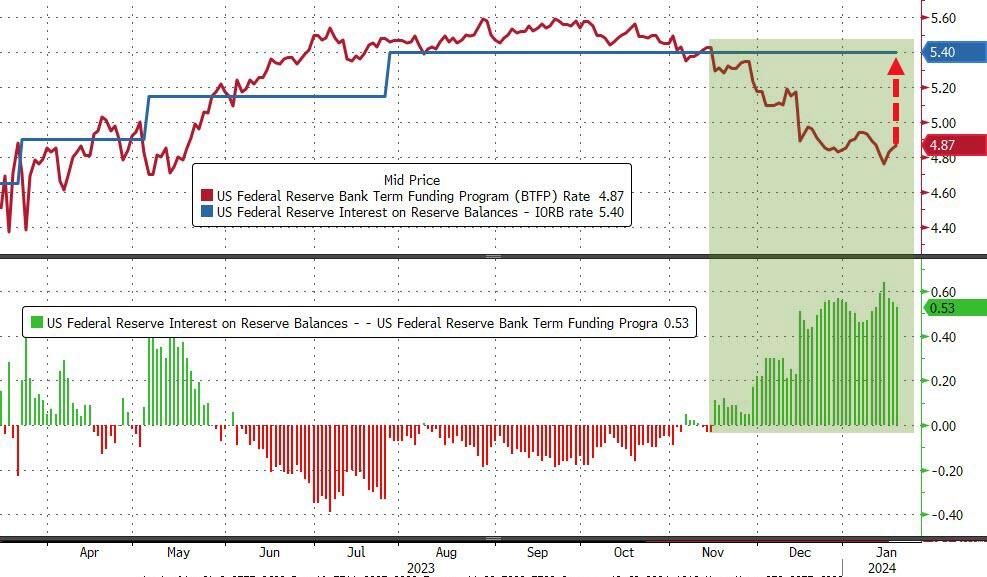
Fed Unexpectedly Kills Bank "Free Money" Bailout-Fund Arbitrage Scheme As It Ends BTFP Program

 The arbitrage of The Fed's various balance sheet facilities - which we have exposed in detail for weeks - first appeared after The Fed's November 1st meeting made it clear that peak-rates were in (and the Treasury announced a lower than expected refunding plan). That was when the market started to price in lower rates in the year ahead, dragging the one-year overnight index swap rate lower (which The Fed's Bank Term Funding Program - BTFP) is predicated on.

As we explained before, a completely perfect and riskless 'free money' arbitrage was available to those banks who could lodge collateral with The Fed at its BTFP facility receiving cash at par (at a cost of OIS+10bps) and then post that cash earning Fed Funds rate on it, pocketing the difference.

War Is Always Inflationary

 by Michael Wilkerson via The Epoch Times,

While the United States is ostensibly not at war with anyone, our government is spending taxpayers’ money as if it were.

This year, the budget for the U.S. Department of Defense is $844 billion. The United States spends nearly three times more on defense than does China and 10 times more than does Russia. At the same time, the depletion of U.S. military stockpiles and other reserves is accelerating through multiple conflicts such as in Ukraine and the Middle East. The defense contractors, their shareholders, and bought politicians benefit, but who pays? In the end, it is the American taxpayer, who never voted to send their hard-earned tax dollars abroad or to have their militaries engage in wars in all but name, that foots the bill. These citizens are paying twice: first in their tax dollars, and second, and most perniciously, in their diminished purchasing power and real (after inflation) wealth.

This is taxation without representation, in that these decisions are made without appropriate congressional oversight.

Wars are always inflationary.

This is a rule without exception.

We will continue to see high inflation in the United States to the extent these current engagements remain unchecked or others are allowed to mushroom from them.

When examples are given of runaway inflation, the hyperinflation of Weimar Germany following the First World War is the most often cited of the twentieth century. While it certainly was among the worst suffering nations, Germany was not alone. Every European country engaged in the continental war suffered massive inflation. When Germany entered the war in August 1914, the currency stood at 4.2 Reichsmarks to one U.S. dollar. In the wake of war and its aftermath, the German currency depreciated to a near infinite level of 4.2 trillion Reichsmarks to the U.S. dollar in December 1923, when a new currency was introduced, and hyperinflation eventually brought to heel. All of which came at great political and social cost.

Russia, like Germany, saw its currency become worthless and its government violently overthrown.

Other belligerents, including Great Britain, France, Austria, and Hungary saw prices double or triple and their currencies substantially devalue in dollar terms.

In the United States, the history is the same.

Prices rose during the Revolutionary War between 350–700 percent depending on the colony and their own fiscal and monetary policies (there was no central government with tax-levying power). During the Civil War, prices rose by over 60 percent, and by much more in the South. Prices rose nearly 70 percent in the United States during World War I, and well over 50 percent during World War II. Price levels rose by 35 percent during the decade-long Vietnam War, but the real inflationary effects were delayed until the 1970s, when high inflation kicked in following the oil crises. Inflation lags monetary expansion by years.

Governments go to great lengths to hide the true cost of war from their citizens. They do this in a number of ways, but one of the most common is by ensuring that the links in the chain between cause and effect are made long, plentiful, and as invisible as possible. It would be too obvious to levy a “war tax.” So instead, governments fiddle with interest rates, allow inflation to run hot while manipulating the statistical headline rates of prices, and blame greedy corporations and evil villains when inflation is too obvious to ignore. For example, recall President Joe Biden’s reference to “Putin’s price hike!” to explain U.S. inflation in 2022, in order to find someone else to blame and to divert the attention of Americans from the unprecedented $7 trillion of deficit spending that had occurred without congressional restraints over the previous two years. Inflation is a tax, but it is a hidden tax, initially unseen to most as it creeps along year by year, slowly devouring savings and purchasing power.

When currencies were backed by gold, governments were restrained from perpetuating wars and state-sponsored violence by the fact that wars were very costly and specie was limited. Leaders sued for negotiated peace and wars were ended when government coffers started to run low. However, after each of the world’s leading powers abandoned the gold standard in the twentieth century, and moved instead to a fiat model (i.e., paper currencies backed by nothing more than the faith and credit of the issuing government), this natural restraint on war was removed. So long as the printing press could run, deficits could grow, new debt could be raised, and paper money (or its digital equivalent) issued to pay for ongoing conflict. The massive economic costs are quietly borne by the same patriotic working and middle classes who send their sons and daughters to sacrifice their lives and bodies.

Today, the United States stands at a crossroads.

While not technically at war, the country is deficit spending at war-time levels. It would be one thing if the fiscal and monetary position of the nation was healthy at the starting point. But it is not. The U.S. government has over $34 trillion in debt growing by the trillions just from debt-service (interest) costs. The government continues to deficit spend as if the party can go on forever. But it cannot. The risk of a widening war grows with each passing month.

The U.S. government’s ability to finance a major conflict is slowly but surely being eroded as those foreign nations and other investors who would otherwise subscribe to our debt grow wary of fiscal disaster.

The remaining option will be monetization of the debt (when the Federal Reserve steps in as buyer of last resort), galloping domestic inflation, and an eventual currency crisis.

https://www.zerohedge.com/geopolitical/war-always-inflationary

'Who can benefit from preterm birth therapy'

 A UC San Francisco-led study has for the first time identified genetic variants that predict whether patients will respond to treatment for preterm birth, a condition that affects one in 10 infants born in the United States.

The findings are critical because no medication is available in the U.S. to treat preterm birth.

Last year, the Food and Drug Administration (FDA) pulled the only approved therapy to help prevent this condition, a synthetic form of progesterone sold under the brand name Makena, from the market, citing ineffectiveness.

The new research found that pregnant individuals with high levels of mutations in certain genes -- specifically those associated with involuntary muscle contraction -- were less likely to respond to the treatment.

Screening for the mutations could allow doctors to target the medication to those most likely to benefit, the authors suggest.

"This study calls for a precision framework for future drug development," said the study's senior author, Jingjing Li, PhD, associate professor in UCSF's Department of Neurology and the Eli and Edythe Broad Center of Regenerative Medicine and Stem Cell Research.

"In addition to understanding drug effects based on population averages, we also need to take into account the drug response of each individual patient and ask why some respond and some don't."

The study, which was done in collaboration with Stanford University, appears Jan.

19, 2024, in the journal Science Advances.

New genes associated with preterm birth

Preterm birth, or babies born alive prior to 37 weeks of gestation, is the leading cause of infant mortality and affects some 15 million pregnancies worldwide each year.

Preterm birth also leads to a range of long-term health consequences including breathing problems, neurological impairments such as cerebral palsy, developmental disabilities, visual and hearing impairments, heart disease and other chronic illnesses.

To conduct the study, researchers developed a machine-learning framework to analyze genomes of 43,568 patients that had spontaneous preterm births.

The approach uncovered genes that had not previously been known to be associated with preterm birth.

They then examined mutations in the genes among those who had received the progesterone treatment Makena.

The FDA had approved the drug in 2011 after a single clinical trial but took it off the market last spring after concluding the drug didn't work.

The decision left doctors without an approved medication for preterm birth and frustrated those who had found it effective for a subset of their patients.

This posed the question: Could there be a genetic reason why progesterone therapy worked for some, but not for others?

The researchers discovered that the patients in the group with low levels of mutations in the genes associated with muscle contractions were more likely to respond to Makena, but those with higher levels tended not to respond.

The finding indicates a personalized medicine approach that involves genetic screening could lead to successful results in patients without a high burden of those mutations.

"Progesterone therapy was the only treatment for recurrent preterm birth over the past decade, and its recent withdrawal by the FDA has left a void in the medication options available for preterm birth patients," said the study's first author, Cheng Wang, PhD, a postdoctoral scholar at UCSF.

"In previous clinical practice, we did see that many patients benefited from progesterone therapy," Wang said.

"We probably should reevaluate its efficacy, if we can identify those who respond positively to the treatment."

The researchers included a cohort of African American patients in the study to determine whether the findings applied broadly across different races.

Black women in the U.S. are almost twice as likely to give birth prematurely than white women.

They found the genetic burden did not vary by race. This suggests the high rate of preterm birth among Black mothers may be due primarily to environmental factors such as elevated stress hormones, health care biases and lack of prenatal care.

A new type of precision medicine

The researchers then went beyond that finding to identify new targets and potential therapies to treat preterm birth.

They screened more than 4,000 compounds and homed in on 10 that were predicted to interact with the genes associated with preterm birth.

Many of these therapeutic compounds are already being used to treat cancer and other diseases, which means that these drugs could possibly be repurposed to help prevent preterm labor.

A top candidate is the small molecule RKI-1447, a drug that is currently being used to treat cancer, glaucoma and fatty liver disease. Additional study of the potential of these molecules in treating preterm birth is needed.

Journal Reference:

  1. Cheng Wang, Yuejun Jessie Wang, Lihua Ying, Ronald J. Wong, Cecele C. Quaintance, Xiumei Hong, Norma Neff, Xiaobin Wang, Joseph R. Biggio, Sam Mesiano, Stephen R. Quake, Cristina M. Alvira, David N. Cornfield, David K. Stevenson, Gary M. Shaw, Jingjing Li. Integrative analysis of noncoding mutations identifies the druggable genome in preterm birthScience Advances, 2024; 10 (3) DOI: 10.1126/sciadv.adk1057

How To Thwart The Nefarious Propaganda Technique Of Projection

 by James Agresti via The Epoch Times,

One of the most effective and devious methods of mass deception is falsely accusing others of one’s own misdeeds.

This is called “projecting” or “accusation in a mirror,” and it was used by:

  • corrupt politicians in ancient Rome to purge a statesman who stood in the way of their graft.

  • the Nazis to launch World War II.

  • influential people in Rwanda to incite a genocide.

Certain moral frameworks that have gained traction in modern times permit and even encourage this type of propaganda.

Although it can be hard to determine who is projecting and who is the target, this can be accomplished with an awareness of human nature and vital research skills.

What Is Projection?

The social scientist Jacques Ellul explained the nature of projection in a classic book titled “Propaganda: The Formation of Men’s Attitudes”:

“The propagandist will not accuse the enemy of just any misdeed; he will accuse him of the very intention that he himself has and of trying to commit the very crime that he himself is about to commit. He who wants to provoke a war not only proclaims his own peaceful intentions but also accuses the other party of provocation. He who uses concentration camps accuses his neighbor of doing so. He who intends to establish a dictatorship always insists that his adversaries are bent on dictatorship.” [Hat Tip: Stella Morabito]

Another social scientist named Roger Mucchielli explained why projection is so effective in a French book titled “Psychology of Advertising and Propaganda.” Loosely translated via Google, he notes that “the advantages of mirror charging are many,” such as:

  • placing “honest people” in a “state of self-defense.”

  • depriving “the enemy” of “his arguments.”

  • convincing “everyone” to “be on the side of ‘the just Cause.’”

These “advantages” are vividly illustrated in history and current events.

Rome

In the first century BC, a Roman statesman named Publius Rutilius Rufus—who was famed for having high integrity—was prosecuted for and convicted of extortion. According to historians of that era, this was an unjust act of revenge by corrupt officials because Rufus had stopped them from overtaxing citizens and pocketing the excess money.

Modern philosophers Ryan Holiday and Stephen Hanselman describe the tactic used against Rufus like this:

“Accuse the honest man of precisely the opposite of what they’re doing, of the sin you yourself are doing. Use their reputation against them. Muddy the waters. Stain them with lies.” [Hat Tip: Larry Reed]

While this projection was targeted at an individual, it has also been used against nations.

World War II

Fast forward to Sept. 1, 1939, when Nazi Germany launched a pre-dawn military raid on Poland. This marked the official start of World War II, the deadliest and most widespread conflict in world history.

Ph.D. historian Alexandra Richie explains how the Nazis used projection to justify their assault on Poland:

  • “The military attack against Poland was masterminded by Hitler,” who was “determined to make it look as if the Poles had provoked the hostilities” by “staging numerous false-flag operations and ‘Polish provocations’ against Germans.”

  • “The most infamous of these was the staged attack at a radio station” near the German-Polish border just hours before the Nazis raided Poland. To carry out this plot, the Nazis murdered a local German who was “sympathetic to Poland,” placed his body at the radio station, and “pretended that Poles” had killed the man—using his dead body as “evidence.”

  • “It was a lie from beginning to end,” but the Nazis were “soon churning out stories about the heinous attack,” and by the next morning, “Hitler was already using” this Nazi-committed murder “to justify his invasion of Poland.”

Evidence of this scheme mainly comes from a former Nazi military official who testified that he participated in it. Yet, Nazi sympathizers claim that “the whole story might have been invented by the Allies to cover up an actual attack by Polish insurgents.”

Hitler’s minister of propaganda—the infamous Joseph Goebbels—was well aware of the tactic of projection and brazenly accused Germany’s opponents of utilizing it. “The cleverest trick used in propaganda against Germany,” said Goebbels in a 1934 speech, “was to accuse Germany of what our enemies themselves were doing.”

Rwanda

Another projection that spawned a tidal wave of murder was deployed during the 1994 genocide in Rwanda. In just 13 weeks, hundreds of thousands of people in the nation’s ethnic majority (the Hutus) tortured, raped, and slaughtered about 75 percent of the nation’s minority (the Tutsis) and anyone who tried to shelter them. Estimates of the death toll range from at least 500,000 to more than 800,000.

In the “most authoritative source” on this bloodbath—a book titled “Leave None to Tell the Story”—Ph.D. historian Alison Des Forges details how projection was employed:

  • Government officials, journalists, scholars, celebrities, business leaders, teachers, and healthcare workers stirred hatred of the Tutsis by accusing them of planning to murder the Hutus, which was “false information meant to spur the Hutu massacres of Tutsi.”

  • A photocopied document found in one of the nation’s most blood-soaked cities called for recruiting more Hutus to join in the killings by:

  • using “lies, exaggeration, ridicule, and innuendo to attack the opponent.”

  • staging fake “events to lend credence to propaganda.”

  • imputing “to enemies exactly what they and their own party are planning to do.”

  • Although “there is no proof” that leaders of the genocide “were familiar with this particular document,” “they regularly used the techniques that it described.”

  • Since the leaders of the genocide “regularly attributed to others the actions its own supporters had taken or would be taking,” potential victims learned to listen to the leaders’ radio broadcasts “to find out” what they “would be doing” next.

Moral Relativism

The author of Rwandan genocide recruiting document appeals to Vladimir Lenin—the leader of Russia’s Communist revolution—to convince readers that “moral considerations are irrelevant” when it comes to “how to sway the public most effectively.”

That mindset echoes a speech Lenin gave in 1920 before the Russian Young Communist League. After declaring that “we reject ethics” based on “God’s commandments,” Lenin stated that “our morality is entirely subordinated to the interests” of advancing Communism.

Lenin’s doctrine was also embraced by Saul Alinsky, the influential leftist who was the topic of Hillary Clinton’s 1969 college thesis. In his famed book, “Rules for Radicals,” Alinsky wrote that the “ends justify almost any means,” and the “most unethical of all means is the non-use of any means.”

In other words, Alinsky, Lenin, and the Rwandan demagogues considered it immoral to let ethics get in the way of what they wanted. This stance permits and even embraces slander, which is the core of projection.

Slander is strictly forbidden by the Bible’s ninth commandment against giving “false testimony against your neighbor.” Thus, Albert Einstein noted in 1940 as Nazis were vilifying Jews that “only the Church stood squarely across the path of Hitler’s campaign for suppressing truth.” In contrast, Einstein was sorely disappointed that Germany’s “universities” and “newspapers” were quickly “silenced.”

However, the portion of the U.S. population who identify as Christians has declined from about 90 percent in the early 1990s to 63 percent in 2022. As for others with biblical moral foundations, less than 2 percent of U.S. residents say they are Jewish by faith.

Even more telling than that, a scientific survey conducted in 2005 found that “just one out of every six adults (16%) claim they make their moral choices based on the content of the Bible.” And this percentage would undoubtedly be smaller if one could actually measure what people do instead of what they claim to do.

Concurrent with the widespread decline in biblical ethics, many have adopted a framework called postmodernism. Generally speaking, this is the belief that there are no moral absolutes and that all ethics are personal and situational. This has rapidly become the dominant view in America.

Less than two decades ago in 2007, a scientific survey conducted by Pew Research found that 78 percent of U.S. residents completely or mostly agreed that “there are clear and absolute standards for what is right and wrong.” Just seven years later in 2014, Pew found that only 33 percent agreed with that statement.

The surrounding language of the survey questions in 2007 and 2014 was different, so some of the drastic drop from 78 percent to 33 percent may be due to this. Regardless, these data suggest that many millions of people could justify slander to achieve their objectives.

Another influential moral code is found in the religion of Islam, which generally forbids lying except in three circumstances, one of which is “at times of war, as a tactic or to demoralize the enemy and win the war.” Given that certain factions of Islam have declared a perpetual war until Israel is “obliterated,” and others have joined a jihad to “achieve global domination—through any means, including violence,” Islam’s permission to lie in “times of war” provides broad leeway for slander.

The bottom line is that significant portions of the U.S. and world populations have no firm moral barricades against projection.

Given the effectiveness and potential deadliness of projection, it is important to learn how to spot and expose it.

Confirmation Bias

The first bulwark against projection is to be constantly aware that people are prone to confirmation bias. This is the tendency to blindly accept anything that accords with their preexisting beliefs.

Skilled propagandists take advantage of this human weakness by using “pre-propaganda,” or easily believed ploys like quoting people out of context. As Mucchielli notes, they do this because:

“[T]he accusations of lies awarded to adversaries can be made easier when we have started by injecting the public with misleading information as if it came from these adversaries.”

In other words, expert manipulators don’t try to deceive the public in one big leap but use a mounting series of falsehoods to make people receptive to the ultimate lie.

A simple antidote to such brainwashing is healthy skepticism, especially when it comes to claims that accord with one’s current beliefs. A rational and well-informed assessment cannot occur unless knee-jerk reactions are defeated.

Mind Reading

Another telltale sign of projection is the use of unproven assertions about people’s intentions, often woven with facts to provide an air of credibility. In the words of Ellul:

  • “The truth that pays off is in the realm of facts. The necessary falsehoods, which also pay off, are in the realm of intentions and interpretations. This is a fundamental rule for propaganda analysis.”

  • “The accusation aimed at the other’s intention clearly reveals the intention of the accuser. But the public cannot see this because the revelation is interwoven with facts.”

  • “The mechanism used here is to slip from the facts, which would demand factual judgment, to moral terrain and to ethical judgment.”

  • Even “intelligent people can be made to swallow professed intentions by well-executed propaganda.”

People are often susceptible to such disinformation because they think they are better at reading people than they actually are. Per a 2003 paper in the Journal of Research in Personality, “Every adult possesses and uses” the “ability to recognize emotions, intentions, and thoughts of others,” but “the results of our research show that the self-reported mind-reading ability was not correlated with actual performance.” This lack of self-awareness can make people suckers for projection.

Again, a little introspection goes a long way. Simply coming to grips with the fact that humans don’t have the magical ability to read minds can foil the tactics of propagandists.

Vetting the Accusation

In addition to being aware of how demagogues exploit human foibles, it is vitally important to learn the necessary research skills to determine the truthfulness of accusations and counter-accusations.

Certain influencers, like Washington Post columnist Philip Bump, claim that “doing your own research is a good way to end up being wrong.” This, he says, is proven by a 2023 study published by the prestigious journal Nature.

However, Bump fails to reveal that the authors of the study “hired professional fact checkers from leading national media organizations” to “determine” what’s “true” and “false.”

 Given the horrid track record of so-called fact checkers and the widespread breakdown of journalistic and academic integrity, this fatally flawed study only reinforces the need to conduct your own research.

Because the U.S. education system has failed to equip the vast majority of the general public and even most college graduates with basic analytical skills, Just Facts developed an initiative to fill a major part of this void. Called Just Facts Academy, this resource provides videos that teach the skills needed to sort out fact from fiction.

By utilizing these skills, Just Facts has consistently been on the forefront of cutting through widespread misinformation. Many research skills are easy and quick to learn, but applying them often takes considerable time and effort. This is the price one must pay for being a rampart against projection instead of a dupe for it.

Conclusion

In the words of Jacques Ellul, “Nothing is worse in times of danger than to live in a dream world.” This is what perpetrators of projection do by creating a false reality in people’s minds, and history shows how these mass mental rapes can be deadly.

To thwart this, stay aware that many people have no moral restraints against projecting, curb your own confirmation biases, don’t jump to conclusions about other’s intentions, master research skills, and share your findings as broadly as possible.

https://www.zerohedge.com/political/how-thwart-nefarious-propaganda-technique-projection