Sweets production has expanded in Canada as companies look to supply sugar-hungry North American households while avoiding US protectionist policies.
Last fall, Hershey Co. repurchased a factory outside Ottawa that it closed more than a decade earlier. Blommer Chocolate Co., a US rival, is expanding in Ontario while it shutters an 85-year-old Chicago plant. Oreo-maker Mondelez International Inc. says it has invested $250 million in Ontario manufacturing facilities just in the last few years.
Although Canada is far too cold to grow enough sugar for its candy industry, it has managed to attract hundreds of millions of dollars of investment in recent years to expand capacity. Some of that can be attributed to a rising population, but many in the industry say it’s the long-standing protectionist measures in place south of the border that are sweetening Canada’s appeal.
This week Slovak Prime Minister Robert Fico appeared in a video message while still recovering from the May 15 assassination attempt which saw him shot multiple times at close range in broad daylight. In the video originally published to Facebook, he uttered hisfirst official televised statements since the ordeal which very nearly took his life.
The video was recorded at his home in Bratislava, which suggests he's nearly made a full recovery and is quickly returning to political life in the country's top office. He said he has forgiven his attacker, identified officially by authorities as 71-year-old "Juraj C", who had been tackled to the ground and immediately taken into custody after the shots rang out.
But Fico used the opportunity to put the opposition on notice, saying the shooter was an "activist of the Slovak opposition." In the searing remarks, Fico called the man a "messenger of the evil and political hatred" who was motivated and whipped up by Slovakia’s "unsuccessful and frustrated" opposition. Amazingly, he at one point in the address - released days ago - made some indirect connections to his firm foreign policy stances and the attempt on his life (policies which have resisted Western hegemony as well as the rush to escalate involvement in Ukraine). Watch the remarkable speech below:
In the video he also addressed the Ukraine situation and his 'controversial' stance in opposition to NATO escalation head-on: "The situation in the relations between my political representation and partners in the EU and NATO escalated after the Russian attack on Ukraine, where we refused to provide Ukraine with any military aid from state stocks, except for humanitarian aid, and where we continue to fundamentally prefer peace to war."
"The reluctance of some large democracies to respect the concept of a sovereign and self-confident Slovak foreign policy became grist to the mill of the Slovak opposition," he continued.
The BBC has noted that "Opposition parties - in particular the liberal Progressive Slovakia, which is neck-and-neck with Mr Fico’s left-populist Smer party ahead of the European Parliament elections - have condemned the shooting and have categorically rejected all links with the attacker."
However, in Fico's talk he made a direct link, saying further:
The opposition was unable to assess, because no one forced them to do so, where their aggressive and hateful politics had led a section of the society and it was only a matter of time before a tragedy would occur.
"People could see with their own eyes what horror can happen if someone is not able to democratically compete and respect other opinions," he said.
He has also committed to the following: "As the Prime Minister of Slovakia, I will not drag the country into such military adventures and, within the framework of our small Slovak capabilities, I will do everything to ensure that peace has priority over war."
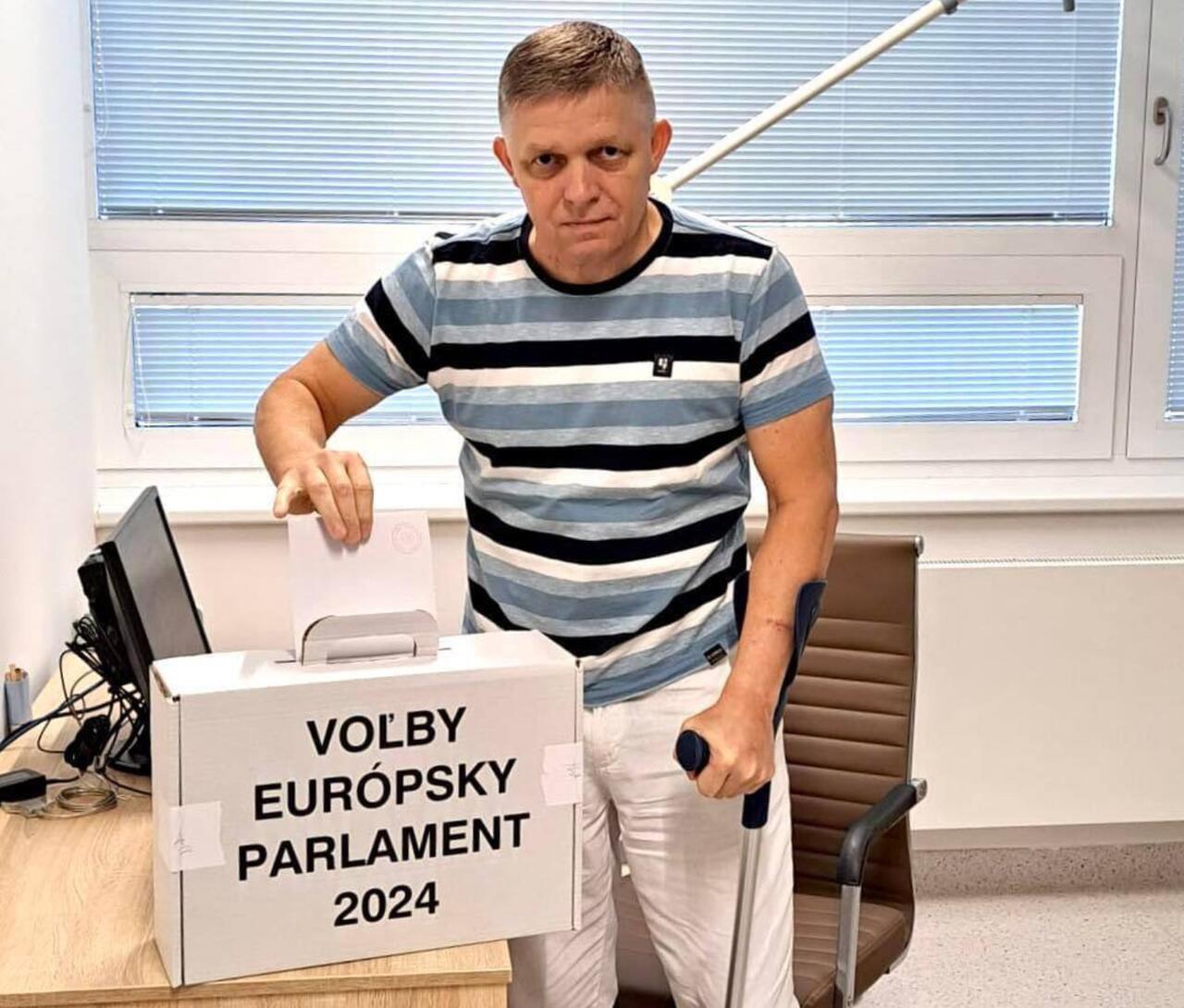
"I voted in the hospital because these elections are also important. It is necessary to vote for European deputies who will support peace initiatives, and not the continuation of the war."
On May 15, Slovak Prime Minister Robert Fico was almost murdered in broad daylight. While shaking hands with supporters during a public appearance, a gunman shot him twice in the abdomen and once in the shoulder. The attack left him fighting for his life while authorities raced for clues, and many observers at home and abroad puzzled about the would-be assassin’s motives and whether foreign actors were in some way responsible for the attack. And despite the shooter’s instantaneous arrest, those questions still linger weeks later.
Fico, a veteran Slovak political figure, was re-elected in September 2023 amid a wave of public resentment over the proxy war in Ukraine, pledging to end arms supplies to Kiev and anti-Russian sanctions. On the campaign trail, Western leaders, journalists and pundits aggressively stoked fears of the “pro-Putin,” “populist” candidate returning to office. Ukraine’s Western-backed “Center for Countering Disinformation” publicly accused him of spreading “infoterror” back in April 2022.
But many Slovakians see it differently. They say Fico is merely committed to defending Slovakia’s sovereignty, and governing in his nation’s interests, not those of Brussels, Kiev, London, and Washington. For Western politicians, his victory came at a highly inopportune time, with public and political consensus on the proxy war in Ukraine rapidly fraying across Europe.
Since Fico’s election, media outlets like Germany’s state broadcaster, Deutsche Welle, have branded him a “threat” to the EU and NATO. His declaration that Kiev must cede territory to Russia to end the war was not well-received in Western capitals. In April, the premier seemingly predicted his own shooting, warning that the virulent political climate in Bratislava could result in politicians getting killed.
Domestically, a number of foreign-funded media assets and NGOs have relentlessly targeted Fico for pursuing neutrality in the conflict. But over two years after Russia’s intervention, local polling indicates just 40% of the population blame Moscow for the proxy war, and 50% consider the US to be a threat to national security. Meanwhile, 69% of Slovakians believe by continuing to arm Ukraine, the West is “provoking Russia and bringing itself closer to the war” and 66% agreed that “the US is dragging [their] country into a war with Russia because it is profiting from it.”
When Fico was re-elected in September 2023, this journalist speculated that a color revolution could soon be impending in Slovakia. We are now left to ponder whether the Prime Minister’s attempted assassination was a Western-directed plot to remove his troublesome government from office. Even though he is finally on the road to recovery, the threat of an overseas-orchestrated coup remains. A vast US-sponsored opposition political and media infrastructure is causing havoc in Bratislava, and this could easily escalate further.
Slovakia has since the end of the Cold War stood apart from its neighbors. Folding the country into the EU and NATO and neutralizing its rebellious politics and population has required an enormous investment in time and money by Brussels and Washington, and relentless meddling in the country’s internal affairs by foreign-funded organizations and actors. Fico’s return to power threatened to not only derail that project, but create a regional contagion effect. Disinfecting the country therefore became of the utmost urgency for the West.
Facebook purge suggests shooter was a no 'lone wolf'
Fico’s shooter, 71-year-old Juraj Cintula, is among the Slovaks who do not support Fico’s positions. A discrepant picture of the man has emerged since his arrest. Some acquaintances describe him as “weird and angry,” and “against everything.” Others report he was meek and mild-mannered, a far from obvious candidate to attempt a high-level political assassination. Cintula, an avowed Kiev ultra, claims he acted alone, his actions motivated by a desire to replace Fico’s government with a pro-Ukrainian administration. Slovakian court documents state that Cintula “wants military aid to be provided to Ukraine and considers the current government to be Judas towards the European Union,” and say this perception is why the would-be assassin “decided to act.”
The mainstream media has made much of Cintula’s background as a dissident poet and writer, in a seeming effort to humanize the would-be killer. By contrast, Aaron Bushnell, who in February self-immolated in protest of Washington’s facilitation of the Gaza genocide, was widely tarred by journalists as a maladjusted, mentally unwell outcast. Unmentioned by any Western outlet is that during the 1980s, Cintula was under surveillance by Czechoslovak security services.
The reason for the Czechs’ interest is unclear, although it may have been due to anti-Communist actions, or foreign contacts. Whether Cintula had seditious confederates within or without Slovakia is a key line of inquiry for police. That all traces of the shooter’s Facebook profile were comprehensively scrubbed from the internet two hours after the shooting, before investigators could access the information, is also source of intense suspicion.
While it is customary for the social network to purge the profiles of “dangerous individuals” – a fate this journalist has suffered for investigative reporting – following such incidents, in Bratislava Facebook relies on cooperating local individuals and organizations to police content. Apparently, Cintula’s profile was wipedbefore his identity had been reported in local media. Slovak authorities must now rely on the FBI to secure and provide the deleted information. Whether whatever is turned over will be unexpurgated is an open question.
Another disturbing feature of mainstream reporting on the shooting is ubiquitous, persistent reference to Slovakia’s unstable politics. According to this narrative, Fico’s anti-Western policies have fueled the chaotic state of affairs, provoking the assassination attempt and making him ultimately responsible for the attempt on his life. In the days following the shooting, the BBC, Financial Times, New York Times and Germany’s esteemed Der Spiegel pinned the blame on Slovakia’s alleged “toxic” political culture. The latter revised its wording after significant public backlash.
One could be forgiven for concluding Western journalists take it as self-evident that defying EU/US will provides legitimate grounds for getting shot. Western politicians clearly do. On May 23rd, Georgian prime minister Irakli Kobakhidze revealed that EU commissioner Oliver Varhelyi warned him he could suffer the same fate as Fico, if his government didn’t drop a highly controversial “foreign influence transparency” law, which would compel local NGOs to disclose their sources of income.
After listing the various ways the EU could retaliate against Georgia in a phone call with Kobakhidze, Varhelyi allegedly stated: “Look what happened to Fico, you should be very careful.”
Varhelyi has since confirmed that he cited Fico’s fate in private conversations with Kobakhidze, but claimed he was merely concerned with “dissuading the Georgian political leadership” from adopting restrictions on foreign-funded NGOs. Varhelyi insisted in a written statement that he simply “felt the need” to caution the Prime Minister “not to enflame [sic] further the already fragile situation,” arguing that he only mentioned “the latest tragic event in Slovakia… as an example and as a reference to where such high levels of polarisation can lead in a society.”
Public records show the US government regime change specialists at the National Endowment for Democracy (NED) have pumped millions into NGOs and media outlets in Slovakia under the aegis of mundane-sounding initiatives such as “strengthening civil society” and “promoting democratic values among youth.” Similar language is used to describe the purpose of Endowment grants in Georgia, financing groups at the forefront of recent violent unrest on the streets of Tbilisi, as The Grayzone has documented. Perhaps unsurprisingly, NED grantees are unanimous in their opposition to Fico.
Anyone searching for the source of Slovakia’s “toxic” politics need not look further than these US-backed organizations. Washington has stirred this cauldron for almost three decades, and with all sides of the Slovakian political class blaming one another the rising tide of hatred, it is hoping the pot will finally boil over.
Regime change blueprint honed in Slovakia
The NED-organized overthrow of Slobodan Milosevic in Yugoslavia in 2000 established an insurrectionary blueprint which was subsequently exported in the form of color revolutions. But throughout the 1990s, Slovakian activists honed the tactics which would eventually be deployed by US regime change operatives across the Soviet sphere.
At the time, Bratislava was one of the only post-Communist countries that neither adopted ruinous neoliberal political and economic reforms, nor pursued EU or NATO membership. Slovakia’s then-Prime Minister Vladimir Meciar paid a harsh price for his independent stance. Relentlessly slandered by US and European leaders as a Russian pawn, he quickly became a target for regime change.
In 1997, then-Secretary of State Madeleine Albright publicly described Slovakia as “a black hole in the heart of Europe,” formally marking him for removal. So it was that NED funded the creation of Civic Campaign 98 (OK’98), a coalition of 11 anti-government NGOs.
Explicitly modeled on an earlier NED-funded effort in Bulgaria, concerned with “creating chaos” after the Socialist Party won the 1990 election, many of the individuals involved had been part of Cold War-era Czechoslovak anti-Communist dissident groups. OK’98 was publicly framed as a non-partisan get-out-the-vote campaign, but its vast resources were explicitly deployed for anti-government purposes. Its activities included rock concerts, short films, and TV infomercials in which Slovak celebrities urged young people to vote.
Meciar emerged with the most votes in the 1998 election, but the opposition gained enough seats to form a government. The NED assets who powered them to victory went on to give practical training to NED-supported pro-Western agitators like Pora, which ignited Kiev’s 2004 “Orange Revolution.” The insurrectionist youth group successfully overturned the re-election of President Viktor Yanukovych that year, installing the US-backed neoliberal Viktor Yushchenko in his place.
The return of Robert Fico represented a significant broadside against ongoing US “democratization” of the former Soviet sphere. It opened up the prospect of further anti-NATO candidates and governments gaining office elsewhere in Europe, at the most inconvenient juncture imaginable for Brussels and Washington.
Not coincidentally, it was at this time polling for Germany’s upstart Alternative für Deutschland became turbocharged. The Euroskeptic party’s standing has soared in recent months, eliciting mainstream calls to ban it outright. And in North Macedonia just one week prior to Fico’s shooting, the anti-establishment VMRO-DPMNE party returned to power, overturning a NATO-fuelled color revolution that removed the party from office almost a decade earlier.
As the anti-Western backlash gained steam, a decision may have been made to draw a bloody red line in Slovakia.
Reflecting plummeting patience with overstepping federal overlords,the Texas Republican Party has adopted two platform planks that call for legislators to assert state sovereignty, and to schedule a secession referendumin the next general election after November's.
"This historic vote at the 2024 Republican Party of Texas Convention represents a substantial shift towards enhancing state sovereignty and exploring the potential for Texas to operate as an independent nation," said the Texas Nationalist Movement (TNM) in a statement. "It reflects the growing sentiment among Texans for greater autonomy and the protection of our rights against federal overreach."
Retail giant Walmart says it is against putting panic buttons in stores - an item shoppers in New York may soon find on shelves.
On Friday, the New York State Senate passed legislation requiring most big retail chains, including Walmart, to put panic buttons in easy-to-access locations in their stores, or to provide staffers with wearable, or mobile-phone-activated, panic buttons.
But Walmart's top corporate affairs officer told Reuters that panic buttons are likely to trigger false alarms.
"Eight out of 10 times somebody thinks something's going on, there's actually not," Dan Bartlett, Walmart executive vice president of corporate affairs, told Reuters.
Walmart had hired a chief safety officer "to look at overall physical safety" of its store workers, Bartlett said. Walmart's new chief safety officer was hired on April 12, a Walmart spokesperson said.
Bartlett said it would be impractical for Walmart to put panic buttons in every store. The nation's largest retailer, Walmart operates 4,700 stores, including 98 in New York state.
New York Governor Kathy Hochul has 10 days to sign the legislation into law or veto it. If she takes no action in 10 days, the Retail Worker Safety Act automatically becomes state law.
The legislation would also require most retailers with 10 or more employees to provide violence prevention and safety training to their staff.
Walmart's workforce is not unionized. However, one major retail union, the Retail, Wholesale and Department Store Union
(RWDSU), which represents more than 100,000 workers across the United States, has pushed for the bill to become law in New York.
At Walmart's annual meeting at its headquarters in Bentonville, Arkansas, this week, some Walmart store workers who hold Walmart shares put forth their own safety-related proposal to Walmart shareholders. The proposal would have required Walmart to conduct an independent review of its policies and practices on workplace safety and violence. It was defeated in a shareholder vote.
Central bankers whistle ‘Dixie’ as mark-to-market losses dramatically shrink the banking system’s economic capital.
Whistling a happy tune, the Federal Reserve vice chairman for supervision, Michael Barr, recently testified to Congress that “overall, the banking system remains sound and resilient.”
A more candid view of the risks would be less sanguine.
Mr. Barr reported that banking “capital ratios increased throughout 2023.” He failed, though, to discuss the mark-to-market losses that have dramatically shrunk the banking system’s economic capital and capital ratios.
A recent study of American banks, including analyses of both their securities and fixed rate loans, estimates that the banking system has at least a $1 trillion mark-to-market loss resulting from the move to normalized interest rates.
Since that loss is equal to half of the banks’ approximately $2 trillion in book value of tangible equity, their aggregate real capital has dropped by about 50 percent. This is just in time for them to be confronted with large potential losses from that classic source of banking busts, commercial real estate, as the prices of many buildings are falling vertiginously.
Given his current position, Mr. Barr could not be expected to mention another particularly large and inescapable threat to financial stability, that from the Federal Reserve itself. As central bank not only to the United States, but to the dollar-using world, the Fed combines great power with an inevitable lack of knowledge, and its actions are a fundamental source of financial instability.
When the Federal Reserve was created, the secretary of the treasury at the time, William Gibbs McAdoo, proclaimed that the Fed would “give such stability to the banking business that extreme fluctuations in interest rates and available credits… will be destroyed permanently.” A remarkably bad prediction.
Instead, throughout the life of the Fed, the financial system has suffered recurring financial crises and Fed mistakes. Mistakes by the Fed are inevitable because the Fed is always faced with an unknowable economic and financial future. This explains its poor record at economic forecasting, including inflation and interest rates.
No matter how intelligent its leaders, how many Ph.D.s it hires, how many computers it buys, how complex it make its models, or how many conferences it holds at posh resorts, the Fed cannot reliably predict the future results of its own actions, let alone the unimaginably complex global interactions that create the economy.
The Fed held both short-term and long-term interest rates abnormally low for more than a decade. It manipulated long term rates lower by the purchase of $8 trillion of mostly fixed rate Treasury bonds and mortgage securities, mostly funded by floating rate deposits, making its own balance sheet exceptionally risky. It decided to manage the expectations of the market, and frequently assured one and all that interest rates would be “lower for longer” (until, of course, they were higher for longer).
Observe the result: Gigantic interest rate risk built up in the banking system. A notable case was Silicon Valley Bank, which made itself into a 21st century version of a 1980s savings and loan, investing heavily in 30-year fixed rate mortgage-backed securities and funding them with short-short term deposits, while its chief executive served on the Board of the Federal Reserve Bank of San Francisco.
SVB was doing basically the same thing with its balance sheet that the Fed was. In the SVB case, it became the one of the largest bank failures in American history; in the Fed’s case, it has suffered its own mark to market loss of more than $1 trillion, in addition to operating cash losses of $172 billion so far. Adding the mark-to-market losses of the Fed and the banking system together, we have a total loss of $2 trillion. We are talking about real money.
The Fed was the Pied Piper of interest rate risk and consequent losses.
Jim Bunning was the only man ever to be both a Hall of Fame baseball player and a U.S. Senator. He pitched a perfect game in the major leagues, and he delivered a perfect strike in the Senate when Chairman Ben Bernanke was testifying on how the Fed was going to regulate systemic financial risk. In paraphrase, Senator Bunning asked,“How can you regulate systemic risk when you are the systemic risk?” There is no answer to this superb question.
With Texas Gov. Greg Abbott enforcing his own border policies and TEXIT gaining momentum with the state's Republican Party, perhaps we shouldn't be surprised that the state is taking another step toward becoming a semi-autonomous region.
To that end, the Lone Star State is launching its own stock exchange.
Houston financier James H. Lee, backed by a $120 million investment from asset management firms BlackRock and Citadel Securities, plans to launch the Texas Stock Exchange next year, the Wall Street Journal reported Tuesday.
It’s worthing noting that BlackRock has been at the center of several controversies, most recently being accused by a U.S. House subcommittee of compromising U.S. national security by investing in blacklisted Chinese companies. Meanwhile, Citadel has paid millions in fines since 2014 for trading irregularities and violations.
Nonetheless, the operators of the Dallas-based exchange hope it can compete with the New York Stock Exchange and Nasdaq, challenging those exchanges increasingly high compliance costs and new rules including setting targets for board diversity, the Journal reports.
Lee, whose four decades of work experience includes time at First Boston Corp., E*Trade and the now-defunct Lehman Brothers, wants the TXSE to make its first trade in 2025 and put up its first stock listings in 2026, according to the Dallas Morning News.
“It is exciting; it’s transformational,” Lee told the Morning News. “Frankly, it could change the arc of Dallas for decades. It’s the destiny of this technology infrastructure, market participants and the network effect that makes Dallas a major financial hub.”
The TXSE will focus on attracting companies from Texas and surrounding states to list their stock. Texas is home to more Fortune 500 companies than any other U.S. state, and Charles Schwab, Tesla and Hewlett Packard all relocated her in the past three years.
“Texas is already the ‘headquarters of headquarters,’ with 52 Fortune 500 companies calling our state home, making us an ideal for for the nation’s newest stock exchange to compete with the current duopoly of NYSE and Nasdaq,” The Texas Association of Business said in a statement. “CEOs have continually named Texas the Best State for Business for the last two decades, while Site Selectors have consistently chosen Texas as the top state for new capital investment projects for 12 years and counting.”
It’s not Texas’ first foray into the world of financial markets, however.
Last year, Texas Capital Bank launched the Texas Capital Equity Index (TXS), an Exchange Traded Fund (ETF) based on the values of publicly traded Texas-based companies, including Exxon Mobil, Waste Management and American Airlines, among others.
However, the TXS index hasn’t received much fanfare in this Bull market. Its shares have bounced between $24 and $28 since being launched last July.
President Vladimir Putin has continued to address some trends out of the West related to Ukraine... and specifically the way European and US leaders have reacted to the recent escalation in Kharkiv oblast and in the east. Officials in the UK, Germany, and France have of late signaled to their populations that Europe must be 'war ready' and on a war footing.
Some have even claimed that Russia is readying to attack NATO countries and that it seeks to expand the conflict beyond Ukraine. For example, on Wednesday German Defense Minister Boris Pistorius claimed that "Putin won’t stop at Ukraine's borders Russia is a threat to Georgia, Moldova & ultimately to NATO."
He claimed in an address before German parliament: "Putin's war economy is working towards another conflict. We must be ready for war by 2029."
On Friday during a lengthy, wide-ranging discussion panel at the St. Petersburg International Economic Forum (SPIEF), Putin responded to these statements which say he's looking to attack a NATO country.
"Look, someone has imagined that Russia wants to attack NATO. Have you gone completely insane? Are you as thick as a plank? Who came up with this nonsense, this bulls**t?" Putin said, as translated by Russian media.
He then explained that Western officials need to keep up the hype and false optimism surrounding their support to Kiev, in order to keep up sentiment among Western populations:
"Why is this being done, really? To maintain their own position of greatness, that’s why. There’s nothing to these scary stories, intended for the townsfolk in Germany and France and elsewhere in Europe," Putin explained. "In Ukraine, we’re just protecting ourselves."
"Don’t make up things and then form opinions about Russia on the basis of them," he added. "You only hurt yourselves this way."
He also took the opportunity to address headlines suggesting that Russia is ready to use nukes.
He explained that nothing has changed in Russia's nuclear doctrine, saying that nuclear weapons usage is only possible in "exceptional cases". He then emphasized that he does not believe "such a case has arisen" and that he is not brandishing nuclear arms.
He further repeated in response to the US having greenlighted Kiev's usage of Western-supplied missiles against Russian territory, "If they supply (weapons) to the combat zone and call for using these weapons against our territory, why don’t we have the right to do the same?"
Putin added, "But I’m not ready to say that we will be doing it tomorrow, either" - while not naming countries which theoretically could receive Russia's weapons.
He was also asked by journalists about the end game in Ukraine, and concerning whether truce negotiations could be on the horizon. "All negotiations are based on either military defeat, or military victory. Of course, we will win," he said confidently.