Search This Blog

Sunday, March 22, 2026

Senate Democrats Are Quietly Plotting To Oust Chuck Schumer

 Senate Minority Leader Chuck Schumer has had a fractured relationship with the Democratic Party base ever since he voted to fund the government last March. Unfortunately for him, time hasn’t healed that wound, and there’s a growing resistance to Schumer that hopes to oust him from his leadership position after the midterms.

The Wall Street Journal, drawing on more than four dozen interviews with Democratic senators, candidates, current and former congressional aides, activists, and advisers, found widespread unease about the New York senator's grip on the party's direction. The report makes it clear that Schumer’s own colleagues increasingly see him as an anchor, slowing their response to President Trump, steering primaries toward centrists they don't want, and draining the fundraising pipeline that Democrats desperately need heading into the midterm elections.

According to the report, last month, Sen. Chris Murphy of Connecticut met with progressive activists at a French restaurant in Georgetown. The conversation turned to what to do about Schumer. According to people familiar with the dinner, Murphy disclosed that some lawmakers had already been running informal vote counts to see whether enough support existed to remove Schumer from his leadership post. Murphy added that Schumer had enough backing to survive. But the fact that anyone was counting at all said something.

Murphy has since walked it back, carefully. "Could someone infer from that that someone was keeping a count? Maybe, but that's not what I meant," he told reporters. "I meant that he has the support of the caucus." 

But Murphy’s backpedaling doesn’t change the reality. Murphy is reportedly part of a group of senators who have been actively canvassing colleagues about their frustrations with Schumer. This group, nicknamed “Fight Club,” (hey...) is a Signal chat group where progressives coordinate strategy around opposing Schumer's preferred candidates in key 2026 races. The Fight Club's grievance, at its core, is that Schumer is tilting the playing field toward centrists while an insurgent energy on the left goes untapped. The group includes Sen. Elizabeth Warren (D-Mass) and Sen. Tina Smith (D-Minn.), and it appears that Warren has been initiating those conversations directly. Smith's advisers have gone further, holding discussions with other Senate staff about concrete scenarios to challenge Schumer's leadership. 

The concern isn't purely ideological. It's financial, and that's where things get uncomfortable. Schumer's aligned super PAC, Senate Majority PAC, got outpaced by its Republican counterpart last year. Entering 2026, the Democratic super PAC had $36 million in cash on hand and $12.4 million in debt. The GOP's equivalent had $100 million on hand and zero debt. 

In the money primary - the one that quietly decides Senate races before a single vote is cast - Schumer's side is getting lapped.

Making matters worse for Schumer, meetings among Democratic Senate chiefs of staff, which should be routine operational sessions, have reportedly become forums for airing discontent with Schumer's stewardship. The pressure building in those rooms is aimed at a specific outcome: Schumer commits to retiring from the Senate when his seat is up for re-election in 2028, clearing a path for whoever comes next.

That next person may already have a name attached. Sen. Brian Schatz of Hawaii has been identified as Schumer's own preferred successor. Apparently, Schumer has thought this through enough to have a pick. But Schatz isn't moving until Schumer moves first. His posture, per senators and aides familiar with the discussions, is to wait it out.

Schumer may have the votes to survive a mutiny for now. But his colleagues are doing the math, his fundraising is underperforming, his preferred candidates are generating internal blowback, and the party seems anxious to see him go. The caucus isn't in open revolt yet, but it’s not looking good for Chuck Schumer. 

https://www.zerohedge.com/political/senate-democrats-are-quietly-plotting-oust-chuck-schumer

Iran Issues 10 Million Rial Banknote Amid Soaring Inflation

As the Iran war rages, Tehran has rolled out a new 10 million rial banknote, its highest-ever denomination, as authorities seek to "manage" soaring inflation and meet demand for hard cash... but mostly to "manage" soaring inflation, similar to how Venezuela would add a new 0 to its currency every week in the late days of the Maduro ergime before everyone simply gave up. 

Banks, which have been targeted on at least one occasion by Western strikes, began distributing the new note this week, which is worth about $7, as Iranians waited in long lines at cashpoints to withdraw currency over fears electronic systems could fail. Many quickly ran out.

The new bank note is worth about $7 US dollars.

The new pink banknote features a vignette of the 9th-century Jameh Mosque of Yazd, while the back displays an image of the 2,500-year-old Bam Citadel. It is now the highest denomination in circulation, overtaking the 5mn-rial note introduced in early February, which at this rate will be equal to roughly $1 USD in a few weeks.

Iran’s central bank said that the bill was introduced “to ensure public access to cash”, adding that electronic systems - including debit cards, mobile and internet banking - would continue to serve as the main platforms for financial transactions, at least until the Mossad cripples all domestic electronic payments. 

Yet despite government assurances of a continuous supply of cash after the war broke out, banks are providing limited currency to clients seeking to withdraw funds.

“I waited my turn for an hour and the clerk said he could only give me 10mn rials. But when I made a fuss, telling them I had no money and needed cash, I got 30mn instead,” Maryam, an 80-year-old resident of Tehran, told the FT this week. “It’s not much but it can sustain me for a few days if the debit cards stop working.”

Iranians waiting at an ATM to withdraw currency; Getty Images

The new bill is the latest indication of how Iran’s economy is collapsing as the war enters its fourth week.

The US and Israel have targeted infrastructure including a major bank, adding to the strain for businesses already impacted by the constant bombardments and indefinite closure of Iran’s airspace. Imported items have become more expensive as trade routes have closed.

A building of Bank Sepah, which serves Iran’s armed forces alongside the wider public, was hit by a missile on March 11, further compounding public worries.

The bank said on Wednesday that access had been restored, allowing clients to use their cards for in-store shopping and at ATMs. Online banking services, it said, would resume soon. 

The economy was already under strain from years of US sanctions, declining oil revenues, persistently high inflation and systemic corruption - factors that have resulted in a steep devaluation of the rial. The currency had lost 40% of its value in the months that followed Israel’s 12-day war in June last year, with the economic malaise fuelling mass protests in January that were crushed in a brutal crackdown that killed tens of thousands 

It weakened further to a record low of 1.66mn rials per US dollar ahead of the start of the latest war on February 28, but had strengthened to about 1.5mn as of Friday. 

Iran's annual inflation was 47.5% in the month ending February 19, according to Iran’s statistical agency, but the true inflation is said to be orders of magnitude higher. 

Food and drink inflation surged to above 105% in the same period, after the government eliminated subsidized foreign currency for essential imports. Instead it started a food voucher program that grants 80mn Iranians monthly credit to purchase staples at designated stores.

Iran food and drink inflation has soared above 100%.

In November, Iran introduced a law to slash four zeros from the rial over a five-year period in an effort to simplify transactions and reduce the cost of printing money. On the new 10 million rial note, the final four zeros appear faintly while 1,000 is also printed in bold. This style, used for all new banknotes printed since 2019, is designed to help the transition.

Banknotes printed in Iran in recent years mainly showcase historical monuments. Some of the older, smaller banknotes depict Ayatollah Khomeini, the founder of Iran’s revolution.

Demand for cash is usually already high at this time of year before Nowruz, the Persian new year, when many Iranians gift money to children and family members. 

The recent strengthening of the rial comes as foreign trade has reduced, Iranians have cancelled overseas trips and people in need of cash for urgent expenses exchange their foreign currency.

“Only those who have sold property or a car and don’t want to keep their money in rials are buying foreign currency,” one foreign exchange broker in Tehran said. “On the other hand, supply has also decreased a lot. Only those who urgently need money in these conditions are selling their foreign currency.”

https://www.zerohedge.com/economics/iran-issues-10-million-rial-banknote-amid-soaring-inflation

https://www.zerohedge.com/geopolitical/punish-iran-saudi-arabia-uae-inch-closer-joining-us-israeli-war

https://breakingthenews.net/Article/Iran-demands-US-Israel-pay-for-nuclear-site-attacks/65924040

Gain-of-Function at the Manchester Meningococcal Reference Unit?

 The outbreak of a curiously virulent and transmissible form of bacterial meningitis in Canterbury, England presents a pressing and fascinating challenge to investigators.

The Club Chemistry nightclub in Canterbury is the apparent origin of the outbreak

The fact that the outbreak occurred in a nightclub made me wonder about the possibility of cocaine snorting using the same straw. Inhalation of cocaine irritates the nasal passage and respiratory mucosa, making it easier for bacteria to enter the body and causing higher susceptibility to infection.

Canterbury lies about twenty-five miles from the Port of Dover, which is a known port of entry for recreational drug contraband such as cocaine.

Moreover, British cocaine has been found to be seriously “cut” or adulterated with Levamisole—is a veterinary anthelmintic (dewormer) and former human immunomodulator that causes severe side effects, most notably agranulocytosis (critically low white blood cell count) that can cause a dramatic reduction in neutrophils, which are critical for fighting infections. Agranulocytosis can lead to severe bacterial infections, septic shock, and death.

If I were investigating the outbreak, I would take a hard look at the possibility of cocaine snorting with the same straw being the vector. It’s notable that additional cases of the disease were traced to a second party in Whitstable, Canterbury at which girls claim to have shared a vaping pipe.

The virulence of the outbreak made me wonder if someone has been tinkering around with Neisseria meningitidis bacteria in a British lab.

I was reminded me of Lyme Disease, and the curious fact that the OspC type A genotype of Borrelia burgdorferi is linked to more severe inflammation and arthritis in Lyme disease cases. This is the genotype that is prevalent in the Northeast, starting around Connecticut, characterized by specific, conserved amino acid sequences in its variable loop regions, making it a key marker for pathogenic strains. The U.S. biodefense lab on Plum Island, off the coast of Lyme, Connecticut, has long been suspected of being the origin of this strain.

The University of Kent School of Biosciences operates a BSL-2 lab.

Most remarkable is the Manchester Royal Infirmary operates the Manchester Meningococcal Reference Unit (MRU).

The MRU primarily performs routine and national reference testing on Neisseria meningitidis, including culture, serogrouping, and genome sequencing. The lab maintains over 50,000 characterised meningococcal isolates and 6,000 PCR-positive samples.

What is most remarkable to me—and what I believe should be investigated—is the lab’s work in vaccine evaluation, antibiotic resistance monitoring, pre-clinical vaccine development, and virulence studies.

According to University and public health websites, manipulations involving viable organisms are carried out under biosafety level 2 (BSL‑2) practice with heightened containment (biosafety cabinets, droplet precautions), following the UK Health Security Agency’s biosafety guidance for N. meningitidis.

While officially BSL‑2, the MRU claims it “applies BSL‑3‑equivalent engineering controls for higher‑risk manipulations (centrifugation, and aerosol production) because MenB is a potentially fatal pathogen via aerosol exposure.”

According to CDC data, lab infections and deaths have occurred from improper handling of N. meningitidis.

The distance from Manchester to the University of Kent (Canterbury campus) is approximately 235–250 miles by road, typically taking 4 to 4.5 hours to drive.

If I were an outbreak investigator, I would take a very hard look at the outbreak strain to see if it matches a strain in the Manchester Meningococcal Reference Unit that is being used for vaccine evaluation, antibiotic resistance monitoring, pre-clinical vaccine development, or virulence studies.

The UK Health Security Agency should also issue a directive to the MMRU to preserve all samples in its lab.

John Leake is a True Crime Writer. Coauthor with Dr. Peter McCullough of "The Courage to Face COVID-19.: Preventing Hospitalization and Death While Battling the Biopharmaceutical Complex."
https://www.thefocalpoints.com/p/gain-of-function-at-the-manchester

What Do Bonds Know That The Stock Market Doesn't?

 by Lance Roberts via RealInvestmentAdvice.com,

Most investors spend their time watching the S&P 500. That’s a mistake, because the credit market is the real “tell.” The bond market has been whispering a warning for weeks now, and credit spreads are now shouting it. As of this writing, the CDX Index, a benchmark measure of credit default swap spreads, has climbed to a nine-month high while the S&P 500 sits within 5% of its all-time peak. Over the past 20 years, every time that combination appeared, a bear market followed. Every single time.

That’s a track record worth taking seriously, and credit spreads are critical to understanding market sentiment and predicting potential stock market downturns. A credit spread refers to the difference in yield between two bonds of similar maturity but different credit quality. This comparison often involves Treasury bonds (considered risk-free) and corporate bonds (which carry default risk). By observing these spreads, investors can gauge risk appetite in financial markets. Such helps investors identify stress points that often precede stock market corrections.

The chart shows the annual rate of change in the S&P 500 market index versus the yield spread between Moody’s Baa corporate bond index (investment grade) and the 10-year US Treasury Bond yield. Rising yield spreads consistently coincide with lower annual returns in the financial markets.
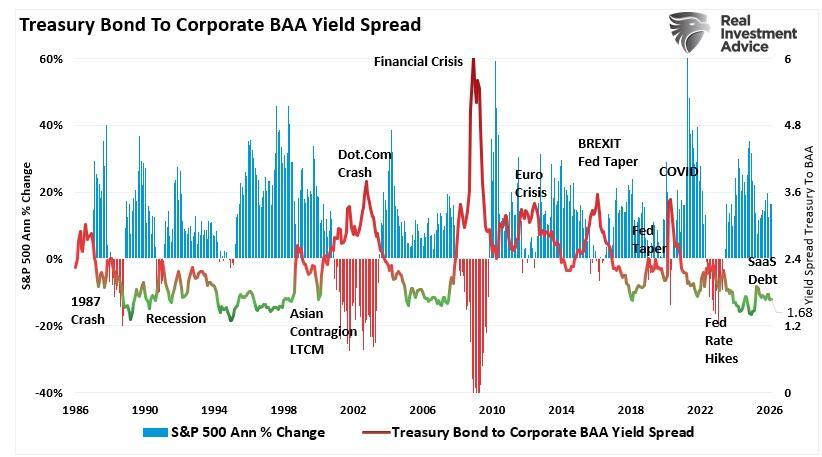
The reason is that credit is the lifeblood of the economy. Businesses borrow to operate, and consumers borrow to spend. As such, when the cost of that borrowing rises, particularly the premium lenders demand to extend credit to riskier borrowers, it signals that the economy is under stress. That “stress” directly affects forward earnings estimates and increases the likelihood of a valuation repricing.

The “Junk to Treasury” spread is the clearest expression of this dynamic. Investors who buy high-yield bonds, the ones with a meaningful chance of default, should demand a premium above the risk-free rate offered by U.S. Treasury bonds. When that premium compresses, it signals that investors are comfortable speculating, willing to reach for yield without demanding adequate compensation for the risk they’re accepting. When the premium expands, the mood has shifted. Lenders are getting nervous. Credit conditions are tightening. And historically, tighter credit conditions have preceded more challenging environments for stocks.
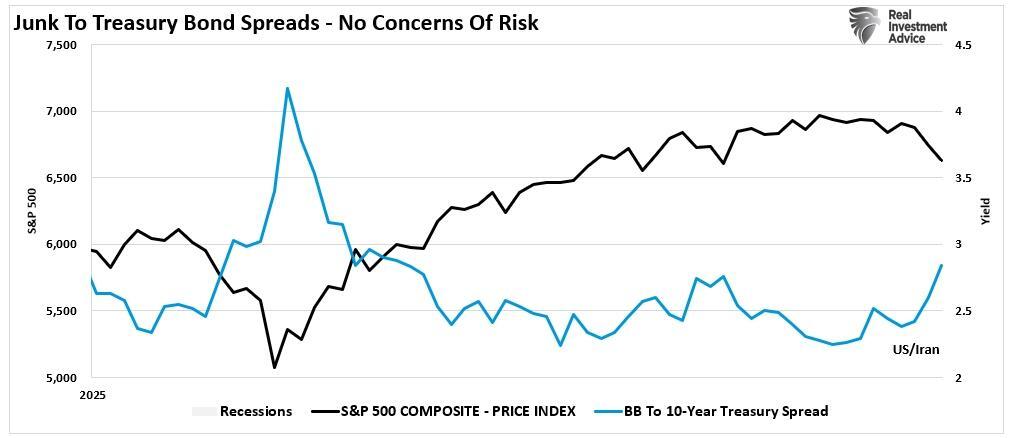
This isn’t a theoretical relationship; it has repeatedly appeared in the data for decades. The bond market (CDX) prices risk continuously across thousands of issuers and maturities. It’s harder to talk up than equities, and it’s not susceptible to the same retail-driven momentum that can keep stock prices elevated long after the fundamental picture has deteriorated.
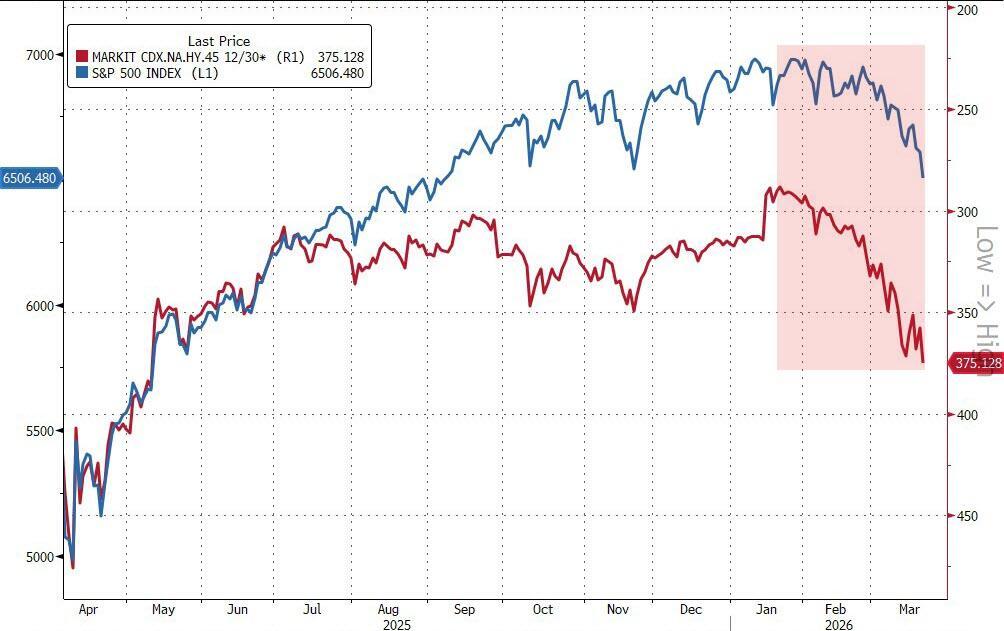
When credit spreads widen, investors should pay attention.

What The CDX Is Telling Us Now.

The chart from Sentiment Trader below tells the story as clearly as any amount of prose could. The top panel tracks the S&P 500 since 2007. The middle panel shows the CDX Index of credit default swaps. The bottom panel shows where those spreads stand relative to their 189-bar range, essentially a percentile reading of how elevated they are relative to recent history. (Red markers indicate instances where CDX spreads hit 9-month highs while the S&P 500 is within 5% of its high.)
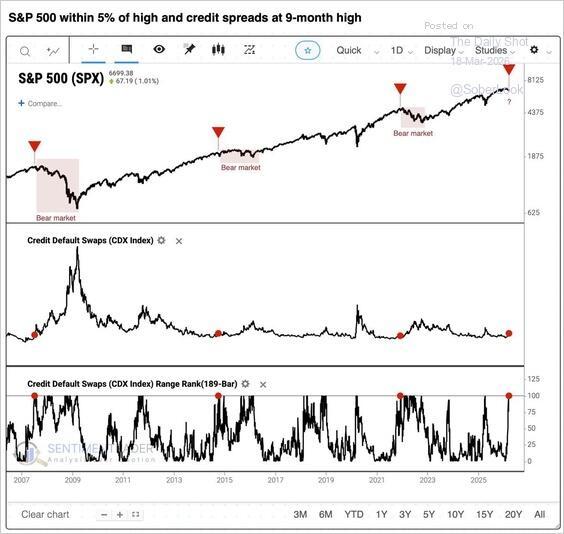
Notice that each red arrow marks a moment when CDX spreads reached a nine-month high while stocks remained near their all-time highs. The 2007 signal preceded the worst financial crisis since the Great Depression. The 2015 signal preceded a sharp correction and an extended period of volatility. The 2022 signal arrived just before the Federal Reserve’s aggressive rate-hiking campaign drove the S&P 500 down 25%. And now, in early 2026, the signal has triggered again.

“This has been one of the more important divergences we’ve been tracking recently. CDS is pushing to a 9-month high even with equities near highs, effectively tightening financial conditions. Historically, this setup has been unstable: about half the time it led to sharp drawdowns, while the rest saw either mild pullbacks or continued gains.” – Sentiment Trader

The range-rank reading in the bottom panel is particularly instructive. It shows that current CDX spread levels are not a minor blip, but are registering near the upper end of their recent historical range. That’s not statistical noise, but a market pricing in genuine credit stress. The table below summarizes the four instances over the past two decades where CDX spreads hit nine-month highs while the S&P 500 traded within 5% of its peak. The subsequent market outcomes speak for themselves.
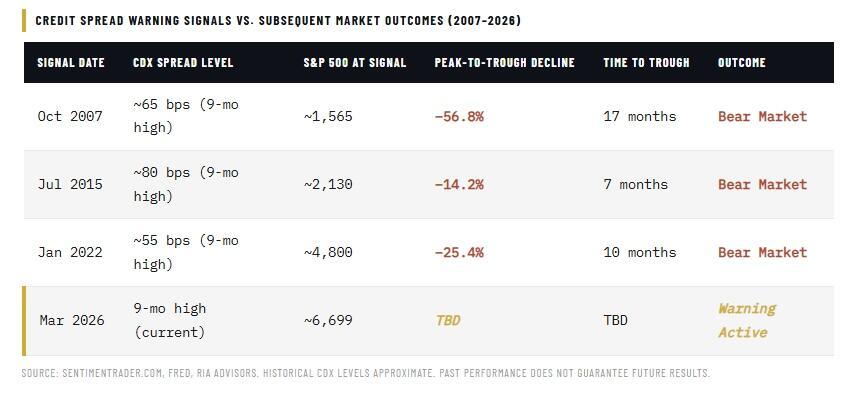
Does this mean the current situation will devolve into a bear market? Not necessarily, but history suggests the risk is elevated enough to warrant investors’ attention. It is also worth noting that the magnitude of the subsequent declines varied considerably, from the catastrophic 2008 to 2009 bear market to the more contained 2015 correction. That is due to the severity of the credit impact on the underlying economy. However, they all shared a period of elevated credit spreads that the equity market initially chose to ignore.

So far, this “time is not different.”

The Counterargument Is Not Convincing

The bulls will argue that CDX spreads are widening from historically tight levels and that the absolute level of stress remains modest by historical standards. That’s technically accurate, as shown, Treasury-to-Junk Bond spreads in early 2026 are not at the panic levels seen in 2008 or 2020. So why worry?
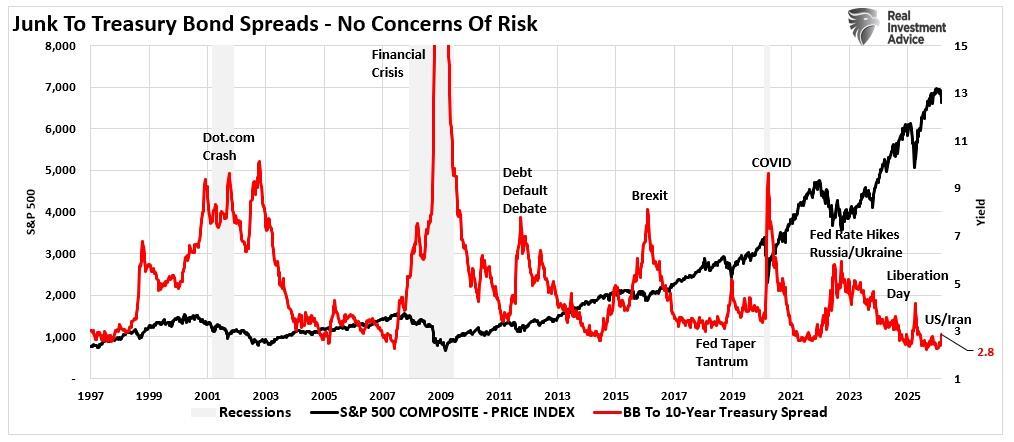
It isn’t the absolute level of the CDX that matters, but the direction of travel and the rate of change. If investors wait for the “spike,” it will likely be too late to act. Sentiment Trader’s nine-month high threshold isn’t about measuring the peak of a crisis; it is a warning of a potential turn. Credit stress doesn’t arrive fully formed. It builds. Each of the prior signals triggered before the real damage was done, precisely because spreads were starting to move, not because they had already maxed out.

There’s also the macro backdrop to consider. The S&P 500 enters this period with valuations near the upper end of its historical range, forward earnings estimates elevated, and sentiment still bullish. As investors, we monitor the high-yield spread closely because it is often one of the earliest signals of a fundamental shift in corporate and economic conditions. In other words, watching spreads provides insights into the health of the corporate sector, which is a major driver of equity performance. When CDX spreads widen, they often lead to lower corporate earnings, economic contraction, and stock market downturns. The reason is that a significant widening of the CDX spreads signal:

  • Liquidity Drain: As investors become more risk-averse, they shift capital from corporate bonds to safer assets, such as Treasuries. The flight to safety reduces liquidity in the corporate bond market. Lower liquidity can lead to tighter credit conditions, affecting businesses’ ability to invest and grow and weighing on stock prices.

  • Corporate Financial Health: Credit spreads reflect investor views on corporate solvency. A rising spread suggests a growing concern over companies’ ability to service their debt. Particularly if the economy slows or interest rates rise.

  • Risk Sentiment Shift: Credit markets are more sensitive to economic shocks than equity markets. When CDX spreads widen, it typically indicates that the fixed-income market is pricing in higher risks. This is often a leading indicator of equity market stress.

  • Corporate earnings may decline: Companies with lower credit ratings may struggle to refinance debt at favorable rates, thereby reducing profitability.

  • Economic growth is slowing: A widening CDX spread often reflects concerns that the economy is heading for a slowdown, which can lead to reduced consumer spending, lower business investment, and weaker job growth.

  • Stock market volatility may rise: As credit conditions tighten, investor risk appetite tends to decline, leading to higher volatility in equity markets.

Listening to credit spreads, particularly the high-yield spread versus Treasuries, is a critical indicator of stock market downturns. Historically, they have been a reliable early warning signal of recessions and bear markets.

Key Catalysts Next Week

The calendar downshifts after two consecutive weeks of high-impact data. No marquee releases are scheduled, but don’t mistake a thin calendar for a quiet tape. The dominant forces will be the market’s ongoing digestion of the March 18 FOMC decision, the updated dot plot, and Powell’s characterization of the stagflation dilemma—all compounded by quarter-end institutional flows that historically amplify moves in both directions.

By Monday, traders will have had a full weekend to digest whether the dots shifted to zero cuts (risk-off repricing in housing, small caps, and high-duration tech) or held at one with dovish language acknowledging labor deterioration (relief bid). A parade of Fed speakers throughout the week will provide color, walking back or reinforcing whatever Powell signaled. Those headlines will move markets more than any scheduled data.

Tuesday’s Q4 Productivity final revision matters more than usual. The prior quarter showed output rising 5.4% while hours worked grew just 0.5%. The unit labor cost component is the inflation signal: falling costs give the Fed room, rising costs tighten the stagflation case. Richmond Fed Manufacturing rounds out the regional factory picture alongside the Empire State and Philly Fed surveys.

Friday’s final UMich Consumer Sentiment is the week’s marquee event. The preliminary reading dropped to 55.5—near post-pandemic lows. The one-year and five-year inflation expectations are what the Fed watches most closely; a spike above 3% would validate the hawkish hold and kill remaining hopes for near-term easing.
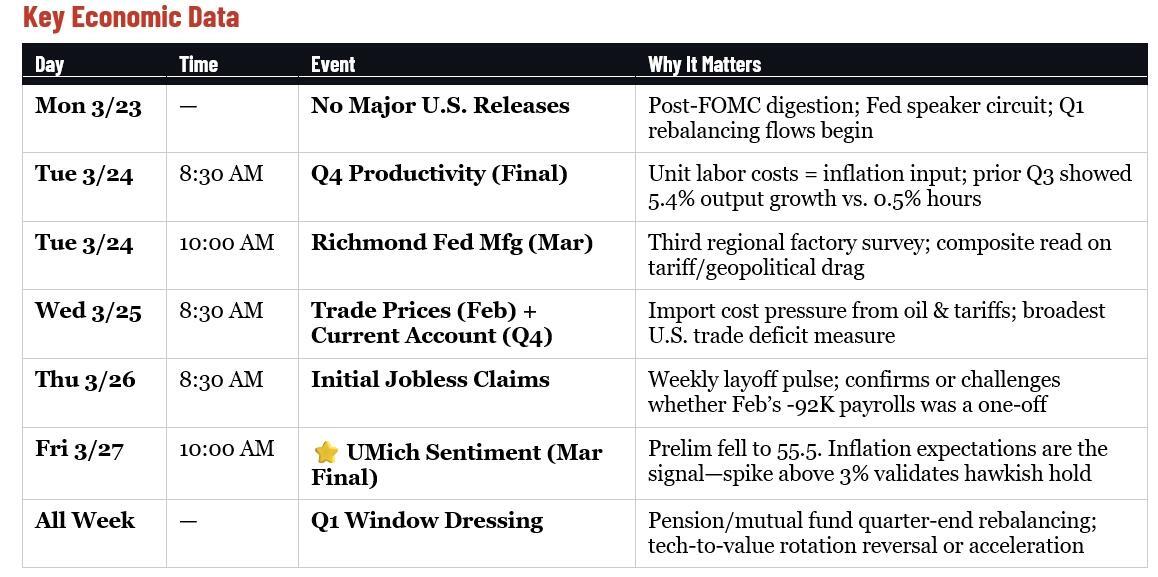
Underneath the data, the real story is mechanical: Q1 ends March 31. Pension funds and institutional allocators begin quarter-end rebalancing and window dressing. After the sharp rotation out of tech and into value that defined the first quarter, the question is whether those flows reverse or accelerate. In a thin-catalyst week, flow-driven moves can be outsized.

Don’t mistake repositioning for conviction.

https://www.zerohedge.com/markets/what-do-bonds-know-stock-market-doesnt