What do you get when you put the world's first trillionaire, the man who builds killer drones in Ohio, and a former House Speaker in a room and ask them to design the next century of warfare? According to Pete Hegseth, you get "Project Meridian."
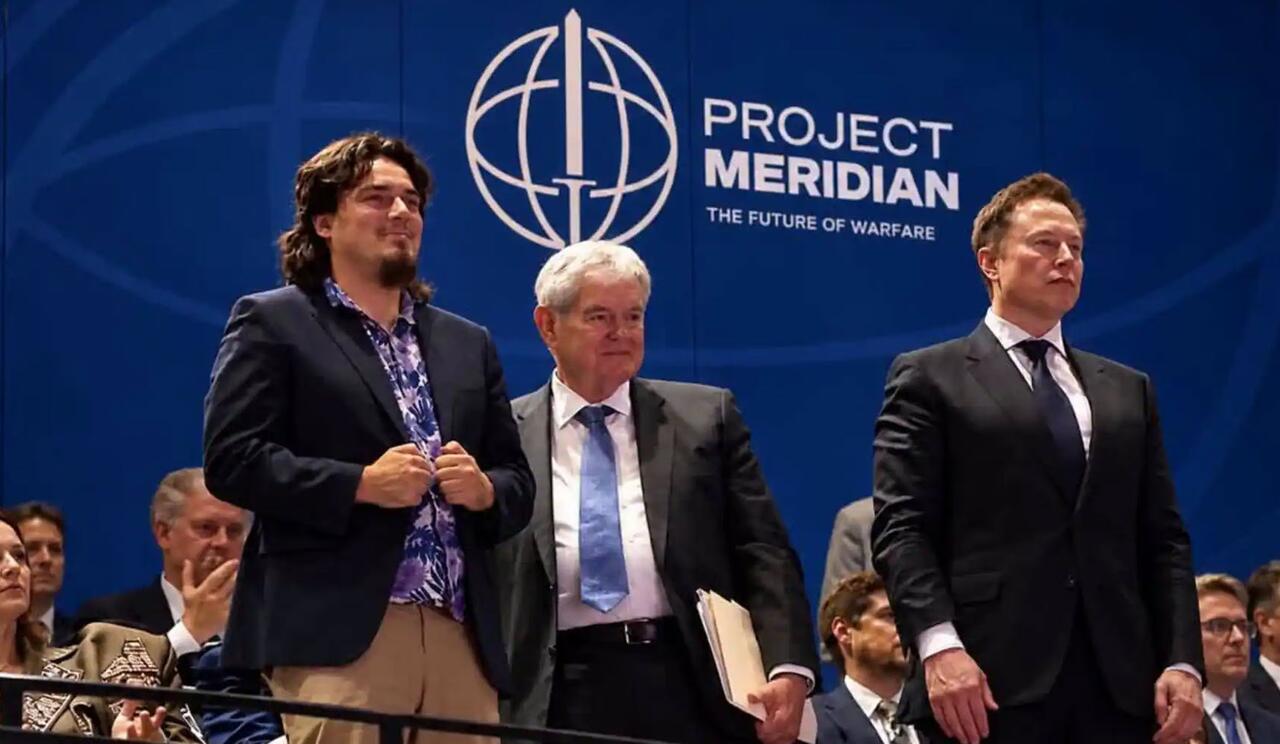
In a sprawling "State of the Force" address to junior officers and enlisted troops at Marine Corps Base Quantico on Wednesday, the Secretary of War announced that Elon Musk, Anduril founder Palmer Luckey and Newt Gingrich (all three were in the audience) will lead an initiative "focused on discovering, developing and fielding the weapons and systems that our children and our grandchildren will need in their lifetimes."
"Its purpose is to creatively look to the future and identify the domains that we must conquer and capabilities we must master," Hegseth said, adding that "the best forecasters of future conflict" do "not solely reside inside the Pentagon."
The project will be overseen by Emil Michael, the former Uber executive who is now the Pentagon's top technology official. Bloomberg said Hegseth offered no further details, although Axios reports that the trio is expected to deliver its findings within 120 days, in both a public and a classified version.
The Customer Asks The Suppliers What It Should Buy
One does not need to be a cynic (although it helps) to notice that two of the three people now advising the Pentagon on which "capabilities we must master" also happen to run two of the companies most likely to sell those capabilities.
Musk's SpaceX handles national security launches and has been a public company since its blockbuster June 12 IPO, which made Musk the planet's first trillionaire. Luckey's Anduril, meanwhile, has gone from defense upstart to prime-in-waiting in record time: it landed a $20 billion Pentagon contract in March, followed in May by a $5 billion raise at a $61 billion valuation, and it also builds the software for Golden Dome together with Palantir. As for Gingrich... Bloomberg notes he "has written a book on technology and entrepreneurism," which is presumably what counts as a defense credential in 2026.
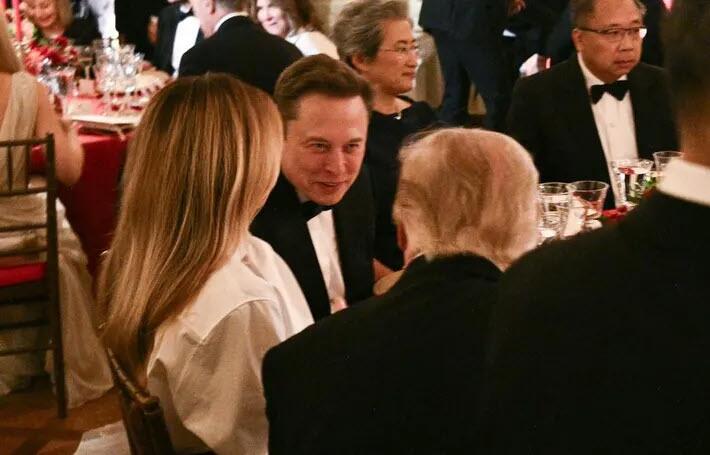
Then there is the Musk comeback. More than a year after the ultimately unpopular DOGE effort and the very public falling out with Trump, which at one point had the administration weighing shutting SpaceX out of Golden Dome, Musk is baaaack. In the past week alone he attended the Trump-Xi state dinner and was slated for a White House AI lunch, and now has his first formal advisory role since DOGE. Some feuds age like milk, others like fine wine; this one appears to have aged like a Pentagon contract.
What Goldman Says About The "Affordable Mass" Pitch
To be fair, there is a real case for letting outsiders shake up how the Pentagon buys things, and few have laid it out better than Goldman's A&D analyst Noah Poponak, who sat down with Anduril's management in June. Goldman's diagnosis was that the legacy defense industry produces "low numbers of expensive, bespoke assets" that are hard to scale, while Anduril designs for "affordable mass" through selective vertical integration, common components across product lines, designs simple enough to automate, and flexible factories that can switch products quickly.
The economics also explain why everyone wants in. Per Goldman, Anduril targets a near 25% total company operating margin over time and gets roughly 70-80% of its revenue from fixed-price work, well above what the traditional primes earn. Poponak also saw "early signs of progress" in Pentagon acquisition reform, including multi-year frameworks and open-testing programs such as Drone Dominance. One of the architects of the "affordable mass" model will now help write the Pentagon's wish list, which is either the most efficient procurement reform in history or the most efficient sales pitch. Possibly both.
Goldman is also constructive on the listed drone names. In his AeroVironment notes this month, Poponak noted that funded backlog rose 37% y/y and 23% sequentially and that AVAV "has exposure to faster growing portions of the defense budget." He pointed to demand for its LOCUST directed-energy counter-drone system (first international order: more than $50mn) and the low-cost Freedom Eagle interceptor, which offers "a significantly lower-cost alternative to traditional missile defense systems."
Enter AutoWarCom
Meridian was not the only new acronym. Hegseth also unveiled a new four-star Autonomous Warfare Command (yes, "AutoWarCom") with "service-like authorities" over drones, AI and command-and-control. It is set to be operational by October 1, 2027. Until then, an interim effort called Project Agincourt will draw on the Defense Innovation Unit and the Drone Dominance program, pairing "operators with entrepreneurs in rapid adaptation cycles." Existing programs such as the Collaborative Combat Aircraft and the Navy's MQ-25 unmanned tanker are being folded in. Hegseth called it "the fastest peacetime shift in modern military history."
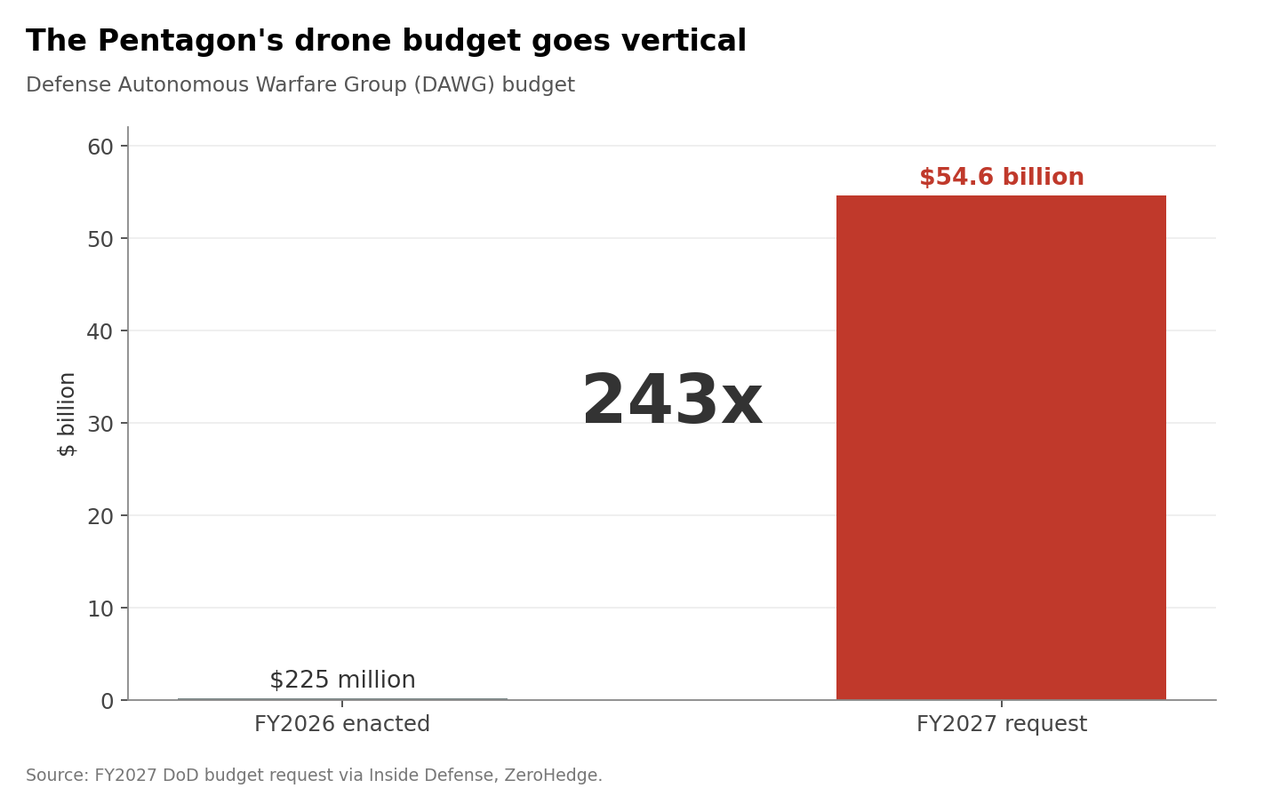
The money was already lined up. As we reported in April, the Pentagon's FY27 request seeks $54.6 billion for the Defense Autonomous Warfare Group, up from $225 million in FY26, a 243x increase that would make even a Silicon Valley VC blush.
Add the $1.1 billion Drone Dominance initiative to stockpile 300,000 sub-$5,000 attack drones by the end of 2027 (which sent drone stocks soaring in May), plus the Army's $500 million FPV award to Neros in July, and the direction of travel is pretty clear.
...So Why Are Defense Stocks Puking?
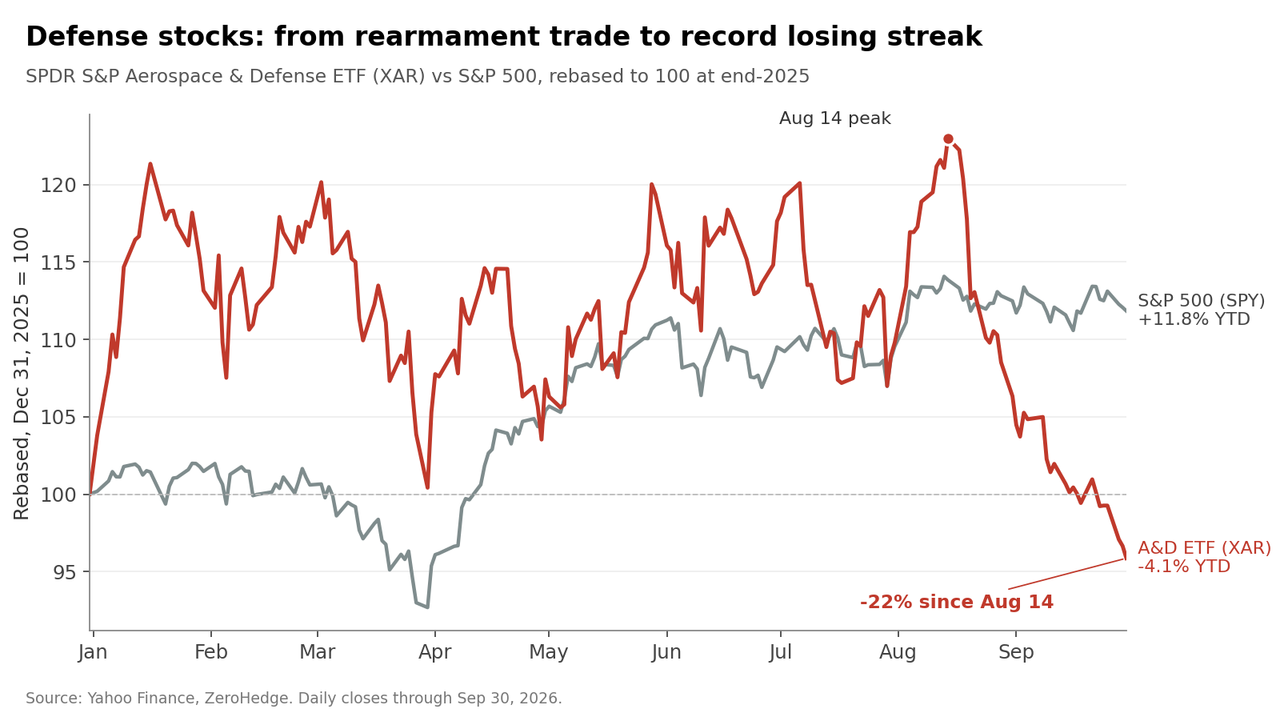
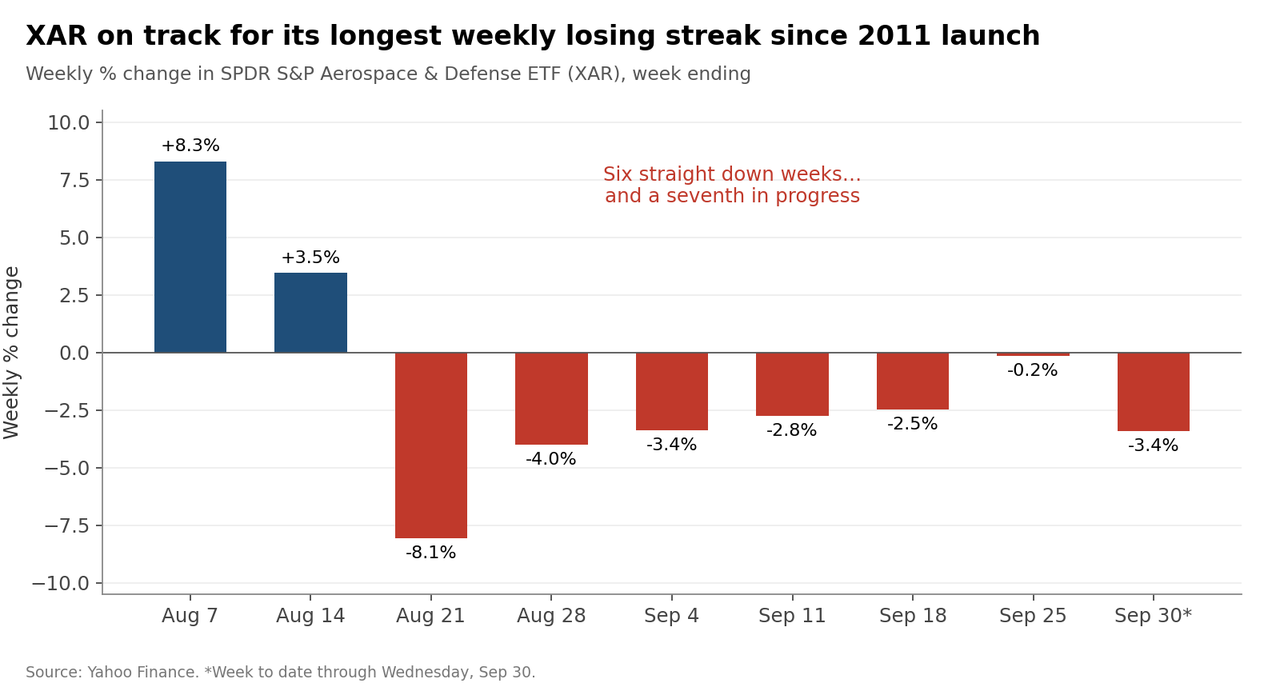
You would think a four-star command dedicated to drones, a 243x budget request and the world's richest man drafting the shopping list would be manna for defense stocks. Instead, the SPDR S&P Aerospace & Defense ETF (XAR) is down 22% from its August 14 peak and in a bear market, and as of Wednesday it is on track for a seventh straight weekly decline, the longest losing streak since the fund launched in 2011. XAR is now down 4.1% YTD while the S&P is up almost 12%.
The explanations are familiar to ZH readers:
- First, peace is breaking out, or at least the possibility of it: on September 22 reports surfaced that Iran offered to reopen the Strait of Hormuz in exchange for an easing of US military pressure, while Trump floated a negotiated end to the conflict at the UN (that didn't quite work out as expected, although the downward momentum was already in there).
- Second, the budget is stuck. Neither chamber has passed appropriations, and a stopgap through December 11 would freeze spending at 2026 levels. "The budget is stalled," said Bernstein's Douglas Harned, noting that defense stocks have gone from a 15% premium to the S&P 500 in February to a 12% discount.
- Third, the midterms: as we wrote two weeks ago, UBS's Allyson Gordon said investors "remain reluctant to add exposure... until after the midterms," and the Polymarket odds on Senate control are the reason why. Whoever controls Congress controls appropriations.
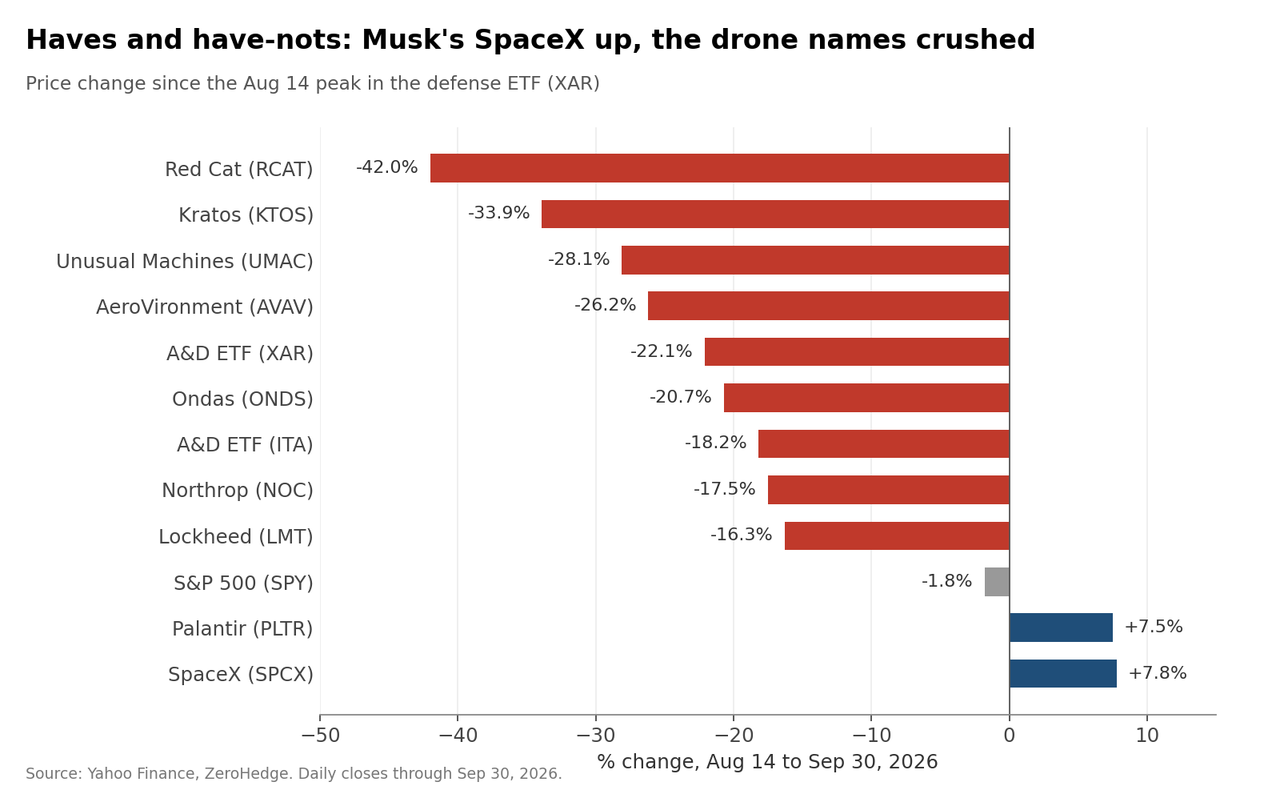
But the most interesting part is who is getting hit. Goldman's US Industrials desk (Ryan Novak) put it bluntly in late August: defense tech "is definitely a tale of haves and have nots," and "the day to day in SPCX is having impacts on the broader 'space' but specifically drone names." The six weeks since have proved the point. The pure-play drone names have been crushed (Red Cat -42%, Kratos -34%, Unusual Machines -28%, AeroVironment -26%), while SpaceX and Palantir are both up roughly 8% since the sector peaked. In other words, the market has already picked its winners, and the biggest of them now has its CEO sitting at the Meridian table.
"Behind The Meter" Comes To Fort Bragg
Buried in the speech was one item ZH readers will recognize. Hegseth said he wants every major US military installation to generate its own power, so that bases keep running if a cyberattack takes down the grid. That will come in the form of nuclear microreactors, with the first targeted to be operational by September 2028 and Eielson AFB in Alaska leading the Air Force effort.
This has been building for a while. The Army launched its "Janus" microreactor program last October, and in August it picked five companies under agreements worth up to $2.2 billion: Antares (Fort Bragg), BWXT (Fort Campbell), General Atomics (Fort Hood), Radiant (Fort Benning) and Westinghouse (Fort Drum). Meanwhile, the Air Force has its own microreactor pairings at three bases and has also been working with NANO Nuclear: AFWERX gave the company a $1.25 million contract last September to study putting its KRONOS microreactor at Joint Base Anacostia-Bolling in Washington, and in July it followed up with a second award to adapt KRONOS for military installations more broadly.
Long-time readers know where we stand. Back in November we argued that every data center must have its own "behind the meter" onsite power generation, and in December we put it more simply: "Make 'behind the meter' mandatory." We have also long said that small modular reactors are the only real long-term answer to America's power crunch. It is nice to see the Pentagon get there too, even if it took the threat of a grid-killing cyberattack rather than a hyperscaler's electricity bill.
And The Rest
In case that wasn't enough for one morning, Hegseth also:
- Confirmed that general and flag officer billets will be cut by 20%, double last year's 10% (as we previewed on Tuesday), with the reductions due by January 1, 2027;
- Announced the first new US military base in four decades, a "Next Great American Base" for 15,000-plus troops built in "timeless classical architecture," with states invited to compete to host it, as the Pentagon weighs large troop cuts in Europe;
- Created an Office of Religious Affairs reporting directly to the Secretary;
- Launched new "corps of cadets" partnerships with Hillsdale, Liberty, LSU, Mississippi State and Tuskegee; and
- Accused US media outlets of "treason" over their coverage of the Iran war, a few weeks after Thomas Massie forced a House vote on impeaching him.
- Oh, and he clarified who may serve: "No fatties...No trannies...No beardos....No weirdoes...No wimps."
The bottom line: the Pentagon is reorganizing itself around drones, autonomy and AI, putting the people who build those things in charge of deciding what comes next, and asking for the budget to match. The market isn't buying it yet. Not because the story is wrong, but because nobody wants to own the stocks until Congress, the midterms and Iran give them a reason to. When that changes, the "haves" are already obvious. The have-nots, at 40% off, may turn out to be the more interesting trade... assuming Meridian's 120-day report leaves any room for them.

No comments:
Post a Comment
Note: Only a member of this blog may post a comment.