by Steve Watson via Modernity News,
The New York Times has decided the open question in science this week is whether a baby is conscious. Not a cluster of cells. Not a theoretical model. An actual newborn baby.
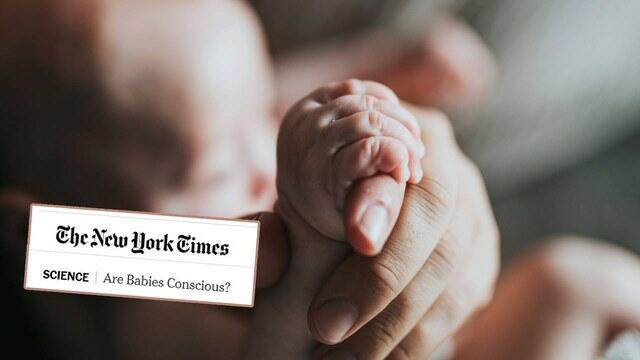
Carl Zimmer's 5 October piece, "Are Babies Conscious?" (yes that's a real headline) walks readers through a lab test and then informs them that a "squirming, gurgling infant" does not seem conscious, "at least not in the way adults are."
Zimmer's setup is the oddball-sound test. A subject hears three low tones and a high one, over and over, then a run of four low tones. Adult brains throw a brief, distinctive blip at the break. People in a coma do not. People who are asleep do not. The Times then puts a newborn in the same frame and asks whether the blip will be there.
Are Babies Conscious? As scientists map the birth of consciousness, they hope to gain a better understanding of how it evolved in humans in the first place. https://t.co/g1D5A4wRtF
— Patrick Emerton (@egregiousknave) October 5, 2026
Er what? https://t.co/ZqhoAq4dJk
— m o d e r n i t y (@ModernityNews) October 6, 2026
The paper calls it an active scientific debate. Dr Topun Austin, a neonatologist at the University of Cambridge, is quoted defining the thing under study: "Consciousness is a process of being receptive to the outside world and mixing that with our own internal world, to create the feeling of who we are and where we are."
A caption under the piece states that there was a time when our brains were too rudimentary to support consciousness. Zimmer's own promo line said he had found scientists "on a mission to find out when consciousness begins in babies."
The reaction online was immediate, and it was not about neuroscience. It was about where the line moves next.
@ModernityNews Ever get the feeling we're living inside a cautionary tale?
— Alpha Of The Betas (@AlphaOfTheBetas) October 6, 2026
Like we're all just trapped in a dystopian '70s sci-fi movie, while Charlton Heston screams about the sanctity of human life? pic.twitter.com/oxA1EaZhXJ
"Are Babies Conscious?"
— Arthur in California (@ArthurReturnss) October 5, 2026
Give this a few more years and they'll claim consciousness doesn't begin until the baby is one years old, so abortion should be legal up to that point. pic.twitter.com/hLxMdTzZzC
@JackPosobiec This is setting to push for post-birth abortion down the line.
— Emmanuel Gonzalez (@Emm_Gonzalez38) October 6, 2026
@JackPosobiec They want abortion legality to extend into early childhood
— Paul Joseph Tinkle (@PTinkleIndy) October 5, 2026
@JackPosobiec Anyone who has had a child knows that babies are conscious. Only the childless hacks at the NYT are confused.
— Andrew McCann (@andymccann) October 5, 2026
All this is going on while we're debating whether 'machines can be conscious', a disturbing irony.
Incredible that we're debating whether "machines can be conscious" while Democrats still haven't acknowledged that babies in a mother's womb have consciousness.
— Benny Johnson (@bennyjohnson) October 3, 2026
Of course, there are countless studies that indicate infants, even unborn infants have consciousness as we understand it.
In January, neonatologist Carlo Bellieni of the University of Siena published "A Rudimentary Consciousness Appears in the Late Fetal Period" in EC Gynaecology, reviewing 31 clinical trials from the last decade on fetal anatomy, perception and memory. His conclusion: the early appearance of memory is a sign of rudimental consciousness, and it does not depend on whether the fetus is inside or outside the womb, only on the grade of brain development.
HUGE!
— LifeNews.com (@LifeNewsHQ) February 20, 2026
Unborn babies experience consciousness.
A new study was published in a peer-reviewed medical journal. A neonatologist reviewed 31 clinical trials from the last decade and confirms babies before birth are conscious.
https://t.co/4XhRXYdcs6 pic.twitter.com/mzwsMjBl1z
Bellieni's account of the hardware is specific. "Intrauterine life includes structures which, at least partially, replace the developing cortex, that the fetus begins to form around 20 weeks of gestation. These structures are the subplate, useful for most sensations, and the thalamus for pain. ... We can realistically say that the first sensations are perceived by mid-pregnancy."
Fetuses in the trials preferred carrot-flavoured amniotic fluid to kale, responded more to face-like patterns, and touched the uterine wall longer when the mother touched from outside. Magnetoencephalography work found fetuses at 35 weeks and older detecting breaks in tone patterns. The old claim of continuous fetal sedation does not survive the blood chemistry or the sleep-wake cycling.
That sits on earlier research. In 2023, Tim Bayne, Joel Frohlich, Lorina Naci and colleagues published "Consciousness in the cradle" in Trends in Cognitive Sciences. Bayne put the split plainly: researchers disagree on whether consciousness arises early, at birth or shortly after, or late, by one year or much later. "Nearly everyone who has held a newborn infant has wondered what, if anything, it is like to be a baby."
The review's own reading of network connectivity, attention, multimodal integration and cortical responses to global oddballs was that consciousness is likely in place in early infancy and may begin before birth. Naci, who leads Trinity College Dublin's Consciousness and Cognition Group, said newborns can integrate sensory and developing cognitive responses "into coherent conscious experiences to understand the actions of others and plan their own responses."
A 2025 Science report on the Infant Consciousness Conference at NYU recorded the same shift. Bioethicist Claudia Passos-Ferreira, who co-organised it, said fetal consciousness would have been a less central topic at a meeting like that a few years earlier. Preliminary survey results from the room: 47 percent placed the first development of consciousness in the later prenatal window, from about 24 weeks to birth.
A 2026 survey in Neuroscience of Consciousness, of attendees at two leading conferences, found a majority favouring the view that newborns are conscious, and a plurality favouring emergence after 24 weeks of gestation.
In June, New Scientist reported that the fetal connectome already shares 61 percent of the functional organisation of an adult brain. Bayne's line there: "There certainly could be snippets of experience before birth, and the capacity for consciousness is probably there."
None of this is a claim that a six-week embryo writes poetry. It is a claim that the "are they even aware?" framing, applied to born infants and late-term fetuses, is behind the data the same research community has been publishing.
The same day the Times asked whether babies are conscious, LifeNews republished a shocking case that makes the question obscene. A boy at 21 to 22 weeks, about half a pound and the size of a hand, survived an abortion at Christ Hospital in Illinois and lived for 45 minutes. The baby was taken to a soiled utility room because his parents wanted nothing to do with him. There was no care. No intervention.
Baby Born Alive at 22 Weeks Was Gasping for Air. Abortion Clinic Left Him in a Soiled Utility Room to Die https://t.co/rFubF5UXP7 pic.twitter.com/95zJ9MYi7Z
— LifeNews.com (@LifeNewsHQ) October 5, 2026
Nurse Jill Stanek later told a U.S. Senate committee she could not leave him to die alone. "I could not bear the thought of this suffering child dying alone, so I rocked him for the 45 minutes that he lived." He was old enough to gasp for air. He was not old enough, under the logic now being laundered by the New York Times, to count as a human being.
State health figures cited around the same reporting put at least 40 babies born alive after botched abortions in Minnesota, Arizona and Florida between 2016 and 2018, and CDC data at least 143 between 2003 and 2014.
In August, Massachusetts legalised abortion up to birth, and the applause came from the same political class that treats viability as a clerical error.
In March, the UK House of Lords rammed Clause 208 of the Crime and Policing Bill through and decriminalised self-induced abortion at any stage. A YouGov survey found 1 percent support for abortion up to birth. A Whitestone Insight poll found 62 percent saying abortion should remain illegal after 24 weeks, and 53 percent saying it should not be an option if the baby could survive outside the womb. GB News put the gap in one line: "Just 1% of the public agree with this... and yet it has now made it into law."
A country that will arrest someone for silent prayer outside a clinic has arranged the law so that healthy, fully grown babies can be killed without a criminal consequence for the woman.
In March of 2025 the Trump administration moved to cut federal money to Planned Parenthood, which took an average of $592 million a year from taxpayers between 2019 and 2021, more than 40 percent of revenue, while performing 1.11 million abortions in that window.
Anyone who has held their own newborn, or any newborn for that matter, and witnessed the child's curious glare, the tight grip of their hand, and felt the intense emotional connection knows that babies are conscious. The New York Times deciding to ask whether they are or not does not make it a real debate.
https://www.zerohedge.com/medical/ny-times-suggests-babies-are-not-conscious

No comments:
Post a Comment
Note: Only a member of this blog may post a comment.