Search This Blog

Tuesday, December 19, 2023

More Details on Mastermind Behind Secret Chinese Biolab In California

  by Steve Ispas and Lear Zhou via The Epoch Times (emphasis ours),

An Epoch Times investigation has revealed further details on Jiabei “Jesse” Zhu, the person behind the black-market biolab discovered in California, as well as his connections with the Chinese Communist Party (CCP).

The secret biolab operated in a warehouse in Reedley, California, about 25 miles southeast of Fresno. It was discovered on Dec. 19, 2022, by Jesalyn Harper, a code enforcement officer with the City of Reedley Fire Department.

In the warehouse, Ms. Harper discovered thousands of vials of infectious agents, including coronavirus, chlamydia, E. coli, streptococcus pneumonia, HIV, hepatitis, herpes, rubella, and malaria.

On Oct. 19, 2023, Mr. Zhu was arrested in California and charged with manufacturing and distributing misbranded medical devices and for making false statements to the FDA.

Mr. Zhu filed a suit against the city of Reedley for $30 million and against the county for $50 million. The prospect of having a conversation with the city leaders regarding his claims was used to entice him to show up at the warehouse and have him arrested on the spot by FDA agents with automatic machine guns in their hands.

Mr. Zhu had claimed that he was a consultant named David He hired to help get Universal Meditech and Prestige Biotech out of the trouble they were in. Prestige Biotech is the company that owns the biolab in Reedley.

However, City of Reedley officials recognized him as Universal Meditech’s president.

This is not a hired consultant; this is the lab CEO. The picture we have of the lab CEO matches this guy perfectly,” said Nicole Zieba, Reedley city manager, in an interview with The Epoch Times.

But she still cannot figure out what Mr. Zhu was thinking in suing the city, pretending to be someone else, and bringing attention to himself, which ultimately led to his arrest.

I’m not sure if it’s stupidity, arrogance, or some long con that we simply haven’t figured out ... but it certainly is confounding and baffling to me,” said Ms. Zieba.

The investigation by The Epoch Times revealed additional connections between Mr. Zhu and the CCP.  Mr. Zhu’s father, Zongxiang Zhu, was born in 1923 and is a famed acupuncture expert and medical educator in China. He also serves as Director Professor of Institute of Biophysics, Chinese Academy of Sciences, according to 163.com.

According to a Chinese encyclopedia, until recently Zongxiang Zhu has been involved in various activities and has been a very well recognized figure in China.

Jiabei Zhu’s mother, Pengdi Zhu, was listed as one of the ultimate beneficial owners at Aide Modern Cattle Industry (China) Company Limited and at least four other Chinese companies controlled by Jiabei Zhu, according to the House Select Committee on the Chinese Communist Party report that was released on Nov. 15, 2023.

Pengdi Zhu’s name is also listed as the beneficial owner of Qingdao Aide Biotechnology Development Fund (General Partnership), a company that partners with Jiabei Zhu’s company Ai De Biopharmaceutical Industry (Qingdao) Co., Ltd.

Shanghai Kunpeng Technology Investment and Development Limited, a company that has Pengdi Zhu as its legal representative and that is currently suspended according to the Shanghai Businesses listing website, invested 2,250,000 yuan (approximately $314,879) in Aide Modern Cattle Industry (Qingdao) Company Limited in December 2020.

According to the House Select Committee’s report, the main company Jiabei Zhu controlled, Aide Modern Cattle Industry (China) Company Limited, was established in 2002 with a registered equity of 181,000,000 yuan ($25,219,092 with today’s exchange rate).

According to the company’s listing website, the company has gotten into 62 lawsuits, the most recent one a financial loan contract dispute, which triggered a 10 million yuan ($1,393,418 under current rate) equity freeze and ended in an execution that targeted 12,294,755 yuan ($1,713,698 under current rate) on Oct. 27, 2023.

According to the updated status on the qcc.com website, Aide Modern Cattle Industry (China) Company Limited was listed as “abnormally operating” on Sept. 23, 2021 because people were not able to contact the company via the registered address.

Though The Epoch Times did not obtain the exact date Mr. Zhu entered the United States as Qiang (David) He, the year 2021 matches the time that his main company in China was listed as “abnormally operating” due to lack of contact.

Aide Modern Cattle Industry (China) Company Limited is still active, according to the qcc.com website. Xuejun Zhang, board member of the public company Jushri Technologies Inc., was also listed as an active board member of Aide Modern Cattle Industry (China) Company Limited, on page 39 of the Jushri Technologies 2022 annual report issued April 24, 2023.

Mr. Zhu had a judgment against him in 2016 for $330 million in Canadian dollars from the Canadian Supreme Court as well as another judgment for $8.5 million in Canadian dollars in a Hong Kong court in the same year. However, no lawsuits were filed in China for the same damages incurred, where Aide continues to operate.

Other connections include Barry Zhang (Bai-Rui Zhang), who is listed as Prestige Biotech’s registered agent by the Nevada Secretary of State; and Michael M. Lin (Meng-Ru Lin) of Lin Law Group in Nevada, who is the leading attorney hired by Universal Meditech. Both have close relationships with the CCP’s United Front.

Mr. Zhang was listed as one of the community leaders in Hunan Benevolent Association of America, according to its official website, while Mr. Lin was an active sponsor for the Las Vegas Chinese Spring Festival Gala supported by Consulate General of P.R.C. in San Francisco.

Universal Meditech also seemed to have a close relationship with the Chinese government. Its COO, Candace Liu, attended the 2019 China-California Business Forum as a guest. The forum was mainly organized by the Chinese General Consulate Los Angeles as well as the California Governor’s Office of Business and Economic Development, according to a UNE News report.

Currently, according to LinkedIn, Ms. Liu is the vice president of business development, North America, at jd.com, one of China’s largest online retail companies.

The California biolab received more than $1.3 million in unexplained payments from banks in China while in operation, according to U.S. lawmakers.

Possible Ebola in Freezer

In May 2023, several agencies inspected the lab—the CDC, FDA, County Public Health, and California Department of Public Health. They looked at all the items in the refrigerators and freezers that were labeled and that they could determine what they were. However, there were many other items that were not labeled or were labeled with a code that the city officials had no key to.

The interior of a biolab, in Reedley, Calif., on July 31, 2023. (Courtesy of City of Reedley)

The CDC created a report for the 20 items that were labeled. All these items were sprayed down, disinfected, and put in special waste containers to be incinerated.

In July, a city worker found a freezer that was labeled “Ebola.”

“It was a white piece of paper that was folded over where you couldn’t read it unless you specifically unfolded it. And that paper read Ebola, and it was handwritten,” Ms. Harper with the city of Reedley told The Epoch Times.

Nothing inside that freezer was labeled. This gave Ms. Harper some sleepless nights. The CDC would not investigate something unless it had a specific label on it.

Unless an item is actually labeled Ebola, it doesn’t fall under the CDC purview for their select agents,” said Ms. Harper.

The bags of potential Ebola virus were shoved in the freezer in a disorderly fashion. They were all in silver sealable bags.

The city never found out what was actually in the bags, as the CDC never examined them.

“They didn’t come, they didn’t test, they didn’t even ask us to sample, and I think that’s why the congressional report was so critical to [the] CDC,” said Ms. Harper.

Nevertheless, the samples were destroyed.

Some of the other refrigerators were found to have things of unknown nature spilled on the bottom of the trays, and it looked like they were taped and moved around in the warehouse or from another warehouse, Ms. Harper said.

“Everything seems to have been done very haphazardly,” she said.

The interior of a suspected biolab, in Reedley, Calif., on July 31, 2023. (Courtesy of City of Reedley)

Previously, the CDC ended up hanging up on Ms. Harper on a different inquiry. In March 2023 during an inspection warrant, after the inspectors left, Ms. Harper was left alone in the building as she had to determine whether to turn off the power to the building in order to prevent a fire, given the disorderly things in the warehouse.

With the power off, the freezers’ contents would melt with potentially dangerous consequences due to the pathogens. This is when she called the CDC for advice.

It was a very short-lived and frustrating phone call that ended with them hanging up,” said Ms. Harper.

Ms. Harper said under-the-radar entities like the biolab can purchase "a lot of chemicals and a lot of biologicals easily and no one is watching over them to make sure they know what they are doing." (Courtesy of Jesalyn Harper)

She ended up not turning off the power in the part of the building where the freezers were after she consulted with Ms. Zieba.

While Ms. Zieba and Ms. Harper are not aware of any other possible charges against Mr. Zhu, they feel that the Energy and Commerce congressional committees should get involved, since the select committee on the CCP does not have authority over privately funded labs, according to Ms. Zieba.

There needs to be a single source within the government that is responsible for private labs,” added Ms. Zieba.

Both Ms. Zieba and Ms. Harper added that the congressional investigation was very non-partisan and involved great cooperation.

“From the way they talked, you couldn’t tell who was a Democrat and who was a Republican. And I thought, wow, this is phenomenal,” said Ms. Zieba.

While these viruses could have been used for research, they could also be weaponized.

It is all in the intention,” said Ms. Harper.

According to Dr. Limeng Yan, a virologist who worked at the WHO Reference Lab at the University of Hong Kong until 2020, it is extremely difficult to transport these dangerous pathogens internationally and even more difficult to obtain them in the United States.

“If you need to do international transport, you have to acquire a very strict license from the local government and also the imported government; that means you have to get both approval from the country you ship it from and also [from] the United States. And also, all of these shipments need to be carefully monitored by the couriers, like, we use FedEx or DHL. Without a license, it could only be done illegally,” Mr. Yan told The Epoch Times.

The exterior of a biolab, in Reedley, Calif., on July 31, 2023. (Nathan Su/The Epoch Times)

Zhu’s Legal Case

Mr. Zhu is represented by Tony Capozzi, a well-known defense attorney in the Fresno area. Right after he was announced as Mr. Zhu’s defense attorney, Mr. Capozzi mentioned to another outlet that Mr. Zhu applied for asylum, but the attorney provided no confirmation or evidence when repeatedly asked by The Epoch Times.

Mr. Capozzi did respond to The Epoch Times stating that he is waiting for the evidence on the criminal charges filed against his client Mr. Zhu.

I have not received any such discovery. The government indicated that it was not using the select committee report in the criminal case,” Mr. Capozzi stated.

Mr. Zhu pleaded not guilty to both charges on Nov. 16, and in the detention hearing, he also entered denial of forfeiture to the properties in the warehouse that have been mostly destroyed by the Reedley City under an abatement court order.

The next court date is set to Jan. 17, 2024 for a status conference. Until then, Mr. Zhu is to stay in custody, according to the court status website.

A date for the trial to start has not yet been set.

https://www.zerohedge.com/medical/investigation-leads-additional-details-regarding-mastermind-behind-secret-chinese-biolab

China Pulls Punches to Keep Pricey Electric Cars Flowing to EU


  • EU attracts bulk of China EV exports, where prices double
  • Protectionist tariffs after probe could come as early as July

When the European Union launched a probe into Chinese support for electric vehicles, the bloc’s carmakers braced for painful retaliation from the increasingly assertive superpower.

The dire reprisal hasn’t materialized, at least yet. Beyond some initial strong words from China, both the government and companies like BYD Co. and SAIC Motor Corp. have cooperated since the start of the subsidy investigation. The muted response points to the pressure China’s oversupplied EV market is under, made worse by the price war Tesla Inc. touched off over the last year.

https://www.bloomberg.com/news/articles/2023-12-20/china-is-under-pressure-to-keep-exporting-electric-cars-to-the-eu

Colorado Supreme Court Disqualifies Trump From 2024 Ballot, Setting Up Supreme Court Challenge

 The Colorado Supreme Court has disqualified Donald Trump from Colorado’s 2024 presidential election ballot, and in a 4-3 ruling has effectively blocked Trump from seeking the presidency because of his role in the Jan. 6 Capitol attack, citing the post-Civil War-era 14th Amendment to the US Constitution that bans insurrectionists from holding public office. The Colorado case was the first constitutional challenge to Trump’s 2024 run to go through a full trial.

Voters, represented by the advocacy group Citizens for Responsibility and Ethics, had argued he should be barred from the ballot for inciting the Jan. 6, 2021 attack on the US Capitol.

Colorado’s highest court - whose seven-member bench was entirely appointed by Democratic governors - overturned a ruling from a district court judge who found that Trump incited an insurrection for his role in the Jan. 6, 2021, attack on the Capitol, but said he could not be barred from the ballot because it was unclear that the provision was intended to cover the presidency.

In its ruling, the Democrat-controlled court found that Trump engaged in insurrection by inflaming his supporters with false claims of election fraud and directing them to the Capitol. The state justices determined that the office of the president is covered under the insurrection clause, which specifically lists those who previously took oaths to support the Constitution as “a member of Congress,” “officer of the United States,” “member of any State legislature” or an “executive or judicial officer of any State.” The district court had previously ruled that the office of the president was not covered under the clause. 

The majority opinion was unsigned but joined by four of the seven justices.

Three justices dissented from Tuesday’s decision: Chief Justice Brian Boatright, Carlos Samour and Justice Maria Berkenkotter. Each wrote separate dissents taking issue with how the plaintiffs brought their 14th Amendment lawsuit using a provision of Colorado election law.

Berkenkotter wrote that “the majority construes the court’s authority too broadly.”

“The questions presented here simply reach a magnitude of complexity not contemplated by the Colorado General Assembly for its election code enforcement statute,” wrote Boatright. “The proceedings below ran counter to the letter and spirit of the statutory timeframe because the Electors’ claim overwhelmed the process.”

Samour similarly wrote that Colorado’s election law provides no “engine” for such a lawsuit, also noting that no federal legislation existed to enforce the 14th Amendment’s insurrection clause.

“Even if we are convinced that a candidate committed horrible acts in the past—dare I say, engaged in insurrection—there must be procedural due process before we can declare that individual disqualified from holding public office. Procedural due process is one of the aspects of America’s democracy that sets this country apart,” Samour wrote.

Ironically, all this ruling will do is further cement Trump's status as leading presidential candidate as it not only affirms his status as target #1 of the Biden Department of Justice and liberal court system, but will test the Conservative-dominated Supreme Court appeal over its interpretation of the 14th Amendment, which according to many including a Colorado District court,  does not apply to the Presidency.

The court put its ruling on hold until Jan. 4, so Trump can first seek review from the Supreme Court, which he will. Until then, Trump’s name automatically remains on the ballot until the justices resolve the appeal.

“We do not reach these conclusions lightly,” wrote the court’s majority. “We are mindful of the magnitude and weight of the questions now before us. We are likewise mindful of our solemn duty to apply the law, without fear or favor, and without being swayed by public reaction to the decisions that the law mandates we reach.”

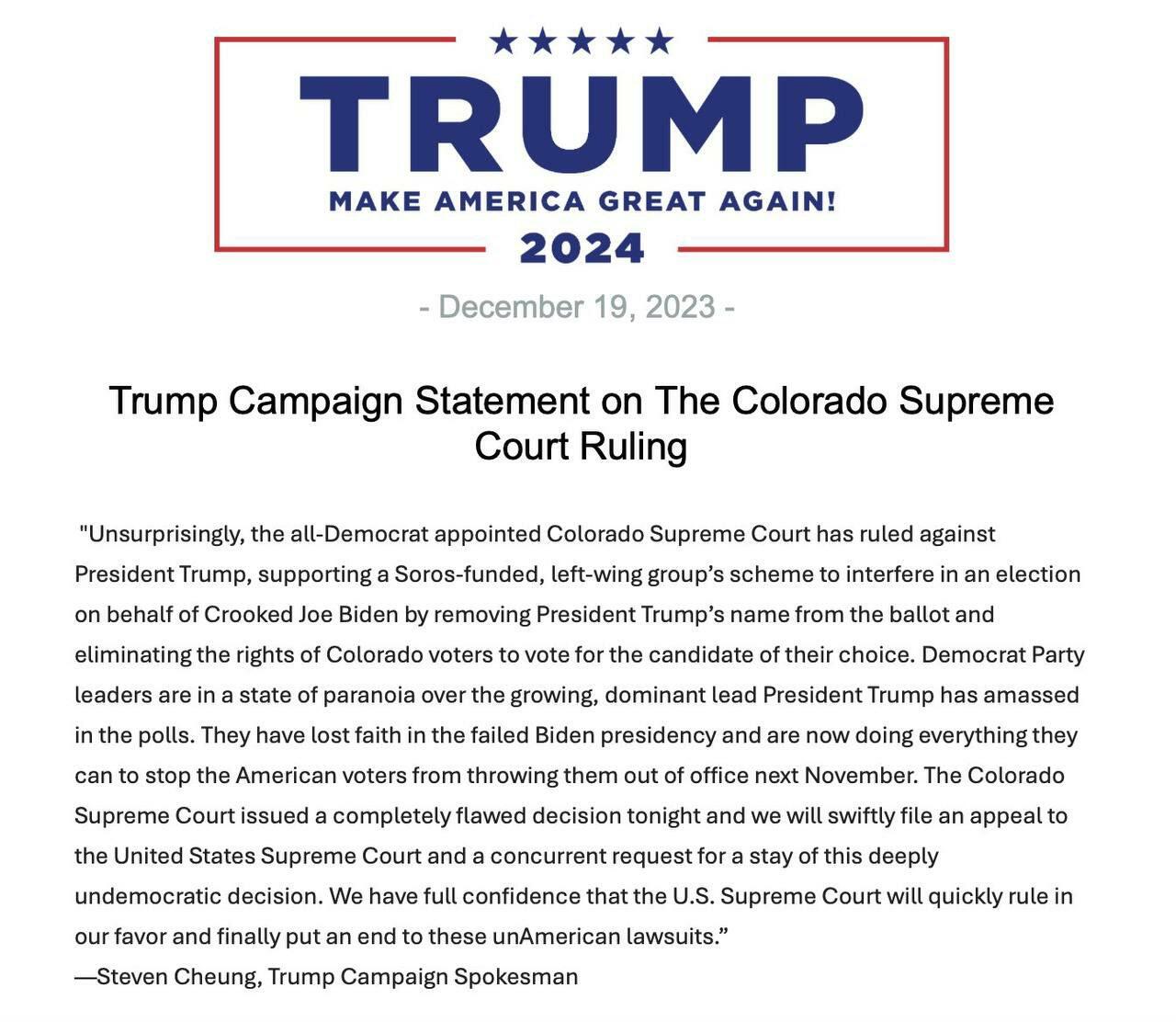
Naturally, Trump’s campaign immediately denounced the ruling.

“Unsurprisingly, the all-Democrat appointed Colorado Supreme Court has ruled against President Trump, supporting a Soros-funded, left-wing group’s scheme to interfere in an election on behalf of Crooked Joe Biden by removing President Trump’s name from the ballot and eliminating the rights of Colorado voters to vote for the candidate of their choice,” a campaign spokesman, Steven Cheung, said.

“We have full confidence that the U.S. Supreme Court will quickly rule in our favor and finally put an end to these un-American lawsuits."

Constitutional law scholar Jonathan Turley, who previously said the case has no solid legal basis, also responded to the decision:

"My first impression remains that same. The court is dead wrong in my view... ...It is striking that the court relies on Schenck v. U.S., where the Court upheld the denial of core free speech rights of a socialist opposing a war. The opinion of the Colorado Supreme Court is so sweeping that it would allow for tit-for-tat removals of candidates from ballots."

Here is the Colorado Supreme Court Decision in its entirety.

Explanations Don't Help Clinicians Spot Biased AI

 Providing clinicians with artificial intelligence (AI) predictions along with model explanations can boost diagnostic accuracy, but that accuracy drops when using a biased AI model -- and explanations don't mitigate those negative effects, according to a randomized clinical vignette survey study.

Clinicians who were asked to differentiate between pneumonia, heart failure, or chronic obstructive pulmonary disease (COPD) had a baseline accuracy of 73% (95% CI 68.3-77.8), which rose to about 76% when using AI without explanations. Adding in an explanation of the model -- to mitigate any errors it may make -- brought accuracy up to about 78%, according to Michael Sjoding, MD, of University of Michigan Health in Ann Arbor, and colleagues.

However, when using a systematically biased AI model, diagnostic accuracy fell to about 62% -- a decline that wasn't fixed by adding model explanations, which only restored accuracy to about 64%, they reported in JAMAopens in a new tab or window.

"AI is being developed at an extraordinary rate, and our study shows that it has the potential to improve clinical decision making," co-author Sarah Jabbour, MSE, also of the University of Michigan, told MedPage Today in an email. "But we must be thoughtful about how to carefully integrate AI into clinical workflows with the goal of improving clinical care while not introducing systematic errors or harming patients."

Jabbour and colleagues explained that recent regulatory guidance has called for AI models to include explanations that may help mitigate errors made by models, but the effectiveness of this strategy hasn't been established.

To dig deeper into the issue, they designed a studyopens in a new tab or window that involved analyzing vignettes of patients hospitalized with acute respiratory failure and diagnosing either pneumonia, heart failure, or COPD as the underlying cause.

To establish baseline diagnostic accuracy, clinicians -- doctors, nurse practitioners, and physician assistants -- were shown two vignettes without AI input. They were then randomized to see six vignettes with AI input, with or without model explanations. Three of these vignettes included standard-model predictions, while three included systematically biased predictions.

A final vignette with support from an "expert clinician" consult established an upper bound for diagnostic accuracy, which in this case was about 81%.

Overall, 457 clinicians from 13 states participated between April 2022 and January 2023, with 231 randomized to model predictions without explanations, and 226 randomized to also get explanations. Median participant age was 34 and about 58% were female.

The vignettes included presenting symptoms, physical examination, laboratory results, and chest radiographs. Biased AI models were skewed to make predictions using age, weight, and radiograph adjustments. Explanations for biased models were written to try to reveal potential biases, the researchers said.

"In our study, explanations were presented in a way that were considered to be obvious, where the AI model was completely focused on areas of the chest X-rays unrelated to the clinical condition," Jabbour told MedPage Today. "We hypothesized that, if presented with such explanations, the participants in our study would notice that the model was behaving incorrectly and not rely on its predictions."

"This was surprisingly not the case," she said, "and the explanations when presented alongside biased AI predictions had seemingly no effect in mitigating clinicians' over-reliance on biased AI."

AI models can reflect biases that already exist in the healthcare system and can lead to worse overall clinical decision making, Jabbour said. For example, a model trained on a dataset including women who were underdiagnosed for heart failure might identify female patients as being at lower risk for heart failure, especially if clinicians rely heavily on the predictive models without further explanation, she said.

One limitation of the study was its reliance on a web-based survey interface, which is inherently different from the clinical setting. Nor did the study include radiologists who have more training on reading diagnostic imaging, the researchers noted.

In an accompanying editorialopens in a new tab or window, Rohan Khera, MD, MS, of the Yale School of Medicine in New Haven, Connecticut, and colleagues said the results suggest that "a more careful approach to evaluating AI tools is warranted before their rapid adoption, even when AI is used as assistive technology."

"Even in controlled settings, without the usual pressures on time, clinicians favored automated decision-making systems, relying on the AI-based tool, despite the presence of contradictory or clinically nonsensical information," Khera and colleagues wrote.

"If a model performs well for certain patients or in certain care scenarios, such automation bias may result in patient benefit in those settings," they wrote. "However, in other settings where the model is inaccurate -- either systematically biased or due to imperfect performance -- patients may be harmed as clinicians defer to the AI model over their own judgment."

Disclosures

The study was funded by the National Heart, Lung, and Blood Institute (NHLBI).

The study authors reported financial relationships with the U.S. Department of Energy, Toyota Research Institute, the National Science Foundation, the Alfred P. Sloan Foundation, Machine Learning for Healthcare, and Airstrip.

Editorialists reported financial relationships with the Doris Duke Charitable Foundation, Bristol Myers Squibb, Novo Nordisk, Evidence2Health, Ensight-AI, Johnson & Johnson, the Medical Devices Innovation Consortium, and Arnold Ventures.

Primary Source

JAMA

Source Reference: opens in a new tab or windowJabbour S, et al "Measuring the impact of AI in the diagnosis of hospitalized patients: A randomized clinical vignette survey study" JAMA 2023; DOI: 10.1001/jama.2023.22295.

Secondary Source

JAMA

Source Reference: opens in a new tab or windowKhera R, et al "Automation bias and assistive AI: Risk of harm from AI-driven clinical decision support" JAMA 2023; DOI:10.1001/jama.2023.22557.


https://www.medpagetoday.com/special-reports/features/107944

Can a GLP-1 Agonist Improve Parkinson's Symptoms?

 An investigational brain-penetrant, pegylated analogue of the glucagon-like peptide-1 (GLP-1) receptor agonist exenatide (Byetta, Bydureon) known as NLY01 did not lead to improvement in Parkinson's disease symptoms compared with placebo, a phase II trial

opens in a new tab or window showed.

Neither 2.5 mg or 5.0 mg of weekly NLY01 injections showed any difference from placebo in the sum of Movement Disorder Society Unified Parkinson's Disease Rating Scale (MDS-UPDRS) parts II and III scores at 36 weeks, according to Andrew McGarry, MD, of Rowan University in Camden, New Jersey, and colleagues.

Compared with placebo, the difference at 36 weeks was -0.39 (95% CI -2.96 to 2.18, P=0.77) for 2.5 mg and 0.6 (-2.28 to 3.00, P=0.79) for 5.0 mg, McGarry and co-authors reported in Lancet Neurologyopens in a new tab or window.

However, a subgroup analysis suggested the possibility of motor benefit in participants under age 60, the researchers said.

The GLP-1 receptor is present in the brain, and agonist activity is thought to be anti-inflammatory by reducing microglia activation. Exenatide is a GLP-1 receptor agonist approved to treat type 2 diabetes.

"In a database of more than 100,000 individuals with diabetes, those using GLP-1 receptor agonists had a 62% lower riskopens in a new tab or window of developing Parkinson's disease," McGarry and colleagues pointed out. In 2017, a single-center trial showedopens in a new tab or window that exenatide had positive effects on Parkinson's motor scores that continued beyond the period of exposure.

People with type 2 diabetes have an increased risk of Parkinson's disease, particularly those with early diabetes onset (ages 25-44) and a low BMI (below 18.5), noted Claudia Trenkwalder, MD, and Brit Mollenhauer, MD, of the University Medical Center Göttingen in Germany, in an accompanying editorialopens in a new tab or window.

"The Parkinson's disease course can be faster and more severe for individuals with type 2 diabetes than for those without type 2 diabetes, and it can be characterized by motor fluctuations in response to treatment occurring earlier and a more rapid decline in cognitive function," Trenkwalder and Mollenhauer wrote.

Trials like the NLY01 phase II study that investigate the preventive potential of existing drugs are urgently needed, the editorialists observed.

"One strategy to move forward with GLP-1 agonists could be to better select the participants with Parkinson's disease -- e.g., young people with high inflammatory activity who would benefit most from the targeted metabolic and inflammatory mechanism of GLP-1 agonism," they suggested.

"In addition to carefully selecting participants at an appropriate disease stage, improvements to the design of studies in people with established Parkinson's disease need to be pursued," they added.

McGarry and co-authors randomized 255 people with early untreated Parkinson's disease to subcutaneous 2.5 mg or 5.0 mg NLY01, or placebo (85 people in each group). Participants were told to administer the drug or placebo once a week for 36 weeks. Mean age was 61.5 and more than half of participants were men.

The primary efficacy endpoint was change from baseline to week 36 in the sum of MDS-UPDRSopens in a new tab or window parts II and III scores. Part II assesses motor aspects of experiences of daily living and part III is a motor examination. Each MDS-UPDRS subscale has a rating from 0 (normal) to 4 (severe).

Secondary endpoints included MDS-UPDRS part I scores (non-motor aspects of experiences of daily living), clinical and patient impressions of severity, cognitive test scores, and dopamine transporter imaging parameters. No secondary endpoint differed from placebo at either dose.

NLY101 was generally safe and well tolerated. Gastrointestinal disorders emerged in 61% of the 2.5-mg dose group and 75% of the 5.0-mg group, most frequently nausea.

Participants under age 60 showed nominally significant reductions from baseline in the sum of MDS-UPDRS parts II and III scores at 36 weeks compared with placebo, "a finding that could be driven in part by a greater decline in the younger placebo group," McGarry and colleagues acknowledged. "Further studies should look to test a younger population for potentially better treatment outcomes."

The phase II trial may have been too short to see effects clearly, the researchers noted. Exenatide-PD3opens in a new tab or window, a phase III, 2-year study of exenatide in 200 people with mild-to-moderate Parkinson's disease on standard treatment, is underway; results are expected in 2024.

Disclosures

Funding for the study came from D&D Pharmatech-Neuraly.

McGarry and several co-authors received salary support from Neuraly for their work on the study. Other co-authors were either Neuraly employees, employees of the contract research organization, or received research support from Neuraly. One co-author received stock and equity in D&D Pharmatech.

Editorialists reported relationships with General Electric Healthcare, Bial, Roche, Biogen, AbbVie, Amprion, the Michael J. Fox Foundation for Parkinson's Research, Aligning Science Across Parkinson's, AbbVie, Boehringer, Britannia, Ono, Convatec, UCB, Alexion, EU Horizon 2020, ERA-NET BRAVA, and the International Parkinson and Movement Disorder Society.

Primary Source

Lancet Neurology

Source Reference: opens in a new tab or windowMcGarry A, et al "Safety, tolerability, and efficacy of NLY01 in early untreated Parkinson's disease: a randomized, double-blind, placebo-controlled trial" Lancet Neurol 2024; DOI: 10.1016/S1474-4422(23)00378-2.

Secondary Source

Lancet Neurology

Source Reference: opens in a new tab or windowTrenkwalder C and Mollenhauer B "The long road to neuroprotection for Parkinson's disease" Lancet Neurol 2024; DOI: 10.1016/S1474-4422(23)00462-3.


https://www.medpagetoday.com/neurology/parkinsonsdisease/107945

CHMP backs Biogen’s Skyclarys for Friedreich’s ataxia

 Biogen’s Skyclarys is on course to becoming the first approved medicine for the inherited neurological disease Friedreich’s ataxia (FA) in the EU after it was recommended by the EMA’s human medicines committee.

The CHMP has backed the drug as a treatment for FA in patients aged 16 years and older, a few months after Skyclarys (omaveloxolone) was approved by the FDA for the same indication, and shortly after Biogen acquired it as part of its $7.3 billion takeover of Reata Pharma.

The positive opinion sets up a likely approval by the European Commission in the first quarter of next year for the Nrf2 activator, which made its debut in the US with a $370,000-a-year price tag, which Jefferies analysts think could propel sales to $400 million in the US alone by the end of the decade.

FA is a debilitating disease that results in a range of symptoms that worsen over time, including difficulty walking, inability to coordinate movements, muscle weakness, speech problems, damage to the heart muscle, and diabetes.

Other positive recommendations by the CHMP notably include the first gene-editing therapy – Vertex Pharma/CRISPR Therapeutics' Casgevy (exagamglogene autotemcel or exa-cel) for beta thalassaemia and sickle cell disease, which has recently also been cleared in the UK and US.

The CHMP said the one-shot therapy has the potential to free patients from the burden of the two diseases and significantly improve their quality of life. Casgevy is the first drug to be licensed based on CRISPR, a gene-editing technique for which its discoverers won a Nobel Prize in 2020.

Also backed was Pfizer’s Velsipity (etrasimod), for the treatment of patients with moderate to severe ulcerative colitis, which was cleared in the US in October. The S1P inhibitor is the second drug in the class to be cleared for UC after Bristol-Myers Squibb’s Zeposia (ozanimod) – first approved in 2021 – which made $223 million in sales in the first nine months of 2023.

Pfizer acquired Velsipity as part of its $6.7 billion purchase of Arena Pharmaceuticals last year, and says the drug could have a best-in-class profile, with a higher rate of clinical remissions and better tolerability than BMS’ drug in clinical trials.

The CHMP also confirmed that the EMA will rescind the approval of GSK’s multiple myeloma drug Blenrep (belantamab mafodotin), after a request to look again at the data on the BCMA-targeted drug by its manufacturer.

An EMA scientific advisory group concluded that the data available to date does not support the view that the efficacy of Blenrep as a fifth-line treatment for relapsed or refractory multiple myeloma outweighs its risks. The European Commission will now complete the process of striking down the marketing approval.

GSK recently reported data from a new study that it reckons could see Blenrep rise again as a second-line treatment option.

https://pharmaphorum.com/news/chmp-backs-biogens-skyclarys-friedreichs-ataxia

Biogen bonus as generic Tecfidera approvals are pulled in EU

 The European Commission has pulled marketing authorisations for generic versions of Biogen’s oral multiple sclerosis therapy Tecfidera, after concluding that the brand qualifies for additional protections in the marketplace.

Biogen said in a statement today that the decision affects centralised marketing authorisations for Tecfidera (dimethyl fumarate) generics held by Accord, Mylan (now Viatris), Neuraxpharm, Polpharma and Teva.

The EC has “affirmed that Biogen is entitled to full data protection and marketing protection for Tecfidera,” extending protection from generic competition until 3rd February 2025, according to the company, which said it has already started litigation in the EU to defend its market protection rights.

The new decision means Tecfidera “is the only dimethyl fumarate treatment for multiple sclerosis that may be lawfully placed on the market for sale in the EU until that date.” It also says it has sufficient Tecfidera to supply the market once the generics are no longer available.

Tecfidera was Biogen’s biggest-selling drug for several years, adding $4.4 billion to its top line in 2019, its sales peak, but contracted rapidly after losing patent protection and generated $768 million in the first nine months of this year, with around $570 million of that total from outside the US.

The company sought to limit the impact of Tecfidera competition with the launch in 2019 of Vumerity (diroximel fumarate), designed to reduce gastrointestinal side effects that have long been a recognised problem with Tecfidera.

Sales of Vumerity have never gathered much momentum, reaching $420 million in the first nine months of 2023, and the renewed lease of life in the EU for Tecfidera is a boost to Biogen’s MS franchise which still accounts for two-thirds of its product revenues.

It’s also important given Biogen’s aborted launch of Alzheimer’s therapy Aduhelm (aducanumab) and the anticipated slow take-up of follow-up Leqembi (lecanemab), both partnered with Eisai, and the effects of increased competition in the spinal muscular atrophy (SMA) market that has stalled sales growth for blockbuster Spinraza (nusinersen).

In March, Biogen won a ruling from the European Court of Justice confirming regulatory data protection for Tecfidera until at least February 2024, but generics have nevertheless remained on the market.

At the time, the company said it would try to maintain patent protection for the drug until 2028 through the enforcement of EU patent number EP 2 653 873.

https://pharmaphorum.com/news/biogen-bonus-generic-tecfidera-approvals-are-pulled-eu