Liquidia Co. (NASDAQ:LQDA - Get Free Report)'s stock price gapped up prior to trading on Tuesday following insider buying activity. The stock had previously closed at $7.47, but opened at $7.70. Liquidia shares last traded at $7.90, with a volume of 603,745 shares traded. Specifically, CEO Roger Jeffs purchased 139,665 shares of Liquidia stock in a transaction that occurred on Thursday, December 14th. The stock was purchased at an average cost of $7.16 per share, with a total value of $1,000,001.40. Following the completion of the transaction, the chief executive officer now owns 640,805 shares of the company's stock, valued at approximately $4,588,163.80. The purchase was disclosed in a filing with the SEC, which can be accessed through this hyperlink. In other Liquidia news, Director Caligan Partners Lp acquired 1,117,318 shares of the business's stock in a transaction dated Thursday, December 14th. The stock was bought at an average cost of $7.16 per share, with a total value of $7,999,996.88. Following the completion of the transaction, the director now directly owns 11,280,945 shares in the company, valued at approximately $80,771,566.20. The transaction was disclosed in a legal filing with the SEC, which is available at this hyperlink. Also, CEO Roger Jeffs acquired 139,665 shares of the business's stock in a transaction dated Thursday, December 14th. The stock was acquired at an average cost of $7.16 per share, with a total value of $1,000,001.40. Following the completion of the transaction, the chief executive officer now owns 640,805 shares of the company's stock, valued at $4,588,163.80. The disclosure for this purchase can be found here. Insiders own 31.60% of the company's stock.
Major automakers including General Motors, Toyota and Volkswagen said on Tuesday they oppose a bid by U.S. auto safety regulators to require the recall of 52 million air bag inflators produced by auto suppliers ARC Automotive and Delphi Automotive.
Officials with the U.S. National Highway Traffic Safety Administration (NHTSA) said at a public hearing that the inflators produced by those two auto suppliers should be recalled because they may rupture and send metal fragments flying.
It would be one of the largest recalls in U.S. history.
Three U.S. Senators have urged Treasury Secretary Janet Yellen to block the $14.9 billion acquisition of U.S. Steel by Japan's Nippon Steel , citing national security.
Nippon clinched a deal on Monday to buy U.S. Steel for $14.9 billion in cash, prevailing in an auction for the 122-year-old iconic steelmaker over rivals such as Cleveland-Cliffs, ArcelorMittal and Nucor.
"Despite the absence of any security-focused deliberation on U.S. Steel's part, domestic steel production is vital to U.S. national security," according to the letter on Tuesday from Republican Senators JD Vance, Josh Hawley and Marco Rubio.
Yellen is also the chair of the Committee on Foreign Investment in the United States (CFIUS), a panel that scrutinizes deals for potential national security risks. The CFIUS is expected to review the transaction.
At least two Democratic senators, Sherrod Brown and John Fetterman, have also expressed opposition to the deal.
The United Steelworkers union, which represents thousands of workers at the storied steelmaker, has also come out against the transaction.
After decades in the classroom, award-winning teacher Steve Gardiner, of Billings, Montana, became acutely aware of a new problem making it difficult for his high-school students to learn.
Ironically, it was the so-called smartphone.
“The phones were disruptive and distracting—the most disruptive and distracting thing in the classroom in my 38 years of teaching,” Mr. Gardiner, now retired, told The Epoch Times.
“Students could not stop looking at them. And when they weren’t looking at them, they were thinking about looking at them. I called it an addiction."
Experts now are calling attention to how smartphone use in the classroom can have negative effects on learning and safety at school. They show evidence that suggests allowing students to keep the devices with them during the school day leads to poorer academic performance, and sometimes even compromised safety and an increased chance of devastating consequences of bullying.
Mr. Gardiner takes teaching—and impediments to it—seriously. He holds a doctorate in education, served three years on the board of directors of the National Board for Professional Teaching Standards. He was Montana's Teacher of the Year in 2008.
While teaching English at Billings Senior High School, he was so concerned about the impact of phones on learning that he conducted an informal survey. He asked eight business owners in town how they addressed employee use of cellphones on the job.
"It was amazing," Mr. Gardiner said. "All but one had a variation of the same policy, and that was that texting on the job was not allowed, and an employee would be given two warnings, if caught texting, and after that, he would be terminated.”
The only exception was the local newspaper, he said, because staff sending texts "to ask questions, research, and receive information was part of the job.”
Teens Tethered to Phones
As the government response to the COVID-19 pandemic caused social isolation and prolonged absences from school, children's time online increased dramatically.
In the United States, children and teens aged 10 to 14 more than doubled their daily time online, going from an average of 3.8 hours to 7.7 hours, according to research published in a JAMA Pediatrics research letter on Nov. 1, 2021.
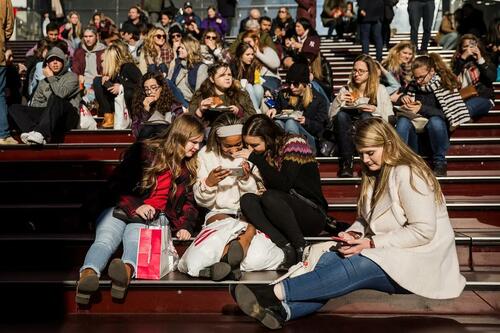
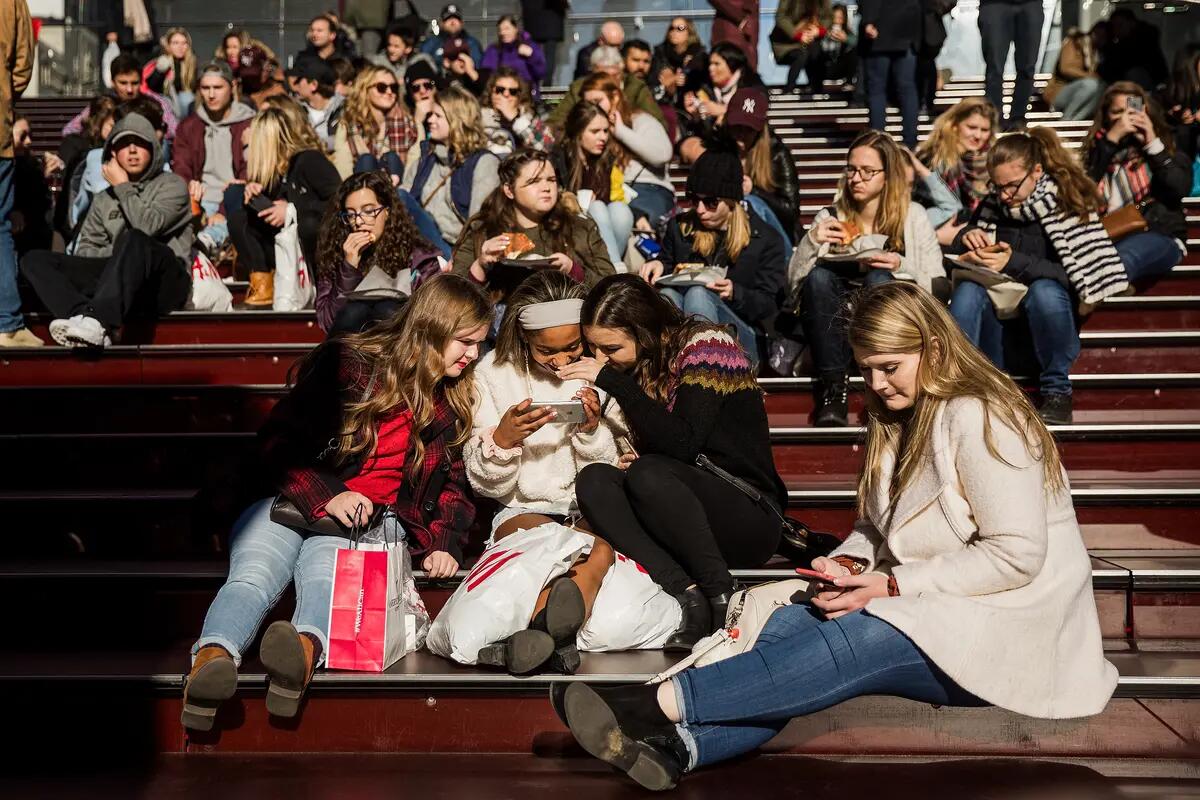
A group of teens look at a photograph taken on a smartphone in Times Square in New York City on Dec. 1, 2017. (Drew Angerer/Getty Images)
Even as quarantine restrictions were reversed, the authors wrote, "screen use remains persistently elevated.”
Almost all students have smartphones now.
“Getting a smartphone is now a rite of passage for most children and adolescents in the United States,” states Common Sense Media in its 2023 study titled “Constant Companion: A Week in the Life of a Young Person’s Smartphone Use.”
The study notes that "about half of U.S. children get their smartphone by age 11."
Common Sense Media—citing its own data and research from Peggy Rideout and the Pew Research Center—reported that 88 percent to 95 percent of teens (aged 13 to 18) have their own smartphone.
Shortly after Apple introduced the iPhone in 2007, almost all schools implemented some sort of ban on phones.
But the breadth of the ban has fluctuated over the years.
In 2009, 90 percent of U.S. schools had bans on cell phones in class, according to the National Education Association (NEA).
By 2015, only 67 percent of schools had cell phone bans.
In 2020, the number of schools banning smartphones had jumped back up to 77 percent of schools, according to the National Center for Education Statistics.
Teachers have been competing with cell phones for the eyes and ears of students for more than a decade, an insight documented by a 2010 Pew Research Center study. It includes data from 2009, when 90 percent of U.S. schools had cellphone bans.
Of the teens surveyed, 62 percent said they could have their phones in school but not in class, and 24 percent were not allowed to have phones on school property. Of those who attended a school with a total ban, 65 percent brought their phones to school anyway, and 58 percent texted in class.
While in class, 64 percent of teens said they had texted, and 25 percent had made or received a call, researchers found.
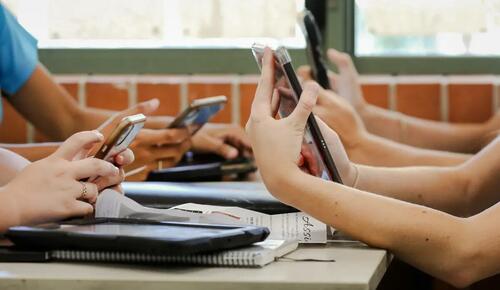
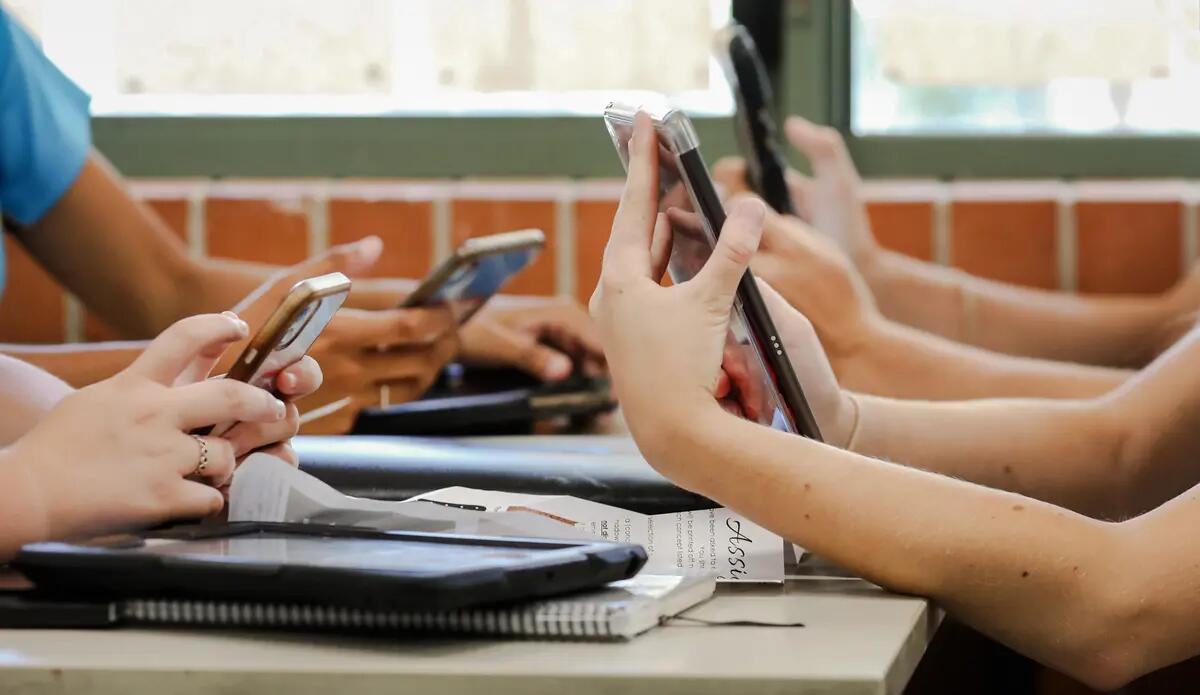
High school students sit at a table holding multiple digital devices such as phones and tablets during a class lesson. (LBeddoe/Shutterstock)
Growing Opposition to Phones in School
Arnold Glass understands well the lure and attraction of the phone to students.
Mr. Glass, a professor of cognitive psychology at Rutgers University, led a team that, in 2018, published the first academic study documenting how cell phones in classrooms lower student test scores.
"The negative effects of cell phones in the classroom were immediately obvious, which led to the initial bans," Mr. Glass told The Epoch Times.
"However, there was pushback from parents and school boards, and principals caved in to what they knew was a destructive policy" and allowed students to bring them to school.
"Now school boards are being sued by parents for outcomes—including bullying—that are consequences of permitting cell phones in schools," he said. "So, the self-protective bans are being reinstated."
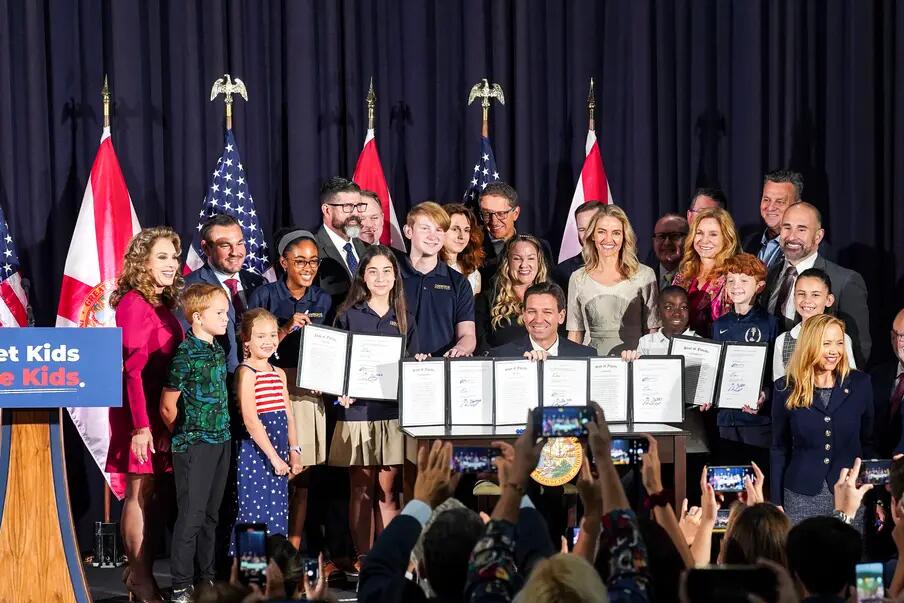
While bans in varying forms are common now throughout the nation, only Florida has made it the law. In May, two weeks before announcing his presidential run, Gov. Ron DeSantis signed House Bill 379, which prohibits student use of phones in class during instructional time in public schools.
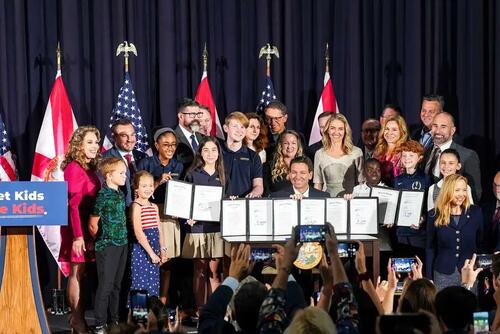
Florida Gov. Ron DeSantis shows off five bills to 'let kids be kids' at a ceremony in Tampa, Fla., on May 17, 2023. (Courtesy of Florida Governor's Office)
And in Florida, the school board of Orange County Public Schools (OCPS)—the eighth largest public school district in the country—instituted an even more restrictive cell phone policy than the state law.
Under the new regulations, approved in August, students are prohibited, except in an emergency, from using their phones at any time during the school day. Students are allowed to have their phones on them, as long as they're kept in a backpack.
OCPS now is conducting a survey asking students, parents, and teachers about the policy and how it can be improved. The survey results will be released after winter break.
Yet already there is positive feedback on the phone restrictions, OCPS media relations manager Michael Ollendorff told The Epoch Times.
“Anecdotally, we are seeing an improvement in grades, and more positive in-person interactions among students," Mr. Ollendorff said.
"We are also finding that during lunchtime—when in the past kids were busy on their phones—they're now playing games, including pickleball and cornhole."
Lawmakers in Congress also are considering the topic of cellphones in school.
In October, U.S. Sens. Tom Cotton (R-Ark.) and Tim Kaine (D-Va.) introduced the Focus on Learning Act. The bill would appropriate $5 million for the Secretary of Education to “conduct a study regarding the use of mobile devices in elementary schools, and to establish a pilot program of awarding grants to enable certain schools to create a school environment free of mobile devices."
China, the United Kingdom, France, the Netherlands, and other nations have established variations of bans on phones in class.
In August, the United Nations Educational, Scientific and Cultural Organization (UNESCO) called for an international ban on smartphones in classrooms. The United States is a member of UNESCO.
Proof of the Problem
"Dividing attention in the classroom reduces exam performance," Mr. Glass showed in a 2017 study published in the academic journal Educational Psychology. He co-authored the work with Mengxue Kang, a fellow professor of cognitive psychology at Rutgers.
The study is often referenced by those advocating for bans or curtailed access to phones in school.
“I've studied learning and memory for over 50 years,” Mr. Glass said. One of his main pursuits has been "to create instruction tools to improve performance in the classroom."
Research and analysis of the academic performance of his students from 2005 through 2010 showed that the technology and tools he implemented in his teaching and in the classroom environment were producing positive results, he said.
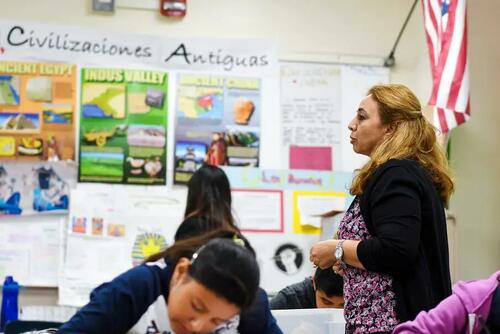
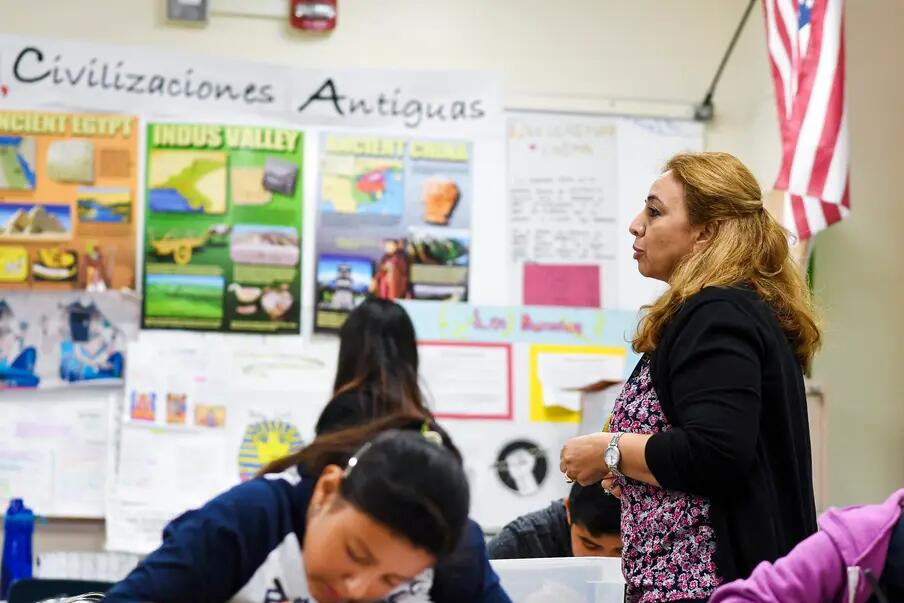
Instructor Blanca Claudio teaches a history lesson in Spanish in a dual language academy class at Franklin High School in Los Angeles on May 25, 2017. (Robyn Beck/AFP via Getty Images)
“The students were doing better in their exams every year until 2010, when we hit a ceiling, and then marks started falling, and I needed to see why,” Mr. Glass said.
A startling revelation has emerged from a recent congressional investigation: several leading pharmacy chains in the United States, including CVS Health, Kroger, and Walgreens Boots Alliance, have been found to provide patients' medical records to law enforcement agencies without warrants.
Initiated in June, the congressional review targeted eight prominent pharmacy chains to scrutinize their privacy practices in response to rising public concerns about health privacy and surveillance. This investigation, led by Senator Ron Wyden, Representative Pramila Jayapal, and Representative Sara Jacobs, was propelled into motion following the Supreme Court's decision to overturn Roe v. Wade in 2022, which heightened fears about the confidentiality of medical records.
Key findings from the probe:
Lack of Legal Review: CVS Health, Kroger, and Rite Aid, among others, do not require legal review before complying with law enforcement requests for patient records. This practice puts immense pressure on pharmacy staff, who are not legal experts, to immediately respond to such demands.
Inconsistent Privacy Protections: The investigation discovered a concerning disparity in how these pharmacies handle government demands for patient data. Many Americans are left vulnerable due to inconsistent privacy protections across different pharmacy chains.
Warrantless Sharing: Alarmingly, none of the eight surveyed pharmacies require a warrant before sharing pharmacy records with law enforcement, except where state law mandates otherwise.
Transparency and Notification: Only a few companies, like CVS Health, Walgreens Boots Alliance, and Kroger, have committed to issuing annual transparency reports regarding law enforcement demands. Amazon Pharmacy stands out as the only entity that proactively notifies patients of law enforcement requests for their records, barring legal prohibitions.
Under the Health Insurance Portability and Accountability Act (HIPAA), patients in the U.S. have the right to know who accesses their health information. That said, one has to request this disclosure data, as healthcare providers are not obliged to provide it. This gap in the HIPAA provisions leaves room for unchecked access to sensitive medical information by law enforcement without patients' knowledge.
Officials with CVS, Kroger and Rite Aid said they instruct their pharmacy staff members to process law enforcement requests on the spot, saying the staff members face “extreme pressure to immediately respond,” the lawmakers’ letter said.
The eight pharmacy giants told congressional investigators that they collectively received tens of thousands of legal demands every year, and that most were in connection with civil lawsuits. It’s unclear how many were related to law enforcement demands, or how many requests were fulfilled.
Only one of the companies, Amazon, said it notified customers when law enforcement demanded its pharmacy records unless there was a legal prohibition, such as a “gag order,” preventing it from doing so, the lawmakers said. -WaPo
The lawmakers have called on the Department of Health and Human Services (HHS) to address these shortcomings and revamp HIPAA standards. Senator Wyden, voicing concerns on social media, warned of a potential 'witch hunt' in Republican-led states, where law enforcement could misuse this access to prosecute women for abortion-related procedures or even birth control.
CVS retorted that its practices are in alignment with industry standards and HIPAA regulations, while Amazon reiterated its commitment to customer privacy.
According to the lawmakers, "Americans deserve to have their private medical information protected at the pharmacy counter."
Joe Biden's economy is a disaster, but that doesn't mean it can't get worse.
A couple of little publicized commerce/transport events make new problems, specifically, shortages of consumer goods, all but certain.
Start with what's going on around the Saudi Arabian peninsula, where Houthi rebel rocket and drone attacks on ten commercial ships has reached crisis levels, and major shipping lines, such as Maersk, have opted to go around the horn of Africa the way Magellan had to do, in order to deliver their cargo loads to Europe and beyond.
Shipping in the Red Sea is grinding to a halt with oil tankers idling and container vessels rerouting around Africa as violence linked to the Israel-Hamas war threatens to undermine the global economy.
undefined
Two European oil and gas giants said Monday that their tankers would avoid waters off the coast of Yemen — an unavoidable waypoint for ships using the Suez Canal to cut between Europe and Asia. They join major container shippers who pulled out of the area last week as Iran-backed Houthi militants stepped up attacks in support of Hamas.
Jazz Shaw at Hot Air points out that the plan of action announced by Defense Secretary Lloyd Austin is a pretty weak one, lots of ships shooting down rockets and drones, amounting to swatting cockroaches as he compared it, instead of going for the nest. Biden, see, doesn't want to anger the Houthis' sponsor, Iran, he noted.
Meanwhile, down at the border in the Del Rio sector, cross-border commercial train traffic is being halted so that Border Patrol agents can give the crush of unvetted illegal migrants speedier customer service, known as "processing" so that they will be free to move about the country sooner.
The Border Patrol issued a statement Sunday evening that, as of 8 a.m. Monday morning they were suspending all rail traffic through the Eagle Pass and El Paso railway crossing bridges.
Statement from CBP on Suspension of Rail Operations in Eagle Pass and El Paso, Texas
“CBP is continuing to surge all available resources to safely process migrants in response to increased levels of migrant encounters at the Southwest Border, fueled by smugglers peddling disinformation to prey on vulnerable individuals. After observing a recent resurgence of smuggling organizations moving migrants through Mexico via freight trains, CBP is taking additional actions to surge personnel and address this concerning development, including in partnership with Mexican authorities.
“Beginning December 18, 2023 at 8:00 AM local time, CBP’s Office of Field Operations will temporarily suspend operations at the international railway crossing bridges in Eagle Pass and El Paso, Texas in order to redirect personnel to assist the U.S. Border Patrol with taking migrants into custody. CBP will continue to prioritize our border security mission as necessary in response to this evolving situation…
Closing down the bridge at Eagle Pass takes one of the most heavily used and important trade routes in the entire country out of the picture. As Eagle Pass likes to brag, out of the over 450 airports, seaports and other border crossings in the US? It was 34th.
Eagle Pass is ranked number 10 for international imports and exports by value when up against just the border crossings. That’s some huge numbers which have come to a screeching halt.
Welborn has a slew of charts and graphs showing the impact from this shutdown of commerce owing to the Biden administration's priorities to put illegal foreigners, mostly military-aged young men, first, not the U.S. economy.
Aside from coming shortages based on goods not getting to port, the BBC reports that there's also this:
Attacks on commercial ships in the Red Sea risk pushing up the price of oil and other goods, analysts have warned.
Several firms have paused shipments through the route after vessels were attacked by Houthi rebels in Yemen.
The world's second largest shipping line, Maersk, said on Tuesday that it would reroute some of its vessels around Africa's Cape of Good Hope.
Inflation is caused by money-printing and therefore hard to get rid of, but there's no doubt that a bottleneck in the supply chain will force a temporary increase in higher prices as goods become dearer and money becomes, by default, more abundant. Inflation is always too much money chasing too few goods, so fewer goods coming in -- from car parts, to produce, to baby products, to school supplies, to farm equipment, to fertilizer, to tech goods -- is going to be a problem.
Who is running the show here that U.S. economic priorities are so poorly placed? Instead of telling illegals to stand outside and wait, the Biden administration puts their convenience first to the detriment of the entire country. Combine that with the shipping issue in the Middle East and it all amounts to our economy in distress and we will feel it.
Illegals will get the passage they crave but the rest of us will deal with shortages and higher prices which will be entirely outside the scope of the Federal Reserve to control, meaning, it's back to the bad old days of supply crunch, empty shelves and soaring prices.
What a gift that amounts to from the Biden administration to the American people. Merry Christmas, America, Joe Biden's got some coal for you for under your tree except that it's sitting at the bottom of a ship somewhere around the Horn of Africa and unlike the illegals, you're going to have to wait.
Who says laws preventing entry by migrants likely to become public charges have any meaning?
According to a new study from the Center for Immigration Studies, citing the U.S. Census's 2022 Survey of Income and Program Participation (SIPP), such laws are a joke.
Migrants are America's most prodigious consumers of government welfare programs.
The 2022 SIPP indicates that 54 percent of households headed by immigrants — naturalized citizens, legal residents, and illegal immigrants — used one or more major welfare program. This compares to 39 percent for U.S.-born households.
The rate is 59 percent for non-citizen households (e.g. green card holders and illegal immigrants).
Compared to households headed by the U.S.-born, immigrant-headed households have especially high use of food programs (36 percent vs. 25 percent for the U.S.-born), Medicaid (37 percent vs. 25 percent for the U.S.-born), and the Earned In
come Tax Credit (16 percent vs. 12 percent for the U.S.-born).
Our best estimate is that 59 percent of households headed by illegal immigrants, also called the undocumented, use at least one major program. We have no evidence this is due to fraud. Among legal immigrants we estimate the rate is 52 percent.
Illegal immigrants can receive welfare on behalf of U.S.-born children, and illegal immigrant children can receive school lunch/breakfast and WIC directly. A number of states provide Medicaid to some illegal adults and children, and a few provide SNAP. Several million illegal immigrants also have work authorization (e.g. DACA, TPS, and some asylum applicants) allowing receipt of the EITC.
Which tells us a lot about why the migrant crisis is so expensive. The current figures cover the period before the most recent border surge, which is the highest in history.
What that means is that the costs are going to go significantly higher as migrants have children here to secure their status here and then draw welfare benefits on behalf of their U.S.-born children. They will then bring in equally situated family members of comparable education, skills and social capital into the country once they are permitted to stay. These costs will extend for decades.
What that adds up to is a huge welfare cost to U.S. taxpayers, and a big benefit bonanza to foreign nationals who've never paid a penny into the system they're mining for a better life, while more often than not, do not have a right to be here.
There are laws on the books against admitting migrants likely to become public charges. It's pretty obvious here that these laws are being ignored.
Who knew that Joe Biden's open borders would import the welfare classes of more than a hundred-fifty countries into the U.S. and then tell taxpayers that immigrants enrich our country and anyone looking at the data is a xenophobe?
It's one of the biggest myths out there that migrants aren't a drain on the public fisc. It's not just the cost of feeding and transporting and "processing" them at the border itself and in the sanctuary cities they travel to -- it's a lifetime of costs that go well beyond the billions that are bankrupting New York City just from the illegal entries.
Something's got to give here. The great libertarian economist Milton Friedman once noted that one can have open borders, one can have a welfare state, but one cannot have both; the one is incompatible with the other. At the rate Joe's open border is going, the welfare state is going to be the one that goes as the U.S. is bankrupted from giving a free ride to every foreign national who can cross the U.S. border without papers.