Search This Blog

Friday, August 9, 2024

FDA OKs ARS's Once Rejected Neffy Nasal Spray Alternative To EpiPen For Emergency

 On Friday, the FDA approved ARS Pharmaceuticals Inc’s (NASDAQ:SPRY) neffy (epinephrine nasal spray) for the emergency treatment of allergic reactions (Type I), including those that are life-threatening (anaphylaxis), for adult and pediatric patients.

ARS Pharma’s Neffy is to be an alternative to EpiPen and other autoinjectors like Sanofi SA’s (NASDAQ:SNY) Auvi-Q filled with epinephrine.

The approval comes almost two months before the PDUFA target action of October 2, 2024.

“Today’s approval provides the first epinephrine product for the treatment of anaphylaxis that is not administered by injection,” said Kelly Stone, Associate Director of the Division of Pulmonology, Allergy and Critical Care in the FDA’s Center for Drug Evaluation and Research.

Neffy’s approval is based on four studies in 175 healthy adults without anaphylaxis that measured the epinephrine concentrations in the blood following the administration of Neffy or approved epinephrine injection products.

Results from these studies showed comparable epinephrine blood concentrations between neffy and approved epinephrine injection products.

Neffy also demonstrated similar increases in blood pressure and heart rate as epinephrine injection products, two critical effects of epinephrine in treating anaphylaxis.

A study of neffy in children weighing more than 66 pounds showed that epinephrine concentrations in children were similar to adults who received neffy.

Neffy is a single-dose nasal spray administered into one nostril. As with epinephrine injection products, a second dose (using a new nasal spray to administer neffy in the same nostril) may be given if symptoms do not improve or worsen.

In February, ARS Pharmaceuticals released topline results from its clinical study comparing repeat doses of neffy to repeat doses of epinephrine intramuscular injection that was submitted as part of its response to the complete response letter (CRL).

In September 2023, the FDA rejected ARS Pharma’s Neffy application and requested the completion of a pharmacokinetic/pharmacodynamic study assessing repeat doses of Neffy compared to repeat doses of an epinephrine injection product under allergen-induced allergic rhinitis conditions to support approval.

https://finance.yahoo.com/news/fda-approves-ars-pharmas-once-173440887.html

J&J’s Stelara More Expensive Under Medicare Part D Than Part B: OIG


With Medicare expenditures on Stelara increasing nearly tenfold, a new report from the HHS Office of Inspector General has found major differences in drug payment amounts under Part B versus Part D.

Medicare expenditures on Johnson & Johnson’s biologic Stelara, used for treating psoriatic arthritis, Crohn’s disease and ulcerative colitis, have skyrocketed nearly tenfold from $300 million in 2016 to almost $3 billion in 2023. A report released Friday by the Department of Health and Human Services’ Office of Inspector General has found big differences in the methods used to set drug payment amounts under Medicare Part B versus Part D.

“OIG found that when Stelara was being covered under Part B and administered by physicians in their offices, it was costing the Medicare program and most enrollees far less than when it was being covered under Part D, and enrollees were self-administering the drug at home,” the report said.

The report found that in 2021 the annual cost per enrollee for Stelara was 80% more under Part D than Part B. The average Part B costs for a Stelara injection remained relatively flat between 2016 and 2023, dropping from over $14,450 per shot to approximately $13,000, according to the OIG.

At the same time, Part D customers saw an 84% rise in costs during the same period, rising from over $17,000 per shot in 2016 to more than $32,000 last year.

In 2022, Medicare and its enrollees paid approximately $2.4 billion for Stelara, with $62 million in Part B and $2.3 billion in Part D.

“Our findings illustrate how differences in the methods used to set drug payment amounts under Part B (i.e., manufacturers’ sales prices) versus under Part D (i.e., negotiations between plan sponsors, manufacturers, pharmacy benefit managers, and pharmacies) result in widely different payment amounts for the same drugs,” the OIG said.

Stelara, which the OIG report describes as a “high cost” prescription biologic, is usually self-injected and covered under Part D. Prior to 2023, having the medicine administered by a physician under Part B was also an option. However, Medicare Administrative Contractors are now excluding Stelara Injections after the contractors made changes to place injectable versions of the biologic on the self-administered drug exclusion list.

According to the OIG report, Stelara injections are subject to a policy to omit self-administered drugs from Part B coverage. Ultimately, the report noted that with Stelara now only being obtained in a pharmacy, patients could face higher out-of-pocket costs.

With Stelara named to the first 10 medicines impacted by the Inflation Reduction Act’s Medicare Drug Price Negotiation Program, the Biden administration is looking to bring down the cost of the biologic.

Still, Stelara remains a significant earner for J&J, pulling in over $2.8 billion in sales in the second quarter of 2024. However, the drug is also facing biosimilar competition from Teva and Alvotech, as well as Samsung Bioepis, with launches slated for early 2025.

https://www.biospace.com/policy/j-js-stelara-more-expensive-under-medicare-part-d-than-part-b-oig

White House Speaks Of 'Finalizing' Gaza Deal, Diplomats See 'Hail Mary' Time

 With the Middle East on the brink of a possible major war between Iran and Israel, also involving Lebanese Hezbollah, the White House and its regional partners are desperately trying to salvage ceasefire talks.

The United States, Qatar, and Egypt are calling on Israel and Hamas to step back to the negotiating table. They say it is urgent "to resume urgent discussion" on August 15 in Doha or Cairo "to close all remaining gaps and commence implementation of the deal without further delay." Gaps?

While the statement speaks of "remaining gaps" - a fresh Axios report cites a diplomatic source strongly suggests the situation is a far cry from mere closing gaps...

A source familiar with the negotiations said the planned summit is a "Hail Mary" attempt by the Biden administration to get a deal and prevent a regional war.

The White House also needs to present to the American public that it has helped secure a ceasefire, which would be a boost to Democratic nominee Kamala Harris and her supposed foreign policy credentials going into the November election.

The statement from the US, Qatar, and Egypt continued: "It is the time to conclude a ceasefire agreement and release hostages and prisoners," they said.

"We have worked for months to reach framework agreement and it is now on the table, with only details of implementation missing."

But this is the same language that negotiators have presented to the public for several months at this point. They are always and ever "near the goal line," we are told. Yet Israeli and Hamas officials themselves constantly suggest the opposite. There also doesn't seem to be much US pressure on Israel, or serious efforts to reign in its adventurism in places like Iran.

Additionally, Washington policy itself is schizophrenic: President Biden has criticized Israel at times, lamenting the mass civilian casualties in the Gaza Strip, while at the same time he continues to arm Israel's military to the teeth.

Consider too the rosy picture of negotiations painted by Secretary of State Antony Blinken last month at the Aspen Security Forum: "I believe we’re inside the 10-yard line and driving toward the goal line in getting an agreement that would produce a cease-fire, get the hostages home and put us on a better track to trying to build lasting peace and stability,” Blinken said July 19.

Perhaps it's past time for Blinken and US officials to retire the football metaphors when it comes to Hamas negotiations? 

https://www.zerohedge.com/geopolitical/white-house-speaks-finalizing-gaza-deal-while-diplomats-admit-its-hail-mary-end-game

Why Iovance Biotherapeutics Shares Are Soaring

 After watching its stock fall for weeks on worries of disappointing results, Iovance Biotherapeutics (NASDAQ: IOVA) has vindicated itself. Shares of the young biopharma company are up 24.2% as of 11:20 a.m. ET today in response to an impressive second-quarter report. This bullish jolt could also mark the beginning of a more prolonged move higher.

Iovance's Amtagvi is off to a solid start

In simplest terms, caregivers are embracing Iovance's new cancer drug Amtagvi (also known as lifileucel).

Amtagvi is the first therapy using tumor-infiltrating lymphocytes to be approved by the FDA as a means of fighting cancer. Although February's approval is only for certain melanoma patients who haven't had success with other types of treatment, the drug itself holds promise as a therapy for a range of cancers. It's currently being tested in over a dozen other trials.

During the three-month stretch ending in June, however, Iovance Biotherapeutics did pretty well with Amtagvi just on the melanoma front. Revenue of $31.1 million easily topped estimates of $24.6 million, and better still, top-line guidance of between $53 million and $55 million for the quarter now underway compares favorably to the consensus estimate of $53 million.

The company's still deep in the red, for the record. Iovance lost $97 million during its second fiscal quarter of the year, continuing to spend a great deal of money on ongoing research and development as well as simply managing a complex biopharma business. That's nothing particularly unusual, however, for a biotech company that's only recently launched its first revenue-bearing drug.

For certain investors, the reward will be worth the risk

There's the rub for interested investors. The potential for Amtagvi is enormous; researchers with Global Data suggest it could be producing annual sales of more than $800 million by 2029. But the underlying science of tumor-infiltrating lymphocytes is different than other more common cancer treatments. It could take some time for the medical community to use it to the fullest extent possible. As such it's unclear how long it might take Iovance Biotherapeutics to push its way out of the red and into the black.

Nevertheless, to veteran biopharma investors none of this is new, nor deal-breaking. This above-average risk and uncertainty is paired with above-average potential upside. If you can stomach that risk, today's big gain -- following yesterday's post-close Q2 report affirming that Amtagvi is marketable -- is likely to start a recovery of at least some of the stock's value lost earlier in the year.

'A million bucks isn't what it used to be': What if 'great wealth transfer' isn't so great?

 The expected inheritance of trillions of dollars could get eaten up by healthcare, taxes and longevity

There's been much ado about the so-called great wealth transfer's promise to shift trillions of dollars to younger generations over the next 20 years, but what if this hoped-for windfall fails to happen?

This wave of wealth has been predicted for years, and has been heralded as a way for younger generations grappling with student debt, high housing costs and stagnant pay to shore up their financial security. The thinking was that as older, wealthier baby boomers die, they will bequeath their riches to their children, other family members and charities. Recent research from consulting firm Cerulli Associates estimated that $72.6 trillion would go to younger heirs, with an additional $11.9 trillion earmarked for charities.

But new research from Northwestern Mutual said only 22% of baby boomers and older generations and Generation X plan to leave behind a financial gift when they die.

That could disappoint the younger generations: one-third of millennials and 38% of Generation Z expect to receive an inheritance, according to Northwestern Mutual's 2024 Planning & Progress Study.

"There are a lot of issues that can derail the great wealth transfer. The great wealth transfer can look robust, but when you look at it on a granular level, it may not be what it's been reported to be," William Milne, founder, partner, and private wealth adviser at Northwestern Mutual's C3 Wealth Management, told MarketWatch.

"There's a perception of wealth that may not be real. Younger people see their parents with a million dollars in a 401(k), but it's like that saying 'a million bucks isn't what it used to be.' There's a lack of clarity and communication," Milne said. "They don't understand that money needs to carry on mom or dad to [age] 95 or 100."

The risks to the great wealth transfer include healthcare expenses in retirement and rising taxes, as well as people living longer, Milne said.

For example, Fidelity Investments estimates that a 65-year-old retiring this year can expect to spend an average of $165,000 on healthcare and medical expenses during their retirement - up nearly 5% from a year ago and more than double the forecast in 2002, when the company began estimating this cost.

"From the younger generation's standpoint, we believe it comes down to a communications breakdown and an expectations breakdown," Milne said.

Half of Americans expecting an inheritance consider it "critical" or "highly critical" to their financial security, Northwestern Mutual said. Gen Z has the greatest expectations for the impact of an inheritance on their retirement strategy, expecting that the gift would cover 10% of their retirement funds, the research found.

Northwestern Mutual found that parents may fear their heirs won't be good stewards of an inheritance.

Six in 10 American parents said their children do not value financial responsibility at the same levels that they do. And among them, more than half (52%) are concerned that their differences in values could negatively impact the family's assets from one generation to the next, the research found.

"Education is the core issue here. Some level of financial aptitude should be part of high school or college curriculum," Milne said. Families also need to educate their heirs and communicate about their expectations.

There's also a lack of preparation when it comes to estate planning, Northwestern Mutual found.

The research found 40% of baby boomers and older generations, and two-thirds of Gen X (65%) do not have a will. Among the primary reasons: people think they don't have enough assets, they're too young, it's complicated and awkward to think about, and they're uncertain about where to leave their assets.

Without a will, you would die "intestate" and your estate could languish in probate court as the intricacies of your finances get sorted out and a variety of state laws dictate who gets your assets.

Almost half (47%) of baby boomers and older generations who expect to leave an inheritance or gift have not talked to family about their financial plans. More than a third of Gen X (38%) said the same, Northwestern Mutual found.

To make sure younger generations aren't prematurely counting on an inheritance, Milne said the firm plans very cautiously.

"We will not put an inheritance into a financial plan unless we know what's been done a generation ahead," Milne said so that the younger set doesn't bank on funds that may never materialize.

"If something good happens, then it's a bonus," Milne said.

https://www.morningstar.com/news/marketwatch/20240809256/a-million-bucks-isnt-what-it-used-to-be-what-if-the-great-wealth-transfer-weve-been-waiting-for-isnt-so-great

Health care costs for retirees continue to soar

 High inflation has made the price of just about everything in the U.S. more expensive – including health care and medical expenses for retirees.

Research published by Fidelity shows that a 65-year-old retiring today can expect to spend $165,000 on health care in retirement, a 5% increase from last year and more than double the estimate from 2002.

Yet there appears to be a disconnect for many Americans between the actual projected cost of health care in retirement and how much they expect to spend on those expenses. The average American thinks they will spend about $75,000 on health care and other medical expenses, less than half of Fidelity's calculation, according to the research.

"Health care costs are among the most unpredictable expenses, especially when it comes to retirement planning," said Robert Kennedy, senior vice president of workplace consulting at Fidelity.

he estimate assumes that an individual is enrolled in Medicare – including Part A and Part B, which cover most hospital care and doctor's visits – and Part D, which covers prescription drugs. Other expenses such as Medicare premiums, over-the-counter medications, dental and vision care and other costs typically not covered by Medicare are "left to retirees to manage on their own," the report said.

As of April 2024, about 67.3 million Americans were enrolled in Medicare, according to the Centers for Medicare and Medicaid Services. Of those, about half were enrolled in a Medicare Advantage plan, while about 80% were covered by Medicare Part D.

placeholder

Americans are also dealing with a spike in the cost of prescription drugs, which has surged nearly 40% over the past decade, easily outstripping the pace of inflation. 

A separate report from GoodRx, a drug savings company, shows that the list price for prescription drugs has climbed about 37% since 2014. Although price increases have slowed this year, costs continue to pose a "significant burden" to many consumers.

In 2024 alone, Americans have spent $21 billion on out-of-pocket prescriptions. That amounts to about $16.26 per person, according to the data. 

While health care is often covered by insurance, more of the cost burden is being shifted to consumers as prescription insurance coverage gets more complex and restrictive. These restrictions are what GoodRx dubbed the "big pinch" – insurance plans, both Medicare and commercial, are covering fewer medications and adding more restrictions on coverage.

About 54% of medications are covered by insurance, based on Medicare plans. Half of medications that are covered by Medicare have an insurance restriction, like step therapy or prior authorization. And at least one-quarter of Americans have a prescription that is not covered by insurance.

"For most Americans, the difficulty with affordable medications isn’t over the ones that cost thousands of dollars," said Tori Marsh, director of GoodRx research. "It’s about affording routine drugs for chronic conditions, and finding that their insurance doesn’t cover what it used to." 

https://www.foxbusiness.com/healthcare/health-care-costs-retirees-continue-soar

Universal Basic Income – Tried, Tested, And Failed As Expected

 by Lance Roberts via RealInvestmentAdvice.com,

A Universal Basic Income (UBI) sounds great in theory. According to a previous study by the Roosevelt Institute, it could permanently increase the U.S. economy by trillions of dollars. While such socialistic policies sound great in theory, history, and data, they aren’t the economic saviors they are touted to be.

What Is A Universal Basic Income (UBI)

To understand why the theory of universal basic income (UBI) is heavily flawed, we need to understand what UBI is.

Basic income, also called universal basic income (UBI), is a public governmental program for a periodic payment delivered to all citizens of a given population without a means test or work requirement. Basic income can be implemented nationally, regionally, or locally, and is an unconditional income sufficient to meet a person’s basic needs (i.e., at or above the poverty line).

The idea of guaranteed income is not a new thing. According to Wikipedia:

“The concept of a state-run basic income dates back to the early 16th century when Sir Thomas More’s “Utopia” depicted a society where every person receives a guaranteed income. 

In the late 18th century, English radical Thomas Spence, and American revolutionary Thomas Paine, declared their support for a welfare system that guaranteed an assured basic income. Nineteenth-century debate on basic income was limited, but during the early part of the 20th century, a basic income called a “state bonus” was widely discussed. 

In 1946, the United Kingdom implemented unconditional family allowances for every family’s second and subsequent children. In the 1960s and 1970s, the United States and Canada conducted several experiments with negative income taxation, a related welfare system. From the 1980s and onward, the debate in Europe took off more broadly, and since then, it has expanded to many countries around the world. “ 

While the concept of a UBI sounds good in theory, do they work in reality?

Will UBI Won’t Increase Economic Growth

“More money in people’s pockets will lead to stronger economic growth.” – J.M. Keynes

The underlying sentiment behind a universal basic income is that if the government provides a base income, it will lead to more robust economic growth. In 2020 and again in 2021, the U.S. Government implemented a limited form of UBI by sending $1400 checks to households. The result was unsurprising. While those checks did lead to strong economic growth, they also created a surge in inflation, essentially wiping out the stimulus’s benefit.
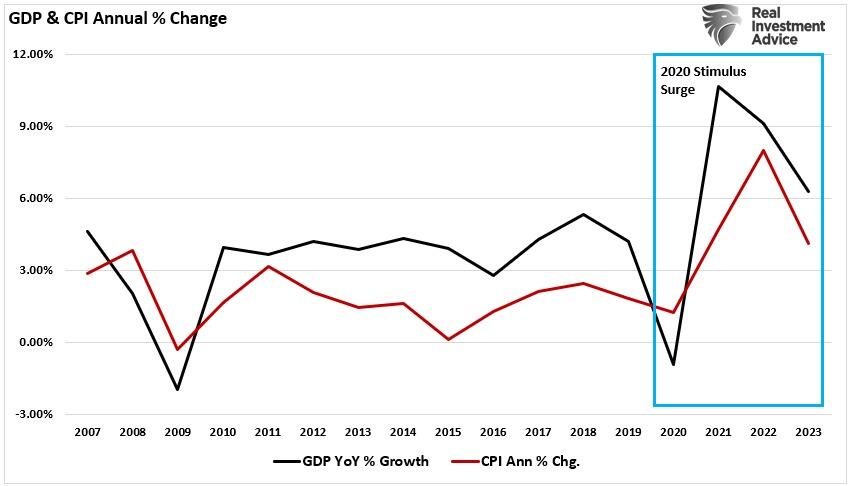
As shown, the stimulus surge led to an increase in economic activity. However, the impact on the quality of life (due to the rise of inflation) was minimal, if not negative. Those stimulus payments were not true UBIs, as each payment only occurred once. A true UBI is a monthly income provided.

While the Roosevelt Institute suggested that UBI was an economic savior, the other point they missed was that the UBI would only provide benefits for a single year.

Let’s run a hypothetical example using GDP from 2007 to the present. We will assume that In 2008, in response to the “Financial Crisis,” Congress passed a bill providing $1000/month ($12,000 annually) to 190 million families in the U.S. 

The chart below shows the economy’s annual GDP growth trend, assuming the entire UBI program contributes to economic growth. For those supporting programs like UBI, it certainly appears as if GDP is permanently elevated to a higher level. 
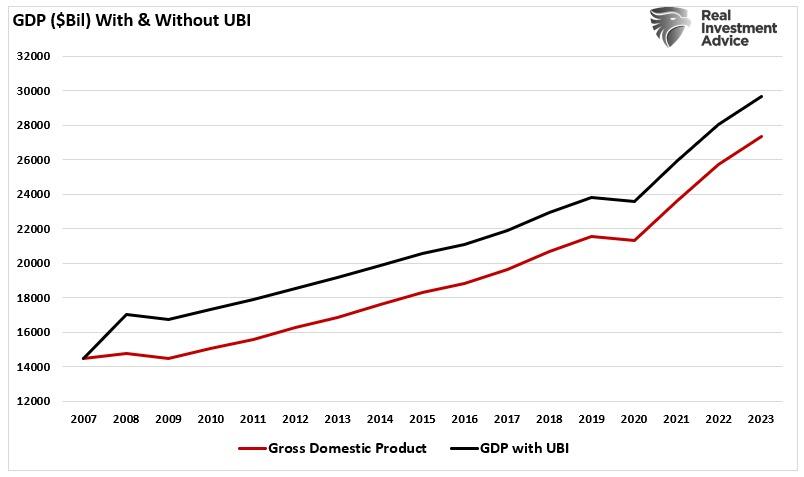
However, such is a bit deceiving. When we examine the annual rate of change in economic growth, which is how we measure GDP for economic purposes, a different picture emerges. In 2008, when the initial $12,000 arrived at households, GDP spiked, printing a 17% growth rate versus the actual 1.81% rate. Such would be expected as consumers spend the additional income. (The spike in GDP In 2021 was due to the stimulus payments during the Pandemic.)
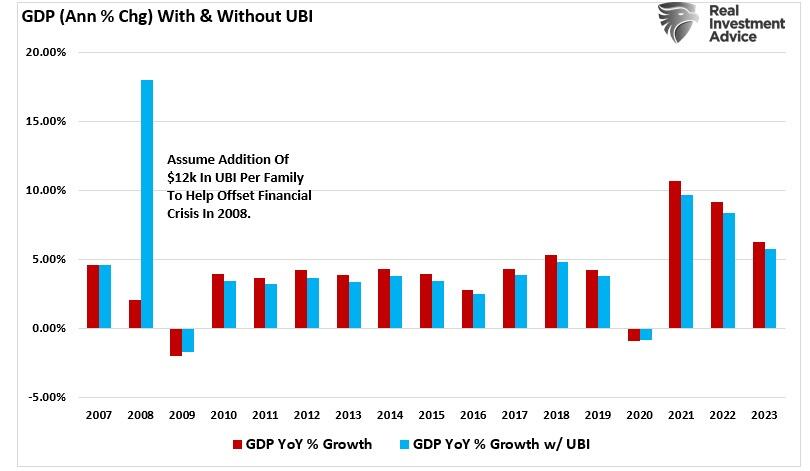
However, beginning in 2009, the benefit disappears. That is because following the injection of UBI into the system, the economy normalizes to a new level after the first year. Also, notice that GDP grows slightly slower as the dollar changes to GDP at higher levels print a lower growth rate. Furthermore, the increase in demand from providing a UBI will be offset by the rise in inflation, just as we saw in 2021.

A good example was the Biden Administration’s increase in childcare benefits. While households received more benefits to pay for childcare, the cost of childcare rose faster than the benefit, making childcare even more unaffordable.

Economic basics are nearly always forgotten in a rush to help those in need. If incomes are increased by $1000/month, prices of goods and services will adjust to the increased demand. The economy will quickly absorb the increased incomes, erasing the proposed UBI benefit.

UBI’s Dark Side

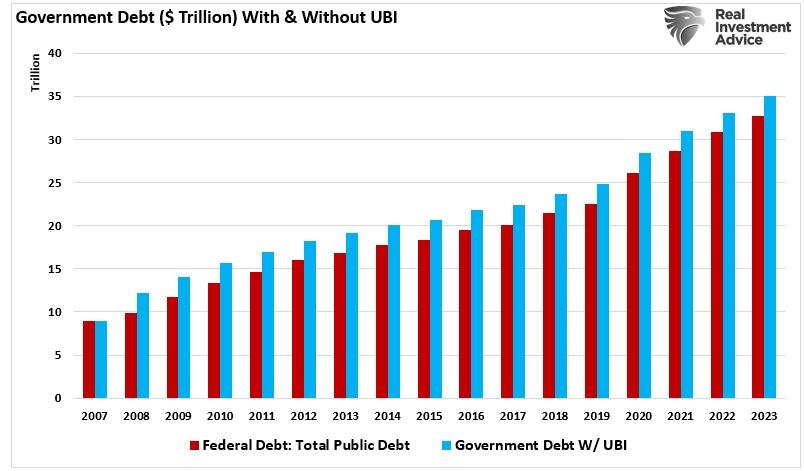
Of course, the money to provide the $12,000 UBI benefit had to come from somewhere.

According to the Center On Budget & Policy Priorities, in 2023, roughly 90% of every tax dollar went to non-productive spending. 

“In fiscal year 2023, the federal government spent $6.1 trillion, amounting to 22.7 percent of the nation’s gross domestic product (GDP). About nine-tenths of the total went toward federal programs; the remainder went toward interest payments on the federal debt. Of that $6.1 trillion, only $4.4 trillion was financed by federal revenues. The remaining amount was financed by borrowing.”
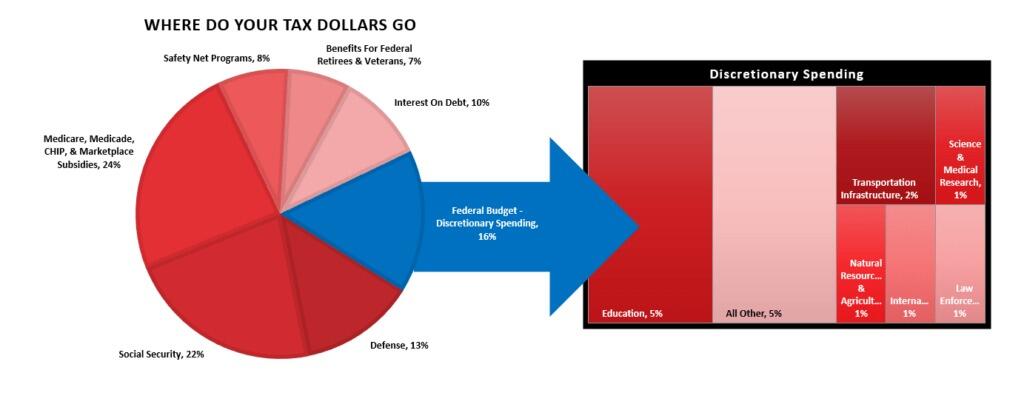
Think about that for a minute. In 2023, 90% of all expenditures went to social welfare, non-productive spending, and interest on the debt. Those payments required $6.1 trillion, roughly 138% more than the tax dollars collected.

Given the decline in economic activity this year, those numbers will likely become markedly worse. Given this data, it would also mean that 100% of the UBI payments would have come solely from debt.

The table below shows the increase in total Federal Debt adjusting for the annual UBI payment. 
The chart below takes our hypothetical example and compares the impact of the additional debt on the Federal deficit from the implementation of UBI.
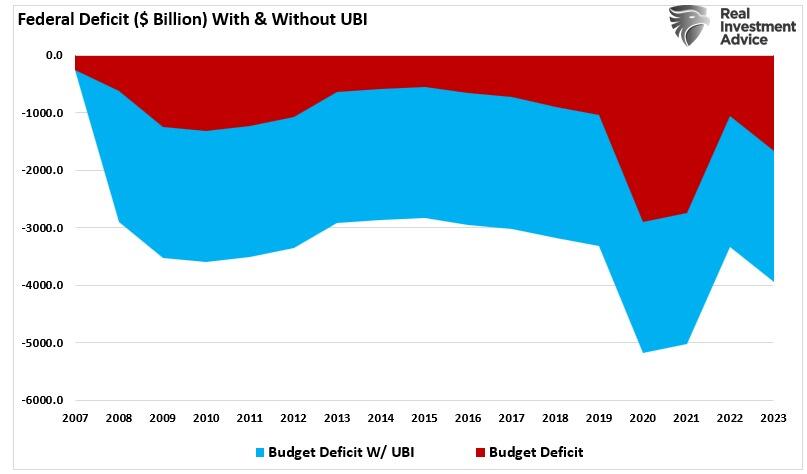
While the “theoretical models” assume that UBI will create enough economic growth and prosperity to “offset” the increase in debt, 40-years of history suggest otherwise.

However, this is all theory about the impact of UBI on economic prosperity. A recent 3-year study provides the actual results.

The Results

“Five researchers published a paper that tracked 1,000 people in Illinois and Texas over three years who were given $1,000 monthly gifts from a nonprofit that funded the study. The average household income for the study’s participants was about $29,000 in 2019, so the monthly payments amounted to about a 40 percent increase in their income.”

Surely, those who received $1000/month for three years were much better off in the end? As noted by Reason:

“Relative to a control group of 2,000 people who received just $50 per month, the participants in the UBI group were less productive and no more likely to pursue better jobs or start businesses, the researchers found. They also reported “no significant effects on investments in human capital” due to the monthly payments.

Participants receiving the $1,000 monthly payments saw their income fall by about $1,500 per year (excluding the UBI payments), due to a two percentage point decrease in labor market participation and the fact that participants worked about 1.3 hours less per week than the members of the control group.”

If those people are working less, the question to ask is how they spend that extra time.

“Participants in the study generally did not use the extra time to seek new or better jobs—even though younger participants were slightly more likely to pursue additional education. There was no clear indication that the participants in the study were more likely to take the risk of starting a new business, although Vivalt points out that there was a significant uptick in “precursors” to entrepreneurialism. Instead, the largest increases were in categories that the researchers termed social and solo leisure activities.”

The results of the 3-year experiment are unsurprising, as basic economics and human nature would already surmise.

Conclusion

In its essential framework, a universal basic income sounds excellent. It would ensure that everyone has fundamental needs covered. Then, they can go out and produce and not worry about covering critical bills. Unfortunately, the additional income is quickly absorbed into the economy as prices rise (inflation) to compensate for the extra spending. After the first year, the UBI would have to be increased or no longer have any benefit. 

Therein lies the trap with all socialistic programs.

While UBI, along with free healthcare, education, childcare, etc., sounds great, they are NOT productive investments with a higher return than the carrying cost of the debt. History suggests these welfare supports have a negative multiplier effect on the economy.

Most telling is the inability of the current economists, who maintain our monetary and fiscal policies, to realize the problem of trying to “cure a debt problem with more debt.”

The Keynesian view that “more money in people’s pockets” will drive up consumer spending and boost GDP has been wrong. 

It hasn’t happened in 40 years.

We fear these socialistic programs, which promise “free everything” with no consequences, instead deliver inflation, generate further income inequality, and ultimately increase social instability and populism. Such has resulted in every other country running such programs with unbridled debts and deficits.

It is also showing up in the United States as well.

While UBI sounds excellent at the conversational level, so does “communism” and “socialism.” In practice, the outcomes have been vastly different than the theory.

As Dr. Woody Brock aptly argues:

“It is truly ‘American Gridlock’ as the real crisis lies between the choices of ‘austerity’ and continued government ‘largesse.’ One choice leads to long-term economic prosperity for all; the other doesn’t.”

Take your pick.

https://www.zerohedge.com/political/ubi-tried-tested-and-failed-expected