Search This Blog

Friday, January 29, 2021

Miami Heat opens doors to fans thanks to COVID-sniffing dogs

 Miami Heat fans were able to watch a basketball game in person for the first time since the pandemic shut down the NBA last March—in part thanks to dogs trained to detect COVID infections.

With the canine help, real life spectators streamed once more into American Airlines Arena in Miami before the  against the LA Clippers Thursday—though only 2,000 were allowed, or just 10 percent of the venue's capacity.

A "canine team" guided two trained pups along the line of socially distanced fans waiting to enter the arena, and the dogs sniffed each person's hands.

"Dogs (screen) for drugs, so why not for coronavirus?" 25-year-old fan Kayla Roeber said to AFP, having just been smelled. "I think that it would prevent a lot of viruses from spreading, a lot of people entering buildings who have it."

If the dogs detect the virus, they indicate it to their handler by sitting down next to the individual in question.

In that case, according to the team's website, the potentially contaminated person and their companions must leave the line and are not permitted to enter the game. Their tickets are refunded.

"They can spot it (COVID-19) within seconds. Dogs are the most efficient mobile detection system," explained Michael Larkin, the vice president of the Global K9 Protection Group, which manages the dogs.

"They are a living, breathing animal that has this incredible olfactory senses that are used across the world in a variety of environments," he said.

He explained how they are trained to find the virus.

The "dog is not going 'Okay, tonight I'm finding COVID-19,'" he said. "They're playing a game... they've been imprinted to find this odor, and when they find it, they get rewarded."

The  are just an extra level of protection against the spread of coronavirus at Heat games. Fans must still maintain social distancing and masks are required.

The Miami Heat are the first NBA team to try this screening method, which has already been tested in airports in Santiago, Dubai and Helsinki.

Its reliability, however, has not yet been totally proven.

"I think it's so new and novel that we have yet to determine how effective it is and how reliable the canines are at detecting these type of things," Douglas Kratt, president of the American Veterinary Medical Association, told CNN.


Explore further

COVID-19 dogs could be sniffing out cases in months
https://phys.org/news/2021-01-miami-doors-fans-covid-sniffing-dogs.html

Screening asymptomatic health care personnel for COVID-19 not recommended: review

 Routine screening of asymptomatic health care personnel (HCP) in the absence of confirmed exposures to COVID-19 is not a recommended strategy for preventing transmission of the coronavirus causing the current global pandemic, according to a new review co-authored by an infectious disease specialist at Massachusetts General Hospital (MGH). The review, published in Infection Control & Hospital Epidemiology, found that such testing is unlikely to affect the transmission of SARS-CoV-2 in health care settings and could even have unintended negative consequences.

Many universities, sports leagues and other institutions require individuals in their organization to undergo routine testing for COVID-19, whether or not they are experiencing symptoms. Current public  recommendations are to test individuals with symptoms consistent with COVID-19 and those with confirmed exposures. At MGH and across the Mass General Brigham health system, asymptomatic employees are provided access to testing when it is required (such as for travel), but routine surveillance of  personnel has not been pursued. "People were constantly asking: If sports teams and local universities are doing routine asymptomatic surveillance, why aren't we doing this in health care? Wouldn't it make care for our patients safer?" says Erica S. Shenoy, MD, Ph.D., associate chief of the Infection Control Unit at MGH, who co-authored the review with David Weber, MD, MPH, professor of medicine in the division of Infectious Disease at the University of North Carolina.

Shenoy learned that her colleagues at other hospitals were being asked the same question, so she and Weber performed a focused review of health-care-associated transmission as well as what is known about the frequency of infection among asymptomatic health care providers, addressing the common questions they had received:

  • What portion of asymptomatic HCP have undiagnosed COVID-19 infections?
  • Do asymptomatic HCP with undiagnosed COVID-19 pose an infection risk to patients?
  • Do patients with undiagnosed COVID-19 pose an infection risk to HCP?

Shenoy and Weber compiled data from MGH's voluntary testing program as well as several other hospitals that had either screened or made COVID-19 testing available to asymptomatic health care personnel. Infection rates ranged from 0.2% to 0.4% (i.e., 1 in 250 to 1 in 500). "That's quite low," says Shenoy. MGH's asymptomatic on-demand testing program continues, and the frequency of positive COVID-19 tests in health care personnel prevalence has remained below 1%. "This low prevalence means that in a routine surveillance approach, you would have to test a lot of people in order to detect one asymptomatic case." Given the low frequency of positive tests, the possibility of false positive results is a concern, and Shenoy and Weber describe how facilities considering routine surveillance must consider whether confirmatory testing would be used to address the possibility of false-positive results. "This is the most comprehensive paper to review publicly available results for routine COVID-19 testing of asymptomatic health care providers," says Weber.

Meanwhile, a negative test result should have no impact on a HCP's day-to-day actions, says Shenoy, who is also an assistant professor of Medicine at Harvard Medical School. "Being negative today doesn't change anything that we do in the hospital," she says. "If I test negative today, I'm still wearing my surgical mask at work and my cloth mask when out and about outside of work. I'm still physically distancing and doing my symptom monitoring." Yet it's possible, she adds, that health care providers who  negative may change their behavior and relax their guard outside of the clinical setting, such as not wearing a face covering in hospital breakrooms or choosing to attend gatherings outside of work.

The literature suggests that the risk of health care personnel and patients transmitting the  to one another is very low when effective safety protocols such as wearing masks, testing when indicated, and screening symptomatic patients are followed. Reported instances of health care personnel acquiring infection through exposures to patients show overall low risk of transmission; similarly, risk to patients from asymptomatic infected health care providers has also been reported to be low, highlighting the efficacy of current protocols, Shenoy and Weber found.

Instead of considering routine screening of health care personnel for COVID-19, hospitals should continue to focus on interventions that are known to reduce spread of the disease, says Shenoy, which also include rapid identification and isolation of patients who are suspected of COVID-19, proper use of personal protective equipment when appropriate, and testing asymptomatic patients known to have been exposed to the coronavirus. "Health care is not a bubble," says Shenoy, "and routine surveillance won't make it one."

More information: Erica S. Shenoy et al, Routine Surveillance of Asymptomatic Healthcare Personnel for SARS-CoV-2: Not A Prevention Strategy, Infection Control & Hospital Epidemiology (2021). DOI: 10.1017/ice.2020.1428

https://medicalxpress.com/news/2021-01-screening-asymptomatic-health-personnel-covid-.html

WCLC: With Keytruda-Yervoy data, Merck casts doubt on Opdivo's place in lung cancer

 Bristol Myers Squibb just broke into previously untreated non-small cell lung cancer less than a year ago with an FDA go-ahead in PD-L1-positive patients for the dual checkpoint inhibitor regimen of Opdivo and Yervoy. But rival Merck & Co. is already casting doubt on its place in the lucrative market.

Adding Yervoy to Merck’s Keytruda didn’t extend the lives of first-line NSCLC patients whose tumors express biomarker PD-L1 at a tumor proportion score of at least 50%; instead, it increased the incidence of serious side effects, according to data unveiled at the World Conference on Lung Cancer.

Specifically, patients on the Keytruda-Yervoy combo in the phase 3 Keynote-598 study lived a median 21.4 months, compared with 21.9 months for the solo Keytruda group. The combo receivers also lived a median 8.2 months without their disease worsening, shorter than the 8.4 months for those in the Keytruda monotherapy arm.

“The monotherapy arm performed as expected,” Roy Baynes, chief medical officer at Merck Research Laboratories, said in an interview ahead of the data presentation, ruling out the scenario in which the control group outperformed and made the experimental regimen look less effective.


The long-held hypothesis is that targeting CTLA-4 would have additional benefits for certain cancer patients when used on top of PD-1 blockade, but there was no well-designed head-to-head trial to make that direct comparison—until Keynote-598.

As Baynes sees it, the answer to the PD-1/CTLA-4 question is now “pretty clear.” At least in this population, “the addition of [Yervoy] did not do anything to enhance efficacy, and it did introduce additional toxicities,” he said. “It does point out to clinicians that there’s really no need, at least in PD-L1-positive patients, to add a CTLA-4 to a PD-1.”

About 27.7% of patients on the Keytruda-Yervoy cocktail experienced serious side effects, while the rate was lower at 13.9% for solo Keytruda. The discontinuation rate was also higher for the combo than the monotherapy.


While the trial directly showed that the addition of Yervoy did more harm and no good with Keytruda, it also indirectly raised questions around Opdivo.

The thing is, Opdivo only has a place in front-line NSCLC because of Yervoy. Back in 2016, Opdivo as a monotherapy failed to top chemotherapy in treatment-naïve patients in the CheckMate-026 trial. The drug only entered the setting last May after showing that paired with Yervoy, it could reduce the risk of death by 21% over chemotherapy in PD-L1-positive patients in the phase 3 CheckMate-227 trial.

To industry watchers, it was already clear at the time that Opdivo and Yervoy’s showing was no match to a Keytruda-chemo combo’s 51% death risk reduction versus solo chemo, regardless of PD-L1 expression. 

But that still left a chance that Opdivo-Yervoy might make a better chemo-free option compared with solo Keytruda. After all, in the Keynote-042 trial, Keytruda monotherapy cut the risk of death by just 19% among first-line patients with a PD-L1 score of at least 1%—a figure that was dragged down by a lackluster performance in low PD-L1 expressers. But now that Keytruda-Yervoy has failed to top solo Keytruda, the bull case for Opdivo-Yervoy has diminished.

Since Keytruda’s chemo-combo monster showing, the Merck drug has become the standard of care in front-line NSCLC, squeezing Opdivo’s market in the second-line setting.

In a statement, Sabine Maier, Bristol Myers' head of oncology clinical development, said the benefit of the Opdivo-Yervoy combo “has been well established in phase 3 trials across lung cancer, melanoma, renal cell carcinoma and mesothelioma,” that these studies “clearly demonstrate that combining Yervoy with Opdivo can help patients achieve durable, long-term survival outcomes.”

https://www.fiercepharma.com/marketing/wclc-keytruda-yervoy-data-merck-casts-doubts-opdivo-s-place-lung-cancer

Protecting American Drivers

 Deaths from Covid-19 are rightly treated as a tragedy. Fatal road crashes are equally tragic, however. About 36,000 Americans died on the roads in 2019, and 2.7 million were injured. Just as government is working to reduce Covid deaths, it should also do its part to make driving less dangerous.

Yet last November, the Federal Communications Commission made a decision that endangers the lives and well-being of American drivers when it voted to turn over the transportation safety spectrum in the 5.9 GHz band, known as the Safety Band, to high-tech and cable companies for use as unlicensed Wi-Fi. If the FCC under the Biden administration doesn’t reconsider this move, we will see more deaths and injuries on American roads—and a loss of American technological leadership.

Life-saving automotive technology has been deployed in 25 states, and the auto industry has committed to putting such technology in 5 million cars within five years if the Safety Band is preserved. But the system requires radio spectrum (the radio frequency portion of the electromagnetic spectrum), just as our mobile phones require spectrum, allocated by the FCC.

Using the Safety Band, connected vehicle technology lets cars communicate directly with one another, warning drivers and pedestrians about potential crashes. Devices attached to traffic lights and telephone poles, developed by Continental and other companies, can warn drivers about accidents out of their line of sight. Even cars and pedestrians can be connected, so that drivers could receive warnings before pedestrians step out in front of their cars.

Additional technology connecting vehicles to roadside units, also requiring the Safety Band, would enable traffic to flow more smoothly, reducing accidents, traffic jams, and pollution. Devices attached to ambulances and fire engines would enable them to change traffic lights from red to green as they are speeding toward accidents and fires, preventing accidents with other vehicles. A full bus running behind schedule would also be able to change traffic lights to green.

Companies and investors are not asking for government handouts or subsidies to deploy this technology. They just need to know that the transportation Safety Band will remain available, and that their investments, research, and development will not be rendered worthless.

Unfortunately, in recent years the FCC has consistently signaled plans to give away the Safety Band. The November FCC vote allocated 45 MHz of the 75 MHz of the spectrum reserved by Congress in 1999 for traffic safety. The Commission proposed a plan to use the remaining 30 MHz for transportation safety needs, but this is unworkable due to interference from other spectrum users.

The FCC attempted to justify its decision by arguing that the auto industry was not using the Safety Band—but the FCC itself has impeded its use. When Toyota was planning to install technology in its vehicles in 2018, two FCC commissioners wrote the company a letter warning it not to do so because it might lose the spectrum. And the FCC has failed to approve over 1,000 requests by states for roadside traffic safety units.

The FCC also said that the spectrum had to be sacrificed for the United States to become a leader in 5G, the next-generation wireless technology. The commission did not allocate the Safety Band for 5G, though, but for unlicensed Wi-Fi (the kind that pops up on your phone at the airport or at a restaurant telling you that you can join a network). The FCC had already allocated an additional 1,200 MHz for unlicensed Wi-Fi. The FCC’s action makes it impossible to develop comparable transportation-safety applications for the American consumer.

It will also damage America’s global leadership in transportation technology. Canada, Europe, Australia, and much of Asia have allocated at least 70 MHz in the same 5.9 GHz band for transportation safety. Without the Safety Band, America will become a technological wasteland in this area. Chinese companies would then be free to dominate the transportation-safety market, putting their connected-vehicle technology in cars and intelligent transportation systems around the world. The Wi-Fi Alliance, which lobbied the FCC to give up the transportation safety spectrum, boasts Huawei and more than 100 other Chinese companies as members.

For the sake of American lives and technological leadership, let’s hope that the FCC will reverse course.

COVID vaccine supply causing EU crisis – what’s being done to speed production?

 The EU has a vaccine shortage problem. AstraZeneca pledged earlier this month to supply 2 million doses a week to the UK, but has also said it will cut deliveries to the EU from 80 million doses to 31 million during the first quarter of 2021.

The UK has vaccinated more than 11% of its population so far. EU nations such as Italy, Poland, Finland and Germany have only vaccinated between 2% and 3%. After the tense Brexit negotiations and the criticism the UK received for not joining the EU vaccine procurement scheme, this difference is stark. The EU, understandably, is keen not to fall further behind in rolling out vaccines and so has demanded it be given doses of the AstraZeneca vaccine made in the UK.

Whether the EU’s contract with AstraZeneca is a commitment to deliver certain quantities or an agreement for the company to do its “best effort” is contested. The content of the contract and timings of orders will be at the core of arguments over who should receive stock and when. The dispute continues.

This is all down to the vaccine pipeline being squeezed – but why are vaccine manufacturers struggling to keep up the pace of production? Details of the contracts between vaccine producers and the UK or the EU are not publicly available, but what is known about the vaccines’ supply chains can explain some of the reasons for the current shortage.

Lower production output

The immediate problem stated by AstraZeneca is a lower than expected output at a manufacturing site in its European supply chain. This can happen because vaccines are complex biological products: the production process does not always yield the same amount of usable vaccine. Stringent quality checks are also in place to ensure that all batches are safe. If the quality is not right, less vaccine becomes available.

According to AstraZeneca chief executive Pascal Soriot, issues with yield are to be expected when rapidly increasing production. He says that such problems have also occurred in plants in Australia, the US and the UK. However, as the UK signed its contract three months earlier than the EU, there was more time to resolve any teething issues.

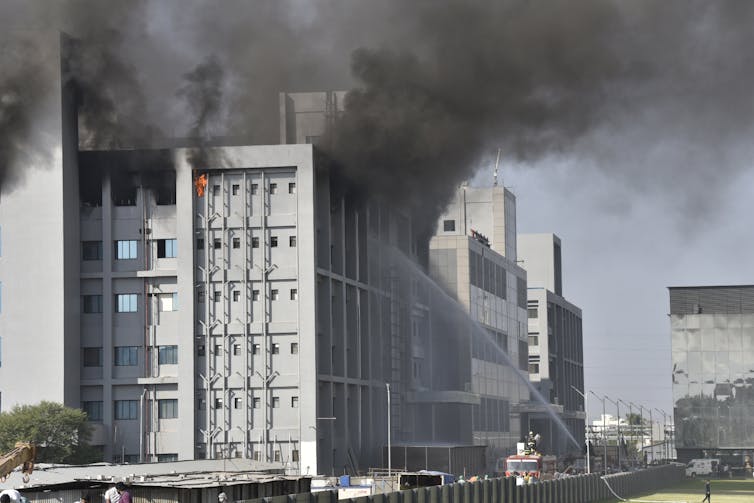
Issues can interrupt operations too. Vaccine production at an AstraZeneca site in Wales had to be paused for several hours while a suspect package was investigated. And in India, a fire at the Serum Institute (the world’s largest vaccine producer, which has a licence to produce the Oxford/AstraZeneca vaccine) claimed several lives, but reportedly did not affect production.

Firefighters tackling the blaze at the Serum Institute's facilities in Pune, India.
Despite the fire, India’s Serum Institute is aiming to manufacture 1 billion vaccine doses in 2021. EPA-EFE

To deliver billions of vaccines to the world, production capacity has to be large – but increasing it can lead to delays as well. Pfizer announced a temporary decrease in output in order to expand a Belgian factory, for example. The Belgian plant is the core supplier of Pfizer/BioNTech vaccines for Canada, the EU and the UK, which shows how widespread knock-on effects can be.

How to safeguard production

One way around this problem is to increase capacity by working with competitors. For instance, the French pharmaceuticals company Sanofi has announced that it will produce more than 100 million doses of the Pfizer/BioNtech vaccine. This puts Sanofi’s existing production capacity to use even though its own COVID-19 vaccines are experiencing delays. Such “coopetition” – simultaneous competition and cooperation – is not unusual in supply chains.

Another way to bolster production is to use regional supply chains to make and distribute vaccines, with each serving only particular parts of the world. Not relying on just one supply chain enhances overall resilience; if something goes wrong in one supply chain, the others can still function. Spreading production around the world – which is what AstraZeneca has done – also means easier access to appropriate facilities and trained staff.

However, this strategy is now at the heart of the disagreement with the EU. The EU is suggesting that the shortfall in yield at a Belgian AstraZeneca plant should be made up by distributing doses produced in the UK. But that would mean an inability to fulfil contractual obligations to Britain.

European health commissioner Stella Kyriakides speaking at a media conference
EU health commissioner Stella Kyriakides to AstraZeneca: ‘We reject the logic of first come, first served.’ Alexandros Michailidis/Shutterstock

To avoid these sorts of issues, other countries are keen to set up their own vaccine production sites. Australia has announced it has paid a premium to produce the AstraZeneca vaccine domestically. From March, its output is expected to be around 1 million doses per week.

But domestic production is also not without its problems. Brazil plans to rely mainly on domestic production and has a strong pharmaceutical industry to support this. But it needs to import key ingredients, a process that is currently hampered by bureaucratic hurdles and technical issues. It will still rely on supply chains elsewhere – particularly in India and China.

The cost of ‘vaccine nationalism’

At the moment, demand for COVID-19 vaccines is much higher than supply. Competition to secure doses is fierce, with many disappointed parties demanding answers – when the vaccines will arrive and in what quantity. Uncertainty may lead to vaccine protectionism, with stock produced in key locations withheld and hoarded to serve only local populations.

But while rich countries’ concerns about delayed deliveries are valid, it’s important to keep in mind that many nations will not have widespread access to vaccines in 2021. Concern about the lack of equal access to medicines has been voiced globally, nationally and regionally, as government bodies attempt to secure vaccines for their populations.

Developed nations focusing on themselves is not going to help solve a global crisis. As long as the virus is free to spread and mutate in some countries, no country is safe. The global economy could lose more than US$9 trillion (£6.6 trillion) if governments fail to ensure developing economies have access to COVID-19 vaccines. This vast figure points to the dangers of these current moves towards self-interest.

 is Director of the Digital Health Enterprise Zone (DHEZ), University of Bradford, Reader in Health Service Operations, University of Bradford.

 is Senior Lecturer in Supply Chain Management, Liverpool John Moores University.

https://theconversation.com/covid-vaccine-supply-is-causing-an-eu-crisis-so-whats-being-done-to-speed-up-production-154153

CVS opens 1st COVID vax clinics in Conn., more to come as spring nears

 CVS Health opened COVID-19 vaccination clinics in two pharmacies in Connecticut on Wednesday, the first steps in a rollout that is eventually expected to include most of its 180 pharmacies in the state, an effort that is seen as critical to fighting the coronavirus.

The CVS clinics that opened Wednesday are in Putnam and Waterford and were chosen to be the first because they are bringing the vaccine to areas of the state that have fewer options for vaccinations. CVS worked with the state to pick the locations.


The CVS locations join a dozen opened in Connecticut last week by another pharmacy giant, Walgreens. Walgreens operates 116 pharmacies in the state.

Pharmacist Janine Brandt prepares a COVID-19 vaccination at the CVS pharmacy in Putnam.
Pharmacist Janine Brandt prepares a COVID-19 vaccination at the CVS pharmacy in Putnam. (Mark Mirko/Mark Mirko)

“In the short run between now and the coming weeks, they are helping us cover some of the more remote areas of the state,” Josh Geballe, the state’s chief operating officer, said Wednesday. “As they increasingly open up most of their retail locations, they will help provide even more options for vaccinations.”


Connecticut continues to see high levels of deaths attributed to COVID-19, even as the state’s test positivity rate has decreased. As of Wednesday, the total number of deaths during the pandemic had reached nearly 7,000 in the state.

While the vaccination efforts of major health care systems in Hartford and New Haven initially have grabbed a lot of attention, the pharmacy chains with their stores in towns and cities across the state are expected to emerge as a critical piece of the vaccination puzzle.

Vaccine recipients sit and talk after receiving their first dose of the COVID-19 vaccine at the CVS pharamacy in Putnam.,
Vaccine recipients sit and talk after receiving their first dose of the COVID-19 vaccine at the CVS pharamacy in Putnam., (Mark Mirko/Mark Mirko)

Geballe said he expects more pharmacy-based clinics to open by the spring, bringing convenience and familiarity to those seeking the vaccine.

Under agreements with the federal government, both Walgreens and CVS will take a national role in administering the vaccine. In Connecticut, CVS and Walgreens have first focused on vaccinating the state’s 22,000 nursing home and assisted living residents.


How quickly CVS, which owns Hartford-based health insurer Aetna, and Walgreens can ramp up clinics in their pharmacies will largely depend on the volume of vaccine that comes to the state from the federal government, which has been in short supply.

Geraldine Tetreault, 85, receives a COVID-19 vaccination from pharmacist Doris Arundel at the CVS pharmacy in Putnam.
Geraldine Tetreault, 85, receives a COVID-19 vaccination from pharmacist Doris Arundel at the CVS pharmacy in Putnam. (Mark Mirko/Mark Mirko)

For example, this week, providers in Connecticut have the capacity to administer 150,000 doses, but received only 46,000, Geballe said.

“We could have used three times that,” he said.

In Putnam, CVS pharmacist Ali O’Hearn said there is clearly “pent-up” demand, noting that 150 slots Wednesday filled up and word had just gotten out late Tuesday that the clinic was opening.

“Other customers are coming in and saying, ‘What’s going on here today?” because there is more foot traffic, cars out in the parking lot and they are seeing all the people,” O’Hearn said.

She said that provided an opportunity to talk about scheduling an appointment.

Single-use syringes filled with COVID-19 vaccine rest in a tray at the CVS pharmacy in Putnam.
Single-use syringes filled with COVID-19 vaccine rest in a tray at the CVS pharmacy in Putnam. (Mark Mirko/Mark Mirko)

CVS has said it will draw on its experience providing flu shots annually in its pharmacies and safety procedures it developed conducting broad-based coronavirus testing. Both CVS and Walgreens launched a hiring blitz to ramp up staffing for vaccination clinics.

https://www.courant.com/coronavirus/hc-news-coronavirus-connecticut-cvs-vaccination-20210128-53fbakpitjheriqcckoj2pm4ki-story.html

Super Bowl, outdoor dining will be big tests of L.A.'s COVID-19 progress

 With coronavirus cases and hospitalizations continuing to decline, officials are worrying about the next potential super spreader event: the Super Bowl.

Los Angeles County and California have managed to bend the curve after a deadly fall and winter surge in COVID-19, but the football championship is one of several concerns. Outdoor dining is expected to be allowed to resume at restaurants as early as Friday, the last of several stay-at-home restrictions to be lifted this week.

L.A. Mayor Eric Garcetti on Thursday urged people to keep up their guard and limit exposure to the virus.

“It’s about minimizing risk,” Garcetti said during an evening news briefing. Even as COVID-19 hospitalizations have fallen from a peak of 8,098 on Jan. 5 to 5,855 on Wednesday, the number is still far higher than it was in early October, when fewer than 700 COVID-19 patients were in the hospital.

Said the mayor: “Progress is very fragile.”

L.A. County’s average daily number of cases has fallen over the last two weeks, from about 15,100 cases a day for the weeklong period that ended Jan. 13 to about 7,400 cases now. Daily COVID-19 deaths are expected to remain high for the next couple of weeks; on Thursday, 212 deaths were recorded. L.A. County is averaging 209 deaths a day over the last week, down from an average of 241 deaths a day for the seven-day period that ended Jan. 14.

Garcetti urged people to continue wearing masks when not eating or drinking, and to exercise caution when meeting or gathering with people outside their household.

Especially for the Super Bowl. The Tampa Bay Buccaneers and Kansas City Chiefs take the field in Tampa, Fla., on Feb. 7, and officials fear big social gatherings such as the holiday events will push another winter surge.

“It will be tragic if the Super Bowl becomes a super-spreader of coronavirus,” county Public Health Director Barbara Ferrer said this week. She urged restaurants, in reopening outdoor dining areas, to not repeat the mistakes in the run-up to the World Series and NBA Finals, when crowds of packed fans crammed into outdoor dining patios are believed to be a major factor in the deadliest surge of the pandemic in L.A. County.

More than 9,000 COVID-19 deaths have been reported in L.A. County since Nov. 1, more than half of the county’s cumulative COVID-19 death toll of 16,127.

County health officials have long pointed to gatherings held among people from different households as a primary driver of coronavirus transmission. The risk is heightened in crowded settings; when people aren’t wearing masks; and when they’re chanting, singing or shouting — because doing so can propel the respiratory aerosols and droplets that carry the virus even greater distances.

That’s why health officials were alarmed by the celebrations, both impromptu and planned, held to mark the championship triumphs in the fall of the Lakers and Dodgers, and why a typically huge social event such as the Super Bowl is cause for concern.

An uptick in transmission could slow or halt the county’s progress toward wider reopenings, such as the reopening of more elementary schools, or refuel the now-fading surge.

“Every person and every business must continue to take every precaution every day to prevent transmission,” Ferrer said. “It’s really up to us whether we can sustain these reopenings without jeopardizing each other’s health and our ability to get more schools to reopen.”

This year, sports fans should “play it safe,” Ferrer said. “Don’t organize a party at home. Don’t go to a Super Bowl party.”

For the first time in two months, L.A. County this week officially allowed the resumption of private gatherings, so long as they’re held outdoors, attended by members of no more than three households and with no more than 15 people.

But the relaxation of the ban on get-togethers, Ferrer said, “is meant to only allow for a household to form a small, stable social group with one or two other households, so that you can get together occasionally — always outdoors, always keeping six feet of distance and always with no more than 15 people.”

“It just doesn’t work,” she said, “if every night people gather with a different group of folks to have small parties.”

An increase in transmission, officials warn, will kick off a domino effect. More people being infected means more people will be hospitalized with COVID-19 in the weeks ahead. Some of those people will eventually require treatment in an intensive care unit, and some will die of the disease.

“We cannot let this happen,” said Dr. Christina Ghaly, L.A. County’s director of health services. “We can’t let the current high number of COVID patients still in the hospital become normal to us. It is simply not sustainable.”

Garcetti, who turns 50 next week, received his first dose of the COVID-19 vaccine last week. He is not in L.A. County’s designated groups of people who are getting the vaccine — he’s not 65 years or older nor a healthcare worker — but got the first dose on advice of medical staff after he spent five days at Dodger Stadium helping with the vaccination effort.

“There was strong medical advice,” Garcetti said, that he get the shot, just like anyone else working at the mass vaccination site, “to minimize risk to the folks I’m interacting with.”

Garcetti said he felt mild soreness in his arm the day after getting the shot and nothing else after that. “I was able to continue working,” Garcetti said.

He urged people to get the shot when they have the opportunity to do so. “When your time comes, please take advantage of that. Get the vaccine.”

The vaccine has proved to be quite effective among L.A.'s firefighters. About 60% of the city’s firefighters had been vaccinated as of the end of last week, and the number of firefighters testing positive for the virus has dropped significantly.

https://www.latimes.com/california/story/2021-01-28/super-bowl-2021-could-become-covid-superspreader-event