Search This Blog

Friday, April 16, 2021

Vaccine Manufacturing Issues Force Moderna to Cut Supplies to Canada, UK

 Moderna Inc. expects a shortfall in Covid-19 vaccine doses it will deliver to countries outside the U.S., including Canada and the U.K., citing issues with its European supply chain.

The Cambridge, Mass., company said Friday the dose shortfall affects expected deliveries for the second quarter in a number of countries but didn't specify others beyond Canada and the U.K. The manufacturing problems won't affect U.S. supplies.

"The trajectory of vaccine manufacturing ramp-up is not linear, and despite best efforts, there is a shortfall in previously estimated doses from the European supply chain," the company said in a statement. "Vaccine manufacturing is a highly complex process, and a number of elements, including human and material resources, have factored into this volatility."

The shortfall marks the latest setback for efforts to ramp up manufacturing of Covid-19 vaccines. Moderna and Pfizer Inc. were initially able to make only limited quantities while they built manufacturing capabilities. In March, AstraZeneca PLC warned European officials its output was falling short of plans. Also that month, Merck & Co. agreed to help Johnson & Johnson make more of its vaccine.

Canadian Procurement Minister Anita Anand said in a statement distributed by her office that the next expected shipment from Moderna scheduled for the end of April would be cut in half, to 650,000 doses.

Canada had been anticipating 12.3 million doses from Moderna during the three-month period ending June 30. Ms. Anand said she expects a reduction in the second-quarter supply by as much as 16%.

"We are disappointed," Ms. Anand said. "Our government will continue to press Moderna to fulfill its commitments." Canada said Moderna advised officials the cutback is due to a slower-than-anticipated ramp-up of production capacity, and that other countries would be affected.

The timing of the Moderna cutback couldn't be worse for Canada, which has witnessed a sharp rise in Covid-19 infections -- so much so that the country's seven-day average of new, confirmed Covid-19 cases per million has exceeded the U.S. level for six days in a row. Furthermore, regional authorities across the country have canceled vaccination appointments, citing a lack of supply.

Based on the most recent Canadian government data, Moderna's vaccine accounts for 22% of the 12 million doses distributed across the country. Pfizer, in partnership with BioNTech SE, is the largest Covid-19 supplier to Canada, accounting for roughly 60% of doses distributed.

Canada said Friday it struck another deal with Pfizer to acquire an additional 8 million doses, which it said would help offset cutbacks from Moderna. Moderna's and Pfizer's vaccines are given in two doses, three or four weeks apart.

"We are concerned about the delays and production challenges around Moderna," Canadian Prime Minister Justin Trudeau said Friday at a press conference.

The U.K. government said it always knew vaccine supplies would fluctuate, but its vaccination campaign is on track to meet the target of offering a jab to all adults by the end of July. "Our vaccination programme continues to make phenomenal progress -- with over 41 million vaccines administered so far," a government health spokeswoman said.

Moderna has two supply chains for producing its vaccine.The company manufactures the vaccine for the U.S. at its plant outside Boston, and its contract manufacturing partner Lonza Ltd. also makes it at a plant in Portsmouth, N.H. Other partners handle vial-filling and packaging at U.S. sites.

Moderna has been ramping up its Covid-19 vaccine production for the U.S. and expects to deliver a total of 300 million doses by the end of July. So far, it has delivered more than 117 million of those doses.

Outside the U.S., Moderna has delivered about 15 million doses from a separate supply chain, which includes production at Lonza's plant in Switzerland and partners' facilities elsewhere that handle vial-filling and packaging.

In addition to the U.K. and Canada, Moderna has signed supply contracts with the European Union, Japan, South Korea, the Philippines, Switzerland, Colombia, Israel, Taiwan, Qatar and Singapore.

The company has said it expects to make 700 million to one billion doses globally for 2021.

Moderna said Friday that in response to high global demand, it and its manufacturing partner Lonza are trying to deliver a sustained supply in the shortest time frame possible.

The company said it is making investments to support production increases globally, and explore other potential collaboration opportunities.

https://www.marketscreener.com/quote/stock/MODERNA-INC-47437573/news/Vaccine-Manufacturing-Issues-Force-Moderna-to-Cut-Supplies-to-Canada-U-K-32989785/

Editas started at Sell by Goldman

 Target $20

https://finviz.com/quote.ashx?t=EDIT

Bristol-Myers Opdivo OKd by FDA for 1st line gastric cancer treatment

 Bristol Myers Squibb (NYSE: BMY) today announced that Opdivo (nivolumab) (injection for intravenous use), in combination with fluoropyrimidine- and platinum-containing chemotherapy, was approved by the U.S. Food and Drug Administration (FDA) for the treatment of patients with advanced or metastatic gastric cancer, gastroesophageal junction cancer, and esophageal adenocarcinoma, regardless of PD-L1 expression status.1 The approval is based on the Phase 3 CheckMate -649 trial evaluating Opdivo in combination with mFOLFOX6 (fluorouracil, leucovorin, and oxaliplatin) or CapeOX (capecitabine and oxaliplatin), compared to chemotherapy (mFOLFOX6 or CapeOX) alone.1,2

In the trial of this patient population, Opdivo plus chemotherapy demonstrated superior overall survival (OS) compared to chemotherapy alone, both in all randomized patients (OS HR 0.80; 95% CI: 0.71 to 0.90; P=0.0002), as well as in patients with PD-L1 combined positive score (CPS) ≥ 5 (OS HR 0.71; 95% CI: 0.61 to 0.83; P<0.0001).1 In an exploratory analysis of all patients, 55% of patients on Opdivo in combination with chemotherapy were alive at one year versus 48% of patients on chemotherapy alone.2 The combination also significantly reduced the risk of disease progression or death compared to chemotherapy alone (PD-L1 CPS ≥ 5: progression-free survival (PFS) HR 0.68; 95% CI: 0.58 to 0.79; P<0.0001).1

https://www.businesswire.com/news/home/20210416005465/en/U.S.-Food-and-Drug-Administration-Approves-Opdivo%C2%AE-nivolumab-in-Combination-with-Chemotherapy-for-Patients-with-Advanced-or-Metastatic-Gastric-Cancer-Gastroesophageal-Junction-Cancer-and-Esophageal-Adenocarcinoma....


Czech Republic swoops for Denmark’s 2.4m unwanted AZ COVID shots

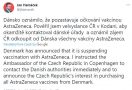
 The Czech Republic wants to buy around 2.4 million doses of the AstraZeneca/Oxford University vaccine ditched by Denmark, which has said it will stop using it because of concerns about rare blood clotting side-effects.

Czech deputy prime minister Jan Hamacek said on twitter that he had instructed the country’s ambassador in Denmark to try to buy the unwanted doses.

Hamacek is also going to travel to Moscow to arrange deliveries of the Russian Sputnik V vaccine once it is approved by the European Medicines Agency.

The Czech Republic is beginning to get a grip on the pandemic and has seen the numbers of deaths falling over the last three weeks.

However it is still reporting more than 4,000 new infections on average each day, according to latest statistics from Reuters.

Denmark has stopped handing out the AstraZeneca/Oxford University vaccine, becoming the first European country to do so because of concerns about very rare blood clotting side-effects.

The move follows advice from the European Medicines Agency last week that announced a possible link with blood clots, although the regulator said that the risk of dying of COVID-19 was far higher.

Several European countries had temporarily suspended the jab but most have reinstated it following the EMA’s advice, albeit with restrictions on its use in younger people where the risk of the blood clots seems to be higher.

Danish officials said that all 2.4 million doses of the AstraZeneca vaccine would be withdrawn until further notice.

They said studies had shown a higher than expected frequency of blood clots following doses, affecting about one in 40,000 people.

Director general Sorn Brostrom said the decision to suspend the vaccine was difficult but noted that there were other vaccines available and that the epidemic was under control in the country.

He said: “The upcoming target groups for vaccination are less likely to become severely ill from COVID-19.

“We must weigh this against the fact that we now have a known risk of severe adverse effects from vaccination with AstraZeneca, even if the risk in absolute terms is slight,” Brostrom said in a press conference.

Around a million people in Denmark have been vaccinated and around 150,000 of them have received the AstraZeneca jab.

France said following the Danish announcement that it views the AZ vaccine as an “essential tool”, with those aged over 55 the Johnson & Johnson vaccine.

https://pharmaphorum.com/news/czech-republic-swoops-for-denmarks-2-4m-unwanted-az-covid-shots/

Medtech’s Spac trend goes robotic

 A new surgical robotics player has emerged, complete with breakthrough status for its system and a plan to go public via the modish route of a Spac merger. Vicarious Surgical’s robot is intended for single-port abdominal procedures, and the company expects to file for FDA approval in 2023. The system employs virtual reality technology to provide what Vicarious calls “a user experience where the surgeon feels transported inside the patient”. This somewhat fanciful pitch seems to have convinced a Hong Kong-based blank cheque group, D8 Holdings, into which Vicarious is reversing in a deal that values the group at $1.1bn. The listed group is expected to have $460m in gross cash; this comprises $345m of cash held in D8’s trust account, if no redemptions are effected, plus a $115m Pipe financing from investors including Becton Dickinson’s corporate VC arm, Khosla Ventures, Innovation Endeavors and Bill Gates. Medtech’s Spac trend is not slowing: this is the third such deal announced this month, and Spacs led by device luminaries including the former Medtronic chief executive Omar Ishrak are known to be on the hunt for targets. 

Selected health tech Spac deals
April's announced deals…
SpacTargetFocusDate merger announced
D8 Holdings Corp Vicarious SurgicalRobotic surgeryApr 15, 2021
Mountain Crest Acquisition Corp IIBetter TherapeuticsPrescription appsApr 7, 2021
CA Healthcare Acquisition Corp LumiradxDiagnosticsApr 7, 2021
...and some Spacs that are still looking
SpacChairTarget areaDate Spac floated
Medtech Acquisition Karim Karti (former Irhythm COO)Medical technology Dec 18, 2020
Compute Health Acquisition Corp Omar Ishrak (former Medtronic CEO)Medical devices and telehealthFeb 5, 2021
Vida Flash AcquisitionsScott Huenneken (former Verb Surgical CEO)Medtech, diagnostics, digital health or genomics-
NB: Vida Flash Acquisitions has not floated yet. Source: company announcements.

GLAXOSMITHKLINE: Sell rating from Deutsche Bank

 In a research note published by Emmanuel Papadakis, Deutsche Bank advises its customers to Sell the stock. The target price is unchanged and still at GBX 1150.

https://www.marketscreener.com/quote/stock/GLAXOSMITHKLINE-PLC-9590199/news/GLAXOSMITHKLINE-nbsp-Sell-rating-from-Deutsche-Bank-32986851/

China Sinovac vaccine 67% effective in symptomatic infection: Chile report

 Sinovac's COVID-19 vaccine CoronaVac was 67% effective in preventing symptomatic infection in the first real-world study of the Chinese shot, the Chilean government said on Friday.

The vaccine was 85% effective in preventing hospitalizations and 80% effective in preventing deaths, the government said in a report prepared by the Chilean health ministry.

The release of the data makes Chile one of a handful of countries, including the United Kingdom and Israel, that have used inoculation campaigns to gather insights into how effective vaccines are outside controlled clinical trials and when faced with unpredictable variables in societies.

Israel's real-world study of the effectiveness of Pfizer's vaccine looked at the results among 1.2 million people, a mix of those who received the shot and those who did not.

Chile's study examined CoronaVac's effectiveness among 10.5 million people, again looking both at people who had been vaccinated and those who had not. Vaccines were administered in Chile approximately 28 days apart.

The data compares favorably to previous data released on CoronaVac's efficacy in clinical trials.

In January, a Brazilian trial said general efficacy of the drug in preventing symptomatic infection was 50.4%. A later study, published this month, said efficacy against symptomatic COVID-19 was 50.7%, efficacy against cases requiring medical treatment was 83.7%, and efficacy against moderate and severe cases was 100%.

Indonesia gave the vaccine emergency-use approval based on interim data showing it was 65% effective.

In a Turkish trial, CoronaVac had an efficacy in preventing symptomatic infection of 83.5%, and 100% in preventing severe illness and hospitalization.

The Chilean study looked at the impact of the vaccination among people in the public health system between Feb. 2 and April 1, adjusting for age, sex, comorbidities, income level and nationality.

Its authors stressed that its results, for example a lower protection against death than in clinical trials, should be considered against the backdrop of a fierce second wave of the pandemic.

It compared people who were not inoculated, individuals 14 days or more after receiving one dose and more than 14 days after receiving a second dose.

Partially vaccinated people, those with just one shot, were found to be far more vulnerable to contracting COVID-19, the results showed.

https://news.yahoo.com/chinas-sinovac-covid-19-vaccine-133324288.html