General Motors bought out roughly half of Buick dealers across the U.S. due to their reluctance to sell electric vehicles as the automaker looks to transition to EVs.
About half of GM’s 2,000 Buick dealers accepted the voluntary buyout. The program remains open so additional dealers may opt to take the buyout instead of making the EV-related investments that GM required for them to continue selling Buicks, as GM is planning for the brand’s vehicles to be 100% electric by 2030.
A spokesperson for the company told FOX Business in a statement, "Buick is transforming, launching the best vehicles the brand has ever had and is the fastest growing mainstream brand in 2023. This all needs to be supported by the best customer experience in the transition to EVs."
As stated before, this year we’ve given dealers who are not aligned with Buick’s future to exit voluntarily in a respectful and structured way; with the full support of our National Dealer Council," the statement continued.
Last year, GM began planning to offer buyouts to its network of Buick dealers after it told the dealers to invest at least $300,000 to facilitate the selling and servicing of electric vehicles – including initiatives like the installation of EV chargers and training of staff – or give up the Buick franchise, according to a report by the Wall Street Journal.
The company noted in its statement that Buick sales are up nearly 60% this year even as it reduced the number of dealer points by 47%. It added that nearly 90% of the U.S. population lives within a roughly 25-mile radius of a Buick dealer so they will continue to have access to parts and service.
Dealers who have accepted the buyout will no longer sell Buick vehicles, although they can continue to sell vehicles from other brands under the GM umbrella, like Chevrolet or GMC.
GM, which is also the parent company of Cadillac, instituted a buyout program for Cadillac dealers in 2020 that reduced the number of dealerships in the brand’s network by about one-third.
Some auto dealers have been hesitant to embrace the EV push. A group of over 3,000 dealers sent an open letter to President Joe Biden last month urging him to "tap the brakes" on EV mandates amid relatively soft demand for EVs at present.
"These vehicles are ideal for many people, and we believe their appeal will grow over time," the dealers wrote. "The reality, however, is that electric vehicle demand today is not keeping up with the large influx of BEVs [battery electric vehicles] arriving at our dealerships prompted by the current regulations. BEVs are stacking up on our lots."
Japan’s government expects per capita income growth to outpace inflation next fiscal year for the first time in three years.
Per capital income, including wage gains and tax cuts scheduled to take effect in June, will increase by 3.8%, exceeding the government’s 2.5% inflation forecasts, according to calculations released Thursday by the Cabinet Office.
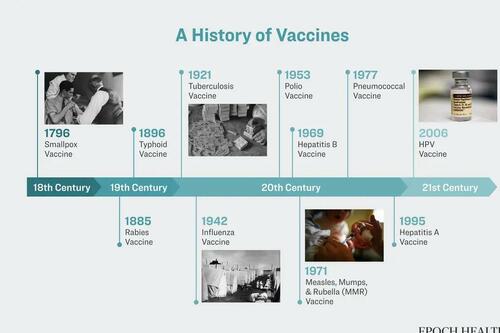
In the rich tapestry of medical science, vaccines stand out as monumental achievements lauded for their role in controlling, and sometimes eradicating, some of humanity's deadliest diseases. Yet, the story of vaccines is not just a straightforward account of scientific triumph. It is a complex narrative, woven with evolving methodologies, diverse perspectives, and debates over efficacy and safety.
The story of vaccines—particularly the smallpox vaccine—is more than a chapter in medical history; it's a reflection of the human journey, marked by groundbreaking discoveries, societal impacts, and ongoing learning. Smallpox, once a formidable scourge, was the first disease to be eradicated through vaccination. However, the path to this success was not linear. It was punctuated with challenges and controversies.
In this series, “Revisiting the Historical Vaccines,” we will explore the multifaceted history of vaccines, examine historical data, and seek a nuanced understanding of vaccine efficacy and safety.
This journey begins with the smallpox vaccine—a starting point that opened doors to modern immunization but also raised questions that resonate to this day.
Our critical evaluation is to offer a well-rounded perspective, grounded in scientific data and enriched by historical context. Join us as we delve into the past to understand the present and shape our thoughts for the future of public health and medical science.
(Illustration by The Epoch Times, Shutterstock, Getty Images)
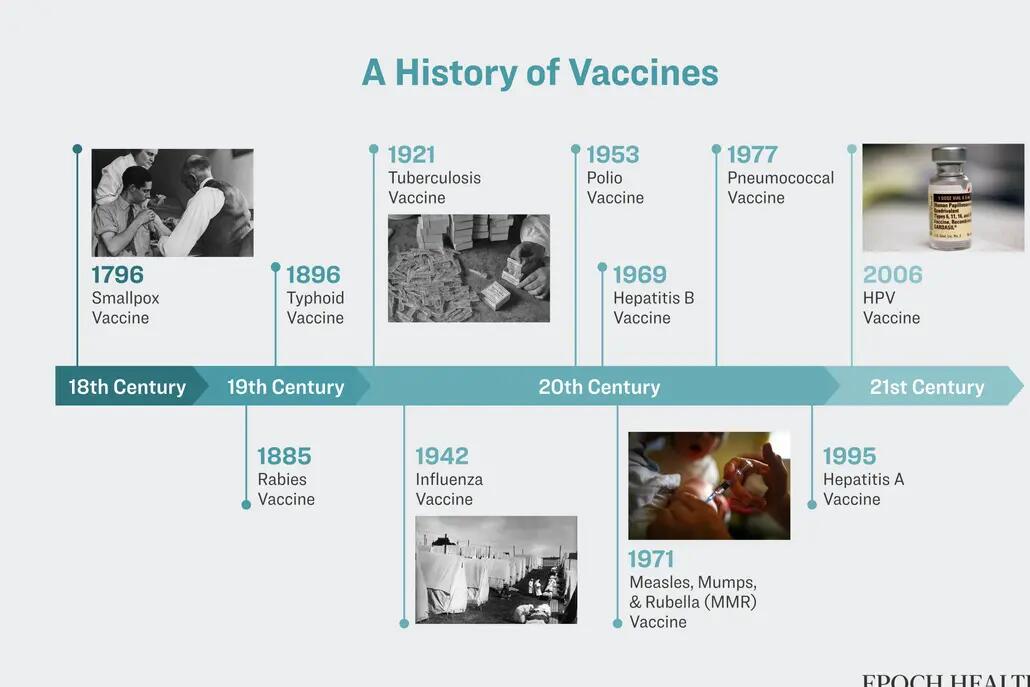
In general, smallpox vaccines can be roughly differentiated into three stages. The first stage began with the invention of the vaccine by Dr. Edward Jenner in 1796. The second stage involved the different versions of smallpox vaccines propagated and used by people during the 18th and 19th centuries. Finally, the third stage includes modern smallpox vaccines used in the late 20th and 21st centuries.
The Most Fearful Disease in History
The story of vaccines begins with a narrative of groundbreaking triumphs in public health. One of the earliest successes was the development of the smallpox vaccine by Dr. Edward Jenner (1749 to 1823) in the late 18th century, a pivotal moment that demonstrated the potential of the vaccine.
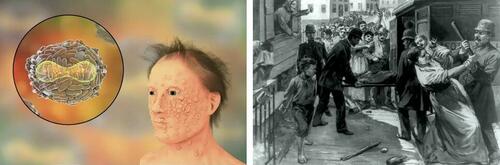
Smallpox, caused by the variola virus, was once one of the world's most feared diseases. Characterized by fever, malaise, telltale pustules on the skin, disfiguring scars, and blindness in many survivors, it has a storied history that intersects with the evolution of human civilization.
According to the World Health Organization (WHO), smallpox has two forms: variola minor, with a 1 percent mortality rate, and the more severe variola major, with a 30 percent mortality rate. About 65 to 80 percent of survivors bear deep, pitted facial scars called “pockmarks.”
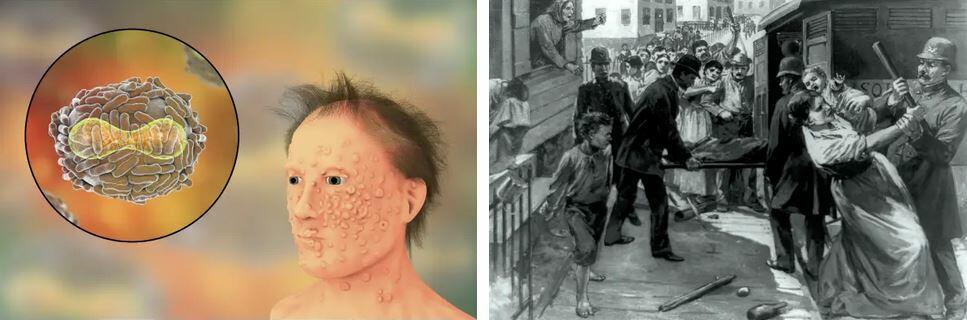
(Left) A transparent viral membrane derived from its host cell covers the virus particle. The inside core (red) contains DNA genetic material. The surface of the virus is covered with surface tubules which help the virus attach to a host cell. (Kateryna Kon/Shutterstock) (Right) Smallpox riots in Milwaukee, Wisconsin (1894). (stock illustration/Getty Image)
Edward Jenner's 1796 Invention
The smallpox vaccine was introduced by Dr. Edward Jenner in 1796. The story of this first vaccine started with a belief among milkmaids that cowpox infection could prevent smallpox.
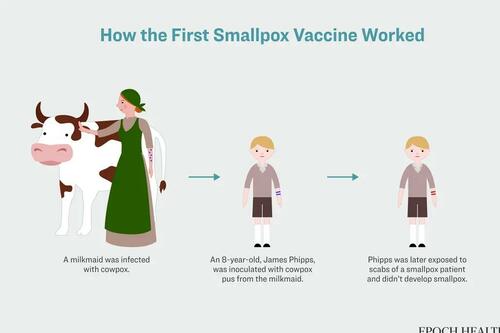
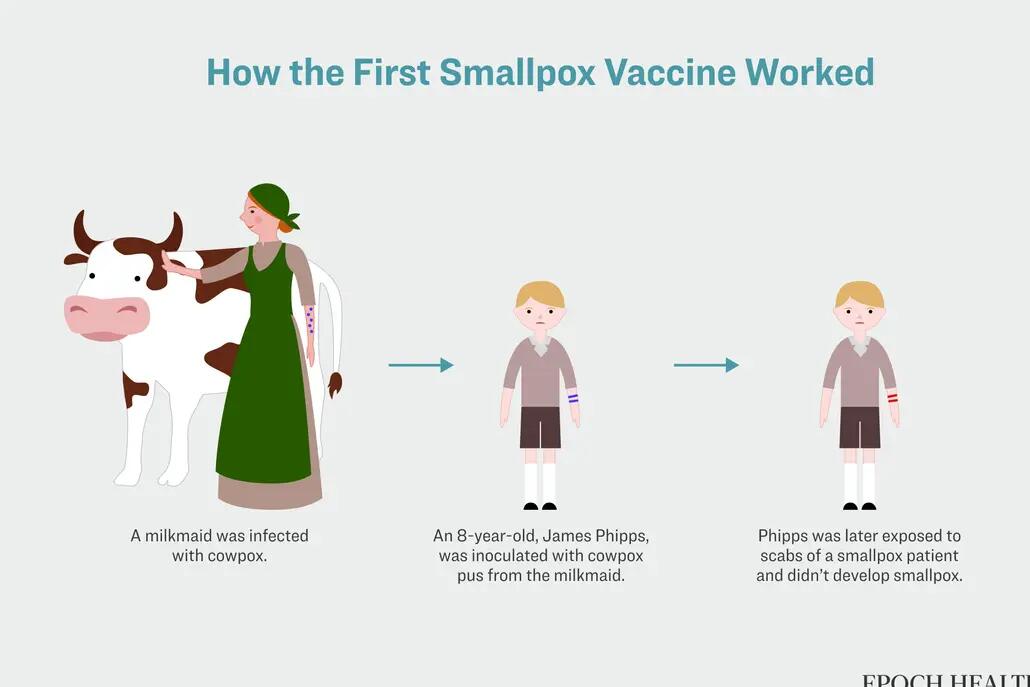
Inspired by this belief, Dr. Jenner experimented on an 8-year-old boy, James Phipps. Dr. Jenner used material from a dairymaid's cowpox lesions and scratched it onto James. When James didn't develop smallpox after exposure, Dr. Jenner concluded that the cowpox vaccination was effective.
The process above shows the steps taken by Dr. Edward Jenner to create the smallpox vaccine, beginning with inoculating James Phipps with cowpox, a virus similar to smallpox, to create immunity. (Illustration by The Epoch Times)
This process was later termed “vaccination,” derived from the Latin word “vaca,” for cow, and “vaccinia,” for cowpox. Dr. Jenner's 1798 paper claimed lifelong immunity from smallpox through this method.
This single-person study evolved into the modern narrative being told in our textbooks for hundreds of years that "inspired by milkmaids, Dr. Jenner invented the smallpox vaccine consisting of the so-called cowpox virus, conferring cross-protection against smallpox."
Furthermore, lesser-known details in this story spread for more than 200 years. There are at least two points that are not true about this narrative.
The first one, unfortunately, is that the story of the milkmaid was a lie invented by John Baron, Dr. Jenner's friend and first biographer. In his book, "The Life of Edward Jenner MD," Mr. Baron states that Dr. Jenner himself never claimed to have discovered the value of cowpox, nor did he ever say, despite a huge volume of correspondence, how he first came across the idea. The myths of the milkmaids are just that, myths.
The second point is that the virus contained in Dr. Jenner's original smallpox vaccine is supposed to be a type of cowpox virus. However, is this true? The answer is relatively obscure. Rather than the cowpox virus, evidence supports that Dr. Jenner might have used the vaccinia or the horsepox virus, which stands as the biggest mystery in Jenner’s vaccine story.
Different Viruses, Different Diseases
Smallpox results from the variola virus, a DNA virus belonging to the Orthopoxvirus genus. This virus only infects humans. Unique to humans, who are its only known reservoir, it spreads primarily through inhaling respiratory droplets or through direct contact with infected material on mucous membranes. Importantly, it is not transmitted from cows.
Cowpox is caused by the cowpox virus affecting only milking cows. The cowpox virus mainly resides in wild mammals like cattle and cats without causing obvious symptoms. In humans, the infection is usually mild and self-limiting, characterized by fever, aches, and a red blister that evolves into a pus-filled lesion.
Moreover, the horsepox virus further complicated the story, as Dr. Jenner had also used lymph from horsepox lesions to prepare the smallpox vaccine in 1813 and 1817. Horsepox causes pustular lesions in horses and horse handlers.
The cowpox virus, horsepox virus, and smallpox virus are all different viruses. Even so, Dr. Jenner used various sources, including cows and horses, to create vaccine substances. This practice led to the development of multiple vaccine concoctions, often used without a full understanding of their composition.
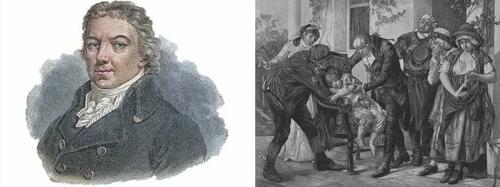
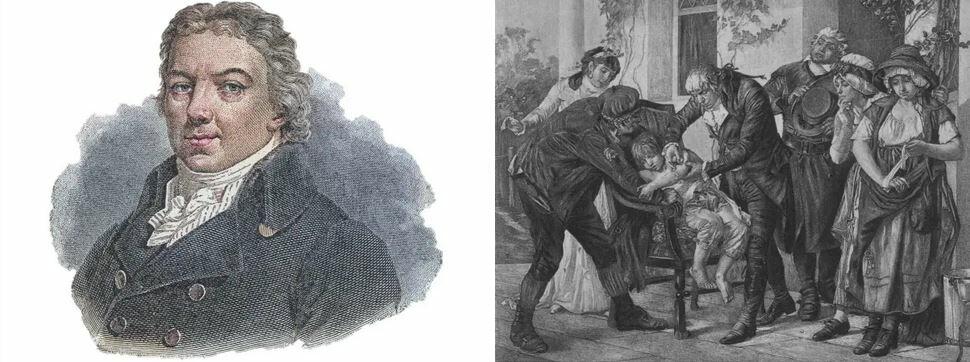
(Left) Portrait of Edward Jenner, British physician and scientist who pioneered the concept of vaccines by creating the smallpox vaccine, the world's first-ever vaccine. (mikroman6/Getty Images) (Right) Old engraved illustration of the first vaccination by Dr. Edward Jenner. (mikroman6/Getty Images)
A 2018 paper in The Lancet Infectious Diseases by Clarissa Damaso carefully revisited the complex and obscure history of smallpox vaccines and concluded that the virus strains used by Dr. Jenner remain a mystery (i.e., cowpox, horsepox, or vaccinia viruses).
In 1823 when Dr. Jenner died, there were already three distinct types of smallpox vaccines: cowpox, described as “pure lymph from the calf,” horse grease, described as “the true and genuine life-preserving fluid,” and horse grease variants.
1. By many measures, access to behavioral healthcare services is highly variable across the United States, and even
among healthcare coverage types within each state. As a result, the accessibility of care can vary widely for
individuals living in different areas of the country, that have different healthcare coverage types, that have different
needs, or that have different levels of personal resources.
Measures of the prevalence of behavioral health conditions
2. Over 24% of individuals across three major healthcare coverage types (commercial, Medicare Fee-for-Service
[FFS], and Medicaid) had diagnoses for at least one behavioral health condition in 2021. The prevalence of
diagnosed behavioral health conditions was highest in Rhode Island (32%) and lowest in Texas (15%).
Measures of behavioral health treatment patterns
3. Only 33% of individuals diagnosed with a behavioral health condition received treatment from a behavioral health
specialist within the year in 2021. Those with Medicaid coverage had the highest rates of behavioral health
specialist care (44%) and those with Medicare FFS coverage had the lowest (15.7%). While some individuals
receive appropriate treatment through primary care or other types of providers, this high percentage of individuals
diagnosed with behavioral health conditions not receiving treatment from a behavioral health specialist indicates a
significant gap in care.
4. Across the studied healthcare coverage types, approximately 8% of emergency department (ED) visits nationwide
included a principal diagnosis of a behavioral health condition in 2021. Medicaid had the highest rate of ED visits
with a behavioral health diagnosis (12.9%) compared with Medicare FFS (7.3%) and commercial (6.9%). ED visits
are often used as a measure of behavioral healthcare access and quality and can indicate under-managed care
Psychedelic drugs such as lysergic acid diethylamide (LSD) and psilocybin (‘magic mushrooms’) induce hallucinations and distort thought-processes. The intensity of a psychedelic ‘trip’ can cause distress, agitation, and even psychosis. A recent report showed that at least 8.4% of drug-related presentations to European emergency departments involve psychedelics.1 This proportion may increase as the clinical use of these agents expands.2
There are multiple ways to control a ‘bad trip’ and avoid hospitalisation. One is to take psychedelics under the supervision of a ‘trip-sitter’—a non-intoxicated friend who can provide psychological support. Another is to use additional psychoactive drugs—‘trip-killers’—to attenuate or prematurely end the psychedelic experience. Trip-killers are not new, but have received increased attention on social media in recent years.3
Information on trip-killers is not available through drug advice services, despite the probable risks they pose. To our knowledge, no relevant papers have been published in the medical literature. It was the aim of our study to gather descriptive data on the use of psychedelic trip killers by analysing posts made on Reddit, a publicly accessible, anonymous social media website. Reddit contains several sub-forums for discussion of recreational drugs, such as ‘r/LSD’ (716 752 users), and ‘r/MDMA’ (237 622 users). The content of Reddit posts has been used previously in psychedelic research.4 Formal ethical approval was not required to conduct this study due to the use of publicly available and anonymous online data.
We conducted a systematic keyword search of the entirety of Reddit using the website’s internal search tool and a site-specific Google query (online supplemental information). We aimed to include English-language threads in which one or more posters had recommended a trip-killer by starting a new thread or responding to an open question from another poster. One hundred and twenty-eight relevant threads were identified (2015–2023) yielding 709 posts from which the following data were extracted: trip-killer(s) recommended, psychedelic drug(s) described, dose(s), safety warning(s). Descriptive statistics were calculated using Microsoft Excel 2016.
A summary of results is provided in table 1. Most commonly recommended were benzodiazepines and antipsychotics. Dose ranges can be found in table 2. Trip-killers were mostly discussed in reference to LSD (n=235), psilocybin mushrooms (n=143), and MDMA (3,4-methylenedioxymethamphetamine) (n=21). Only 58 posts contained warnings about the potential adverse effects of trip-killers.
Akili’s Clinically Proven Digital Medicine Now Authorized for Children 8-17, Opening Option to More Patients as Ongoing Stimulant Shortage Persists
Akili, Inc. (Nasdaq: AKLI), a leading digital medicine company, today announced that it has received authorization from the U.S. Food and Drug Administration (FDA) to expand the label for EndeavorRx® from 8 to 12 year-old patients with primarily inattentive or combined-type ADHD who have a demonstrated attention issue to include older children aged 13 - 17. This increased age range is expected to more than double the number of pediatric patients with ADHD who are now eligible for EndeavorRx – the only FDA-authorized, game-based digital therapeutic – with a prescription from a healthcare provider. (Akili also offers a non-prescription product for adults with ADHD, using the same technology, EndeavorOTC™.)
The clinical study on which the FDA’s label expansion authorization for EndeavorRx is based involved 162 adolescents with a verified diagnosis of inattentive or combined-type ADHD who all received EndeavorRx for 4 weeks and subsequently demonstrated significant improvements in TOVAⓇ-measured* attentional control.
Converging theoretical frameworks suggest a role and a therapeutic potential for spinal interoceptive pathways in major depressive disorder (MDD). Here, we aimed to evaluate the antidepressant effects and tolerability of transcutaneous spinal direct current stimulation (tsDCS) in MDD. This was a double-blind, randomized, sham-controlled, parallel group, pilot clinical trial in unmedicated adults with moderate MDD. Twenty participants were randomly allocated (1:1 ratio) to receive “active” 2.5 mA or “sham” anodal tsDCS sessions with a thoracic (anode; T10)/right shoulder (cathode) electrode montage 3 times/week for 8 weeks. Change in depression severity (MADRS) scores (prespecified primary outcome) and secondary clinical outcomes were analyzed with ANOVA models. An E-Field model was generated using the active tsDCS parameters. Compared to sham (n = 9), the active tsDCS group (n = 10) showed a greater baseline to endpoint decrease in MADRS score with a large effect size (−14.6 ± 2.5 vs. −21.7 ± 2.3, p = 0.040, d = 0.86). Additionally, compared to sham, active tsDCS induced a greater decrease in MADRS “reported sadness” item (−1.8 ± 0.4 vs. −3.2 ± 0.4, p = 0.012), and a greater cumulative decrease in pre/post tsDCS session diastolic blood pressure change from baseline to endpoint (group difference: 7.9 ± 3.7 mmHg, p = 0.039). Statistical trends in the same direction were observed for MADRS “pessimistic thoughts” item and week-8 CGI-I scores. No group differences were observed in adverse events (AEs) and no serious AEs occurred. The current flow simulation showed electric field at strength within the neuromodulation range (max. ~0.45 V/m) reaching the thoracic spinal gray matter. The results from this pilot study suggest that tsDCS is feasible, well-tolerated, and shows therapeutic potential in MDD. This work also provides the initial framework for the cautious exploration of non-invasive spinal cord neuromodulation in the context of mental health research and therapeutics. The underlying mechanisms warrant further investigation. Clinicaltrials.gov registration: NCT03433339 URL: https://clinicaltrials.gov/ct2/show/NCT03433339.