Search This Blog

Friday, August 9, 2024

'Can online voting be secure? Experts in Las Vegas try to hack new platform'

 Hackers from around the world gathered in a small conference room in Las Vegas on Friday to test their skills against a new online voting platform, in a bid to learn what digital vulnerabilities exist in the next generation of election systems.

The platform, known as Secure Internet Voting, or SIV, is ran by a U.S. firm of the same name. Allowing people to vote from their phones or computers, it is already being used in small pilot programs around the United States.

But it faces significant hurdles to greater deployment: most states do not allow for the widespread use of online voting due to security concerns, instead opting for paper ballots that are auditable.

"There are a lot of people that have determined that it's only possible to create insecure internet voting," SIV founder David Ernst told Reuters at the conference.

"We believe that there are modern tools and technologies that allow you to make it hyper secure, with a higher level of security than you can currently achieve with paper."

SIV has already been used at a party level to select a candidate in a primary race, Ernst said. Republican Celeste Maloy was selected as a congressional candidate in a vote powered by SIV in 2023. Maloy went on to win that seat in Utah's 2nd congressional district in November last year.

Voting security is on Americans' minds, with some fearing this November's presidential and congressional elections could be the target of foreign cyberattacks. Senior national security officials say Russia and Iran are already targeting voters with online influence campaigns. During the 2016 and 2020 election cycles, Russian hackers targeted election offices and probed several voting machine companies.

The team behind SIV has offered $10,000 in prize money to be shared among any hackers who can successfully identify flaws in their system.

The event is taking place at the DEF CON Hacking Conference, which brings thousands of cybersecurity professionals to Nevada for one weekend a year, and has been organized by DEF CON's election security group "Voting Village".

Voting Village founder Harri Hursti said the technology had promise, but that the possibility of widespread online voting could take decades to realize.

"There are a couple of mathematical approaches which might, in the future, make internet voting possible," Hursti said. "The inventor of one of those technologies said he might solve it, but not in our lifetimes."

https://www.aol.com/online-voting-secure-experts-las-234750669.html

Meta beats censorship lawsuit by RFK Jr's anti-vaccine group

 Meta Platforms defeated an appeal by Children's Health Defense, an anti-vaccine group founded by Robert F. Kennedy Jr., challenging its censorship of Facebook posts that spread misinformation about vaccines' efficacy and safety.

In a decision on Friday, the 9th U.S. Circuit Court of Appeals in Pasadena, California, said the nonprofit did not show that Meta worked with or was coerced by federal officials to suppress views challenging "government orthodoxy" on vaccines.

Children's Health Defense sued in 2020, saying that Meta had violated its constitutional rights by flagging "vaccine misinformation" as false, and taking away its right to advertise on Facebook.

Meta's actions included prohibiting users from sharing claims that COVID-19 vaccines don't work, and referring viewers of Children's Health Defense posts to the World Health Organization for facts about COVID-19.

Circuit Judge Eric Miller, appointed to the court by Republican former President Donald Trump, wrote for the appeals court that Meta was a "purely private" company with a First Amendment right not to use its platform to promote views it found distasteful.

"Meta evidently believes that vaccines are safe and effective and that their use should be encouraged," Miller wrote. "It does not lose the right to promote those views simply because they happen to be shared by the government."

The court also rejected Children's Health Defense's claims against the Poynter Institute and Science Feedback, which help Meta evaluate the accuracy of Facebook content.

Kennedy, an independent U.S. presidential candidate, helped argue Children's Health Defense's appeal. Meta removed the group's accounts from Facebook and Instagram in August 2022.

Children's Health Defense said it was disappointed with the decision and considering its legal options.

Its general counsel Kim Mack Rosenberg said the First Amendment "seems hollow" when the only speech protected and heard "reinforces the prevailing narrative."

Meta and lawyers for the Menlo Park, California-based company did not immediately respond to requests for comment.

Circuit Judge Daniel Collins, also a Trump appointee, dissented from the decision, saying Children's Health Defense could seek an injunction on its free speech claims. He agreed that its other claims, including for monetary damages, should be dismissed.

Friday's decision upheld a June 2021 ruling by U.S. District Judge Susan Illston in San Francisco.


Developers of vapes for migraine, asthma will need to win over sceptics

 A handful of North American companies which see potential for vape-like devices to ease migraines and respiratory diseases such as asthma have a long road to convince health authorities and patients that their products can be the future of inhaled medication.

Two companies, Qnovia and MIIST Therapeutics, have developed vape-like devices based on technology used in existing medical nebulisers, which turns liquid medications into a fine mist.

Another company, Greentank, says it has developed a way to vaporise substances via a heating chip that addresses safety concerns with current vapes and may offer a better way to treat ailments like migraines.

The companies and experts say inhalation can relieve pain in seconds, with fewer side effects than pills, but their ambitions to sell devices resembling vapes in the medical sphere, amid growing concerns about their health impacts, will be a tough task.

For now, Qnovia and MIIST will launch their products initially as prescription-only nicotine replacement therapy (NRT) treatments, while Greentank is initially targeting the use of its heating chip in recreational cannabis and nicotine vapes.

The companies ultimately aim to see their devices delivering a wide range of drugs and Douglas Dunlap, chief commercial officer at Greentank, cites migraine medication as an example.

A common method of administering migraine treatment is via a pill, which takes up to an hour to kick in and can include symptoms such as vomiting and dizziness.

"If we could shorten that, it would be a huge success for us," said Dunlap, a former executive at vape gaint JUUL, adding vapes can deliver a hit within 60 seconds.

Three billion people globally suffer from migraines, according to the World Health Organization. Hundreds of millions more have conditions like asthma or pulmonary diseases, treated with inhaled medications.

Pharmaceutical company GSK alone generated almost 7 billion pounds ($8.9 billion) of revenue from general respiratory medicines for conditions such as asthma and pulmonary diseases in 2023.

HEALTH CONCERNS

Federico Buonocore, a professor focused on alternative pulmonary drug delivery at Kingston University in Britain, said existing inhaled drug delivery devices are clunky and difficult to operate, and so tend to be used wrongly.

A vape-like design could solve such challenges, he said.

Big Tobacco firms have already tried and failed to tap into this market, their efforts fraught by mistrust and opposition from health officials.

Philip Morris International last year scrapped a goal to earn over $1 billion in annual revenue by 2025 from its wellness and healthcare unit, which includes a business making asthma inhalers.

CEO Jacek Olczak said the company had been "too optimistic about how the external environment will accept... Big Tobacco" in industries outside of nicotine. An inhaled aspirin product developed by the unit was also deemed unsuccessful after a clinical trial last year.

Virginia-based Qnovia and California-based MIIST are pharmaceutical firms and not associated with Big Tobacco, although some of their top executives came from that industry.

Qnovia CEO Brian Quigley, a former boss of tobacco giant Altria, told Reuters the company plans to submit drug applications in the U.S. soon and the United Kingdom in 2026 for its device as an NRT, and launch a clinical trial in September.

MIIST also needs to secure regulatory approvals. Its Phase 1 clinical trial found its device could ease cravings faster than other approved NRTs like patches and gums - notoriously ineffective in helping smokers quit.

Toronto-based Greentank, which was founded in 2015 to make vaping hardware, will see the first U.S. cannabis vape using its technology launched in September by U.S. company Jaunty.

Greentank is now looking for a pharmaceutical partner to support the development of its heating chip for medicine delivery.

MIIST founder Dalton Signor told Reuters he hopes the company's device could one day be used to administer drugs for things like pain and anxiety relief.

However, he said a major challenge is ensuring devices like MIIST's are not conflated with typical vapes - the subject of growing health concerns.

Authorities like the World Health Organization say vapes can produce harmful chemicals like formaldehyde and heavy metals, and their long-term impacts are uncertain.

Venture capital investor Catharine Dockery, CEO of Vice Ventures, said her firm backed Qnovia because its nebuliser technology does not use heat, a process that can result in harmful emissions.

Greentank's device does use heat - a fact that also means some drugs may not work with it.

Dunlap said Greentank is in the early stages of trying to identify medicines that are suited to the technology, and testing shows its heating method does not result in any harmful emissions.

But many may remain sceptical.

Kingston University's Buonocore researched the use of e-cigarettes as drug delivery devices.

"The first thing everyone told me was: 'It is wrong to use this device as a medical device'," he said, adding that concerns included that it would be inappropriate to prescribe them to children.

"Coming out of that stigma is going to be very difficult for the sector."

https://www.yahoo.com/news/analysis-developers-vapes-migraine-asthma-071634874.html

Iran to deliver hundreds of ballistic missiles to Russia soon, intel sources say

 Dozens of Russian military personnel are being trained in Iran to use the Fath-360 close-range ballistic missile system, two European intelligence sources told Reuters, adding that they expected the imminent delivery of hundreds of the satellite-guided weapons to Russia for its war in Ukraine.

Russian defence ministry representatives are believed to have signed a contract on Dec. 13 in Tehran with Iranian officials for the Fath-360 and another ballistic missile system built by Iran's government-owned Aerospace Industries Organization (AIO) called the Ababil, said the two intelligence officials, who requested anonymity in order to discuss sensitive matters.

Citing multiple confidential intelligence sources, the officials said that Russian personnel have visited Iran to learn how to operate the Fath-360 defence system, which launches missiles with a maximum range of 120 km (75 miles) and a warhead of 150 kg. One of the sources said that that "the only next possible" step after training would be actual delivery of the missiles to Russia.

Moscow possesses its own ballistic missiles, but the supply of Fath-360s could allow Russia to use more of its arsenal for targets beyond the front line, while employing Iranian warheads for closer-range targets, a military expert said.

A spokesman for the U.S. National Security Council said the United States and its NATO allies and G7 partners "are prepared to deliver a swift and severe response if Iran were to move forward with such transfers."

It "would represent a dramatic escalation in Iran's support for Russia's war of aggression against Ukraine," the spokesman said. "The White House has repeatedly warned of the deepening security partnership between Russia and Iran since the outset of Russia's full-scale invasion of Ukraine."

Russia's defence ministry did not respond to a request for comment.

Iran's permanent mission to the United Nations in New York said in a statement that the Islamic Republic had forged a long-term strategic partnership with Russia in various areas, including military cooperation.

"Nevertheless, from an ethical standpoint, Iran refrains from transferring any weapons, including missiles, that could potentially be used in the conflict with Ukraine until it is over," the statement said.

The White House declined to confirm that Iran was training Russian military personnel on the Fath-360 or that it was preparing to ship the weapons to Russia for use against Ukraine.

The two intelligence sources gave no exact timeframe for the expected delivery of Fath-360 missiles to Russia but said it would be soon. They did not provide any intelligence on the status of the Abibal contract.

A third intelligence source from another European agency said it had also received information that Russia had sent soldiers to Iran to train in the use of Iranian ballistic missile systems, without providing further details.

Such training is standard practice for Iranian weapons supplied to Russia, said the third source, who also declined to be named because of the sensitivity of the information.

A senior Iranian official, who requested anonymity, said Iran had sold missiles and drones to Russia but has not provided Fath-360 missiles. There was no legal prohibition on Tehran selling such weapons to Russia, the source added.

"Iran and Russia engage in the mutual purchase of parts and military equipment. How each country uses this equipment is entirely their decision," the official said, adding that Iran did not sell weapons to Russia for use in the Ukraine war.

As part of the military cooperation, Iranian and Russian officials often travelled between the two states, the official added.

"DESTABILIZING ACTIONS"

Until now, Iran's military support for Moscow has been limited mainly to unmanned Shahed attack drones, which carry a fraction of the explosives and are easier to shoot down because they are slower than ballistic missiles.

Iran's semi-official Tasnim news agency said in July 2023 the system had been successfully tested by the country's Islamic Revolution Guards Corps (IRGC) Ground Force.

"Delivery of large numbers of short-range ballistic missiles from Iran to Russia would enable a further increase in pressure on already badly overstretched Ukrainian missile defence systems," said Justin Bronk, Senior Research Fellow for Air Power at the Royal United Services Institute (RUSI), a London-based defence think-tank.

"As ballistic threats, they could only be intercepted reliably by the upper tier of Ukrainian systems," he said, referring to the most sophisticated air defences Ukraine has such as the U.S.-made Patriot and European SAMP/T systems.

Ukraine's Ministry of Defense did not have immediate comment.

The NSC spokesman noted that Iran's newly elected President Masoud Pezeshkian "claimed he wanted to moderate Iran's policies and engage with the world. Destabilizing actions like this fly in the face of that rhetoric."

U.N. Security Council restrictions on Iran's export of some missiles, drones and other technologies expired in October 2023. However, the United States and European Union retained sanctions on Iran's ballistic missile programme amid concerns over exports of weapons to its proxies in the Middle East and to Russia.

Reuters reported in February on deepening military cooperation between Iran and Russia and on Moscow's interest in Iranian surface-to-surface missiles.

Sources told the news agency at the time that around 400 Fateh-110 longer-range surface-to-surface ballistic missiles had been delivered. But the European intelligence sources told Reuters that according to their information, no transfer had happened yet.

Ukrainian authorities have not publicly reported finding any Iranian missile remnants or debris during the war. Authorities in Kyiv did not immediately respond to a request for comment.

https://uk.news.yahoo.com/exclusive-iran-deliver-hundreds-ballistic-173202389.html

US to lift ban on offensive weapons sales to Saudi Arabia

 The Biden administration has decided to lift a ban on U.S. sales of offensive weapons to Saudi Arabia, the State Department said on Friday, reversing a three-year-old policy to pressure the kingdom to wind down the Yemen war.

The State Department was lifting its suspension on certain transfers of air-to-ground munitions to Saudi Arabia, a senior department official confirmed. "We will consider new transfers on a typical case-by-case basis consistent with the Conventional Arms Transfer Policy," the official said.

Reuters was first to report the decision earlier, citing five sources.

The administration briefed Congress this week on its decision to lift the ban, a congressional aide said. One source said sales could resume as early as next week. The U.S. government was moving ahead on Friday afternoon with notifications about a sale, a person briefed on the matter said.

"The Saudis have met their end of the deal, and we are prepared to meet ours," a senior Biden administration official said.

Under U.S. law, major international weapons deals must be reviewed by members of Congress before they are made final. Democratic and Republican lawmakers have questioned the provision of offensive weapons to Saudi Arabia in recent years, citing issues including the toll on civilians of its campaign in Yemen and a range of human rights concerns.

But that opposition has softened amid turmoil in the Middle East following Hamas' deadly Oct. 7 attack on Israel and because of changes in the conduct of the campaign in Yemen.

Since March 2022 - when the Saudis and Houthis entered into a U.N.-led truce - there have not been any Saudi airstrikes in Yemen and cross-border fire from Yemen into the kingdom has largely stopped, the administration official said.

"We also note the positive steps that the Saudi Ministry of Defense have taken over the past three years to substantially improve their civilian harm mitigation processes, in part thanks to the work of U.S. trainers and advisors," the State Department official said.

WARMER SAUDI TIES

Yemen's war is seen as one of several proxy battles between Iran and Saudi Arabia. The Houthis ousted a Saudi-backed government from Sanaa in late 2014 and have been at war against a Saudi-led military alliance since 2015, a conflict that has killed hundreds of thousands of people and left 80% of Yemen's population dependent on humanitarian aid.

Biden adopted the tougher stance on weapons sales to Saudi Arabia in 2021, citing the kingdom's campaign against the Iran-aligned Houthis in Yemen, which has inflicted heavy civilian casualties.

Ties between the kingdom and the United States have warmed since then, as Washington has worked more closely with Riyadh in the aftermath of Hamas' Oct. 7 attack to devise a plan for post-war Gaza.

The Biden administration also has been negotiating a defense pact and an agreement for civil nuclear cooperation with Riyadh as part of a broad deal that envisions Saudi Arabia normalizing ties with Israel, although that remains an elusive goal.

The decision comes as the threat level in the region has been heightened since late last month, with Iran and Lebanon's powerful Iran-backed Hezbollah group vowing to retaliate against Israel after Hamas' political chief Ismail Haniyeh was killed in Tehran.

The Houthis have emerged as a strong supporter of the Palestinian Islamist group Hamas in its war against Israel. Earlier this year, they attacked commercial ships that they said are linked to Israel or bound for Israeli ports.

https://www.yahoo.com/news/exclusive-us-lift-ban-offensive-165146769.html

Million Dollar Ba-Boy: Genetic Male Wins Gold In Women's Olympic Boxing

 Algerian boxer Imane Khelif, a genetic male, won a gold medal in the Paris Olympics Friday night after beating 13 women to snatch victory in the walterweight final.

The 25-year-old Khelif - who was disqualified from last year's IBA World Championships for failing a gender test, beat China's Yang Liu in front of a packed audience at Roland Garros - capping off a controversial path to first place in which the boxer didn't lose a single round.

ter winning, Khelif could be seen with a raised arm in a mock military salute before being carried around the ring.

As the Daily Mail notes, questions have been raised over whether Khelif should have been permitted to fight in the women's competition in Paris, where eligibility rules were lax compared to the IBA.

The IBA was stripped of its right to run the Olympic competition amid a war with Games bosses the IOC. As a result, there are no gender or testosterone exams in Paris and the category is open to those who have ‘female’ in their passport.

Khelif, who roared ‘I am a woman’ after cruising to quarter-final victory, has been the subject of a wave of online abuse.

Meanwhile, Taiwan's Lin Yu-Ting, who was also disqualified from the IBA World Championships, will fight for gold in the featherweight division on Saturday night.

There has been a massive controversy over whether Khelif was actually born a male or a female - with some claiming 'she' has hyperandrogenism, a condition which features higher-than-usual levels of androgens (male hormones), however earlier this year IBA president Umar Kremlev told Russian news agency TASS that DNA tests "proved they had XY chromosomes and were thus excluded from the sports events."

The IBA told The Guardian that it had made the decision "following a comprehensive review and was intended to uphold the fairness and integrity of the competition."

Last week the IOC and the Paris 2024 Boxing Unit issued a joint statement saying that every athlete competing in the 2024 games had complied with their regulations.

"All athletes participating in the boxing tournament of the Olympic Games Paris 2024 comply with the competition's eligibility and entry regulations, as well as all applicable medical regulations set by the Paris 2024 Boxing Unit (PBU)."

And since there were no gender tests, and all that was required was a passport that says 'female,' they complied.

Meanwhile, IOC President Thomas Bach claims there are 'zero scientific ways' to identify a woman.

The balls on these people...

 https://www.zerohedge.com/political/million-dollar-ba-boy-genetic-male-wins-gold-womens-olympic-boxing

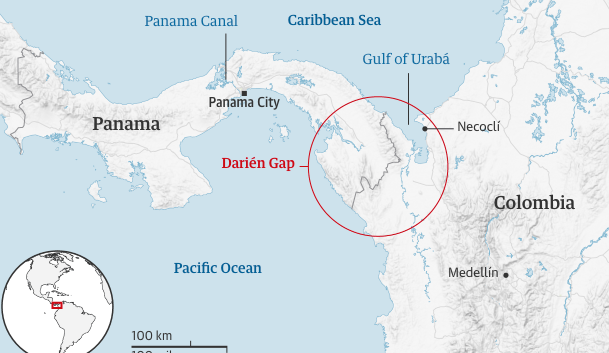
Panama Hits 'VIP' Chinese Migrant-Smuggling Route Through Notorious Darien Gap

 In the latest indication that new President Jose Raul Mulino may be serious about his campaign pledge to end the country's role as a major funnel of masses of illegal immigrants bound for the United States, Panamanian border police on Wednesday arrested 15 people linked to an illicit "VIP" migrant-smuggling operation that caters to Chinese clients, AFP reports. The detainees -- who face 15 to 20 years in prison -- are all Panamanian, but are accused of working for Colombian gangs. 

While the Pan-American Highway stretches some 19,000 miles through South, Central and North America, there's a 66-mile gap that starts just inside Colombia and stretches into Panama. That means migrants have to make a harrowing journey on foot through a mountainous and marshy region called the Darien Gap. They not only have to survive dangerous natural conditions, but also criminal gangs known to rape, murder, kidnap and rob them.

The VIP service targeted this week promised a faster, easier and safer passage into Panama -- but at a higher price. Migrants pay about $500 for a standard escort through the gap, but fees for this expedited trip range from $2,600 to $8,000, local prosecutor Emeldo Marquez told AFP. Given the price, most customers who can afford the first class experience are Chinese. 

The VIP trip is shortened in a variety of ways, starting with boat service that bypasses a portion of the jungle trip by departing the Colombian coast from Capurgana or Necocli and dropping migrants in Carreto or Caledonia, Panama. Smugglers then whisk them through the remaining wilderness using canoes, horses and ATVsThat helps cut the average VIP jungle jaunt down to just two days, instead of upwards of eight days or more for everyone else. 

About half-million migrants made the Darien Gap trek in 2023, and about 200,000 so far this year. They come from many countries, but most of the recent migrants are Venezuelan. While still a small percentage, Chinese traffic has soared, with more than 55,000 Chinese crossing the Mexican border since 2023

On the campaign trail, President Jose Raul Mulino emphasized his intent to end Panama's role as a critical link in a path that funnels northbound migrants into Central America. He reiterated that intention in his inaugural address, saying"I will not allow Panama to be a path open to thousands of people who illegally enter our country supported by an entire international organization related to drug trafficking and human trafficking."

Earlier this summer, Panama started installing concertina-wire fences inside the Darien Gap. “The patrol at the national border service has begun to block the majority of border passages," said Frank Abrego, Panama's minister of public security during a June 28 visit to the area.  

On July 1 -- the same day that Mulino was sworn into office, Panama announced it had signed an agreement with the United States with a goal of cutting the flow of migrants through the isthmus. Under the deal, the US government has committed to covering Panama's expenses for deporting people who enter Panama illegally, and to help with "equipment, transportation and logistics." 

https://www.zerohedge.com/geopolitical/panama-hits-vip-chinese-migrant-smuggling-route-through-notorious-darien-gap