Search This Blog

Sunday, May 20, 2018

5 takeaways from the first look at cancer’s biggest conference

Every year tens of thousands of cancer researchers, doctors, investors and analysts travel to Chicago in early June for the annual meeting of the American Society of Clinical Oncology. It’s the largest conference in the drug industry’s hottest field.
Research at the conference often highlights progress from key clinical studies of cancer therapeutics, impacting the market fortunes of the drugmakers which make them.
After the close of the market yesterday, some 5,000 abstracts for studies set to be presented at the meeting were posted online. While the data contained within those study snapshots is incomplete, investors and analysts have taken to digging through the documents for clues as to how important drugs are performing.
Read on for five (early) takeaways of what to expect from ASCO when it kicks off in two weeks:

Case for immunotherapy plus chemo looks even stronger

While cancer immunotherapy has impressed with strong efficacy in some cancer types, too many patients still don’t see a benefit.
In hopes of boosting the number who do, drugmakers across the industry have invested in studies testing combinations of immunotherapies with other drugs. Results have been mixed, as successes have come alongside setbacks.
What’s become clear, however, is that combining immunotherapy with chemotherapy appears to be effective in driving further benefit. Merck & Co.’s Keytruda stands out in this regard, having won approval for treating non-small lung cancer (NSCLC) when combined with chemo.
But, as updates included in several ASCO abstracts suggest, rival drugs also appear to pair well with chemo in first-line NSCLC.
Bristol-Myers Squibb’s Opdivo (nivolumab) plus chemotherapy drove a 26% reduction in the relative risk of progression-free survival versus chemo alone, data from an abstract of the pharma’s closely watched CheckMate-227 trial shows.
Elsewhere, an abstract of Roche’s IMpower-150 study detailed the overall survival benefit from a combination of the Swiss pharma’s Tecentriq paired with chemo and the older cancer drug Avastin (bevacizumab).
Updates from several other key studies by Merck and Roche are still under wraps and will be revealed at the conference.
“We think the market in 1L NSCLC is becoming even more competitive as [Bristol-Myers] and Roche demonstrate comparable efficacy in their own combinations, and the role of PD-1/chemo combo is further consolidated with more positive data,” wrote Leerink analyst Geoffrey Porges in a May 17 note.

Regeneron’s cemiplimab stays on track

Five PD-1/L1 inhibitors are currently approved in the U.S., with Keytruda (pembrolizumab) and Opdivo far ahead of rivals.
The clinical and commercial success of the checkpoint blockers has sparked a frenzy of ‘me-too’ drug development, raising questions of where drugmakers looking to enter the market can make a mark.
Such doubts haven’t stopped Regeneron from pushing forward with testing of its own PD-1 inhibitor cemiplimab, though. The biotech is aiming first at cutaneous squamous cell carcinoma (CSCC), an indication for which the other immunotherapies aren’t approved.
Regeneron, and its partner Sanofi, presented positive data last December and submitted the drug for U.S. approval earlier this year. Data included in the ASCO abstract of the study revealed little new information, highlighting a roughly similar 47.5% response rate among CSCC patients.
For the first time, however, investors got a glimpse of the drug’s efficacy in the more lucrative — but more competitive — lung cancer market. Early results from 21 patients in a Phase 1 NSCLC study showed treatment with the drug led to a 29% overall response rate. While good, that’s not exactly a sign of market-beating efficacy.
“[Regeneron]’s cemiplimab looks like a PD-1 antibody, which it is,” Evercore ISI analyst Josh Schimmer noted dryly in a May 16 note to investors.
Regeneron claims its drug will be third to market, not sixth, hypothesizing that blocking the PD-1 receptor rather than the PD-L1 ligand is more effective. Investors are still waiting for proof.

Investors aren’t sold on Nektar combo just yet

In February, Bristol-Myers bet $1.85 billion on the promise of an experimental early-stage immunotherapy developed by Nektar Therapeutics, hoping to pair the drug with Opdivo. The companies plan to test the two drugs together across nine different cancers.
At ASCO, data from a Phase 1/2 study known as PIVOT will be presented for several solid tumor types — giving investors a more detailed look at what attracted Bristol-Myers to Nektar’s compound.
Early signs from the abstract, which includes efficacy data from only 60 patients, raise some questions though. Response rates from the combo in melanoma and kidney cancer dropped a touch lower from previous updates.
Opdivo has already demonstrated benefit in these indications, so investors are looking for signs adding Nektar’s drug yields a significant efficacy boost.
“We’re still not convinced that NKTR-214 has been dosed to add meaningful incremental effect over PD-1 antibody alone — so will look towards the full dataset to better inform our perspective,” Evercore’s Schimmer wrote.
Worth noting, however, is the fact that 22 patients in the Phase 2 portion of the study had only one follow-up scan, meaning results could improve over time. Look to the conference itself for a clearer reading on whether Bristol-Myers’ bet was well placed.

Loxo outshines rival in RET-mutant cancers

Loxo Oncology first captured investor attention at last year’s ASCO meeting, presenting impressive data for its experimental drug larotrectinib in patients whose cancer expressed a rare genetic abnormality known as TRK fusion. The biotech has since parlayed that data into a $1.5 billion deal with German pharma Bayer.
Now, as ASCO approaches, investors will be focused on another pipeline drug known as LOXO-292.
Designed to treat cancers with a genetic mutation known as RET, the drug drove a 69% overall response rate among RET-positive patients with non-small cell lung cancer and a type of thyroid cancer, according to an abstract of the Phase 1 study.
Notably, no dose-limiting toxicities were observed and the drug appeared relatively well-tolerated, with no Grade 3 adverse events attributed to LOXO-292.
The results also appear to stack up well against data from Blueprint Medicine’s rival candidate BLU-667, analysts noted. Shares in Loxo surged by nearly 20% in Thursday morning trading.

Jounce gets bounced by shaky data

Investors were less impressed with data from Jounce Therapeutics.
Shares in the Cambridge, Massachusetts-based biotech fell more than 30% Thursday as markets digested interim results from a Phase 1 study of the company’s ICOS agonist JTX-2011.
Data included in the study abstract showed low response rates to the drug, given as monotherapy or paired with Opdivo in patients with gastric cancer and triple-negative breast cancer (TNBC).
Of seven gastric cancer patients given JTX-2011, only one saw a partial response. Among 19 patients given Jounce’s drug with Opdivo, two experienced a partial response and two had ongoing stable disease. In TNBC, one partial response was reported in 15 patients given the combo.
Patients in the study were heavily pretreated and immunotherapy has not seen as much success in TNBC as of yet.
In a May 16 statement, the company sounded an optimistic note and indicated updated results would be presented at ASCO.

Recommended Reading:

TX hospice exec admits overdosing patients to speed deaths, make more $

The former executive of a Frisco hospice admitted Thursday to overdosing patients to “hasten their deaths” so the company could make more money, court records show.
Melanie Murphey, 36, admitted serving as the “go-between” for Novus Health Services owner Bradley Harris, doctors and nurses in an alleged $60 million scheme.
Murphey, Novus’ director of operations, pleaded guilty to health care fraud and is expected to testify against 15 others in the case, including Harris and his wife, Amy. The other defendants have pleaded not guilty.
Chris Knox, an attorney for Bradley Harris, said Friday evening that “we are aware of the allegations lodged by Ms. Murphey in her factual resume and we wholeheartedly disagree with her opinions. We are not aware of any evidence that shows that Mr. Harris caused, hastened or otherwise contributed to the death of the hospice patients being treated by Novus.”
An attorney for Amy Harris declined to comment.
When news of the federal investigation became public in March 2016, Novus posted a statement online, saying, “We have not and would not — ever — willfully harm any patient.”
Bradley and Amy Harris were among 16 people indicted in a $60 million Medicare fraud scheme. (Facebook)
Bradley and Amy Harris were among 16 people indicted in a $60 million Medicare fraud scheme.
(Facebook)
Murphey admitted in court records that she defrauded Medicare and Medicaid by billing them for patients who did not qualify for hospice services. She also admitted filling out forms as though she were the doctor by using notes taken by a nurse.
Court records show that Murphey also admitted she followed orders for patients’ care from Bradley Harris, who has no medical training. The patients did not see a doctor in person before they were admitted.
She said Harris’ directives were intended to drive up profits.
Harris ordered that patients who stayed beyond the time they allowed Novus to turn a profit receive higher doses of “whatever narcotic was being used, generally morphine, Dilaudid or Ativan,” records show.
He also sent a text to a nurse that said, “You need to make this patient go bye-bye,” according to an affidavit.
Murphey admitted falsifying paperwork, including orders to not resuscitate patients. This was done to avoid paying for ambulance trips to a hospital if a relative called 911.
Murphey faces up to 10 years in prison.
The indictment alleges that from July 2012 to September 2015, Novus billed Medicare and Medicaid more than $60 million for fraudulent hospice services. The government paid Novus more than $35 million.
The defendants are accused of submitting false claims for hospice services, submitting false claims for continuous care hospice services, recruiting ineligible hospice beneficiaries by providing kickbacks to referring physicians and health care facilities, and falsifying and destroying documents to conceal these activities from Medicare, federal officials say.

Fewer School Shootings Now Than During the 1990s

Now that I have several children, I’m often in the company of other parents who talk about the way things “used to be.” When the issue of child safety comes up, I hear parents sadly shake their heads and say things like “it’s not like it was when we were kids … the world is so much more dangerous now.”
Usually, the sentiment behind this idea is that there are more murders now than there used to be.
Now, I’m not exactly known for being a Pollyanna, but I am willing to admit when things are not, in fact, getting worse.
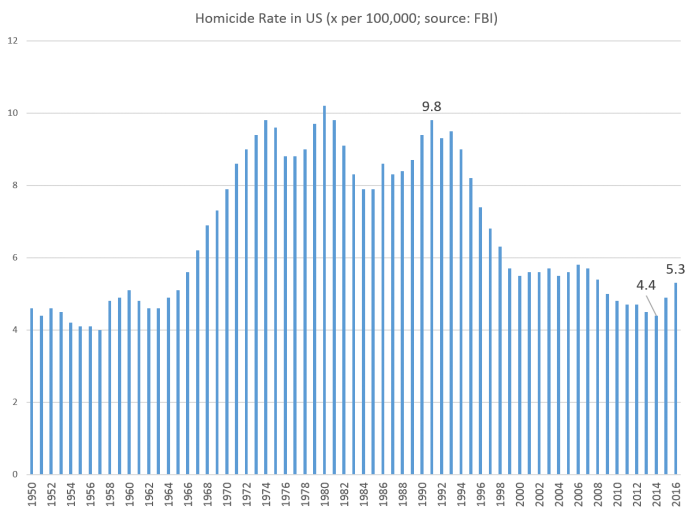
And when it comes to things like homicides, there is no evidence that things are getting worse. It is indeed true that things aren’t like they were “when we were kids,” but that’s a good thing. There were far more homicides in the United States during the 1980s and 1990s than there are today. Things were even worse than that during the 1970s. In fact, the homicide rate in the US was cut in half between 1991 and 2014. And while the homicide rate has inched up over the past two years, it is nowhere near where it was “when we were kids.”
homicide1 (1).png
For anyone familiar with these trends, it should not be a shock to hear that a subset of those homicides — school shootings — have decreased over that period as well.
In response to the latest shooting in Florida, Northeastern University released a preview of new research by James Alan Fox slated for publication this fall which shows, quite clearly, that there is no growing trend in school shootings. The university notes:
Mass school shootings are incredibly rare events. In research publishing later this year, Fox and doctoral student Emma Fridel found that on average, mass murders occur between 20 and 30 times per year, and about one of those incidents on average takes place at a school.
Fridel and Fox used data collected by USA Today, the FBI’s Supplementary Homicide Report, Congressional Research Service, Gun Violence Archive, Stanford Geospatial Center and Stanford Libraries, Mother Jones, Everytown for Gun Safety, and a NYPD report on active shooters.
Their research also finds that shooting incidents involving students have been declining since the 1990s.
Four times the number of children were killed in schools in the early 1990s than today, Fox said.
“There is not an epidemic of school shootings,” he said, adding that more kids are killed each year from pool drownings or bicycle accidents. There are around 55 million school children in the United States, and on average over the past 25 years, about 10 students per year were killed by gunfire at school, according to Fox and Fridel’s research.
In a February 22 article, New York Magazine came to a similar conclusion, noting:
Schools in the United States are safer today than at any time in recent memory. Criminal victimization in America’s education facilities has declined in tandem with the nation’s collapsing crime rate. Meanwhile, as of 2013, the year after the Newtown massacre, mass shootings accounted for only 1.5 percent of all gun deaths in the United States, or 502 total fatalities.
New York was drawing on research from the US Justice Department showing that “school victimization” rates have plummeted since 1992, as a graph provided by the Justice Department shows:
victimization.PNG
Fox, the author of the Northeastern University research, does not oppose policy changes like increasing the age for purchasing guns. But he notes it’s unlikely to impact the numbers very much:
The thing to remember is that these are extremely rare events, and no matter what you can come up with to prevent it, the shooter will have a workaround,” Fox said, adding that over the past 35 years, there have been only five cases in which someone ages 18 to 20 used an assault rifle in a mass shooting.
Ironically, those most familiar with the data on shootings are often less likely to assume that gun control measures are an easy solution to the problem of homicide.
For example, last year, Leah Libresco at the Washington Post — hardly an organ of the NRA — concluded that gun control measures are of extremely limited value:
…my colleagues and I at FiveThirtyEight spent three months analyzing all 33,000 lives ended by guns each year in the United States, and I wound up frustrated in a whole new way. We looked at what interventions might have saved those people, and the case for the policies I’d lobbied for crumbled when I examined the evidence…
I researched the strictly tightened gun laws in Britain and Australia and concluded that they didn’t prove much about what America’s policy should be. Neither nation experienced drops in mass shootings or other gun related-crime that could be attributed to their buybacks and bans. Mass shootings were too rare in Australia for their absence after the buyback program to be clear evidence of progress. And in both Australia and Britain, the gun restrictions had an ambiguous effect on other gun-related crimes or deaths…
By the time we published our project, I didn’t believe in many of the interventions I’d heard politicians tout. I was still anti-gun, at least from the point of view of most gun owners, and I don’t want a gun in my home, as I think the risk outweighs the benefits. But I can’t endorse policies whose only selling point is that gun owners hate them.
What Libresco did conclude, was that a host of societal issues are driving much of what we hear about in terms of so-called gun violence. Mental illness, suicidegang violence, and domestic violence are all important factors that drive gun violence. The problem, Libresco admits, is that simply prohibiting certain types of guns doesn’t really address these issues.

Accepting the “Crisis” Narrative

In the wake of last month’s Florida shooting, many opponents of gun control made the mistake of simply accepting the claim that school shootings are getting worse, and are more deadly overall.
According to Fox’s research, though, this is simply not the case. And we also certainly know that homicides overall are way down from where they were in the good ol’ days of my youth.
These apparent facts, of course, don’t stop even rightwing professional Cassandras like Rod Dreher from authoring articles like this one called “Underestimating American Collapse” which uses school shootings as evidence that American civilization is basically on the brink of collapse:
Why are American kids killing each other? Why doesn’t their society care enough to intervene? Well, probably because those kids have given up on life  —  and their elders have given up on them. Or maybe you’re right  —  and it’s not that simple. Still, what do the kids who aren’t killing each other do? Well, a lot of them are busy killing themselves.
Maybe American society is in a more perilous position that in the 1980s. But if we’re looking for evidence of that, the homicide data won’t help the argument. Dreher is right to question why American kids are killing each other. But an equally relevant question might also be “why are fewer American kids killing each other now than 25 years ago?”

School Shootings and Opportunity Cost

Part of the problem with accepting the crisis narrative is that it ignores other priorities and other problems that may deserve our attention elsewhere.
After all, resources for schools — or anything else — are not unlimited, and it is unclear that extremely rare events like school shootings can be put forward as a priority.
This problem of priorities can be seen in the fact that cities where snow falls irregularly do not maintain a huge fleet of snowplows. In Naples, Italy last week, for example, the city experienced the largest snowfall it’s seen in 50 years. According to the Daily Mail, the snowfall was seen as a citywide emergency and “[r]esidents have been told not to leave their homes unless it is ‘strictly necessary.'” One man was said to have even frozen to death in the unexpectedly frigid temperatures.
Now, if even a few inches of snow can bring the city to a standstill and endanger the lives of residents, why does the city not have far more snow plows than it does? Why is there not a network of emergency workers to ensure that residents are not caught in the cold where they can be injured or even killed by cold temperatures?
The answer, of course, is that the opportunity cost of such measures would be extremely high. By maintaining personnel and equipment designed to address a rare snowfall, the city would be foregoing the opportunity to train people or purchase equipment for a wide variety of other activities that are no doubt also deemed essential.
While school shootings no doubt have a greater psychological impact than frigid temperatures, it is no less true that spending large amounts of resources on anti-shooting measures carry with them their own costs.
Now, in the US, many organizations, both public and private have elected to devote sizable amounts of resources to security. But none of them deny that there is an opportunity cost to doing so.
Indeed, opponents of added security in schools have been quick to point out the costs of more security measures.
And yet, proponents of more gun control act as if there are no opportunity costs to these measures. In reality, of course, the costs of enforcing government prohibitions can be very high, both in terms of tax dollars and costs imposed upon otherwise law abiding citizens. The drug war has made this quite clear. In the absence of individual gun ownership, professional security will become more necessary, and in many cases more costly. This imposes a real cost on citizens, especially on those who cannot afford professional security. Relying on the police for protection, of course, has been shown to be unwise at best. 

What Are We Doing Right?

Many observers will still point out that even a small number of school shootings is too many. That’s true enough, but when the multi-decade trend is downward, it would hardly be honest to attempt to frame the current situation as a “crisis.” Indeed the challenge should be to discover what factors have led to the decline in violence, and act accordingly. Given that gun ownership has greatly increased in recent decades, it may be that the answer lies somewhere beyond a simply government prohibition on guns.

ADMA Bio retires 8.6M shares of stock issued to Biotest

ADMA Biologics (ADMA +10.2%announces that it has negotiated the receipt and retirement of ~8.6M shares of its non-voting common stock previously issued to Biotest Pharmaceuticals (BPC) for its Therapy Business Unit (12.9M total ADMA shares issued).
Under the terms of the deal, BPC will waive its rights to name a director and observer to the ADMA board while ADMA will release BPC of any and all indemnification claims associated with the January 2017 Master Purchase Agreement and waive it rights to repurchase the two ADMA BioCenters in Georgia.
The action reduces the number of outstanding shares of ADMA to 36.7M.

UN, EU call for global action to protect bees, other pollinators

The United Nation’s food agency and the European Union on Saturday called for global action to protect pollinators, and bees in particular, which are crucial for ensuring food security.
“It is not possible to have  security if we don’t have pollinators,” the head of the UN’s Food and Agricultural Organization, Jose Graziano da Silva, told a conference in Slovenia ahead of the first-ever World Bee Day.
Pollinators, such as bees, birds, bats, butterflies and beetles “are responsible for most of the crops and food that we eat,” he said.
To cope with the impact of pesticides, shrinking forest areas and reducing wildlife, the world needs to find “ways to increase, preserve biodiversity,” he said.
To underline the importance of the issue, and following a Slovenian proposal, the UN has named May 20 as World Bee Day, as it marked the birthday of Anton Jansa (1734-1773), a Slovenian pioneer in modern beekeeping.
Bees help pollinate 90 percent of the world’s major crops, but in recent years many have been dying off from “colony collapse disorder”, a mysterious scourge blamed partly on pesticides.
The UN has warned that 40 percent of invertebrate pollinators—particularly bees and butterflies—risk global extinction.
EU environment commissioner Karmenu Vella, also attending the conference, announced that Brussels is scheduled to present its action plan to protect pollinators on June 1.
“Basically, we’ll be addressing the threats, the causes, the consequences but also the actions that we have to take,” to protect pollinators and stop the decline of biodiversity, Vella told journalists.
“We have to take actions not just in Slovenia, not just in Europe, but globally,” he added.
Last month, EU countries voted for a ban on the use of three neonicotinoid pesticides in fields, allowing its use only in covered greenhouses where they cannot get into the environment.
Graziano da Silva saw the ban as “the right way forward.”

Finasteride does not increase risk of prostate cancer death


Twenty five years after it opened for enrollment, the landmark Prostate Cancer Prevention Trial has delivered a final verdict. Finasteride, a common hormone-blocking drug, reduces mens’ risk of getting prostate cancer without increasing their risk of dying from the disease. Initial study findings suggested there may be a link between use of the drug and a more lethal form of prostate cancer, but long-term follow-up shows that is not true.
Dr. Ian Thompson, Jr., principal investigator of SWOG’s (Southwest Oncology Group) Prostate Cancer Prevention Trial, or PCPT, will deliver the findings May 19 at the Journal of Urology Lecture at the 2018 Annual American Urological Association Meeting in San Francisco. The meeting is the largest gathering of urologists in the world.
“What we can now say is that finasteride not only significantly reduces a man’s risk of , it is safe to use based on very long-term follow-up in our study,” said Thompson. “In PCPT, we found no increased risk of prostate  death in men who took finasteride compared with men who did not. These results are transformational. Prostate cancer is the most common cancer diagnosed in American men, and we have found an inexpensive, effective drug that can prevent it. I’m pleased to report that we’ve answered the questions and closed the book.”
Thompson is chair of SWOG’s genitourinary cancer committee, overseeing development of all urologic cancer studies for the federally-funded cancer clinical trials group, and serves as president of CHRISTUS Santa Rosa Hospital—Medical Center in San Antonio, Texas and as emeritus professor at the University of Texas Health Science Center. Thompson led SWOG’s landmark PCPT. He and his team set out to determine whether finasteride, a drug used to treat symptoms of prostate enlargement as well as male pattern baldness, would prevent prostate cancer in men over the age of 55. At the time, scientists and doctors knew that prostate cancers were hormonally sensitive, and finasteride, the first 5-alpha-reductase inhibitor, which targets and blocks the action of androgens like testosterone, became available to test.
The PCPT randomized 18,882 men from 1993 to 1997 to finasteride or a placebo—making it one of the largest cancer prevention trials ever mounted. The trial intervention was stopped in 2003 when investigators found a significant, positive result: finasteride reduced  by 25 percent. But the study also showed that finasteride produced a small increase in the number of high-grade prostate cancers—a negative finding that resulted in a “black box” warning posted by the U.S. Food and Drug Administration on prescription drug labels to flag potentially disabling or life-threatening side effects.
Subsequent SWOG analyses of PCPT data revealed unexpected benefits of finasteride. It improved detection of prostate cancer in screening tests and biopsies, and also improved detection of high-grade cancers. Additional analysis also revealed that men enrolled in the study lived about the same amount of time—regardless of whether they took finasteride or the placebo. Still, despite evidence of the benefits of finasteride, the label warning had an impact. Few men today take the generic drug to lower their cancer risk.
As most deaths from prostate cancer are caused by high-grade cancers, years of PCPT findings still left a critical question unanswered: Would the increased number of high-grade cancers detected in the PCPT years ago result in more prostate cancer deaths over time?
Thompson and his team went back to the study and matched participants to the National Death Index, a centralized database of death record information managed by the U.S. Centers for Disease Control and Prevention. This analysis allowed researchers to determine if a trial participant had died and to determine the cause of death. With almost 300,000 person-years of follow-up and a median follow-up of 18.4 years, they found 42 deaths due to prostate cancer on the finasteride arm and 56 on placebo. Thus, there was no statistically significant increased risk of prostate cancer death with .
“This discovery could benefit tens of thousands of men each year in the United States by identifying a drug that can safely and effectively prevent  cancer,” Thompson said. “Treatment for the disease is costly and can have serious side effects, such as impotence and urinary incontinence. My hope is that the visionary decision of our National Cancer Institute colleagues to conduct this study, and the scientific evidence it produced these last 25 years, will provide a lasting benefit for patients.”

Minimizing exposure to hormone-disrupting chemicals may cut obesity

Everyday products carry environmental chemicals that may be making us fat by interfering with our hormones, according to research presented in Barcelona at the European Society of Endocrinology annual meeting, ECE 2018. Following recommendations on how to avoid these chemicals could help minimise exposure and potentially reduce the risk of obesity and its complications.
Obesity increasingly affects millions of people worldwide, with cases rising sharply in young children and babies—a trend which is not explained by evolving diets and lifestyles alone. The condition contributes to an estimated 2.8 million deaths per year worldwide and leads to many other health complications, which are a large financial burden on healthcare systems.
Chemicals that interfere with how our bodies store and process fat are referred to as ‘obesogens’, and have been suggested as a possible contributor to the increasing number of obesity cases. Obesogens reprogram how our cells work in two main ways: they can promote fat accumulation through increasing the number and size of fat cells or by increasing appetite, or they can make it more difficult to lose fat by changing our ability to burn calories. Previous studies have identified these chemicals in many everyday products, such as pesticides, plastics, flame retardants, repellent coatings on kitchen utensils and clothes, and . This comprehensive analysis aims to highlight to health professionals, and the public, the main sources of obesogens, and includes specific recommendations on minimising exposure.
Dr. Ana Catarina Sousa and her research group, from the Universities of Aveiro and Beira Interior, Portugal, reviewed existing and new epidemiological surveys and animal studies, and showed that the most important sources of exposure to obesogens indoors are diet, house dust, and everyday products such as cleaning chemicals, kitchenware or cosmetics. Diet samples in some of the studies showed, for example, that obesogens such as tributyltin—a  in anti-fouling paint banned a decade ago, and cadmium—a metal widespread in the environment associated with certain cancers, can still be found in food products, in some cases at high concentrations.
“Obesogens can be found almost everywhere, and our diet is a main source of exposure, as some pesticides and artificial sweeteners are obesogens. Equally, they are present in plastics and home products, so completely reducing exposure is extremely difficult—but to significantly reduce it is not only feasible, but also very simple”, Dr. Sousa says.
Based on the findings of the review, the researchers suggest specific recommendations to reduce obesogen exposure. The recommendations include:
  • Choosing fresh food over processed products with long lists of ingredients on the label—the longer the list, the more likely the product is to contain obesogens
  • Buying fruit and vegetables produced without pesticides, such as certified organic or local pesticide-free products
  • Reducing the use of plastic, especially when heating or storing food. Instead, use glass or aluminium containers for your food and drinks.
  • Removing shoes when entering the house to avoid bringing in contaminants in the sole of shoes
  • Vacuuming often, using high-efficiency particulate air (HEPA) filters and dust your house frequently using a damp cloth.
  • Removing or minimising carpet at home or work, as they tend to accumulate more dust
  • Avoiding cleaning products when possible, or choose those that do not contain obesogens
Further studies are needed in order to provide unequivocal evidence of how obesogens contribute to the obesity epidemic. “These are baby steps to achieve an obesogen-free lifestyle but a really good start. Essentially, watch your diet and get rid of the dust at home”, Dr. Sousa comments. “Adults ingest about 50mg of dust every day, and children twice as much, so keeping the house clean is a very effective measure. And use a humid cloth to dust your furniture, rather than a cleaning product that may contain more of these chemicals.”
Further work in Dr. Sousa’s research group includes a  to evaluate obesogen levels in Portuguese obese patients. Additionally, they intend to launch a new cohort study to monitor obesogen levels in urine and hair of pregnant women, and in their children, to further determine how obesogens affect their obesity risk.