Search This Blog

Saturday, April 17, 2021

Pacira Takes ASA to Court in Defense of Non-Opioid Painkiller

 With its only approved drug product on the line, Pacira Biosciences is fighting back against what it's calling “misrepresentation of the clinical effectiveness” of its non-opioid pain reliever Exparel. 

Anesthesiology, the official medical journal of the American Society of Anesthesiologists (ASA), published three articles that Pacira claim create the impression Exparel, its post-surgical bupivacaine liposome injectable suspension, is not an effective analgesic. A headline stating “Liposomal Bupivacaine Is Not Superior” to standard local anesthetics was both printed in the journal and published to the website in the February 2021 issue, along with two additional articles that Pacira states “overwhelmingly overlook the positive body of literature that exists for EXPAREL.” 

Pacira CEO Dave Stack said in a statement, “We cannot allow this misrepresentation of the clinical effectiveness of EXPAREL to continue to be promoted in the journal and on the website of the American Society of Anesthesiologists, at the risk of confusing stakeholders along the patient care continuum about the value of EXPAREL compared to current treatment modalities. Requests for discussion with the ASA and the editor of Anesthesiology were repeatedly dismissed. This left us with no choice but to take legal action in order to ensure this false and misleading information is not inappropriately cited as an accurate reference in other scientific manuscripts and cannot be used to limit access to patients and providers who require low- and no-opioid care.” 

Complaints from Pacira involved the meta-analysis done of the drug, financial and commercial conflicts with journal staff.

According to the lawsuit, “Meta-analyses should only be conducted when the studies included are similar in terms of procedure type, patient population, and outcomes evaluated—this analysis combined a variety of administration techniques which included a variety of off-label uses... for which Pacira does not promote or provide educational support, and employed widely rejected methodologies. When proper methodologies are applied, the results are favorable to EXPAREL.” 

In addition to the met-analysis, a paper examining 76 randomized controlled trials determined evidence did not support the use of the drug. There was also an editorial, claiming the drug was not cost effective. Exparel costs about $300 per dose, while the price of generic bupivacaine is around $3 a dose.

Another key complaint of the suit was regarding three authors of the publication, as well as its editor-in-chief. The complaint claimed they failed to disclose relationships with competitor manufacturers for the Exparel product. That included $14 million in research funding involving competitor treatments. 

Pacira filed a preliminary injunction for the “removal of materials containing these misleading statements from its website in order to prevent the continued spread of misinformation.” In general, pretrial injunctions are not allowed because a legal decision has not yet been made to validate the claim of libel.  

The suit claims Pacira has lost business as a result of the ASA’s articles, due to the reputation of the drug suffering “considerably.” Ongoing and “irreparable” harm to business is the reasoning behind the preliminary injunction motion. 

The New Jersey-based pharma is going into this libel suit no-holds-barred, having hired the fifth largest law firm in the US, Latham and Watkins. The firm is also filing an expedited discovery motion to gain documents to expose what the company is calling “ASA’s unconscionable conflicts of interest and anti-EXPAREL bias.” 

“EXPAREL has been used in more than 8 million U.S. patients and is backed by scores of published studies that demonstrate safe and effective, long-lasting pain control, including decreased opioid requirements, improved patient outcomes, and the migration of surgical cases to outpatient sites of care,” said Stack. 

This isn’t Pacira’s first lawsuit filed to back up Exparel. In 2015 the company accused the FDA of overstepping its authority by issuing a warning letter alleging inappropriate marketing. The FDA alleged Exparel was being promoted for surgeries in which it was not approved and also argued it should only be marketed for 24-hour pain relief, not 72 hours. 

Pacira won that one with the FDA, after the government agency took the unusual step of removing its warning letter from its website.  

Just last year the company paid out $3.5 million to get the company out of a legal scrape involving paying doctors bogus research grants to prescribe Exparel. The company had approved and funded grants from 2012-2015 despite lack of documentation of proposed research and absence of follow-up to be sure the work was actually being done.  

https://www.biospace.com/article/armed-with-a-libel-suit-pacira-defends-efficacy-of-post-surgery-painkiller-/

Friday, April 16, 2021

White House Dedicates $1.7 Billion To Tracking US COVID Mutations

 As President Biden's COVID advisory team scrambles to turn the "fearmongering" dial about the threat posed by mutant strains of the virus that causes COVID-19, the White House is dedicating $1.7 billion in COVID relief funds to tracing the "variant" strains. This comes after Dr. Anthony Fauci and others have struggled to explain why the US lagged behind other western countries, such as the UK, in detecting and tracing the spread of these variants, which require more advanced analysis to identify.

The money, taken from last month's $1.9 trillion stimulus package, will help the CDC and individual states monitor emerging variants by boosting the country's capacity to sequence the virus's genome and detect mutations, the White House said. It comes as the B.1.1.7 variant, also known as "the Kent strain" from where it was first sequenced in the UK, is raising alarms as it is now one of - if not the most - common strains in hotspots like Michigan and NYC.

B.1.1.7 and other variants are increasingly infecting younger children, prompting at least one respected epidemiologist - the University of Minnesota's Michael Osterholm - to warn the press about a "brand new ball game" for fighting COVID (fortunately, Pfizer has been making swift progress in trials of its COVID-19 vaccine on increasingly youonger children).

The money will be used for collecting COVID-19 samples, sequencing their genomes to identify the strain, and sharing the data, according to a fact sheet provided by the White House, which pointed to these "new and potentially dangerous strains" in its statement. The investment also includes $400MM to establish six "Centers of Excellence in Genomic Epidemiology," a partnership between state health departments and academic institutions for research and development of the new strains, while also providing $300MM to create a national bioinformatics system to share and analyze sequencing data. The administration will dole out the first portion of the money in early May, with a second tranche expected to be invested over the next several years.

"At this critical juncture in the pandemic, these new resources will help ensure states and the CDC have the support they need to fight back against dangerous variants and slow the spread of the virus," White House COVID-19 Testing Coordinator Carole Johnson said in a statement.

The administration published a factsheet with a complete breakdown of funding by state.

* * *

Funding from American Rescue Plan will help CDC and Governors monitor, track, and defeat emerging variants that are currently threatening pockets of the country.

The original strain of COVID-19 comprises only about half of all cases in America today. New and potentially dangerous strains of the virus make up the other half. In order to improve the detection, monitoring, and mitigation of these COVID-19 variants, the Biden Administration is rapidly investing $1.7 billion from the American Rescue Plan to help states and other jurisdictions more effectively fight these mutations.

An essential component of the response to the emerging COVID-19 variants is increasing the country’s genomic sequencing — the process by which COVID DNA is decoded and potentially deadly mutations in the virus are detected. Today’s funding, allocated through the Centers for Disease Control and Prevention (CDC), will help the CDC, states, and other jurisdictions more effectively detect and track variants by scaling genomic sequencing efforts. With the information from sequencing, the CDC and state and local public health leaders can implement known prevention measures to stop the spread.

In early February, U.S. laboratories were only sequencing about 8,000 COVID-19 strains per week. Since then, the rate of sequencing has increased substantially, strengthening the country’s ability to detect and respond to emerging and more contagious COVID-19 strains, like the variants currently sweeping through the Midwest and parts of the East Coast. The Biden Administration has already made a nearly $200 million investment to help increase genomic sequencing to 29,000 samples per week. Thanks to today’s funding from the American Rescue Plan, states and the CDC will expand that even further and, importantly, provide states with more resources to expand their own efforts to increase geographic coverage of sequencing to better detect emerging threats like variants. This will mean that both existing and any new COVID variants could be detected faster, before they grow prevalent.

Today’s announcement includes:

  • $1 billion to expand genomic sequencing: This funding will help CDC, states, and other jurisdictions improve their capacity to identify COVID mutations and monitor circulation of variants. Specifically, it will allow CDC and jurisdictional health departments to conduct, expand, and improve activities to sequence genomes and identify mutations in SARS-CoV-2. Much of this work is done through CDC partnerships with the laboratory community and through state laboratories, and the funding will support the collection of COVID specimens, the sequencing of COVID viruses, and the sharing of the resultant data. A state-by-state breakdown of the initial $240 million in jurisdictional funding support is below.
  • $400 million to support innovation initiatives including the launch of new innovative Centers of Excellence in Genomic Epidemiology: The funding will establish six Centers of Excellence in Genomic Epidemiology. These centers of excellence will operate as partnerships between state health departments and academic institutions, and today’s funding will fuel cutting-edge research into genomic epidemiology. For example, the partnerships could focus on developing new genomic surveillance tools to better track pathogens of public health interest with the objective of developing surveillance methods to be used more widely in the public health system. Areas of focus will likely include bioinformatic workflows and the critical integration of genomic and epidemiologic data.
  • $300 million to build and support a National Bioinformatics Infrastructure: One of the challenges of building out the nation’s sequencing capacity is having the data system necessary to quickly and effectively access information and turn it into concrete actions to prevent the spread of viruses. Experts use bioinformatics and complex computing to connect the dots between how pathogens spread and mutate to help solve outbreaks. This investment will support bioinformatics throughout the U.S. public health system, creating a unified system for sharing and analyzing sequence data in a way that protects privacy but allows more informed decisionmaking. This funding also will support training to increase sequencing in clinical settings and expand CDC’s Bioinformatics Fellowship program.

USA Today pointed out that the US ranks 33rd in the world for its rate of sequencing, falling between Burkina Faso and Zimbabwe, according to COVID CoV Genomic, a group led by researchers at Harvard and MIT. The top three nations (Iceland, Australia and New Zealand) sequenced viral genomes at a rate 55 to 95 times greater.

Notably, the money is being announced one day after Pfizer CEO Albert Bourlas told reporters that Americans would "likely" need a third vaccine shot within 12 months (and as soon as six months) after their second dose, and possibly annual jabs every year after that. But how will the public know to be afraid of the new mutant strains if the US can't monitor their spread?

https://www.zerohedge.com/covid-19/white-house-dedicates-17-billion-tracking-mutant-covid-strains-across-us

Moderna (MRNA) Gets New Price Target at Piper

 Shares of Moderna (NASDAQ:MRNA) rose 6.8% on Friday, as analysts and investors grew more optimistic about the vaccine maker's growth prospects. 


Piper Sandler analyst Edward Tenthoff repeated his overweight rating on Moderna's stock and boosted his price forecast from $208 to $234 on Thursday. His new price target represents potential returns to shareholders of roughly 37% from Moderna's current share price near $170. 

Tenthoff noted that data from a phase 3 study showed Moderna's authorized coronavirus vaccine, mRNA-1273, continued to demonstrate efficacy against COVID-19 of more than 90% after six months. That bodes well for sales of the drug; Tenthoff projects that Moderna will generate mRNA-1273 revenue of $10.85 billion in 2021 and $15.75 billion in 2022.

Tenthoff also praised Moderna's "rich pipeline" of mRNA-based drugs. The biotech currently has 14 vaccine candidates in clinical trials.  


Investors have bid up Moderna's shares after the Centers for Disease Control and Prevention (CDC) and the Food and Drug Administration (FDA) asked states to temporarily halt immunizations with Johnson & Johnson's COVID-19 vaccine, while they investigated cases of blood clots in people who were administered the drug. With global COVID-19 cases rising rapidly around the world and safety concerns about rival vaccines mounting, demand for Moderna's coronavirus vaccine could soar. Its stock, in turn, appears set to reward shareholders with even more gains in the months ahead.

https://www.fool.com/investing/2021/04/16/why-moderna-stock-climbed-today


DeSantis: Lockdowns Were A 'Huge Mistake'

 by Ivan Pentchoukov and Jan Jekielek via The Epoch Times,

Florida Gov. Ron DeSantis issued a statewide stay-at-home order on April 1 last year locking down the Sunshine State for 30 days amid a global panic about the CCP (Chinese Communist Party) virus outbreak. Sitting in his office exactly a year later, he told The Epoch Times that the lockdowns were a “huge mistake,” including in his own state.

“We wanted to mitigate the damage. Now, in hindsight, the 15 days to slow the spread and the 30—it didn’t work,” DeSantis said.

“We shouldn’t have gone down that road.”


Florida’s lockdown order was notably less strict than some of the stay-at-home measures imposed in other states. Recreational activities like walking, biking, golf, and beachgoing were exempted while essential businesses were broadly defined.

“Our economy kept going,” DeSantis said. “It was much different than what you saw in some of those lockdown states.”

The governor nonetheless now regrets issuing the order at all and is convinced that states that have carried on with lockdowns are perpetuating a destructive blunder.
After the 30 days of the initial lockdown in Florida lapsed, DeSantis commenced a phased reopening. He faced fierce criticism at each stage from establishment media and his own constituents beholden to the lockdown narrative.

The governor fully reopened Florida on Sept. 25 last year. When cases began to rise as part of the winter surge he did not reimpose any restrictions. Lockdown proponents forecast doom and gloom. DeSantis stood his ground.

The governor’s persistence wasn’t a leap of faith. Less than two weeks after Florida’s full reopening in late September, scientists from Stanford, Harvard, and Oxford went public with the Great Barrington Declaration, which disavowed lockdowns as a destructive and futile mitigation measure. The declaration, which has since been signed by 13,985 medical and public health scientists, calls on public officials to adopt the focused protection approach—the exact strategy employed by DeSantis.

Despite dire predictions about the pandemic in Florida, DeSantis has been vindicated. On April 1, 2021, Florida ranked 27th among all states in deaths per capita from the CCP virus, commonly known as the coronavirus.

The ranking’s significance is amplified because the Sunshine State’s population is the sixth oldest in the United States by median age. California—the lockdown state often compared to Florida due to its lower per-capita death rate—is the sixth youngest. The risk of dying from the CCP virus is highest for people over 55, with the group accounting for 93 percent of the deaths nationwide.

While Florida is doing either better or relatively the same as the strict lockdown states in terms of CCP virus mortalities, the state’s economy is booming compared to the crippled economies in California and New York. Though less quantifiable, the human suffering from the lockdown-related rise in suicides, mental health issues, postponed medical treatments, and opioid deaths is undeniably immense.

“It’s been a huge, huge mistake in terms of policy,” DeSantis said.

“All I had to do was follow the data and just be willing to go forward into the teeth of the narrative and fight the media,” he added.

“As people were beating up on me, what I said was I’d rather them beat up on me than have someone lose their job. I’d rather have them beat up on me than have kids locked out of school. I’m totally willing to take whatever heat comes our way because we’re doing the right thing.”
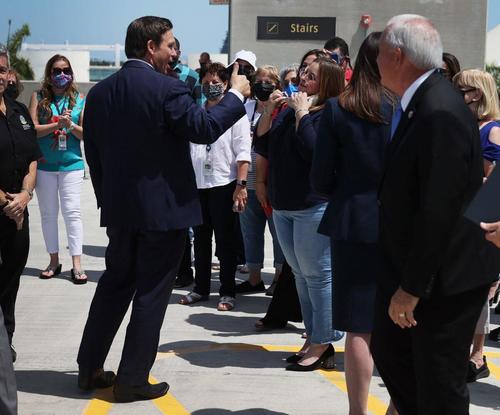
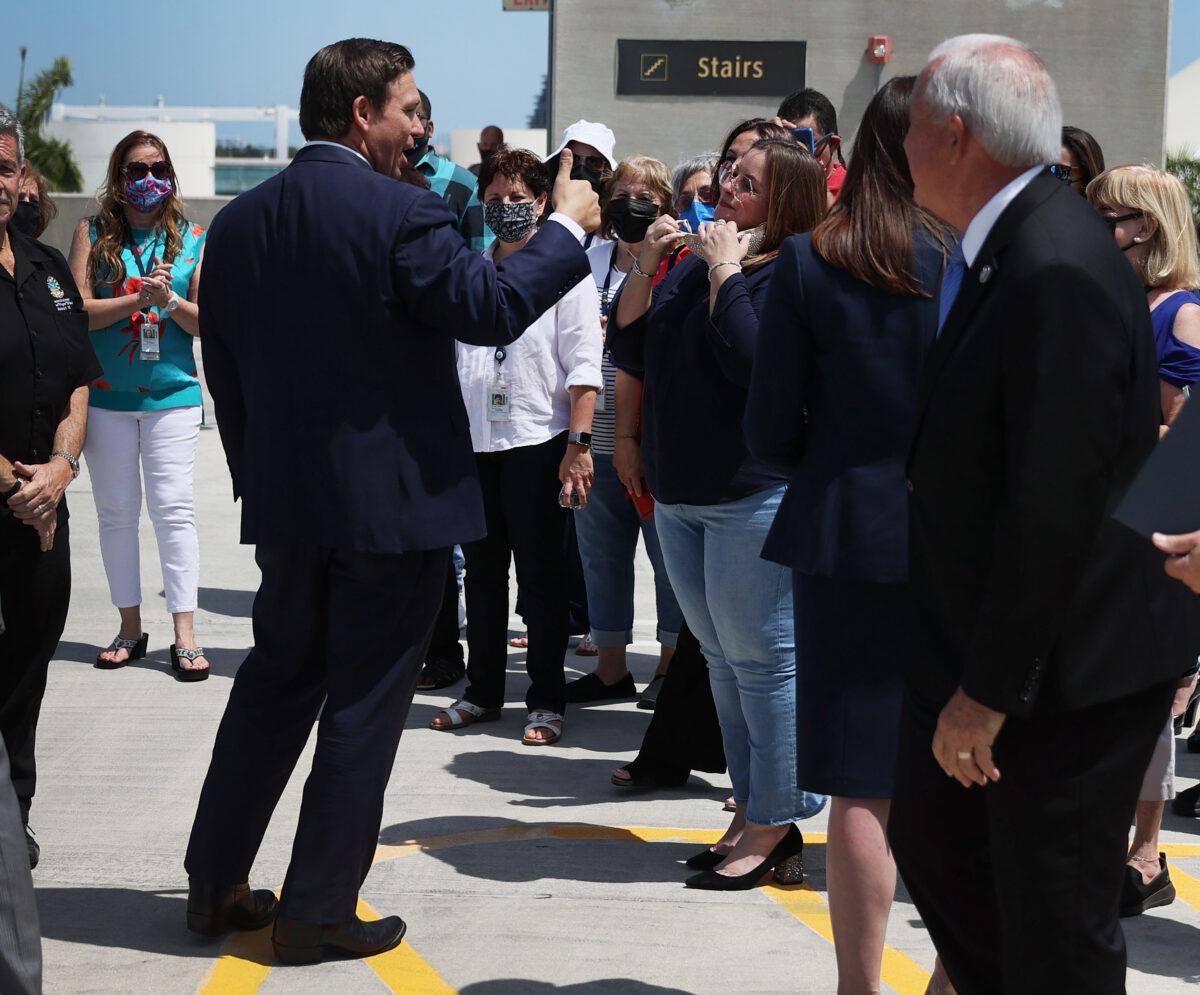
Florida Gov. Ron DeSantis gives a thumbs up as he leaves a press conference where he spoke about the cruise industry at Port Miami on April 08, 2021 in Miami, Florida. (Joe Raedle/Getty Images)

‘Don’t Let Them Roll Over Us’

The Epoch Times spent a day embedded with DeSantis as he crisscrossed the state on April 1, jetting southeast from the seat of state government in Tallahassee to a press conference in Titusville and then back north to the Clay County Fair on the outskirts of Jacksonville.

Across dozens of encounters with Floridians from all walks of life, one trend persisted. People thanked DeSantis for his work and his policies. Business owners praised him for not shutting them down.

Chris Allen, the owner of Java Jitters, opened a coffee shop in Orange Park Mall during the pandemic.

“We could not have done that if it wasn’t for Ron DeSantis,” Allen told The Epoch Times after personally thanking the governor during an encounter at the Clay County Fair.
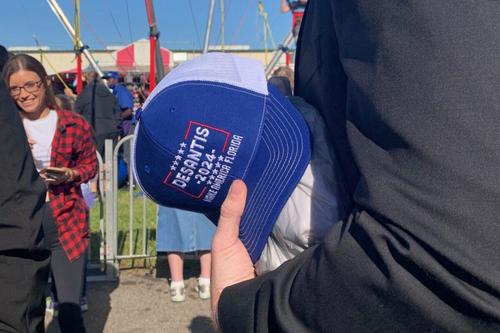
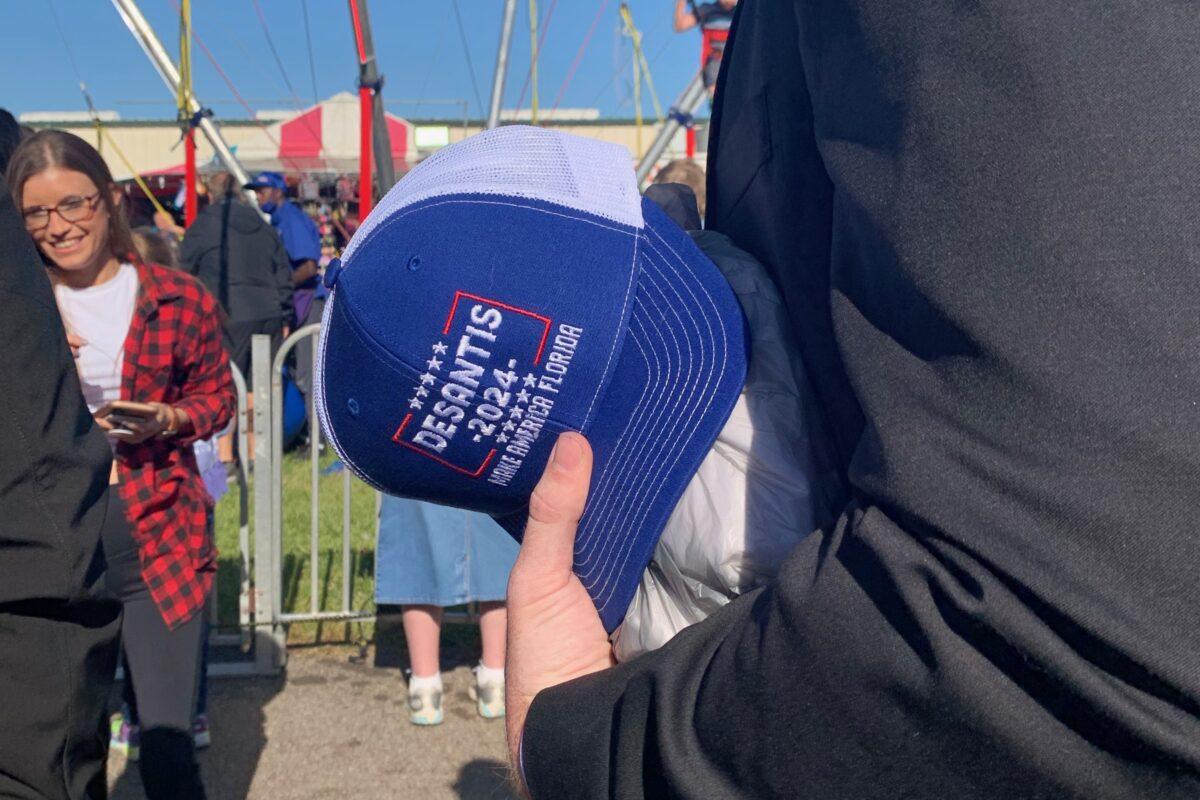
A staff member for Gov. Ron DeSantis holds a “DeSantis 2024, Make America Florida” hat at the Clay County fair on April 1, 2021. The staff member said the hat was handed to the governor by a fair attendee. (Ivan Pentchoukov/Epoch Times)

At the time of the interview, Florida’s unemployment rate was 4.7 percent compared to 6.2 percent nationally. Lockdown states like New York, New Jersey, Pennsylvania, and California had some of the highest rates in the country—8.9 percent, 7.8 percent, 7.3 percent, and 8.5 percent respectively.

“I have a tough time paying for a meal in Florida just because I saved a lot of these restaurants from oblivion,” DeSantis said. Hours after this claim, a curly fries stand at the fair declined to charge the governor.

DeSantis said some people get emotional when they meet him. Several of the interactions with the governor at the Clay County Fair resembled that description. An visibly moved elderly veteran urged the governor to not “let them roll over us.”

“If we hadn’t stood up, these people may not have jobs, the businesses may have gone under, the kids wouldn’t be in school, there’d be all these things,” DeSantis said.

“This really, really impacts people in a very personal way. And I don’t think anything prior to COVID that I’ve seen in politics can quite do it on this level. And it’s really unfortunate that there were governors that had power [who did] the opposite. It really shouldn’t depend on the governor.”

Reopening the state wasn’t as easy as lifting his own stay-at-home measures. When DeSantis issued the final reopening order in late September last year, he signed a companion order prohibiting local Florida governments from restricting people from working or operating a business. The order had far-reaching consequences across the state, especially in densely-populated, liberal-leaning locales where the local authorities imposed their own strict measures.

DeSantis adopted a hands-off approach to local regulations at first, thinking that voters would ultimately hold local authorities responsible. It became obvious eventually that some places would remain locked down despite the data showing that doing so would have no positive impact on the spread of the virus.

“They weren’t going to open this stuff up unless I pried it open,” DeSantis said.

“We had the data. We talked to some of the best scientists in the country,” DeSantis said, referring to Martin Kulldorff from Harvard, Jayanta Bhattacharya from Stanford, and Sunetra Gupta from Oxford.

“Every Floridian has a right to work. Every business has a right to operate.”

In areas that were forced to reopen as a result, the economies are now booming with new hotels and restaurants opening, DeSantis said.

DeSantis received a law degree from Harvard and is a textualist when interpreting the Constitution. He believes barring the local authorities from placing restrictions on the people and businesses was squarely within his authority.

“You can’t have 67 different minimum wages, or 67 different regulations on hotels. We are one state economy, and we need to have certain rules of the road,” DeSantis said.
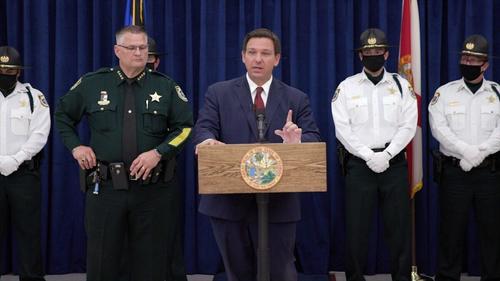
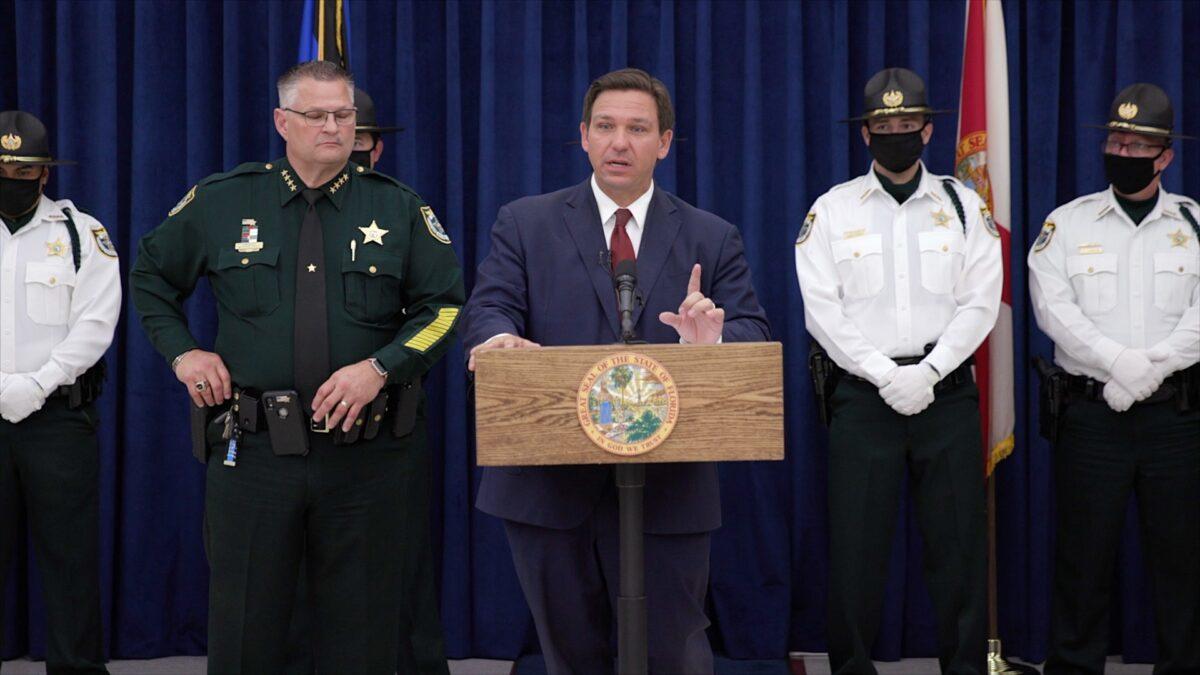
Gov. Ron DeSantis delivers remarks at a press conference in Titusville, Florida, on April 1, 2021. (Screenshot via Epoch Times)

‘They Are Never Going to Admit They Were Wrong’

Standing behind the desk in his office in Tallahassee, DeSantis leafed through a folder of praise he’s received from around the nation and across the globe. Hanging on the walls around the relatively small space was a portrait of Abraham Lincoln, the Constitution, and the Bill of Rights as well as the uniform the governor wore as the captain of the Yale baseball team.

When asked why he chose Lincoln, DeSantis said the president is the best example of a leader who had to make difficult decisions in a time of crisis. When asked why some of the leaders today have continued with lockdowns even with ample evidence of their ineffectiveness, the governor theorized that the people involved have committed too much to the narrative and have made it impossible to change course.

“You have a situation where if you’re in this field, the pandemic, that’s something that you kind of prepare for and you’re ready for. And a lot of these people muffed it,” he said.

“When push came to shove, they advocated policies that have not worked against the virus but have been very, very destructive. They are never going to admit they were wrong about anything, unfortunately.”

Elected leaders aren’t the only ones to blame, according to the governor. The media and big tech companies played a major role in perpetuating fears about the virus while selectively censoring one side of the mitigation debate. DeSantis said the media and tech giants stood to benefit from the lockdown as people stayed home and consumed their products.

“It was all just to generate the most clicks that they could. And so that was always trying to do the stuff that would inspire the most fear,” DeSantis said.

Two weeks after the interview, an undercover video recorded by Project Veritas showed a technical director at CNN talking about the boost the network received due to its pandemic coverage.

“It’s fear. Fear really drives numbers,” CNN Technical Director Charlie Chester said. “Fear is the thing that keeps you tuned in.”

The fear-mongering worked, DeSantis said, pointing to CDC statistics showing that 4 out of 10 American adults delayed or avoided getting urgent or routine medical treatment in June 2020. The agency’s report said that the pattern may have contributed to the excess deaths reported during that period, due to preventable illnesses and injuries going untreated.

Emergency room doctors had reported that fewer people were coming in with cardiac-related chest pains while more were coming in with late-stage appendicitis, something that is usually caught much earlier. The pandemic has also led to a sharp decrease in cancer screenings and detections.

“When you have people too scared to go to the emergency room when they’re literally having a heart attack, that didn’t happen in a vacuum,” DeSantis said.

“Corporate media played a role in that, by really whipping up people into a frenzy.”

The profit motive wasn’t the only factor potentially driving the media’s slanted coverage, according to the governor. The pandemic hit the United States in an election year, presenting an opportunity to heap the blame on President Donald Trump.

“They viewed it as an opportunity to damage Trump. Obviously, they hated Trump more than anything,” DeSantis said.
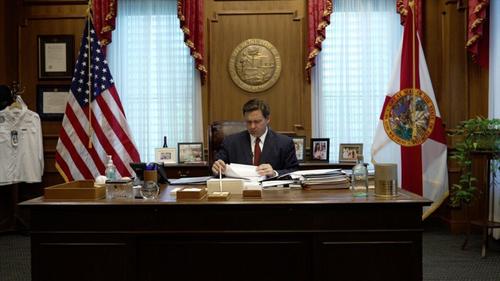
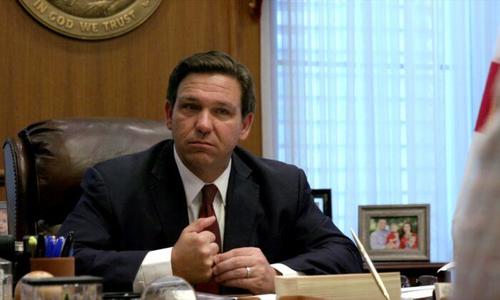
Florida Gov. Ron DeSantis in his office in Tallahassee, Florida, on April 1, 2021. (Screenshot via Epoch Times)

‘Council of Censors’

In the April 1 interview, DeSantis criticized big tech companies for censoring critics of lockdowns. Less than a week after the interview, the governor himself became the victim of censorship. YouTube, without warning, scrubbed videos of a roundtable discussion between DeSantis and prominent scientists from Harvard, Oxford, and Stanford who assessed that lockdowns are ineffective.

The American Institute for Economic Research (AIER) was the first to flag the video’s disappearance. The original clip is now hosted on a different platform and appears along with a full transcript on the AIER website.

“Google and YouTube have not been, throughout this pandemic, repositories of truth and scientific inquiry, but instead have acted as enforcers of a narrative, a big tech council of censors in service of the ruling elite” DeSantis said in response to YouTube’s censorship during an April 12 video conference call with three of the scientists from the banned video.

“When they took down the video … they were really continuing what they’ve been doing for the past year: stifle debate, short-circuit scientific inquiry, make sure that the narrative is not questioned. And I think that we’ve seen already that that has had catastrophic consequences for our society.”

The takedown of the video suggests that Big Tech intends to keep exercising the awesome power it directed against Trump in the closing days of the previous administration. Twitter and Facebook banned the president, cutting off a direct line of communication between the commander-in-chief and tens of millions of Americans.

DeSantis thinks that the power monopolies have now is far more extensive than what the United States had witnessed at the turn of the century.

“What we’ve seen with the big tech and the censorship, they are exercising more power than the monopolies at the beginning of the 20th century ever could have exercised,” the governor said. “The type of power that they’re exercising now in some respects is even more profound than the type of power that government typically exercises.”

No End In Sight

Desantis believes the lockdown states may never fully reopen because the leaders there have invested so heavily in the narrative while the voters have grown fearful.

While restrictions are easing across the nation, only six states, including Florida, have fully reopened, according to a tracker maintained by USA Today. Eight states never issued a stay-at-home order.

“I think if your goal is no cases, then there may never be an end to it, because you’re never gonna have zero COVID,” DeSantis said, adding that a more pragmatic goal would be to aim towards a hospitalization rate indicative of a respiratory virus endemic.

“But I don’t know that they’re willing to accept that reality. I think they’re going to try to have no cases at all, which would basically mean there would never be a full end to these policies, which is scary.”

https://www.zerohedge.com/political/florida-gov-desantis-says-lockdowns-were-huge-mistake

Editas Medicine Falls as Goldman Sachs Initiates the Stock at Sell

 Editas Medicine  (EDIT) - Get Report dropped Friday after analysts at Goldman Sachs initiated coverage on shares off the company with a sell rating and a price target of $20 a share, a Wall Street low. 

The firm said the risk-reward dynamic was skewed negatively for the clinical stage genome editing company. 

Initial results from the company's experimental Crispr gene editing product EDIT-11 in a rare eye disease may not generate enough productive editing to meaningfully improve patients' vision, analyst Madhu Kumar said in his note initiating coverage on the stock.

https://www.thestreet.com/investing/editas-medicine-edit-goldman-sell-initiation

UK-based biotech Gyroscope Therapeutics Holdings files for a $100 million US IPO

 Gyroscope Therapeutics Holdings, a UK-based Phase 2 biotech developing gene therapies for ocular diseases, filed on Friday with the SEC to raise up to $100 million in an initial public offering.


Gyroscope's mission is to preserve sight and fight the devastating impact of blindness, with an initial focus on age-related macular degeneration (AMD). The company is developing a differentiated pipeline of recombinant adeno-associated virus gene therapy candidates. Its lead investigational gene therapy, GT005, is advancing in an ongoing Phase 1/2 trial and is being evaluated in Phase 2 trials in two different genetically defined patient populations with geographic atrophy, an advanced form of dry AMD.

The Hertfordshire, United Kingdom-based company was founded in 2016 and booked $3 million in revenue for the 12 months ended January 31, 2021. It plans to list on the Nasdaq under the symbol VISN. Gyroscope Therapeutics Holdings filed confidentially on January 11, 2021. Morgan Stanley, Goldman Sachs and Citi are the joint bookrunners on the deal. No pricing terms were disclosed.

Medical equipment services provider Agiliti sets terms for $500 million IPO

 Agiliti, which provides medical equipment management, rental, and maintenance services, announced terms for its IPO on Thursday.


The Minneapolis, MN-based company plans to raise $500 million by offering 26.3 million shares at a price range of $18 to $20. At the midpoint of the proposed range, Agiliti would command a fully diluted market value of $2.6 billion.

Agiliti believes it is one of the leading experts in the management, maintenance, and mobilization of medical devices, offering a comprehensive suite of medical equipment management and service solutions. Its customer base includes approximately 7,000 active national, regional, and local acute care hospitals, health system integrated delivery networks, and alternate site providers.

Agiliti was founded in 1939 and booked $773 million in revenue for the 12 months ended December 31, 2020. It plans to list on the NYSE under the symbol AGTI. BofA Securities, Goldman Sachs, Morgan Stanley, BMO Capital Markets, Citi, Jefferies and UBS Investment Bank are the joint bookrunners on the deal. It is expected to price during the week of April 19, 2021.