Search This Blog

Saturday, April 17, 2021

3 Hot Healthcare Stocks Cathie Wood Is Buying in April

 ARK Invest CEO Cathie Wood stated in December that "the biggest upside surprises are going to come from the genomic space." She even has an exchange-traded fund (ETF) focused heavily on trying to capitalize on those potential upside surprises with the ARK Genomic Revolution ETF (NYSEMKT:ARKG).

But Wood doesn't want to miss out on the opportunities with her ARK Innovation ETF (NYSEMKT:ARKK) either. Here are three hot healthcare stocks she's been buying for her flagship ETF in April.

1. Beam Therapeutics

Wood's ARK Innovation ETF has scooped up shares of Beam Therapeutics (NASDAQ:BEAM) on six different days so far this month. The company isn't the well-known investor's favorite biotech just yet, but it's definitely one that she really likes.

Beam Therapeutics is pioneering a type of gene editing called base editing. This approach enables changes to a single DNA base, which is the most finely targeted way possible to modify a gene. The company uses the analogy of scissors and pencils to describe what it does. It compares existing gene-editing methods to scissors that cut the genome, while base editing is like using pencils to erase and rewrite one "letter" (or base) in the genome at a time. 

To be sure, Beam Therapeutics isn't very far along with its technology yet. The biotech doesn't have any programs in clinical testing. Its most advanced preclinical candidate, BEAM-101, targets the treatment of rare blood diseases beta-thalassemia and sickle cell disease. Beam hopes to file for U.S. Food and Drug Administration (FDA) approval later this year to advance BEAM-101 into early-stage clinical testing. 

Wood isn't the only investor who likes Beam Therapeutics. The company has a market cap of around $4.6 billion despite being years away from the possibility of having an approved product. This shows just how much enthusiasm Beam's base editing approach has created. It's definitely a risky stock, but one that could pay off big-time if base editing delivers on its potential.

2. Fate Therapeutics

Fate Therapeutics (NASDAQ:FATE) already ranks among the top 10 holdings of the ARK Genomic Revolution ETF. It could also be moving up the list for Wood's ARK Innovation ETF, which has bought shares of the biotech three times so far in April.

The company focuses on developing cellular immunotherapies targeting cancer and immune disorders. Fate's approach is to use renewable master induced pluripotent stem cells (iPSCs). Pluripotent stem cells are unique in that they can develop into any kind of cell. The biotech's technology enables producing "off-the-shelf" immunotherapies based on these induced pluripotent stem cells.

Fate's pipeline currently includes four iPSC programs in early-stage clinical testing for treating seven different cancer indications. Its most advanced candidate, though, is ProTmune -- an experimental therapy derived from donor cells in phase 2 testing for hematopoietic stem cell transplantation (HSCT) grafts. 

The biotech reported promising early results from phase 1 studies of two of its iPSC candidates in December 2020. Its share price has nearly tripled over the last 12 months thanks primarily to those updates. 

3. 10x Genomics

10x Genomics (NASDAQ:TXG) sits only a couple of spots outside of the top 10 holdings of the ARK Genomic Revolution ETF. The ARK Innovation ETF has also bought the stock on five days so far this month. 10x Genomics currently ranks as the 16th largest holding for that ETF. 

The company's Chromium technology is turbocharging genetic research by enabling scientists to explore single cells in ways that haven't been possible in the past. Its Visium platform enables researchers to see how different cells interact with each other in tissue.

10x's systems are used by 98 of the top 100 global research institutions. They're also used by 19 of the top 20 biggest pharmaceutical companies in the world. The company's technology has helped make important discoveries in multiple diseases, including COVID-19 and cystic fibrosis.

Wood is probably especially attracted to 10x Genomics because of its huge market opportunity. The company estimates its addressable market in life sciences research is around $15 billion, with another $10 billion potential in downstream applications for in situ analysis (the sequencing of molecules in their native tissue). With a market cap of close to $21 billion, 10x Genomics should still have plenty of room to grow.

https://www.fool.com/investing/2021/04/17/3-hot-healthcare-stocks-cathie-wood-is-buying-in-a/

Peloton Fights Fed Safety Recall Request On Treadmill Linked To Child's Death

 Peloton is under federal pressure to recall its Tread+ machine after one child died and other customers were injured last month.

What Happened: Federal regulators are asking exercise equipment company Peloton Interactive Inc (NASDAQ: PTON) to conduct a safety recall of its $4,295 Tread+ treadmill.

Peloton is fighting the request, which comes after a child died and dozens of others were injured using the machine last month, the Washington Post reported, citing officials familiar with the matter.

According to the Washington Post, the Consumer Product Safety Commission (CPSC) earlier this week issued a subpoena asking Peloton to provide "the name of the child who died and the family's contact information so regulators can continue an inquiry into what went wrong."

The CPSC has found "dozens" of incidents involving Peloton's treadmills, including reports of users who experienced injuries such as broken bones and head trauma after getting trapped beneath the equipment.

Peloton issued a statement today calling the agency's information "inaccurate and misleading."

Separately in February, the CPSC also received a report about the Tread+ when a 3-year-old boy suffered a "significant brain injury" after being pulled under the treadmill.

After reports on the number of accidents and the severity of the injuries reported, CPSC staff decided to recommend that Peloton issue a product safety recall.

Peloton, which is worth $34 billion, has been negotiating with regulators on the wording and timing of an alert to consumers regarding possible dangers posed by the Tread+.

Peloton came under fire in March after its CEO and co-founder John Foley posted a letter to its website about the child's death, calling it a "tragic accident." Critics said the company did not do enough to address the family involved.

Peloton bikes range in price from $1,895 to $2,495, and the treadmills cost from $2,495 for the basic model to $4,295 for Tread+.

Why It Matters: The company has said its treadmills are "safe for use when the warnings and safety instructions we provide are followed."

Treadmill-related accidents and deaths are at an alarming stage in the U.S. According to the CPSC, an estimated 22,500 treadmill-related injuries were treated at emergency departments in 2019. About 2,000 in children under 8 years old were treated in the department.

The agency received reports of 17 deaths associated with treadmills from 2018 to 2020.

https://finance.yahoo.com/news/peloton-fights-federal-safety-recall-164552814.html

Japan PM, Pfizer CEO discuss delivery of additional vax doses in 2021

 Japanese Prime Minister Yoshihide Suga asked U.S. drugmaker Pfizer Inc (PFE.N) on Saturday to provide additional supplies of COVID-19 vaccine to Japan this year, Nikkei reported.

Pfizer confirmed in an email that Pfizer CEO Albert Bourla met with Suga virtually to discuss vaccine supply on the last day of Suga's three-day visit to Washington. The Pfizer/BioNTech vaccine is the only one approved in Japan.

Japan's Nikkei newspaper reported earlier that Suga asked Pfizer to provide more vaccine doses.

Inoculations of Japan's sizable elderly population began on Monday, but some experts cautioned that the general population may not have access to vaccination until late summer or even winter because of constrained supplies.

Japan was among the last major economies to begin COVID-19 inoculations when it started in mid-February, after domestic trials to ensure safety.

Only 0.9% of the Japanese public received their first vaccine shot as of Friday, compared with 2.5% in South Korea, and 48% in the United Kingdom.

Japan's top health experts have acknowledged that the COVID-19 pandemic has entered a fourth wave.

Japan has exhibited "poor performance" in containing virus transmission, along with limited testing capacity and a slow vaccination rollout, according to a commentary of health experts published in the British Medical Journal on Wednesday.

Tokyo's Olympics chief said on Friday that Japan was committed to holding a safe Games this summer, as a surge in COVID-19 cases prompted an expansion of contagion controls and with fresh calls for the Games to again be postponed or canceled.

https://www.reuters.com/world/asia-pacific/japanese-pm-pfizer-ceo-discuss-delivery-additional-vaccine-doses-2021-japan-2021-04-17/

Human Trials Begin for Low-Cost COVID Vax to Extend Global Access

 In a major boost to efforts to combat COVID-19 globally, a vaccine that recently entered human trials in Vietnam and Thailand, and is slated for a clinical study in Brazil, holds promise for affordable vaccine manufacturing in countries currently dependent on imported vaccines. The vaccine is the result of a partnership between The University of Texas at Austin, the Icahn School of Medicine at Mount Sinai in New York and global partners interested in advancing the supply of affordable vaccines to address the pandemic.

The vaccine, NDV-HXP-S, can be stored at 2-8 degrees Celsius and is made in eggs, a method also used for flu vaccine manufacturing. These factors mean that affordable manufacturing capacity already exists in each of the countries involved with trials.

The vaccine uses a highly stabilized spike protein from the surface of the coronavirus in order to train the human immune system to recognize and fight infection. This modified spike protein, dubbed HexaPro and engineered by three faculty labs at UT Austin, was found in earlier research to be promising for use in robust vaccines. Other vaccines also use stabilized spike proteins, but this is HexaPro’s first use in a vaccine in human trials.

“My team and I are thrilled that our second-generation stabilized spike protein is part of this vaccine,” said Jason McLellan, an associate professor of molecular biosciences who co-developed HexaPro, having previously helped develop the spike protein now in use in all of the COVID-19 vaccines U.S. residents are receiving. “Our hope is that the vaccine will be safe, efficacious and affordable, allowing more people around the world to have protection against COVID-19.”

In early 2020, McLellan, who holds the Welch Chair in Chemistry, and his team joined with collaborators at the National Institute of Allergy and Infectious Diseases’ Vaccine Research Center to design a version of the SARS-CoV-2 spike protein that is stabilized to help the body recognize the threat. In nature, the spike protein changes shape, making it more difficult for the body to recognize, so the team used two mutations to hold the protein in its shape. This 2020 version of the spike protein is the basis of all the vaccines approved for distribution in the United States.

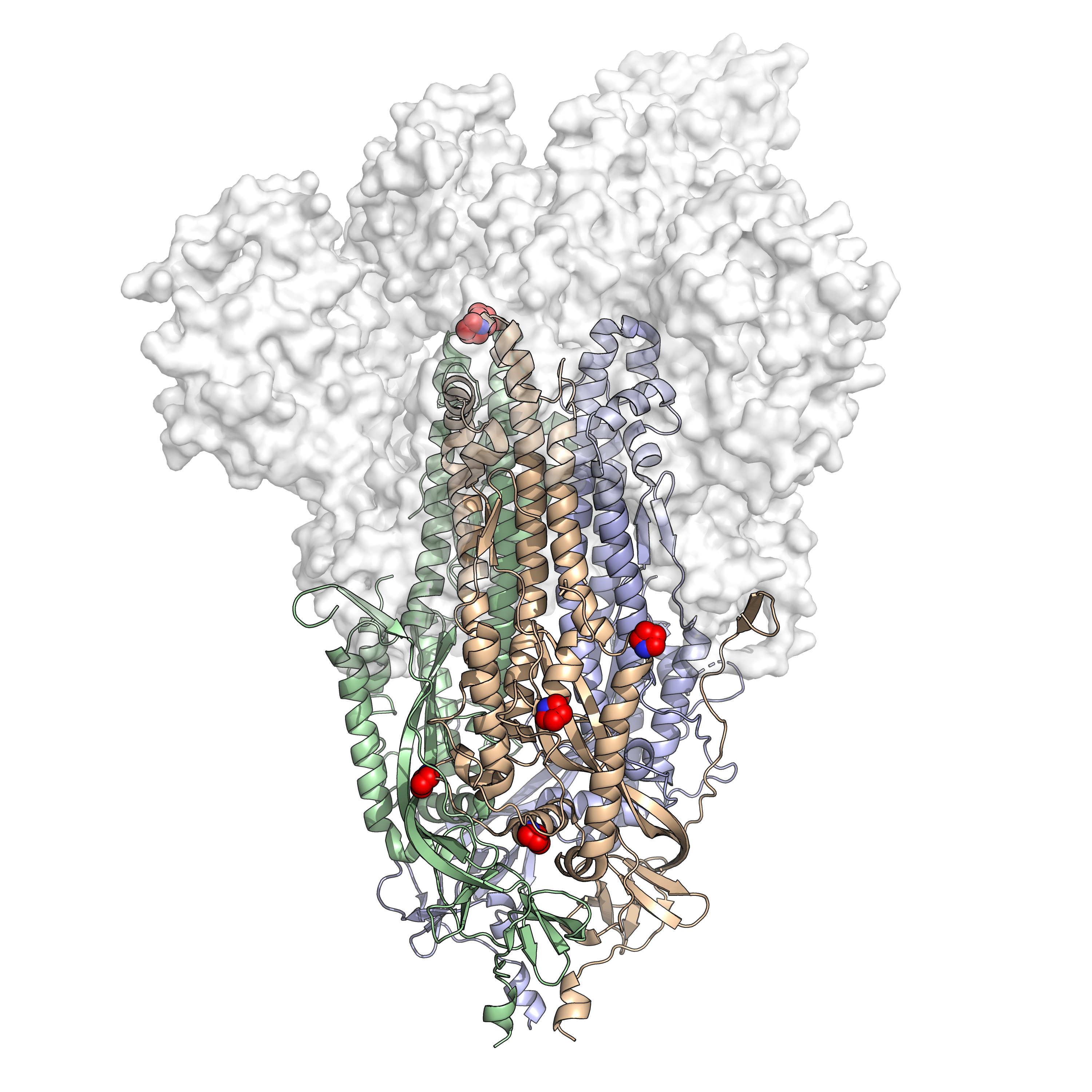
Building on that success, the UT Austin team designed HexaPro, an even more stabilized version of this protein — featuring not two but six mutations that act as molecular staples. The result is the production of more spike proteins to help the body fight infection.

HexaPro
This is a 3D atomic scale map, or molecular structure, of Hexapro, a modified version of the SARS-CoV-2 spike protein, described in a paper in the journal Science on July 23, 2020. Six key modifications, called prolines, are indicated as red and blue spheres and help lock the protein into the prefusion shape. Credit: University of Texas at Austin.

Among the biggest obstacles to mass COVID-19 vaccination in lower income countries are cost and storage. Peter Palese, the Horace W. Goldsmith professor and chair of microbiology and professor of medicine at Icahn School of Medicine at Mount Sinai, genetically engineered a virus called Newcastle Disease Virus to help the body recognize the spike protein from the Texas team. Other members of the Mount Sinai team include Adolfo Garcia-Sastre, professor of microbiology, and Florian Krammer, professor of vaccinology.

NDV-HXP-S (named for both the Newcastle Disease Virus and HexaPro) is produced using the same method that has been used for influenza vaccines since the 1950s, which is faster, cheaper and less complicated than the methods used to produce several leading COVID-19 vaccines. The vaccine is also stable at regular refrigerator temperatures (2-8 degrees Celsius) for weeks, a much higher temperature than needed for leading mRNA COVID-19 vaccines.

“We are witnessing unprecedented disparities in COVID-19 vaccine access around the world,” said Ilya Finkelstein, an associate professor in the Department of Molecular Biosciences, a collaborator on the technology. “We designed HexaPro to be a more stable antigen. In cell culture, this translated to a more than tenfold increased yield relative to the first-generation spike constructs used in current vaccines. If this holds for NDV-HXP-S, HexaPro will bring us a step closer towards addressing the wide disparity in vaccine access.”

Other members of the UT Austin team who led development of HexaPro are Jennifer Maynard, a professor in the Cockrell School of Engineering’s McKetta Department of Chemical Engineering, and Ching-Lin Hsieh, a postdoctoral researcher in McLellan’s lab.

“This project is a great example of how academic research labs can work together to meet a pressing need and contribute to development of new medicines,” Maynard said.

Via license agreements with Mount Sinai and UT Austin, the global organization PATH is helping provide access to the vaccine to manufacturers in each of the three countries: Vietnam’s Institute of Vaccines and Medical Biologicals (IVAC), Thailand’s Government Pharmaceutical Organization (GPO) and Brazil’s Butantan Institute. PATH has also had a limited technical advisory support role during the vaccine’s development, aligning with PATH’s commitment to advancing the supply of affordable and accessible vaccines.

A U.S. patent application has been filed for HexaPro, with the following inventors: Ching-Lin Hsieh, Jory A. Goldsmith, Jeffrey M. Schaub, Chia-Wei Chou, Andrea M. DiVenere, Kamyab Javanmardi, Hung-Che Kuo, Daniel Wrapp, Patrick O. Byrne, Christy K. Hjorth, Nicole V. Johnson, Nianshuang Wang, Jennifer A. Maynard, Ilya J. Finkelstein and Jason S. McLellan.

https://news.utexas.edu/2021/04/05/human-trials-begin-for-a-low-cost-covid-19-vaccine-to-extend-global-access/

J&J vax pause makes it tougher to immunize hard-to-reach populations

 The Johnson & Johnson Covid vaccine pause may not significantly slow the overall pace of the U.S. vaccine rollout, but is making it tougher for hard-to-reach populations to get a shot.

Following the Food and Drug Administration’s request on Tuesday that states temporarily halt using the J&J vaccine “out of an abundance of caution” after six women developed a blood-clotting disorder, White House Covid czar Jeff Zients said that the announcement would not have a significant impact on the U.S. vaccination program.

“We have more than enough supply of Pfizer and Moderna vaccines to continue the current pace of about 3 million shots per day,” Zients told reporters at a press briefing.

So far, this has held true. The country is averaging 3.3 million daily vaccine doses reported administered over the past week, and 3 million when counting only Pfizer and Moderna. Only about 7.8 million of the 202 million total shots given in the U.S. have been from J&J, according to Centers for Disease Control and Prevention data.

But the single-shot Johnson & Johnson vaccine does represent about 10% of all fully vaccinated people in the U.S., a proportion that was on the rise for weeks, and it has proven valuable for certain situations and communities.

“Because of the characteristics of the J&J vaccine, it is being used in many cases for particular circumstances and populations for which it has been harder to get vaccines for,” said Josh Michaud, associate director for global health policy at the Kaiser Family Foundation. 

Mass vaccination sites and mobile vans that drive doses to be administered on the go likely have an easier time with the Johnson & Johnson storage requirements, Michaud said. That vaccine only needs to be kept in a standard refrigerator while the needs for Pfizer and Moderna are more strict.

And for certain populations, such as prisoners who are changing facilities or homeless people who do not have a permanent residence, administering a two-dose regimen can be a challenge. Many states have been using the J&J vaccine with these groups because it’s hard to find people to administer a second dose, according to Michaud. 

The one-shot option may also be more appealing to those who are more hesitant to get a vaccine. A March Kaiser Family Foundation survey showed that among those who say they want to wait and see how the vaccines are working before getting vaccinated themselves, a larger share would get the J&J one-dose vaccine compared to either of the two-dose options.

One in six people in the “wait and see” group said they would “definitely get” the J&J vaccine, while roughly one in ten said the same about the Pfizer or Moderna vaccines.

“We know there is a significant portion of people on the fence about vaccines in general,” Michaud said, “And I think the J&J vaccine is actually a plus for that group. It’s a big selling point for people on the fence.”

Add all of these factors up and the J&J pause could have “an important negative impact on the U.S. vaccination rate,” he said.

It is not yet clear how long the halt on using the Johnson & Johnson vaccine will last. White House chief medical advisor Dr. Anthony Fauci has said that the pause could last from a matter of days to a few weeks

Vaccinating the homeless

Shelly Nortz, deputy executive director for policy with the New York City-based advocacy group Coalition for the Homeless, said the Johnson & Johnson vaccine pause will make it harder to get shots for the population she works with.

The coronavirus has hit New York City’s homeless hard, particularly those in communal living facilities. A Coalition for the Homeless and New York University analysis showed that as of February, the age-adjusted mortality rate for sheltered homeless New Yorkers was 49% higher than the citywide rate.

And while the vaccination campaign among New York homeless is off to a solid start — Nortz said the city’s most recent announcement showed about 4,500 fully vaccinated single homeless adults out of some 21,000 in total, a pace not far behind the nationwide rate — the J&J halt is going to be a hurdle.

“Everybody was really eager to have the one-and-done situation with J&J,” she said, “especially for people who are unsheltered and therefore not in the same place predictably.”

The Coalition for the Homeless recently launched a partnership with the Center for Urban Community Services, which offers mobile medical care across New York, to provide the Johnson & Johnson vaccine at one of its emergency food sites. That program is now on hold, as are discussions about offering the J&J vaccine at the group’s headquarters where many clients come to pick up their mail.

Dr. Van Yu, chief medical officer at CUCS, agrees that a two-dose Pfizer or Moderna vaccine regimen makes things much more complicated.

“If you’re living outside, how am I going to find you in four weeks?” he said.

Yu said the shelter system can make it easier to keep track of people, but there is still a lot of churn as people come and go or are reassigned to one of New York City’s hundreds of shelter sites.

The ease of storing the J&J shots is another advantage when vaccinating the homeless, according to Nortz. 

“The fact that the other two approved vaccines require, in one case, deep refrigeration storage makes it very challenging to do anything mobile or pop-up or with an unknown number of people showing up,” she said.

Zients said Tuesday that all vaccine delivery channels, including mobile delivery units, are equipped to deliver all three vaccines. Yu said the Moderna vaccine is easy enough to handle at his group’s mobile sites, but that the Pfizer vaccine’s ultra-cold refrigeration requirement means it’s not an option.

He is currently sitting on 185 unused J&J doses, and does not have access to any Moderna vaccines.

Some homeless people in the South Bronx, where Noel Concepcion works as the department director of adult homeless services for the nonprofit group BronxWorks, have preferred the J&J vaccine because it only requires one dose. But the pause and surrounding misinformation is making it harder to communicate the importance of vaccinations to a group that is already skeptical of the government, Concepcion said, and it may fuel some hesitancy toward all three vaccine options.

BronxWorks had to cancel a vaccination event to use existing supply of J&J shots due to the pause, according to Concepcion.

J&J more convenient for many working people

Other barriers to getting a Covid vaccine, such as an inflexible work schedule or childcare responsibilities, have made the single-shot Johnson & Johnson vaccine an essential option for some.

Liz Schwandt, who runs a volunteer group called Get Out the Shot aimed at helping people book vaccine appointments in Los Angeles, said that many of the callers into her team’s helpline don’t have traditional job benefits or protections such as time off from work. Many of them are domestic workers such as house cleaners, private nannies, or gardeners who get paid in cash off the books. Some are employees who do not work a 9-to-5 job, like the group of night shift custodians that Get Out the Shot recently booked appointments for.

“We hear stories all the time like hey, my employer is making me get the vaccine, but won’t give me time off,” she said, adding that “for a working family, missing four hours of a shift [for a vaccination appointment] can be a big wage loss.” 

Childcare responsibilities and reliance on public transportation also make going to multiple appointments more tedious, according to Schwandt.

While Get Out the Shot books appointments for all three vaccines, Schwandt said the FDA’s initial approval of the J&J vaccine back in February was welcome news.

“We were so thrilled with it,” she said. “We loved having the one and done option for people.”

A CDC panel on Wednesday postponed a decision on Johnson & Johnson’s Covid vaccine while the investigation into the blood-clotting disorder continues. The panel is expected to reconvene next week, when it will decide what it will recommend to the CDC.

https://www.cnbc.com/2021/04/17/jj-vaccine-pause-could-make-it-harder-for-some-groups-to-get-a-shot.html

New codes governing everyday life in China

 It’s a ritual that has become hard to avoid in China - scanning a code with your mobile phone and proving your health credentials via an app, giving you the green light to go. Or not.

Entering residential buildings, businesses or a park, taking a plane, train or taxi, or simply trying to get home, you are well advised to make sure your phone battery is charged. In the wake of the coronavirus, tracking apps have never been so intrusive in China.

You can now count on one hand the number of official daily new cases of the virus. But the number of times your health codes are checked has never been so high. I've given up counting how many times a day I have to go through it.

For the central government, it provides a wealth of data on people’s movements. Different tracking systems are available; one runs on the popular social media platform WeChat, China’s version of WhatsApp.

The app generates a QR health code which I have to show to gain access to certain places. If it produces a green code, I am allowed to go in. But if the code is red, I have to turn around and go into quarantine for 14 days.

The app determines my health status based on the places I have been. If I have been near a cluster of Covid cases, I may be designated a suspect case. It includes my record of Covid tests. If the last test result was positive, my QR code will be red. 

Just yesterday, I received the first dose of my Covid vaccination -- now duly noted on my app for the next time I am stopped and checked.  

But the app doesn’t just log my infection record. It is linked to my identity number. Every time I scan it, it keeps a digital record of where I am at that moment. In China every residential building is under surveillance and the people in it potentially subject to health checks: they may have to have their temperature taken or fill in a form. So every outing I make, however trivial, is recorded.

No one openly obliges me to use the tracing app. But in practice, it is impossible to live without it. I tested this out one day, at a checkpoint at the entrance to the building that houses the AFP office in Beijing.

Somewhat disingenuously, I took out my old Nokia mobile telephone - a relic from the pre-smartphone era. Attempting to help me, a security guard found out that it was indeed impossible to scan a QR code using a phone without a camera. For five long minutes, he and his colleagues wondered what to do about this foreigner with his outdated telephone. Letting me in without scanning posed a health risk and could get them in trouble.

“What would an elderly person do, who didn’t have a smartphone?” I wondered, trying to keep a straight face in front of the guards. Amid the confusion, I slipped into the building. Five minutes later, our office received a call ordering me to provide a valid security code.

I don’t know if anyone learned a lesson from this incident. I have noticed that at Beijing’s international airport there is a sign advising anyone who does not have a mobile phone or health code to contact a member of staff. “You won't be able to pull that trick anymore,” laughed a Chinese friend of mine.

The few adults who do not have mobile phones - as well as children - are given a health code to hang around their neck. It contains their identity and address so that the authorities can check whether they come from an area considered to be at risk.

In one of the most wired countries in the world, where there is little debate about issues of privacy and data protection, giant tech companies and telephone operators have no difficulty tracking Chinese people wherever they go.

The system has enabled journeys from one end of the country to another to resume. But going on holiday has turned into an obstacle course.

A passenger taking a domestic flight must present a series of different codes: one at check-in, sometimes a second one mid-transit, and a third on arrival. At each stage the passenger must fill in a digital form on their telephone. But so far in many cases the system is not designed for foreign passport-holders.

And if you are in a hurry, you don’t want to come up against the more diligent checkpoint guards.

Travelling is a step into the unknown. Journeys are also complicated by various local health regulations. Some hotels refuse to take travellers who cannot provide a negative Covid test certificate. This rule is not uniformly imposed and can depend on the hotel staff.

Last summer I was categorised as a possible contact case after a cluster was detected in Bejing, despite the fact I was 1,800 kilometres away in the southwest. The hotel where I was staying told me I had to go into isolation for two weeks. To avoid being forced into quarantine, I fled back to Beijing, abandoning my holiday plans.

To avoid similar disappointments, many people avoided travelling for the Lunar New Year holidays in February.

To leave Beijing, travellers had to show evidence of a negative PCR test. Two tests were required to re-enter the capital, with the added risk of a two-week self-isolation period being imposed.

Travelling in China has become an administrative headache and surveillance seems to have increased. With one click on my health code, the authorities can know precisely where I have been over the past two weeks.

I grumble inwardly against the health checks that impinge on my freedom. At the same time, I have the feeling that my slightest movements are being spied upon.

Most Chinese people willingly consent to the tracing, however. During the Lunar New Year holiday, I was surprised to see all the shoppers scanning their codes to enter a mall in Beijing, even though there were no guards obliging them to do so.

Tracing apps “are the price you pay for getting your freedom back” after the virus restrictions and resuming normal life, said one of my Chinese friends. “It is a simple action to protect yourself.”

In terms of the pandemic, the system has undeniably worked. Every time someone tests positive for the virus, their contacts can be identified; their building and even their neighbourhood is placed in isolation if necessary.

In late 2019, China was in the front line of the coronavirus epidemic. Today it is one of the rare countries where the rhythm of life has returned almost to the way it was before the outbreak. That is largely attributed to widespread mask-wearing and to mass-testing.

But the tracing apps introduced to fight the disease, coupled with a pervasive network of security cameras, have provided the authorities with a formidable tool of mass surveillance. Last spring, media reported the case of a man wanted by the police who, after 24 hours on the run, turned himself in: he found it impossible to move around, enter shops or seek work without a smartphone and tracing app.

The apps can also be used to discriminate. In Wuhan, a city that was once the epicentre of the outbreak but now labelled the “safest town in the world” by its inhabitants, I was turned away from a nightclub - not because of my age or clothing, but my health code, which showed I had come from Beijing, 1,000 kilometres away, where a Covid cluster had just been detected.

https://correspondent.afp.com/new-codes-governing-everyday-life-china

New Zealand trials 'early warning' virus app at border

 New Zealand border workers on Thursday began trialling a monitoring app designed to detect coronavirus before the user develops any noticeable symptoms, in what is believed to be a world first.

The app, "elarm", connects to wearable devices such as fitness trackers and smart watches, using artificial intelligence to check variables such as  and temperature for tell-tale signs of COVID-19.

The developer, New Zealand based Datamine, claims it can detect the virus with 90 percent accuracy up to three days before the appearance of symptoms such as coughing, breathing difficulties and fatigue.

The health department said it could provide a vital early warning for workers at the  who face the most risk of exposure to the virus, now virtually only seen in arriving international travellers.

"If the elarm app lives up to its potential, it might provide early notification to our critical border workforce if they're becoming unwell," deputy health director Shayne Hunter said.

"That means they can take appropriate action such as self-isolating and being tested for COVID-19."

New Zealand has been largely successful in containing the virus, with just 26 deaths in a population of five million.

The few community cases that have occurred have generally been linked to border workers who were exposed to the virus via incoming travellers undergoing quarantine.

Hunter said about 500 border workers would take part in a month-long trial of the app.

The technology uses  to establish a health baseline for each user, then alerts them if there are physiological changes consistent with COVID-19.

The government said the privacy of the border workers was guaranteed and only they would have access to their own health data.

Elarm is already available to individuals for a monthly subscription and some firms such as US mining giant Newcrest have made it available to their employees.

However, the New Zealand trial is believed to be the first time a government has used it at the border, which is widely viewed as the frontline in containing the .

"Although this type of technology is available to consumers in other countries, the ministry of  is not aware of any other country who is trialling it in their border workforce," a spokeswoman told AFP.

https://medicalxpress.com/news/2021-04-zealand-trials-early-virus-app.html