Search This Blog

Sunday, April 18, 2021

Economic Growth Is Set to Surge; Hiring Might Not Keep Up

 U.S. employers might have trouble hiring workers fast enough in coming months to keep up with the projected burst of economic growth.

Consumer spending at restaurants, hotels and salons is already starting to take off as the grip of the Covid-19 pandemic eases and more people get vaccinated and draw on their stimulus checks and savings.

But many economists expect economic activity to pick up faster than payrolls, at least initially, for several reasons, causing bottlenecks and wage pressures.

This happened last year for many manufacturers that experienced labor shortages as Americans working from home ordered more furniture, exercise equipment and other goods than before the pandemic. This year, it is likely to be the case particularly for providers of services requiring proximity to people, since they saw the biggest drops in business and employment during the pandemic and are poised to see the biggest rebound in demand this year.

Economists surveyed by The Wall Street Journal project U.S. gross domestic product -- the value of all goods and services produced -- will grow 6.4% this year, measured from the fourth quarter of last year to the same period of this year. That would lift output to nearly 4% above its pre-pandemic level measured in the fourth quarter of 2019.

Meanwhile, the economists expect employers to add 7.1 million jobs in the 12 months ending in December 2021, a gain of 5%. That would leave employment 1.6% lower than in the fourth quarter of 2019.

Job growth will trail GDP for two key reasons, economists say. First, many companies will be reluctant to hire workers until they are convinced the pickup in consumer demand will endure. Second, millions of workers dropped out of the labor force during the pandemic and might take time to return.

Economists point to several forces behind employers' hesitancy to hire. For one, it's unclear when the pandemic will end. Though vaccination rates are rising, so too are the daily totals of Covid-19 cases in many parts of the country as variants of the virus spread and business restrictions ease

Further, many companies face uncertainties over whether they will see permanently weaker demand due to the pandemic's effects. For instance, business travel might never fully return to its previous levels. A long-lasting shift to remote work could dampen business at cafes and shops near offices.

"They're very happy to see this surge as everything reopens, but they still have tremendous uncertainty over what their revenue stream is going to look like," said Steven Blitz, chief U.S. economist at TS Lombard.

Even after an employer posts a job opening, the hiring process can take weeks or months. Meanwhile, the labor pool changed and shrank during the pandemic.

The share of Americans ages 25 to 54 who are holding or seeking jobs--called the prime-age labor-force participation rate--was 81.3% in March, down from 82.9% in February 2020, a loss of 1.9 million workers. Many of those people dropped out of the labor force to care for children while schools are closed. Others have stopped looking for work out of fear of contracting or spreading the coronavirus. The $1.9 trillion Covid-19 relief bill enacted in March also sent new stimulus checks to many Americans and extended a $300-a-week jobless-aid supplement, which could also be deterring some people from seeking work.

"It's just a lot of people who need to get back to work, and it's not going to happen overnight," Federal Reserve Chairman Jerome Powell said at a press conference last month.

The sharp fall in workforce participation shows no signs of quickly reversing. Even though job openings exceed pre-pandemic levels, Google Trends data show worker searches for jobs online declining. Daniel Zhao, senior economist at Glassdoor, said this recent drop "raises concerns that labor-force participation may not recover quickly even after the pandemic is over."

Long-term unemployment poses another hurdle. There were 4.2 million Americans in March facing jobless spells of at least 27 weeks, up from 1.1 million in February 2020.

"The longer people remain unemployed, the more those skills do start to atrophy and then it's harder for them to get back into the labor force," said Jay Bryson, chief economist at Wells Fargo's Corporate and Investment Bank.

The result could be bottlenecks that discomfort consumers, at least temporarily, until labor demand and supply are brought into balance. For instance, lines at airport security checkpoints this summer could grow long as workers attempt to serve an influx of travelers. Salons might require hairdressers to log longer hours so they can serve the many customers who went a year without a haircut. Restaurants could raise wages to attract workers, and as a result, pass on the costs through higher menu prices.

"Over the next few months you could see really strong demand, and you could get some of these pressures...in terms of wages, etc.," said Mr. Bryson. But he added, "our sense is it's not like this is an upward spiral that's going to last for years."

https://www.marketscreener.com/news/latest/Economic-Growth-Is-Set-to-Surge-Hiring-Might-Not-Keep-Up--32997491/

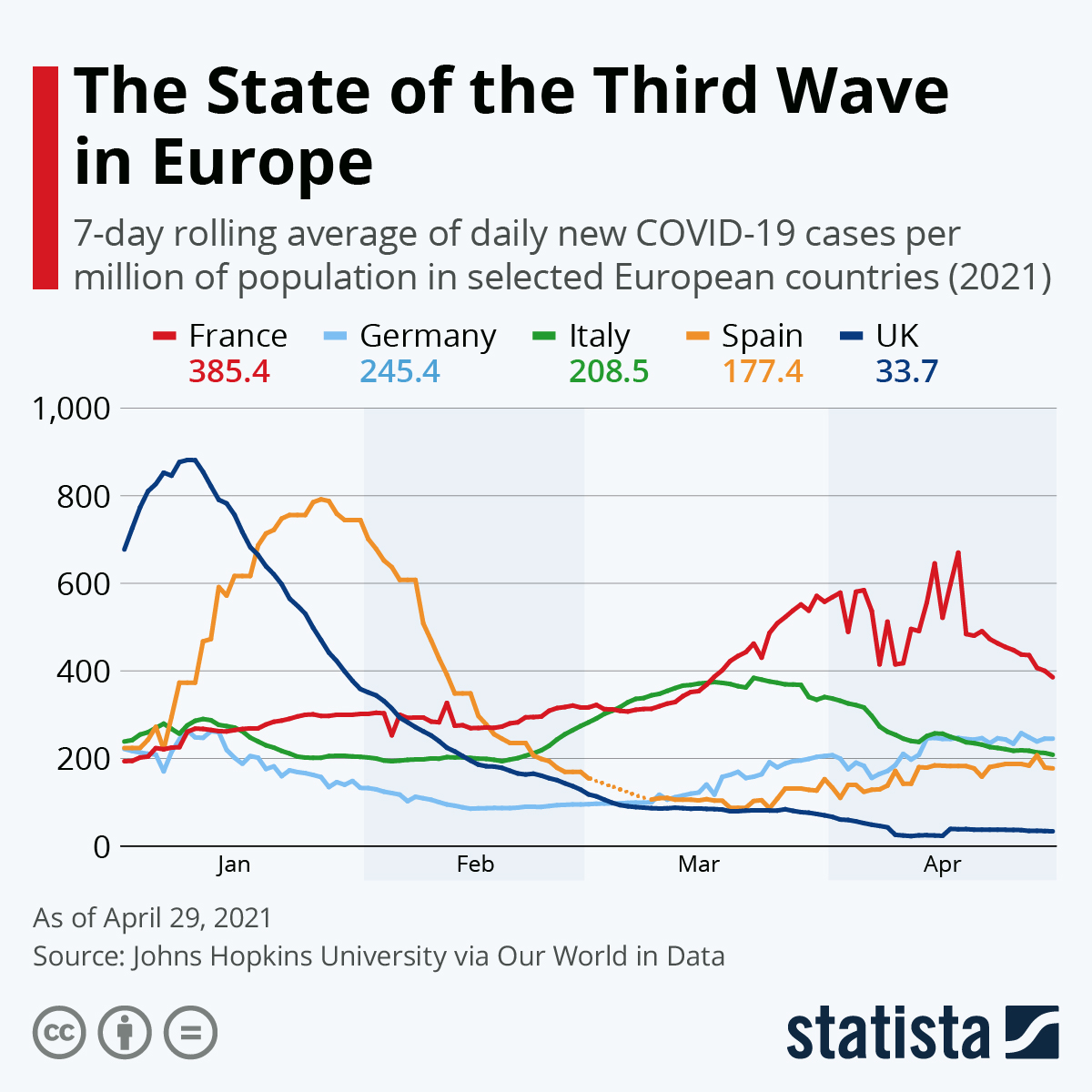
The State Of The 'Third Wave' In Europe

 While the growth of COVID-19 infections is slowing down in some European countries, others are experiencing an increase in case numbers as they head into their third wave of infections. As Statista's Katharina Buchholz notes, between the fall's second wave and the 2021's third wave, the trajectory of infection numbers became less clear, as countries were battling virus mutations while lockdown fatigue set in for citizens and politicians alike.

According to numbers by Johns Hopkins University published on Our World in Data, the UK and Spain experienced their third waves early on in the year and in short succession with the fall's second waves.

Infographic: The State of the Third Wave in Europe | Statista

You will find more infographics at Statista

While the UK's battle with the B.1.1.7 variant and subsequent successful vaccination campaign made for a stark improvement of the situation, Spain recently saw case numbers rise once more in what would constitute a fourth wave for the country.

France was one of the first in Europe to implement a second lockdown in late October, but was more hesitant during the third wave. The country locked down for a third time in mid-March but even one month later, new case numbers show no real improvement.

Germany is in a similar rut. The country went through two waves without ever coming out of its second lockdown, which started November 1, but was tightened significantly on December 16. A hodgepodge of different rules and restrictions in the federal country made getting a handle on the situation more difficult. Federally sanctioned openings started in early March but were almost instantly reversed.

Italy, which like Spain is relying on a regional lockdown system, imposed a tight temporary Easter lockdown but has recently seen third-wave infection numbers fall again.

The recent surge of infections has made France the fourth-most affected country in the world by absolute case numbers, while the UK has descended to rank six.

https://www.zerohedge.com/covid-19/state-third-wave-europe

Some Alzheimer's plaques may be protective, not destructive

 One of the characteristic hallmarks of Alzheimer's disease (AD) is the buildup of amyloid-beta plaques in the brain. Most therapies designed to treat AD target these plaques, but they've largely failed in clinical trials. New research by Salk scientists upends conventional views of the origin of one prevalent type of plaque, indicating a reason why treatments have been unsuccessful.

The traditional view holds that the brain's trash-clearing immune cells, called microglia, inhibit the growth of plaques by "eating" them. The Salk scientists show instead that microglia promote the formation of dense-core plaques, and that this action sweeps wispy plaque material away from neurons, where it causes cell death. The research, which was published in Nature Immunology on April 15, 2021, suggests that dense-core plaques play a protective role, so treatments to destroy them may do more harm than good.

"We show that dense-core plaques don't form spontaneously. We believe they're built by microglia as a defense mechanism, so they may be best left alone," says Greg Lemke, a professor in Salk's Molecular Neurobiology Laboratory. "There are various efforts to get the FDA to approve antibodies whose main clinical effect is reducing dense-core plaque formation, but we make the argument that breaking up the plaque may be doing more damage."

Alzheimer's disease is a neurological condition that results in memory loss, impairment of thinking, and behavioral changes, which worsen as we age. The disease seems to be caused by abnormal proteins aggregating between brain cells to form the hallmark plaques, which interrupt activity that keeps the cells alive.

There are numerous forms of plaque, but the two most prevalent are characterized as "diffuse" and "dense-core." Diffuse plaques are loosely organized, amorphous clouds. Dense-core plaques have a compact center surrounded by a halo. Scientists have generally believed that both types of plaque form spontaneously from excess production of a precursor molecule called amyloid precursor protein (APP).

But, according to the new study, it is actually microglia that form dense-core plaques from diffuse amyloid-beta fibrils, as part of their cellular cleanup.

This builds on a 2016 discovery by the Lemke lab, which determined that when a brain cell dies, a fatty molecule flips from the inside to the outside of the cell, signaling, "I'm dead, eat me." Microglia, via surface proteins called TAM receptors, then engulf, or "eat" the dead cell, with the help of an intermediary molecule called Gas6. Without TAM receptors and Gas6, microglia cannot connect to dead cells and consume them.

The team's current work shows that it's not only dead cells that exhibit the eat-me signal and Gas6: So do the amyloid plaques prevalent in Alzheimer's disease. Using animal models, the researchers were able to demonstrate experimentally for the first time that microglia with TAM receptors eat amyloid plaques via the eat-me signal and Gas6. In mice engineered to lack TAM receptors, the microglia were unable to perform this function.

Digging deeper, they traced the dense-core plaques using live imaging. Much to their surprise, the team discovered that after a microglial cell eats a diffuse plaque, it transfers the engulfed amyloid-beta to a highly acidic compartment and converts it into a highly compacted aggregate that is then transferred to a dense-core plaque. The researchers propose that this is a beneficial mechanism, organizing diffuse into dense-core plaque and clearing the intercellular environment of debris.

"Our research seems to show that when there are fewer dense-core plaques, there seem to be more detrimental effects," says Youtong Huang, first author on the paper. "With more-diffuse plaques, there's an abundance of dystrophic neurites, a proxy for neuronal damage. I don't think there's a distinct clinical decision on which form of plaque is more or less detrimental, but through our research, we seem to find that dense-core plaques are a bit more benign."

Their findings suggest new ways of developing a treatment for Alzheimer's disease, such as boosting expression of TAM receptors on microglia to accelerate dense-core plaque formation. The team would like to conduct cognitive studies to see if increasing the activity of microglial TAM receptors would alleviate the effects of AD.

Lemke, who holds the Françoise Gilot-Salk Chair, believes that the current failure rate of most Alzheimer's drug trials is about to end. "Some people are saying that the relative failure of trials that bust up dense-core plaques refutes the idea that amyloid-beta is a bad thing in the brain," says Lemke. "But we argue that amyloid-beta is still clearly a bad thing; it's just that you've got to ask whether dense-core plaques are a bad thing."

Lemke suggests that scientists looking for a cure for Alzheimer's should stop trying to focus on breaking up dense-core plaques and start looking at treatments that either reduce the production of amyloid-beta in the first place or therapies that facilitate transport of amyloid-beta out of the brain altogether.


Story Source:

Materials provided by Salk InstituteNote: Content may be edited for style and length.


Journal Reference:

  1. Youtong Huang, Kaisa E. Happonen, Patrick G. Burrola, Carolyn O’Connor, Nasun Hah, Ling Huang, Axel Nimmerjahn, Greg Lemke. Microglia use TAM receptors to detect and engulf amyloid β plaquesNature Immunology, 2021; DOI: 10.1038/s41590-021-00913-5

Spatial biology company Akoya Biosciences prices IPO at $20 high end

 Akoya Biosciences, which provides spatial biology solutions for discovery and clinical research, raised $132 million by offering 6.6 million shares at $20, the high end of the range of $18 to $20. At pricing, the company commands a fully diluted market value of $793 million.


Akoya delivers spatial biology solutions focused on transforming discovery and clinical research. Through its CODEX and Phenoptics platforms, reagents, software and services, the company offers end-to-end solutions to perform tissue analysis and spatial phenotyping across the full continuum, from discovery through translational and clinical research. As of December 31, 2020, Akoya had over 550 instruments installed across customers throughout North America, Europe, and APAC, a +27% increase over 2019.

Akoya Biosciences plans to list on the Nasdaq under the symbol AKYA. J.P. Morgan, Morgan Stanley, Piper Sandler and Canaccord Genuity acted as lead managers on the deal.

Oregon seeks to keep COVID mask mandate ‘indefinitely’

 While some states are reopening businesses or dropping mask mandates altogether, Oregon is bucking the trend — floating an idea to require masks and social distancing indefinitely.

One of the state’s top health officials wants to require masks and social distancing in all businesses indefinitely.

“We are not out of the woods yet,” said Michael Wood, administrator for the Oregon department of Occupational Safety and Health department.

But not everyone is happy about the possible extension of the mask rules, which under state law expire on May 4. The agency has gotten a record number of public comments and nearly 60,000 people have signed a petition rejecting the proposal.

“When will masks be unnecessary? What scientific studies do these mandates rely on, particularly now that the vaccine is days away from being available to everyone?” said state Sen. Kim Thatcher, a Republican from Keizer, near the state’s capital.

Wood said he is reviewing the feedback and will make a final decision by May 4.

https://nypost.com/2021/04/17/oregon-seeks-to-keep-covid-mask-mandate-indefinitely/

Saturday, April 17, 2021

‘One Billion Doses On Day One’: Vaccine Company Claims World-Changing Innovation

 It's all come down to Pfizer and Moderna. With Johnson & Johnson’s “one-and-done” shot on pause, America’s race against the virus and its variants now relies on our ability to flawlessly manufacture hundreds of millions of doses of the new mRNA vaccines—at warp speed. And previous quality control issues at a Pfizer plant, on top of Emergent BioSolutions’ fiasco with the J&J vaccine, are a stark reminder that manufacturing medicine is not easy.

Robert Nelsen, the top biotech investor on our annual Midas List of the best venture capitalists, figures there’s got to be a better way. As numerous companies started developing Covid-19 vaccines last spring, he was worried that they wouldn’t get manufactured fast enough. That meant there would be lots of avoidable deaths, which made him angry (his Twitter bio ends “F—k Covid-19”). And when Bob Nelsen gets mad, he starts a new company. That firm, National Resilience officially, or just “Resilience,” as it’s known, came out of stealth in November with $800 million in funding from Nelsen’s Arch Venture Partners and a who’s who of top-drawer VC firms and pharmaceutical companies.

“I started it because I was pissed off, not because I was particularly visionary,” says Nelsen, who is 57. “I was pissed off that things were taking so long. Why was it taking so long to get masks, to get therapies, to get vaccines? It all seemed like a bit of a shit show. That was really what was motivating me, I guess. Most of my really good companies have started because I was pissed off at something.”

Making complex biotech medicines has all too often been a scientific, lab-based process. San Diego- and Boston-based Resilience wants to industrialize it, with more efficient, scalable processes that resemble how microchips are made. The precise details are a closely guarded secret, but Nelsen started by hiring an all-star team led by vice chairman Pat Yang and CEO Rahul Singhvi, supported by a board that includes Susan Desmond-Hellmann, the former CEO of the Gates Foundation, Scott Gottlieb, the former FDA commissioner, and former Senator Bob Kerrey. 

Resilience began by buying existing manufacturing facilities and companies. In February, it acquired an operation near Toronto. In March, it bought a major Sanofi-Genzyme plant in Boston. Then in April, it acquired Alachua, Florida-based Ology Bioservices, a vaccine company with Department of Defense contracts. While Resilience won’t say what it paid for these assets, industry observers say that the startup is acquiring operations on the cheap—often at just one or two times sales. That would mean that Resilience has spent somewhere north of $250 million to date on acquisitions.

It is also building out two facilities from scratch, one in Marlborough, Massachusetts, and the other in Fremont, California. Both will focus on gene therapy, cell therapy and messenger RNA (mRNA). And both are expected to be operational in 2022.

Yang, at 73 a legend in biotech manufacturing, predicts Resilience could reach $500 million in annualized revenue this year. A significant portion of that comes from existing contracts that Resilience acquired but they have ambitions that dwarf existing revenues.

“We’re dealing with 1950s technology, and that’s overstating it,” says Nelsen. He compares what Resilience is doing to Taiwan Semiconductor, Intel and iPhone maker Foxconn, all companies with tens of billions of dollars in revenue and global footprints. “We need to make things more systematic, and more decentralized, and more predictable,” he says. “This is the future of American manufacturing.”

The chances of a new drug being eventually approved by the FDA are just 10% to 15%. Which means it doesn’t make sense to figure out how to make them at scale while they are still in clinical trials. “We chronically underinvest in manufacturing, and there is no incentive to invest in manufacturing early,” Yang says. Adds Nelsen, “The pharmas view it as a cost center, the biotechs don’t have the money and the universities don’t know how.”

The traditional approach of setting up manufacturing after successful Phase 2 clinical trials worked fine for therapeutics made with simple molecules, but today’s biologics are far more complex. And many newer drugs—including ones for cancer, as well as the Covid-19 vaccines—have far shorter clinical trials. “There is no time for the manufacturing people to catch up to the product, so we would launch the product with laboratory scale processes,” Yang says. That rush makes sense when lives are at stake but creates problems in the longer term. “Once they launch the product, the process is locked,” he says. “It’s very hard to change manufacturing processes post-approval.”

Nelsen first broached the idea of building a next-gen biotech manufacturing company with Yang at a February 2020 board meeting of Sana Biotechnology, the cell and gene therapy specialist that is another of Nelsen’s companies. Yang, who had worked in operations at Merck and Genentech before becoming executive vice president at Roche, where he oversaw 21 sites and some 15,000 employees, signed on immediately.

Yang quickly brought on Singhvi, a 56-year-old engineer with whom he’d worked at Merck. Singhvi grew up in a family of doctors in Jaipur, India, before getting a doctorate in chemical engineering at MIT. At Merck, he focused on vaccine manufacturing, the least sexy part of the industry at a time. “It was the backwater of the pharma industry,” he says. “Nobody paid attention to vaccines, but manufacturing was important there because it’s a low-margin business. It’s the one part of the pharmaceutical business where manufacturing matters.”

The deal for Ology Bioservices exemplifies what Resilience is looking for in acquisitions. Yang says that it had previously been “starved for capital,” and that by investing in it Resilience can not only double its revenue, but also shift production to high-margin therapeutics like viral vectors and mRNA. Resilience has a number of other potential deals in the works, including carve outs from biotech and pharmaceutical companies and joint ventures with academic manufacturing facilities.

In the longer term, Resilience plans to layer on cutting-edge technology with the goal of increasing productivity a many-fold—for example, by using new techniques to create viral vectors, the carriers that deliver genetic material into cells. “It’s not just the facilities, but making these products better,” Singhvi says. “It’s faster, cheaper, better. Customers come to us because we have better recipes; the fact that we can take these recipes and put them in our factory is secondary.”

As one example of how technology could improve biologics manufacturing, Nelsen points to the innovations that spring from universities and small startups like making mRNA on semiconductors. “The next generation in our vision would be chip-based technologies as opposed to stainless steel vessels. On the chip you would do cell assembly. It’s science fiction, totally computer controlled. We have new sensors, and we will use lasers, optical tools, to tweak the cell and manipulate the cell. We will go into the nanoparticle space and perform manufacturing cell by cell instead of with a big bucket of reagent that we used to do.” Yang says. That sci-fi future of making medicines on chips is less than three years away, he says.

Yang figures that if Resilience had existed a year ago, many of the problems of scaling up the Covid-19 vaccines could have been avoided. “We would have done it faster at scale,” he says. “From day one, we would have been able to supply a billion doses around the world.”

https://www.forbes.com/sites/amyfeldman/2021/04/15/one-billion-doses-on-day-one-vaccine-company-claims-world-changing-innovation/

Michigan's worst-ever COVID-19 surge may be linked to Ontario

 Michigan has become the new epicenter of the COVID-19 pandemic in the U.S., with one health expert linking the surge to the spread of the U.K. variant from the neighbouring Canadian province of Ontario.

Data compiled by Johns Hopkins University shows that Michigan is currently recording the highest daily infections per capita in the United States, averaging 7,359 new cases per day over the past week.

Much of the COVID-19 surge is due to the spread of the U.K. variant, says the U.S. Centers for Disease Control and Prevention, which is more transmissible and lethal than the original strain.

Dr. George Rutherford, a University of California San Francisco epidemiologist said that the surge may, in part, be due to the corresponding COVID-19 surge in Ontario.

“Where do we have big surges? We have big surges in Michigan and in Minnesota, and also kind of around Buffalo, New York State. Alright, so what (do) those three things have in common? They all touch Ontario,” he said, noting the current third wave surge in the province. 

“I realize the borders are closed and it’s hard to get back and forth … but sort of weird that it’s all happening at the same time, kind of within that general geographic area,” he said.

Since March 2020, the border between U.S. and Canada has been closed to all non-essential travel, with both governments extending the closure on a monthly basis.

On March 18, 2021, Prime Minister Justin Trudeau extended the border closure to April 21.

The U.S. has also posted a travel advisory warning Americans to not travel to Canada.

The link between the surges in Michigan and Ontario is just speculation, Rutherford said, but worth looking into.

“There’s some smoke there. And I think somebody should take a look at it and see what the real thing is,” he said. 

Ontario health officials are currently struggling to contain a third wave of COVID-19 which, if unchecked, could see the province recording up to 6,000 new COVID-19 cases daily by the end of April. On Sunday, the province set a new record high of daily COVID-19 infections recorded after observing 4,456 new infections, bringing the total number of cases to 386,608.

Governor Gretchen Whitmer has urged the Biden administration to increase the amount of vaccine shipped to Michigan in the hopes of dampening down its COVID-19 surge.

According to the Washington Post, President Joe Biden told Whitmer last week that his administration would provide help to her state, including extra federal vaccinators and therapies such as monoclonal antibodies. But Biden has resisted abandoning a formula for allocating vaccine doses based strictly on states’ population.

The White House on Monday turned down the governor’s pleas, telling Whitmer that a shutdown — not more vaccine — is what Michigan needs.

“If we try to vaccinate our way out of what is happening in Michigan, we will be disappointed that it took so long for the vaccine to work,” said Rochelle Walensky, the head of the U.S. Centers for Disease Control and Prevention, in a Monday news briefing.

“The answer” to Michigan’s serious outbreak, she said, “is to close things down, to go back to the basics, to go back to where we were last spring and summer” when many states imposed closing orders on restaurants, commerce and public spaces.

She noted that, depending on which of the three vaccines allowed in the United States for emergency use they receive, someone getting a first shot needs two to six weeks to develop immunity against the virus. “It will take so long for the vaccine to have an impact,” she said.

Over the weekend, the state’s total number of COVID-19 cases were pushed to more than 738,000 since the start of the pandemic. Whitmer has not instituted a lockdown as yet but on Friday called for a voluntary two-week suspension of indoor restaurant dining, youth sports and in-person high school classes, the L.A. Times reported.

On Sunday, Whitmer said in an interview on CBS’s Face The Nation that the spike in cases in Michigan is likely due to variants, adding that it was occurring even though the state has implemented measures such as mask mandates, capacity limits, and working from home.

“That’s precisely why we’re really encouraging them to think about surging vaccines into the state of Michigan,” Whitmer said.

https://nationalpost.com/news/world/michigans-worst-ever-covid-19-surge-could-be-thanks-to-ontario-expert