Search This Blog

Tuesday, April 21, 2026

'AP: Dr. Oz Announces 50-State Audit of Medicaid Program Oversight'

 The Trump administration will require all 50 states to explain their plans to revalidate some of their Medicaid providers in a national escalation of anti-fraud efforts that have so far largely focused on specific states, Mehmet Oz, MD, MBA, said Tuesday.

The Centers for Medicare & Medicaid (CMS) Administrator said during a Politico healthcare summit that his agency plans to ask states to "own" the problem of healthcare fraud this week with requests for states to share their strategies within 30 days.

"It's an example of what we'd like them to do to prove that they're serious about this," Oz said onstage Tuesday. "And if you don't take it seriously, it indicates to us that we might have to take the audits that we're doing to the different states more aggressively," he said, without elaborating.

Tuesday's announcement is part of a federal campaign to tackle waste, fraud, and abuse in federal Medicaid and Medicare programs that so far has mostly targeted Democratic states -- and at least once has erred in its accusations.

Earlier this month, the Associated Press reported that CMS made a significant error in figures it used to help justify a fraud probe in New York. The acknowledgment deepened doubts in the administration's methods and raised a common criticism that has been made about the second Trump administration -- that it tends to attack first and confirm the facts later.

In addition to New York, CMS has approached at least four other states with investigations into potential healthcare fraud and halted some $243 million in Medicaid payments to one of them, Minnesota, over fraud concerns. It also is blocking for 6 months any new Medicare enrollments for suppliers of durable medical equipment, prosthetics, orthotics, or certain other supplies around the country to address the potential for fraud. In addition, federal officials made several arrests earlier this month related to alleged hospice fraud schemes in the Los Angeles area.

Last month, Trump signed an executive order to create an anti-fraud task force across federal benefit programs led by Vice President JD Vance. It's unclear whether Tuesday's move is part of that effort, though Oz has been working closely with Vance on other investigations related to the task force. Asked for details on the new audit, a spokesperson for CMS said the agency was researching the AP's inquiry.

Oz justified Tuesday's move by saying federal health programs in some states have enrolled large numbers of providers who aren't providing real care to patients, but instead profiting from fraud. He said the requests for states to verify the legitimacy of Medicaid providers will be focused on "high risk areas," but didn't explain what those entail.

Asked during the Politico interview whether there was a risk that Trump administration initiatives could eliminate, slow down, or harm essential healthcare programs, Oz said he expects the opposite. He said Medicaid and Medicare are the "crown jewels" of our nation.

"I believe this audit and others like it will save the programs we care most about," he said.

https://www.medpagetoday.com/publichealthpolicy/medicaid/120890

Nanny surveillance, shaming out of control in war with parents: ‘Everybody is at each other’s throats’


  • NYC nannies face a ‘surveillance state’ as moms anonymously monitor and shame them on social media groups.
  • Posts on groups like Moms of the Upper East Side detail infractions, from minor to serious, sparking debate.
  • Melissa Nelson, a former nanny, blames anonymous posts for increased shaming and privacy invasion.

Big mother is watching.

For nannies, New York City has become a surveillance state. Random moms — not just those they work for — are increasingly monitoring their every move on the playground and city streets. They’re tattling on their behavior in anonymous Facebook posts on groups like the Moms of the Upper East Side (MUES) and Stroller Patrol, a site dedicated to child safety.

“So many days I’m like, ‘Oh my God, this is ridiculous,’” said Amanda Theresa, who has five children and runs a boutique household staffing agency. “The way I’ve seen some moms shade nannies is ridiculous. Being a nanny is a hard job, and these moms have absurd expectations.” 

For nannies, New York City has become a surveillance state.Tam Nguyen / NYPost Design

The posts document infractions ranging from genuinely worrisome — a child appearing to be abused or neglected — to seemingly minor or even petty, though it’s all a matter of personal opinion. Tone is also a matter of interpretation.

An anonymous post last week on MUES sounded the alarm about a nanny’s street-crossing, though it was unclear if she was with one of her young charges when observed.

“If your nanny came to work today wearing light grey leggings and a brown crop top with her hair in a bun and was walking on 64th street, please have a conversation with her,” it read. “She crossed 3 streets without looking up from her phone. I’m also on my phone as a mom, but not while crossing the street let alone 3 streets. Accidents only take a second to happen!”

The social media surveillance comes amidst a larger trend of more monitoring of children — and childcare providers. More and more parents are putting Apple AirTags on their kids or in their backpacks and strollers to keep track of their whereabouts. In 2024, the nanny cam market was estimated to be worth $1.5 billion, according to Market Report Analytics, with 10% compound annual growth forecast for the next several years.

Melissa Nelson, who worked as a nanny for 22 years before starting her own agency serving the tri-state area, said she’s never seen as much nanny shaming as she does now. She blames the rise of anonymous posts in Facebook groups — a feature that Meta rolled out during the pandemic and has become increasingly popular.

Amanda Teresa said she’s noticed an increase in tensions between parents and nannies.Courtesy of Amanda Santonastaso

She also believes that some parents became more fussy and neurotic in the wake of the pandemic, after spending years in lockdown with their young children always near.

“I don’t remember nannies being shamed quite like this before,” said Nelson. “When I see [these posts], I just think in my own head, ‘Shouldn’t you be watching your own kids instead of taking photos of other people’s nannies?’”

She added “If you really feel like a child is being threatened you should call the authorities instead of posting it.”

A recent MUES post was concerned about how someone’s nanny was crossing the street.Facebook

Nelson also believes that the posts are an invasion of privacy, as many feature a surreptitious photo of the offending nanny. A Stroller Patrol report from last fall showed an older middle-aged woman holding a container of food while sitting on a bench with a stroller in Central Park. “I saw a lady being extremely rude with with the kid and also she was eating his food and sharing the child’s spoon,” it noted.

A recent MUES post showed a nanny wearing headphones and straddling a pushchair on the playground. The Facebook jury was quick to criticize the practice.

“Hell no next time tell her to get her fat a– out of that baby’s stroller!” wrote an anonymous commenter.

Another post shamed a nanny for sitting on a strollerFacebook

Many parents welcome having watchdogs and express gratitude for these posts gratefully in the comments. 

A State Island mom who has a 13 and 14-year-old told The Post that she wished she’d had people looking out for her kids when they were younger.

“I think nannies that are inattentive and are doing something dangerous should definitely be called out,” she told The Post. “When my kids were small I would have loved to have gotten a warning like this.”

On the other side, Nelson said, “I think if I was working as a nanny right now I would be scared … Everybody is just at each other’s throats.”

https://nypost.com/2026/04/21/lifestyle/nanny-surveillance-and-shaming-is-out-of-control-in-war-with-parents/

Congress Should Not Exempt Medicare from Budget Scrutiny

 The federal government’s fiscal position continues to deteriorate, which means Congress might be forced by circumstances to take up deficit-cutting again after a long holiday. When the moment arrives, Medicare should be treated as a major cause of fiscal pressure and therefore a primary source of required savings. There are many promising reforms on the shelf that would reduce its financial burden on current and future taxpayers. 

Looking to Medicare for budget savings would mark a return to the bipartisan consensus of the 1980s and 1990s. After the Reagan administration pushed tax cuts and a defense build-up through Congress starting in 1981, federal borrowing soared. In response, both parties pursued a series of budget deals over two decades that closed projected deficits, with Medicare playing a prominent role in nearly all of them, including those struck in 1990 and 1997. The 1997 deal, which contributed to the fiscal surpluses recorded over the period 1998 to 2001, , equivalent to more than $700 billion in today’s dollars. 

President Trump broke with GOP orthodoxy on entitlements when he argued that Congress should leave Social Security and Medicare alone. He contends there are better options for closing fiscal gaps, including new tariffs on imported goods, cuts to the federal workforce, curtailment of fraud and abuse in major programs, and stronger growth through tax cuts and deregulation.  

Many Democrats now also believe Medicare savings should go only toward improving the solvency of the Hospital Insurance (HI) trust fund or expanding program benefits. Improving HI solvency might improve the budget outlook, but only if the savings are not used for non-Medicare spending increases, . 

Neither the Trump administration nor Democrats in Congress are offering credible deficit-cutting plans based on their current priorities.  shows annual borrowing slowing down, but only because of an assumption of , which is well above the consensus, and deep cuts in domestic appropriations, which Congress just rejected for 2026. The Supreme Court’s ruling against the president’s asserted authority to impose emergency tariffs has also closed off a large source of presumed revenue.  

For their part, Democrats are focused on securing sufficient political support to increase their power in the coming years, which means they are pushing for expansions of entitlement spending, not cuts. 

In February, the Congressional Budget Office (CBO)  average annual deficits over the coming decade at 6.1 percent of GDP, up from 2.2 percent over the period 1962 to 2008. CBO’s forecast came before the Supreme Court’s tariff decision and the onset of the war with Iran. 

Medicare, the nation’s health insurance program for the elderly and disabled, remains a budgetary giant despite many previously enacted cuts. Spending in 2026 is expected to be $1.3 trillion, or 4.0 percent of GDP, up from 3.1 percent of GDP in 2008. The upward trend is expected to continue indefinitely due to population aging and elevated inflation in the health sector.  

Medicare is partly financed with payroll taxes and beneficiary premiums, but much of the burden gets passed on to general taxpayers through automatic annual transfers from the Treasury. This year, the transfer equals 1.9 percent of GDP, up from just 0.3 percent in 1980, . The funds come from general tax receipts or federal borrowing. 

Although the administration is not advancing proposed Medicare cuts in Congress, it is aggressively pursuing fraud and abuse it can eliminate through tighter administrative controls. , yet they are unlikely to generate enough savings to fully offset the pressures pushing program spending up rapidly. 

Congress has many options to reduce future Medicare spending, starting with changes to Medicare Advantage (MA), which is the program’s private insurance arm. Many independent studies . The Trump administration initially proposed to hold MA rates close to , which would have produced some savings. However, after industry pushback, . 

A better approach would be to push new legislation through Congress that switches the basis for MA payments from administratively-determined rates . MA plans that charge higher premiums risk losing enrollment to lower-priced competitors. An average 5.0 percent reduction in MA rates would produce hundreds of billions of dollars in savings over a decade and is achievable. Putting the formula in law would be challenging; however, if such a push were successful, it would reduce the opportunity for industry influence over complex administrative calculations.  

Medicare continues to allow hospital-owned clinics to charge more than their standalone competitors for the same services. CBO  a “site neutral” policy that paid a uniform outpatient rate regardless of clinic ownership would reduce federal expenditures by $157 billion over ten years. It would also lessen the incentive for further consolidation of the industry. 

Teaching hospitals get bonus payments from Medicare in excess of their actual resident training costs. Pulling this subsidy out of Medicare and capping its growth . 

. Halting the indexing of the income thresholds used to charge higher premiums to well-off retirees, , would save $57 billion over a decade. Lower and middle-income seniors could be protected from the change. Rationalizing the program’s cost-sharing rules with a uniform, single deductible, 20 percent co-insurance on all services, and an overall limit on total costs would save an additional $20 billion over ten years. 

Medicare is a major purchaser of services and products provided outside of hospital settings and physician offices, such as imaging services, lab tests, and home health care. Each could be procured at a lower cost with competitive bidding. 

If both Social Security and Medicare are exempt from budget discipline, the required cuts elsewhere will be excessive. CBO projects 39 percent of non-interest federal expenditures above the nominal level of outlays observed in 2026 will go to Medicare over the coming decade. Social Security gets a similarly large share of planned future spending.  

Republicans in Congress are currently discussing how to offset planned spending on the war in Iran and immigration enforcement in a new budget reconciliation bill. If that legislation gains momentum, it is possible Congress will look to Medicaid and ACA subsidies for additional savings beyond what was achieved in the 2025 legislation. While there are still many possible reforms to these programs that would cut costs, some changes to Medicare might yield greater savings with less political fallout. 

The federal government’s fiscal gap is too wide to rule out any options, including Medicare. Small adjustments to the program can produce substantial long-term savings, which would translate into less pressure for economically damaging tax hikes and potentially harmful cuts to other programs. When Congress is forced to get serious about deficit cutting again, which could happen relatively soon, Medicare should be at the top of the list of programs receiving a thorough review.  

James C. Capretta is a  and the author of US Health Policy and Market Reforms: An Introduction, published by AEI Press in 2022

https://www.civitasoutlook.com/research/congress-should-not-exempt-medicare-from-budget-scrutiny-eaea3b68-a6ff-47d8-9f1a-f8cec8c010d3

Taking Stock of Government Health Program Costs on Tax Day

 Tax Day is an ideal moment to reflect on the growing cost of government. Government spending and the federal debt continue to rise, driven largely by federal health programs. Unfortunately, a substantial share of government health program spending is lost to waste, fraud, and abuse—as recent scandals in Minnesota, California, Indiana, New York, Florida, and Colorado demonstrate. Each year, more than $100 billion in federal Medicaid spending is likely improper, while improper and phantom enrollment continues to plague the Affordable Care Act (ACA) exchanges.

At the National Press Club on April 28, Paragon has invited Dr. Oz for an event focused on the Trump administration’s efforts to reduce improper payments, waste, and fraud in government health programs. The event will also feature a panel with Sen. Ron Johnson and Rep. John Joyce. Both chair key congressional oversight subcommittees dedicated to protecting federal programs for the most vulnerable. You can register for our in-person event here.

In today’s newsletter, I highlight the growing share of federal income tax revenue consumed by health programs, discuss evidence showing the persistence of improper enrollment in the Obamacare exchanges, preview Ryan Long’s testimony before the Senate HELP Committee on policies to reduce prescription drug costs through generic drug and biosimilar competition, and recap our virtual event on the evidence around banning smartphones in schools.

Federal Health Program Spending Consumes Nearly Two-Thirds of Relevant Federal Taxes

According to the Centers for Medicare and Medicaid Services, total national health expenditures reached $5.3 trillion in 2024, or 18 percent of GDP, with federal health care spending at $1.7 trillion. Federal policies influence much of this remaining spending. Last week, I joined Jeffrey Tucker to discuss employer-provided health insurance, the ACA, alternative coverage plans, and how government policies have driven up health care prices.

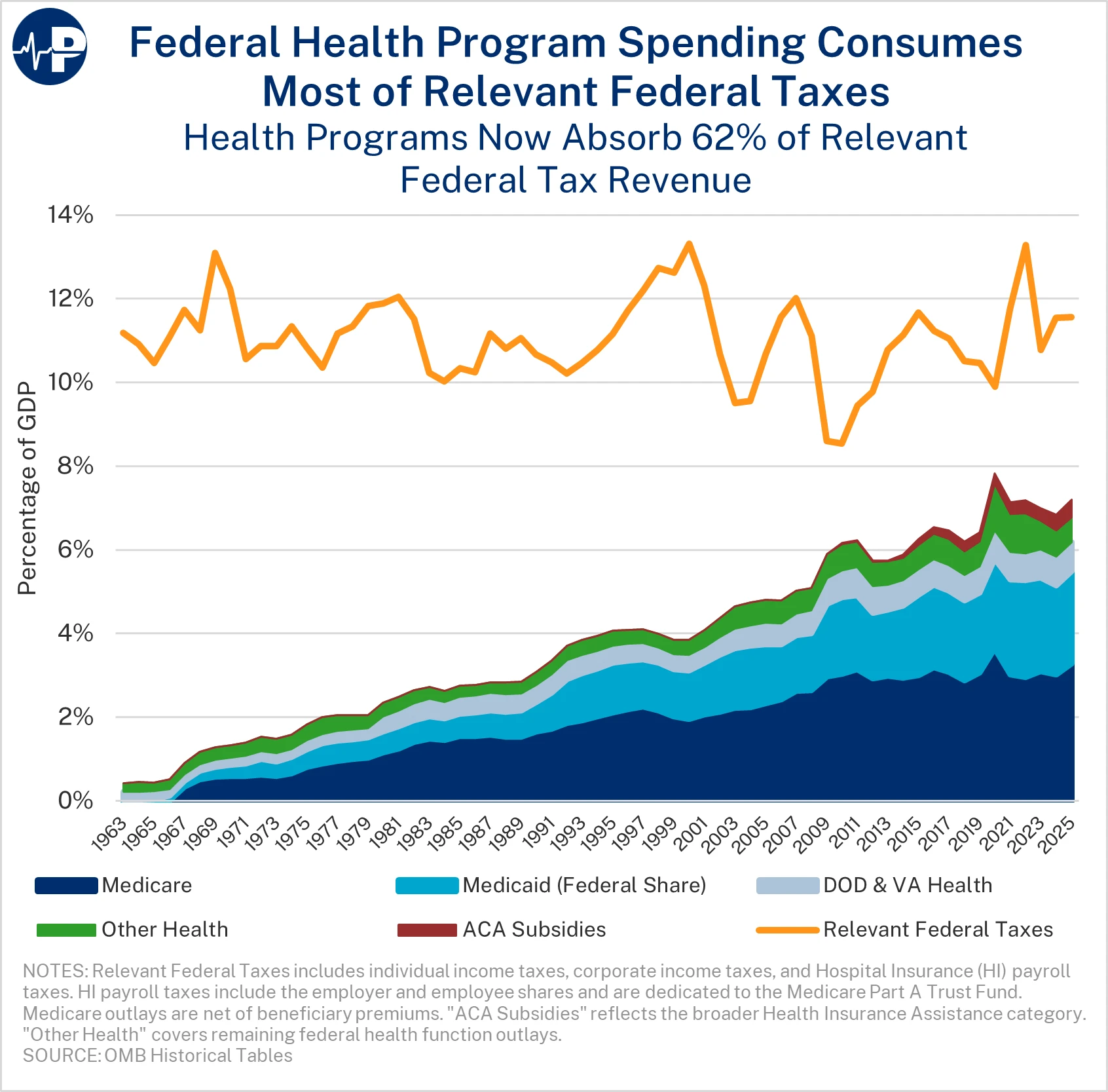
On Tax Day, Americans should consider not just how much they pay in federal income taxes, but where that money is going. As a new Paragon PIC shows, federal spending on health care programs consumed roughly 62 percent of all individual federal income taxes, corporate federal income taxes, and Medicare payroll tax revenue in 2025—up from 29 percent in 2000 and 17 percent in 1975. This high percentage shows how growth in federal health programs is crowding out other priorities while contributing to large annual deficits and a rapidly growing national debt.

Federal Health Program Spending Consumes Most of Relevant Federal Taxes
 

The PIC includes the Medicare Part A (hospital insurance) payroll tax revenue because it is dedicated to financing Part A. Part A payroll taxes cover only a fraction of total Medicare costs as Parts B (outpatient expenditures) and D (prescription drugs) are funded primarily through general revenue. Medicare costs continue to escalate, as do costs in other programs—particularly Medicaid and Affordable Care Act subsidies.

The Persistent Obamacare Enrollment Fraud

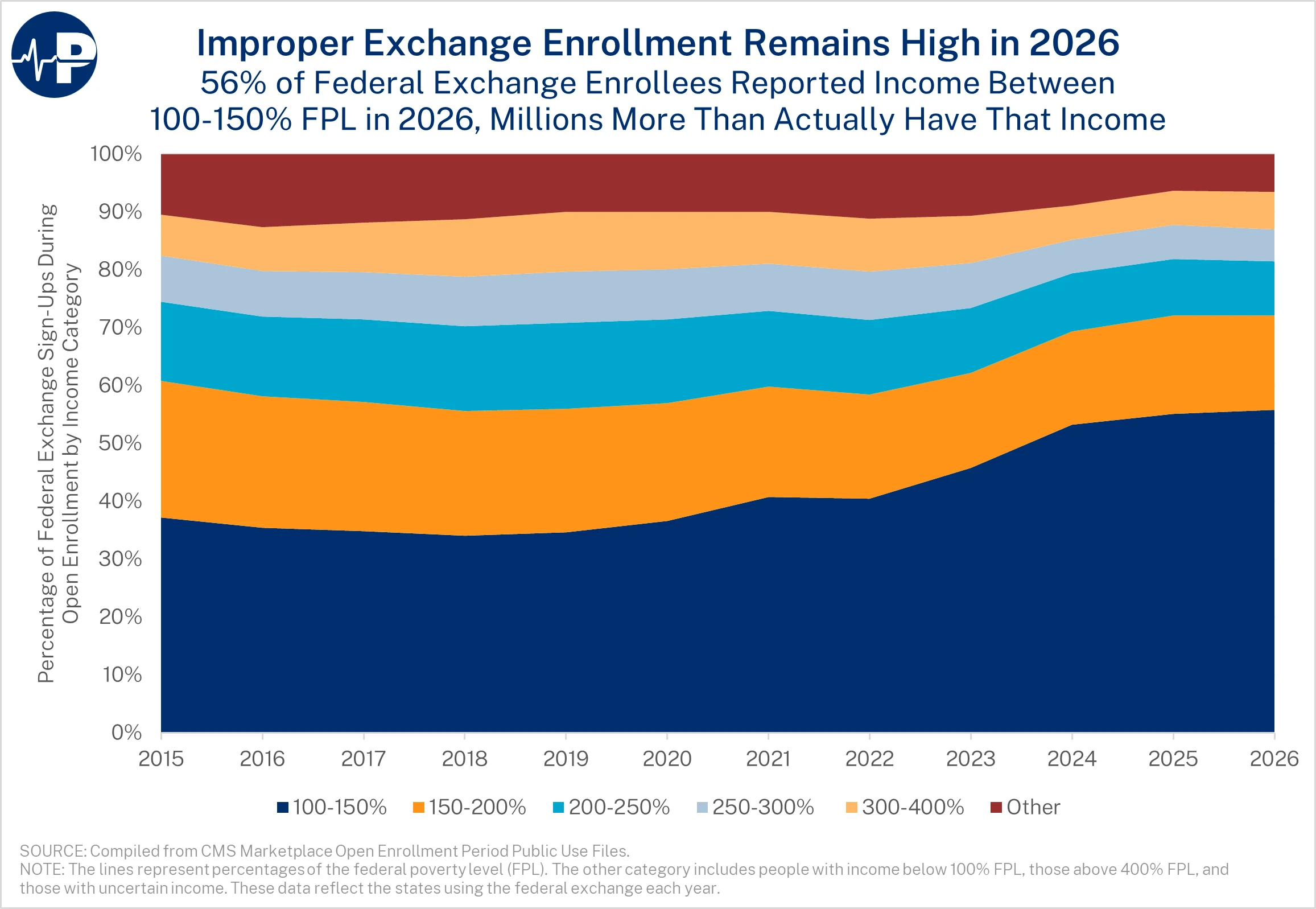
A new Paragon PIC demonstrates continued problems with the integrity of the Obamacare exchanges—namely an increase in the percentage of enrollees claiming income between 100 and 150 percent federal poverty level (FPL). In 2026, a staggering 56 percent of all sign-ups in states using the federal exchange—and 46 percent of all sign-ups nationally—claimed income in this narrow range. That is the highest national proportion ever recorded in the 100 to 150 percent FPL income range, up dramatically from 30 percent in 2020. Enrollees in the 100 to 150 percent FPL income range qualify for the largest subsidies, imposing substantial costs on taxpayers. (The data in the PIC is limited to federal exchange states because enrollment data by FPL category was not consistently available for state-based exchanges over the last decade.)

Improper Exchange Enrollment Remains High in 2026
 

In 2025, we estimated that 6.4 million more enrollees claimed income in this range than had such income. Improper enrollment soared with COVID-era subsidy boosts that made 94 percent actuarial value plans fully subsidized for individuals claiming income in this category. Insurers received massive subsidy payments on behalf of people improperly enrolled, many of whom were phantom enrollees—individuals without knowledge of their enrollment or fictitious individuals created by unscrupulous brokers and enrollment intermediaries. Weak program integrity measures—as evidenced by the Government Accountability Office successfully enrolling 23 of 24 fictitious applicants into fully subsidized coverage—compounded the problem.

Extensive automatic re-enrollment and continued policies that permit widespread fully subsidized bronze and gold plans contribute to a climate where improper and phantom enrollment continues to flourish. I discussed the massive fraud, improper enrollment, and phantom enrollment in the Obamacare exchanges in a recent Washington Post podcast, along with the key 2027 Notice of Benefit and Payment Parameters (NBPP) reforms to expand consumer choice and curtail improper enrollment.

Improper enrollment existed before the COVID-era subsidy boosts due to incentives to misreport income, which benefited insurers, intermediaries, and enrollees aware of their enrollment. The misreporting of income to claim more subsidies grew substantially with the COVID-era subsidy boosts, as demonstrated by the increase in the percentage of federal exchange enrollees claiming income between 100 and 150 percent FPL during open enrollment.

Ryan Long Testifying before the Senate HELP Committee on Drug Costs

Tomorrow (Thursday, April 16) at 10 a.m., Paragon’s senior research fellow Ryan Long will testify before the Senate HELP Committee on generic drugs, biosimilars, and prescription drug costs.

In his testimony, Ryan highlights how generics and biosimilars have delivered substantial savings—more than $3 trillion in the past decade—while identifying policy barriers that continue to limit their full potential. He emphasizes that although biosimilar approvals have accelerated, with 90 products approved since 2016 and significant recent cost savings, adoption remains constrained by misaligned incentives in the pharmaceutical supply chain, particularly rebate structures that favor higher-cost branded drugs.

Ryan’s testimony underscores the success of the Hatch-Waxman framework and subsequent FDA reforms in improving generic drug approvals, noting that generics now account for 90 percent of prescriptions but only a small share of total drug spending. Ryan points to continued progress in reducing approval times and expanding access to complex generic drugs. At the same time, he identifies gaps in utilization, especially among Medicare Low-Income Subsidy beneficiaries, where current cost-sharing structures reduce incentives to choose lower-cost generics.

Ryan also focuses on structural issues that undermine competition, including the 340B program’s “buy low, sell high” incentives, which discourage the use of generics and biosimilars. He also highlights the importance of expanding over-the-counter access and modernizing regulatory pathways to improve access and reduce costs. His recommendations center on aligning incentives to support lower-cost alternatives, strengthening competition, and ensuring that savings from generics and biosimilars are more fully realized by patients and taxpayers.

Brian Blase, Ph.D., is the President of Paragon Health Institute. Brian was Special Assistant to the President for Economic Policy at the White House’s National Economic Council (NEC) from 2017-2019, where he coordinated the development and execution of numerous health policies and advised the President, NEC director, and senior officials. After leaving the White House, Brian founded Blase Policy Strategies and served as its CEO.

https://paragoninstitute.org/newsletter/taking-stock-of-government-health-program-costs-on-tax-day/


Quest beats, raises 2026 revenue and EPS guidance on strong organic volume and high-value mix


Quest Diagnostics beats Q1 2026 estimates with EPS $2.50, revenue $2.9B and raises 2026 revenue and EPS guidance on strong organic volume and high-value mix

  • Company now forecasts full-year 2026 EPS of $10.63–$10.83 and revenue of $11.78–$11.9 billion.
  • Q1 revenue grew 9.2% YoY to $2.9B, driven by 10.8% organic volume growth.
  • Adjusted EPS rose 13% YoY to $2.50, aided by productivity and lower interest expense.
  • Q1 2026 adjusted EPS and revenue results exceeded the Zacks Consensus Estimate on both metrics.
  • 2026 revenue and EPS guidance were raised, and operating margin expected to expand versus 2025.
  • Consumer and advanced diagnostics (notably Alzheimer’s) delivered double‑digit growth and richer mix.
  • Fresenius and Corewell added ~7 pts to Q1 volume but pressured revenue per requisition.
  • Underlying organic volume excluding Fresenius/Corewell was 3.8%, with revenue per req up ~2.5%.
  • Project Nova still a ~$0.25 EPS headwind in 2026, now more weighted to 2H.
  • AI and automation drove a 40% productivity gain in certain customer service workflows.
  • Regulatory overhang persists from PAMA/RESULTS Act and broader Medicare pricing, though management is constructive.
  • Fuel and weather headwinds are embedded in guidance but sized as modest EPS impacts.
  • Main concern: reimbursement and regulatory risk (PAMA, Medicare pricing, fraud initiatives) and mix pressure from large contracts.

Gates Foundation to cut 20% of staff, review Epstein ties, WSJ reports


The Gates Foundation is cutting ‌up to 500 ‌jobs, or roughly 20% of ​its staff, over the next several years, and it has opened an ‌external review ⁠of engagement with the late financier ⁠and convicted sex offender Jeffrey Epstein, the ​Wall Street ​Journal ​reported on Tuesday, ‌citing a memo.

The organization started by Microsoft co-founder Bill Gates and his then-wife in 2000 ‌is one of ​the world's ​biggest ​funders of global ‌health initiatives. Bill Gates ​is ​the chair and board member of the ​foundation.

https://finance.yahoo.com/news/gates-foundation-cut-20-staff-194510568.html