As the saying goes with cancer, the sooner you know, the better. Oftentimes, patients don’t find out soon enough. Han-Keun Lee, a researcher in the Department of Electrical and Computer Engineering at the University of Illinois Urbana-Champaign, dreams of bringing those days to an end. “The only way to do it is by being able to test more frequently,” said Lee, but he doesn’t mean in the lab. “My dream was to bring those cancer diagnostics home.”

The VPodDuoss (the ‘V’ stands for virus) may just do that — it can read and compare results from a variety of tests for pathogens or cancer-associated biomarkers. It’s the brainchild of Lee, University of Illinois Urbana-Champaign Computer Engineering Professor Brian Cunningham, PhD, and Bioengineering Professor Xing Wang, PhD, who shared the design and validation. They’ve achieved promising results, published in July 2026 in IEEE Sensors Journal.
“The device can be utilized for detecting other diseases, not just viruses but also cancer,” said Wang. “It can be also used to detect microRNA, which is considered a biomarker for cancer development.”
The Answer Was Light

Many home tests, like COVID antigen tests or pregnancy tests, work by producing a simple positive or negative result when certain molecules create a visible line. While they’re easy to use and relatively inexpensive, they can have limited sensitivity and produce inaccurate results. What Lee, Cunningham, and Wang were looking to do was reproduce the more sophisticated results that come from a laboratory, where instruments are used to read fluorescent signals.
The answer was light. The problem was fitting it into a compact device that didn’t cost thousands of dollars. “We wanted to kind of show people that the point-of-care detection is not limited by the assay alone, but it’s limited by the system,” said Wang.
When it comes to fluorescence assays, techniques that measure changes in fluorescence intensity to detect reactions in samples, there are many ways to perform the detection. One common technique is using a camera. “A camera is a good sensor but requires a lot of optics and precise alignment. It makes the whole device bulky,” said Lee.
Wang and Cunningham gave Lee the goal of trying to make the device “as small as AirPods.” “And I wanted to make that happen,” said Lee.
Shrinking It Down to Size
Lee used a photodiode, a semiconductor device that converts light into an electrical current. But making it work while keeping size and costs down and portability up was a challenge. The team was trying to create a device that could measure two samples simultaneously: a test and control. “We had to make sure that these two photodiodes inside the device are calibrated to each other and are giving same readings no matter what, so that the test it performs gives you an accurate diagnostic result,” said Lee.
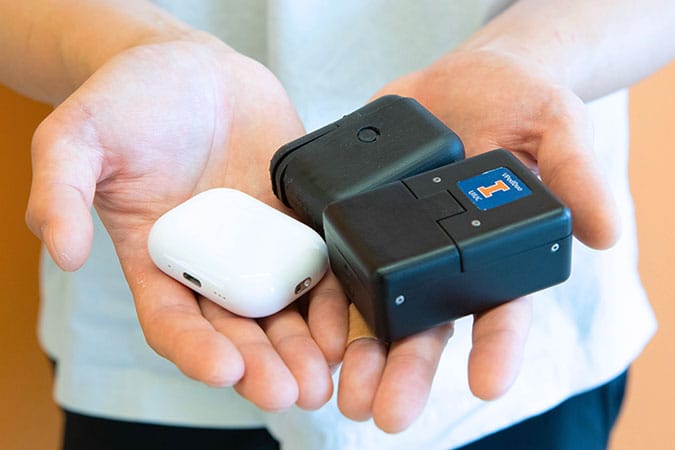
It didn’t happen overnight. The time between the first version of the device, the VPod, and the updated VPodDuo took “a year and a half just for the development,” according to Wang. But when they got it right, they really got it right.
They tested against three lab-grade fluorimeters and successfully achieved comparable results for Zika virus, Staphylococcus aureus, HIV, a lung cancer-associated circulating tumor DNA sequence, and a microRNA biomarker associated with lung cancer.
“I was really surprised by how this tiny device can be used for different kinds of assays,” said Lee. “When I tried the first assay, I was like, ‘oh, it worked.’ And then when I tried the second assay, ‘Oh, it worked again.’ And the third assay — ‘Oh, wow!’ I was able to keep going and going.”
The accuracy and the quality was also a pleasant surprise for Lee. “One of the surprising things was that this inexpensive fluorometer that we developed has the same analytical performance when compared to very expensive laboratory equipment.”
David Erickson, PhD, Sibley College Professor of Mechanical Engineering at the Cornell David A. Duffield College of Engineering, Ithaca, New York, who was not affiliated with the research, acknowledges the possibilities, especially given the difficulty of making an accurate device this small. “When you’re building something small and compact, particularly when you’re dealing with very important diagnoses, you have to be able to make sure that you maintain the same level of analytical sensitivity as well as clinical sensitivity that one would be able to get in a regular laboratory test,” said Erickson. “I would love to see this and other things mature to be able to make diagnostics more broadly available, inexpensive, and quick.”
What’s Next
While the team is excited by the initial results, they still have hurdles to overcome, namely tighter automation and more rigid sample processing. “So how I see the diagnostic is that you start with the sample, you process, you mix with reagents, and you put it into the device,” said Lee. “So I’ve been working on the device, which was kind of a missing piece of the whole diagnostic flow, but I’m moving slowly back to the sample. We have to start with the sample again.”
Once those pieces are ironed out? “What I really want, to be honest, is for the device to be out in the market, for people start using it,” said Lee. “I guess it is just the beginning and we have demonstrated that it is possible. Now we have to try to tackle the problems.”
The researchers hope that ultimately this device will help put an end to preventable deaths, particularly from cancer. “There are all these different cancer therapies, they’re outstanding,” said Lee. “We just need to be able to bring the technology to the patients.”
Erickson reported having no conflicts. Disclosure information for study authors is available in the original study publication.

No comments:
Post a Comment
Note: Only a member of this blog may post a comment.