By Josh Bloom
Of course, this proves nothing. ACSH has long maintained that anecdotes don't equal evidence, especially a single story or case study. Also, about 10–20% of lung cancers occur in people who never smoked cigarettes, for reasons that largely remain unknown, so this story tells us nothing other than that a friend is ill.
Still, it made me wonder: Could smoking marijuana cause lung cancer? Well, this is surprisingly hard to determine. There are “yes” studies and “no” studies, and none of them is definitive. But a new study reporting a nearly fourfold increase in lung cancer among people diagnosed with cannabis use disorder (CUD) got my attention. Does this have any bearing here?
Burning stuff = dirty chemistry
First, there's a certain irony here. People who wouldn't dream of eating food with trace pesticide residues or drinking from a container made with BPA may have no problem whatsoever deliberately inhaling the combustion products of marijuana.
Before getting into the epidemiology, let's start with something we know for sure: Marijuana smoke contains carcinogens.
This shouldn't be surprising. When you burn organic material, especially incompletely, you generate all kinds of nasty chemicals. Marijuana and tobacco smoke both contain benzene, formaldehyde, acetaldehyde, aromatic amines, and polycyclic aromatic hydrocarbons (PAHs), including the notorious benzo[a]pyrene.
And PAHs are hardly unique to tobacco or marijuana. Burn wood, coal, diesel fuel, or plenty of other carbon-containing stuff, and you'll make some of the same chemicals. Fire (like your Weber) is a remarkably efficient way of turning relatively innocuous organic molecules into things you don't want in your lungs.
Some of these chemicals have another nasty trick up their sleeves. What you inhale isn't necessarily what ultimately does the damage. Enzymes that normally help the body metabolize drugs and other foreign chemicals can inadvertently convert some of them into more toxic compounds. This is called metabolic activation. While metabolism normally helps the body eliminate foreign chemicals, in rare cases, the products are more dangerous than what you started with.
Benzene is a good example (Figure 1). One of the first things the body does to benzene is oxidize it to benzene oxide, starting a series of reactions that produce reactive metabolites implicated in benzene's carcinogenicity.
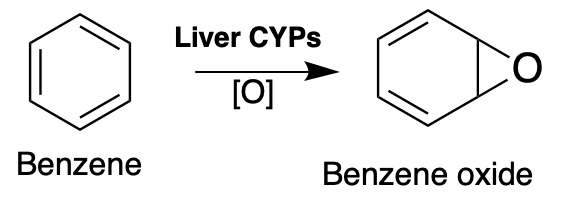
Figure 1. Benzene is oxidized by liver enzymes (CYPs) to benzene oxide, the first step in the formation of a number of toxic metabolites.
PAHs do something even worse. Keep reading.
A carcinogen with a history
In 1775, British surgeon Percivall Pott (can't make this up) noticed that chimney sweeps had an unusually high incidence of scrotal cancer and correctly blamed their exposure to soot. More than 150 years later, chemists identified PAHs in coal tar and soot as potent carcinogens. PAHs were among the first chemical carcinogens ever identified.
One of the best-known is benzo[a]pyrene. Like benzene, it isn't the end of the chemical story. Enzymes convert it through several steps into a highly reactive compound (Figure 2) called benzo[a]pyrene diol epoxide (BPDE).
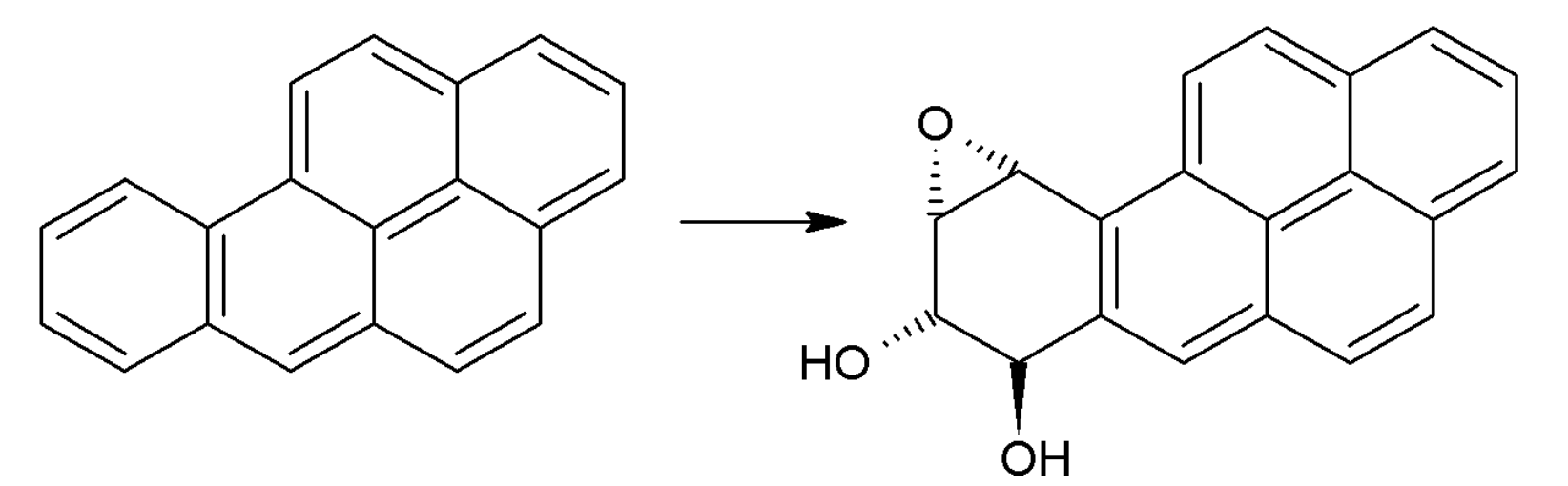
Figure 2. Oxidation of benzo[a]pyrene to form benzo[a]pyrene diol epoxide (BPDE), a known carcinogen.
Here's where the chemistry gets interesting. And deadly.
BPDE contains a large, relatively flat collection of fused rings that can fit between the stacked bases of DNA. Its reactive epoxide can then form a covalent bond with DNA, especially with guanine. If that damaged DNA isn't repaired correctly before the cell divides, a mutation can result.
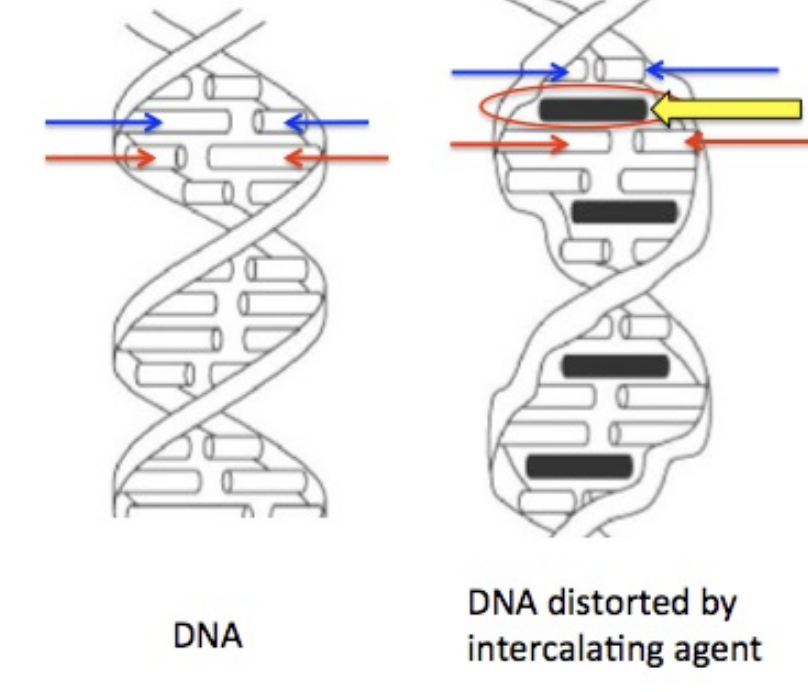
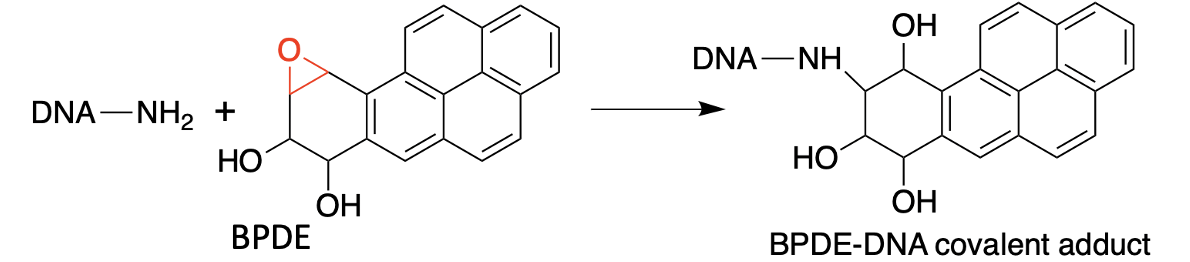
Figure 3. (Top) DNA consists of two strands with stacked base pairs (red and blue arrows). Intercalating molecules (yellow arrow) can slip between adjacent base pairs and distort the DNA structure. (Bottom) BPDE can intercalate into DNA, positioning its reactive epoxide group (red) near an amino group on guanine, where it can react to form a stable covalent DNA adduct. If improperly repaired, such damage can result in mutation.
And marijuana smoke contains benzo[a]pyrene and other PAHs.
There's an important distinction here. Marijuana and tobacco smoke aren't chemically identical. Tobacco contains nicotine and related alkaloids that can form potent tobacco-specific nitrosamines. Cannabis doesn't contain nicotine, so these particular carcinogens are essentially absent from pure marijuana smoke.
In other words, marijuana smoke isn't cigarette smoke. It doesn't contain some of the carcinogens found in tobacco smoke, but it may very well contain others not found in tobacco smoke.
Table 1 lists select groups of carcinogens found in each product.
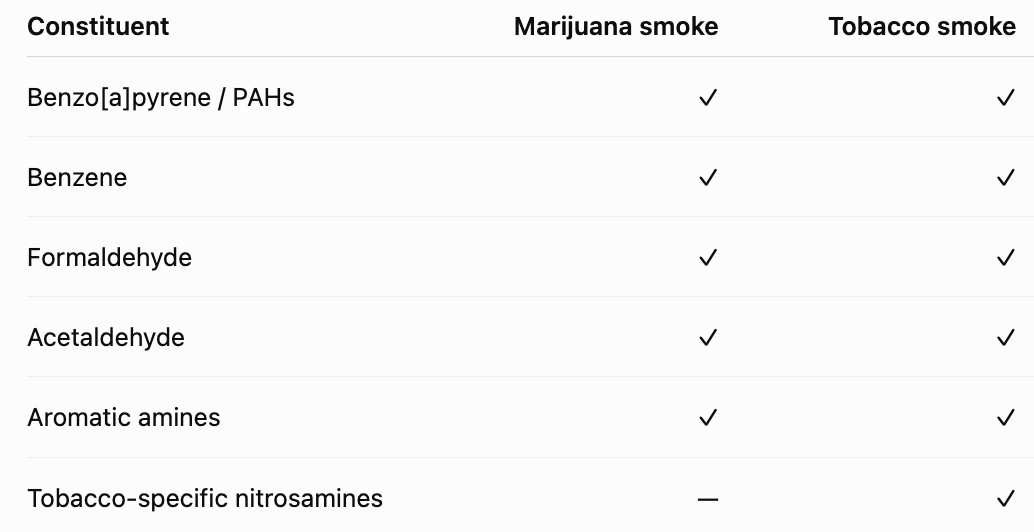
Table 1. Selected carcinogens and toxins found in marijuana and tobacco smoke. Checkmarks indicate the presence of the compound or chemical class, not equivalent concentrations. Tobacco-specific nitrosamines (TSNAs) are formed from nicotine and related tobacco alkaloids and are essentially absent from pure marijuana smoke. Source: https://pubmed.ncbi.nlm.nih.gov/18062674/
Epidemiology: Different studies, different results
Given the chemistry, you might expect marijuana smokers to have an obvious increase in lung cancer.
They don't. At least not obviously.
Studies over the years have gone in both directions. A 40-year Swedish study of nearly 50,000 men found about twice the subsequent risk of lung cancer among those who reported using cannabis more than 50 times by the time they entered military service. But cannabis and tobacco use were measured only at baseline, with little information about what they smoked during the following four decades.
Other studies have found essentially nothing.
Especially noteworthy is a 2015 analysis that pooled six studies involving 2,159 lung cancer cases and 2,985 controls. The odds ratio (OR) for lung cancer among habitual cannabis smokers was 0.96. In other words, no increased risk at all. Even among people with at least 10 joint-years of exposure, the OR was essentially 1 (0.94). There were hints of increased risk at very high exposures, but the numbers were too small to draw firm conclusions.
The Gallagher study reaches a different conclusion
Tyler Gallagher and colleagues recently examined 20 years of electronic medical records from 67 U.S. healthcare organizations. They identified 149,632 adults diagnosed with cannabis use disorder (CUD) and propensity-matched them with an equal number without CUD, taking into account demographics and known lung cancer risk factors.
What they found was anything but subtle.
People with CUD had 3.87 times the risk (RR) of developing lung or bronchial cancer compared with the matched controls. The risks were also elevated for adenocarcinoma (RR 2.54), squamous-cell carcinoma (RR 2.90), and small-cell carcinoma (RR 2.70).
For a subject that has produced decades of equivocal results, an RR of nearly four is hard to ignore.
But it isn't proof.
Why the disconnect?
There are plenty of possibilities. Many marijuana smokers also smoke cigarettes, making the two exposures difficult to disentangle. Older studies often had poor information about how much marijuana people actually smoked. And lung cancer can take decades to develop, so finding large numbers of people with sufficiently heavy, long-term marijuana exposure isn't easy.
The biggest problem is cigarettes. Tobacco smoking is such an overwhelmingly powerful risk factor for lung cancer that imperfect control for cigarette exposure can distort the results of a cannabis study. Gallagher and colleagues matched for tobacco and nicotine exposure, but an electronic medical record indicating tobacco use isn't remotely the same thing as knowing someone's lifetime cigarette exposure in pack-years.
There's another problem. A CUD diagnosis doesn't tell us how much marijuana someone actually used. We don't know whether someone smoked one joint a day for five years or five joints a day for 30. So the study can't provide one of the things we'd most like to see if marijuana smoke really causes lung cancer: a dose-response relationship.
Still, CUD may be a reasonable proxy for substantial cannabis exposure. Since marijuana consumed over much of the past few decades was predominantly smoked rather than eaten, it's reasonable to assume that smoking accounts for much of that exposure. It's not perfect, and it doesn't give us a dose-response relationship, but an almost fourfold association in nearly 300,000 matched subjects can't simply be waved away.
No smoking gun, but maybe a smoldering one
Given how long people have been smoking marijuana, you might think we'd have a better answer by now. We don't.
So where does this leave us? Gallagher doesn't prove that marijuana causes lung cancer. But given the size of the study and the magnitude of the association, its results deserve attention.
Does smoking marijuana cause lung cancer?
There's still no smoking gun. But there's enough smoke that I'd be reluctant to assume the answer is no.
Bottom line: A chemistry opinion
Chemistry tells us that when almost anything burns, PAHs and other toxins and carcinogens will form. Whether these cause disease is a function of exposure and chemical composition. One can't equate a campfire with a pack-a-day or joint-a-day habit.
But intentionally inhaling smoke is far from risk-free. With marijuana, we just don't know how much risk there is.

No comments:
Post a Comment
Note: Only a member of this blog may post a comment.