
Employees of Iran’s oil industry held protests Monday at offshore platforms operated by Pars Oil and Gas Company and in the southern energy hub of Assaluyeh, demanding changes to pay, taxes and benefits as US economic pressure weighs on Iran’s oil exports and wider economy.
Afkar-e Naft, a Telegram channel which reports on issues affecting permanent oil industry employees, said the demonstrations were part of protests held every Monday.
Images published by the channel showed workers at several offshore installations holding placards calling for the removal of salary caps, full payment of wages and benefits, fairer compensation and changes to the tax system for offshore employees.
“Full payment of wages and benefits,” read one placard, while another said, “Fair pay is our right, not an extra privilege.”
Other signs called for an overhaul of the wage system for operational oil workers and the removal of what protesters described as “unfair restrictions” on salary payments.
Several workers also highlighted the conditions under which oil production has continued during the war. One placard read, “Uninterrupted production in a war zone,” while another referred to “uninterrupted production in border areas.”
The protesters are also seeking payment of outstanding compensation under Article 10 of the law governing the duties and powers of Iran’s Oil Ministry.
The so-called Article 10 back pay refers to accumulated payments employees say they are owed following implementation of provisions governing compensation and employment conditions for Oil Ministry personnel.
The protests come as Iran’s economy faces mounting pressure from the regional war and a US maritime blockade that was reimposed in mid-July. Satellite imagery reviewed by Iran International shows a sharp decline in visible vessel activity at Shahid Rajaee and Imam Khomeini, two of the country’s most important commercial ports, since the blockade resumed.
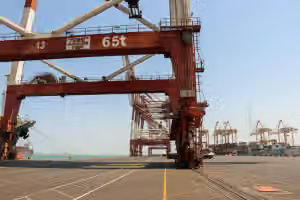
The impact has been particularly severe on Iran’s oil trade, a crucial source of government revenue and foreign currency. Kpler tanker-tracking data reviewed by Iran International showed Iranian crude loadings averaging about 287,000 barrels per day in August through Aug. 21, compared with roughly 2 million barrels per day before the war — a fall of about 85%.
Washington has simultaneously intensified its financial campaign against Tehran. On Aug. 24, the US Treasury launched Operation Economic Outcast, dubbed an “Economic D-Day,” saying it aimed to sever Iran’s remaining financial and commercial connections and increase the risks for foreign banks and companies doing business with Tehran. The campaign has since targeted financial channels in countries including the United Arab Emirates and Türkiye.
The pressure has coincided with a steep deterioration in household purchasing power. Iran’s rial has fallen to a record low of about 2.2 million to the US dollar this month, compared with roughly 958,000 a year earlier.
Official figures for July showed average annual inflation at around 62%, year-on-year inflation at 82% and food inflation at 134%, adding to the pressure on wages and living standards.

No comments:
Post a Comment
Note: Only a member of this blog may post a comment.