Search This Blog

Monday, April 26, 2021

Citius Thrives with Critical Care Solutions for ARDS tied to COVID-19

 Companies like Pfizer, Inc. (NYSE: PFE), Syndax Pharmaceuticals (NASDAQ: SNDX), Merck & Co. (NYSE: MRK), and Amgen, Inc. (NASDAQ: AMGN), among others, understand the importance of creating new, effective pharmaceutical critical care products for unmet needs. 

For example, long-term patients with central venous catheters (CVCs) for dialysis or cancer treatments are still at risk for complications related to bloodstream infections that might be fatal. This creates a new set of needs in order to have successful outcomes for these patients. Finding ways to avoid these complications can be lifesavers.

Citius Pharmaceuticals, Inc. CTXR 6.74%a specialty pharmaceutical company dedicated to developing and commercializing novel critical care drug products, is addressing several of these unmet medical needs with cost-saving and cost-effective solutions with low-risk development pathways.

The company is currently advancing three proprietary product candidates: Mino-Lok®, CITI-002 (halobetasol-lidocaine formulation) and CITI-101 (Mino-Wrap).

The Mino-Lok solution, for example, allows catheters to be disinfected and salvaged to prevent the need to replace and restart a deadly and costly process.

Additionally, Citius recently signed an exclusive worldwide licensing agreement with Novellus, Inc., a privately-held biotechnology company creating new engineered cellular therapies for a novel stem-cell therapy that would initially target Acute Respiratory Distress Syndrome (ARDS) associated with COVID-19. 

Here’s what you need to know.

What is Acute Respiratory Distress Syndrome (ARDS)?

ARDS is a type of respiratory failure characterized by rapid onset of widespread inflammation and fluid accumulation in the lungs and is the most common cause of respiratory failure and mortality in COVID-19 patients. 

ARDS affects approximately 250,000 people in the U.S. annually, exclusive of the current COVID-19 pandemic, and has a 30% to 50% mortality rate. It is reported that 31% of hospitalized COVID-19 patients develop ARDS. 

ARDS impairs the lungs’ ability to exchange oxygen for carbon dioxide. Its symptoms include shortness of breath, rapid breathing and bluish skin coloration; for those who survive, a decreased quality of life is common.

The current clinical management is supportive care, through the use of a ventilator and fluid management, and in some instances, extracorporeal membrane oxygenation and glucocorticoids.

Currently, there is no FDA-approved drug therapy for ARDS.

Novellus – NoveCite i-MSCs

The Novellus cellular manufacturing process, using mRNA reprogramming, is unique and creates a mesenchymal stem cell (MSC) bank that is derived from induced pluripotent stem cells instead of harvesting cells from adult tissue. 

I-MSCs can be produced rapidly, expanded quickly to much greater levels than adult-donor-derived MSCs, and may overcome the limitations of adult-derived MSCs, providing enhanced growth potential and overexpressing immunomodulatory proteins.

A recent study in mice showed that i-MSCs delayed disease progression and improved clinical score 43% improvement as compared to donor MSCs.

Citius recently submitted a pre-IND plan to the FDA under the new Coronavirus Treatment Acceleration Program (CTAP) for the treatment of ARDS in COVID-19 patients and desires to file an IND by Q4  2021. 

Pursuing a New Standard of Care

Citius concentrates on adjunctive cancer therapies, critical care medicine and anti-infectives. 

Its Mino-Lok solution is the first — and only — therapy under investigation that can be used to sterilize and salvage the infected CVC avoiding the complications, discomfort and costs of removal and replacement. 

Currently, Mino-Lok is in late Phase 3 and received a favorable review for Futility Analysis by Data Monitoring Committee (12/2019); favorable review for safety and efficacy analysis in September 2020 and superior efficacy review in Q2 2021 (DMC).

Corporate Highlights

  • Announced closing of $76.5 million registered direct offering priced at the market in February 2021
  • Mino-Wrap™ in pre-clinical development with plans to submit IND to the FDA by the end of the year
  • Mino-Lok® pivotal trial interim analysis and review by the Data Monitoring Committee (DMC) expected in Q2 2021
  • Private placement for gross proceeds of $20 million and investors' exercise of warrants generating $4.5 million in gross proceeds completed in January 2021 and February 2021, respectively

ADC Scores 1st FDA Approval For Lymphoma Type Treatment


  • ADC Therapeutics SA (NYSE: ADCThas scored an FDA approval for Zynlonta, formerly known as loncastuximab tesirine, as a solo treatment for adult patients with relapsed or refractory diffuse large B-cell lymphoma (DLBCL) after two prior lines of therapy.

  • Following a priority review in November with a review date of May 21, Zylonta’s accelerated nod comes a month ahead of schedule.

  • The company will have to prove its clinical benefit in a confirmatory study to maintain its marketing approval.

  • The approval comes just under a year after ADC went public, raising 3 million.

  • The FDA endorsed the drug based on data from a Phase 2 trial, LOTIS 2. The drug turned in an overall response rate of 48.3%, and, for those who responded, the median duration of response was 10.3 months. More than 24% of patients experienced a complete response.

Alkermes upped to Buy from Neutral by Mizuho

 Target to $24 from $19

https://finviz.com/quote.ashx?t=ALKS&ty=c&ta=1&p=d

Avantor® to Up Global Production of Single­-Use Tech, Address Biopharma Demand

 Avantor Inc. (NYSE: AVTR), a leading global provider of mission-critical products and services to customers in the life sciences, advanced technologies and applied materials industries, today announced that it will increase global capacity for high-quality single-use technologies used in the production of biologics and vaccines.

Dr. Brophy: Biopharma looks to Avantor to know and support requirements as they rapidly expand manufacturing capacity

In the U.S. and Europe, the Company will increase its single-use manufacturing footprint by 30% and double its cleanroom space. The investment will support growing customer demand for monoclonal antibodies (mAbs), novel cell and gene therapies for oncology and other diseases, as well as vaccines, including those for COVID-19.

Avantor recently expanded its Morrisville, North Carolina, single-use facility and expects completion of a cleanroom expansion at its Devens, Massachusetts, operation by mid-year. The Company also expects to open its second European single-use facility in Hillegom, the Netherlands, by then as well.

Dr. Ger Brophy, Executive Vice President of Biopharma Production at Avantor, said, "The industry's response to the COVID-19 pandemic has relied heavily on the integration of single-use products into biopharma production processes. Efficacy and safety are of the utmost importance to our customers, and they look to us to understand and support their requirements as they rapidly expand their own manufacturing capacity.

"These additions to our global single-use manufacturing ecosystem are critical steps in enabling our customers to get therapies to patients quickly," Brophy added.

The investment further strengthens the Company's single-use network, providing product consistency and capabilities close to bioproduction customers to help ensure efficient and uninterrupted supply.

Measurable Organ Impairment in Long COVID Patients: Study in BJM

 New research published in BMJ Open outlines findings from a study on multiorgan impairment in individuals with persistent symptoms following recovery from COVID-19 infection— a condition referred to as long COVID. The study included characterization of organ function using global medical technology company Perspectum’s non-invasive imaging technology.

Long COVID, also referred to as post-COVID-19 syndrome, is yet to be fully understood, but has wide-ranging and fluctuating symptoms, which can include breathlessness, chronic fatigue, “brain fog”, anxiety and stress. The research examined associations between hospitalization, severity of COVID-19 symptoms and multiorgan impairment (in heart, lungs, kidneys, liver, pancreas, spleen), and demonstrated a physiological basis for long COVID. Although the study population were considered to be at low risk of COVID-19 mortality but with ongoing symptoms, seventy percent showed impairment in one or more organs up to four months after initial COVID-19 symptoms.

“Early in the pandemic, research and clinical practice focused on pulmonary effects of COVID-19, but as we scanned patients using Perspectum’s quantitative MRI, we found evidence of multiorgan impairment,” says Dr Amitava Banerjee, Associate Professor in Clinical Data Science and Honorary Consultant Cardiologist, University College London. “Because our research demonstrated physiological effects in a majority of patients, we believe major organ systems must be assessed in all patients recovering from COVID-19 — to help define long COVID, determine its aftereffects and develop multidisciplinary care pathways.”

“There are tremendous implications for healthcare and public health, which have assumed low risk in young people with no comorbidities,” adds Dr Banerjee. “While our research examined patients hospitalized with COVID-19, future research should address longer-term follow-up of organ function beyond symptoms and blood investigations, even in lower risk individuals who were not hospitalized with the disease; and prioritization for imaging, investigation and referral.”

https://www.biospace.com/article/releases/new-study-shows-measurable-organ-impairment-in-long-covid-patients/

As Good As It Gets: Goldman Last Big Bank To Turn Bear, Sees Market Drop In Coming Months

 On Friday, something remarkable happened: after 12 months of relentless, raving optimism (and one day after JPM's chief quant preacher Marko Kolanovic appeared on CNBC and urged everyone to BTFD) the most bullish bank on Wall Street, JPMorgan (whose year-end S&P price target of 4,400 is the highest on Wall Street) finally eased back on its "balls to the wall" euphoria and while it did not turn bearish per se, JPM's chief equity strategist Dubravko Lakos-Bujas joined his other notably bearish sellside peers at Deutsche Bank and Morgan Stanley, and said that "easy equity gains for the broad market are likely behind us" and as a result JPMorgan's "bullish conviction is now lower."

As the second phase of global reopening gets confirmed by a pickup in mobility and pent-up demand, we expect yields to retrace higher thereby constraining the equity multiple with S&P 500 entering a period of consolidation. On March 8th, we argued the risk-reward for the Growth trade had tactically improved after the February Momentum crash and Growth derisking. Since then Growth has strongly outperformed, but mainly defensive/bond-proxy Growth, making this segment again vulnerable to rates.

Well, just a few hours later, the bank with the second highest S&P target - Goldman - also capitulated, joining not only JPM but also Deutsche Bank and Morgan Stanley on the bearish side, after the bank's chief strategist David Kostin wrote that recent discussions he has had with clients "have focused on peaking US GDP growth and the capital gains tax hikes proposed by President Biden." Why? Because as Kostin notes, "investors buying S&P 500 as growth peaked have typically realized negative short-term returns and weak 12-month returns, consistent with the 3% upside to our year-end target of 4300." 

In short, this is as good as it gets - for the economy - and it's all sideways from here (at best) until the end of the year.  And just in case that was not enough, Kostin then warns that "S&P 500 returns have also been weak ahead of past capital gains tax hikes." The good news "selling was short lived and reversed afterward" although this time the selling may not be so short-lived as Goldman estimates $1+ trillion in unrealized capital gains for the wealthiest US households."

Here are some more details from the latest Kostin note:

During the past two months, the incoming questions from portfolio managers changed weekly and spanned the macro horizon: interest rates, inflation, corporate tax rates, profit margins, falling volatility, low return dispersion, and money flow. Never a dull moment and at 4180, the S&P 500 index trades nearly at its all-time high, up 10% since the start of the year.

More importantly, it is just 4% from Goldman's year-end target of 4,300. Anyway, back to Kostin and his client conversations:

This week, attention shifted again. First, we received many inquiries about sector and style rotations and peaking economic growth. Second, questions abounded about the impact the potential capital gains tax rate hike could have on stock prices. Our answers: Domestic growth is peaking and forward equity returns are likely to be modest with a 3% gain in the S&P 500 to our year-end 2021 target of 4300. And historical experience suggests equity selling later this year ahead of a possible capital gains tax hike will be short-lived and reversed in subsequent quarters.

So yeah, bearish. Meanwhile...

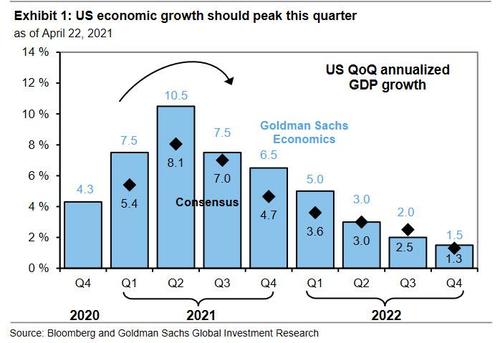
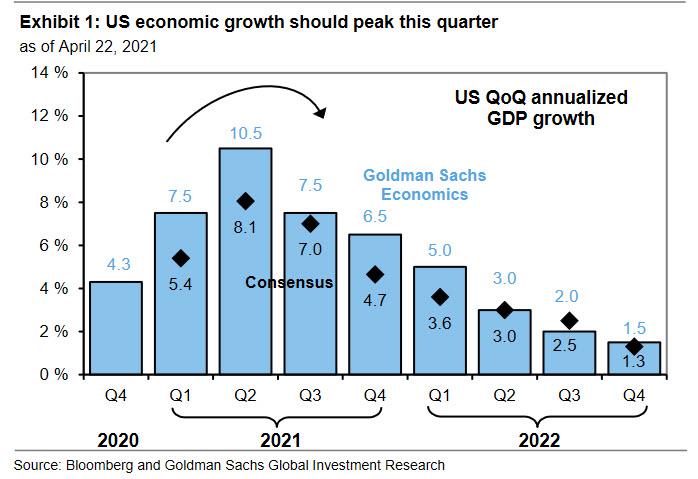
US economic growth is peaking. Goldman Sachs economists expect US GDP growth will peak in 2Q 2021 at an annualized rate of 10.5%. Although GDP growth will remain both above trend and above consensus forecasts through the next few quarters, the pace of growth will peak within the next few weeks as the tailwinds from fiscal stimulus and economic reopening begin to fade.
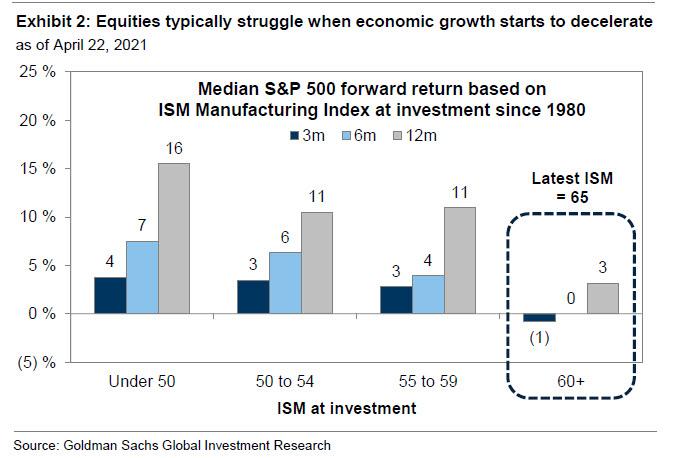
Furthermore, as Kostin shows in the next chart, equities often struggle when a strong rate of economic growth first begins to slow. Picking up on what Michael Wilson said last week, the Goldman strategist writes that during the last 40 years, "investors buying the S&P 500 when the ISM Manufacturing index registered above 60 –typically coinciding with peak growth –have experienced a median return of -1% during the subsequent month and a paltry +3% return during the subsequent year."

Why does this matter? Because the most recent ISM reading was 64.7 - i.e., the highest in almost 40 years, and while Goldman's S&P 500 year-end target reflects a 4% total return from the current level, including dividends, Kostin explicitly reminded readers that the bank's mid-year 2021 target remains 4100. Translation: stocks are set to drop from here over the coming 2-3 months... precisely what Deutsche Bank warned about two weeks ago.

To be sure, Goldman can't spook its clients and go bearish cold turkey, so instead it said that it expects "equity prices will continue to rise as growth slows during the second half of this year. Equities generally appreciate when the rate of economic growth slows as long as growth remains positive, albeit at a slower pace. Although US growth is peaking, the growth rate should remain strong. In addition, the global economy is still accelerating and will not peak until 3Q 2021."

This, of course, is drivel: when even Goldman says the selling is coming, the only question is when does the frontrunning of said selling begin since clients will certainly not be waiting until the last possible moment to dump exposure. And speaking of that, even Goldman admits that rising cap gains taxes are hardly bullish:

The Taxman Cometh, Part II. During the past month, investors have been focused on the Biden administration’s proposed corporate tax reform and the impact on specific stocks. This week, attention shifted to the forthcoming proposal to raise the capital gains tax rate. Long-term capital gains and qualified dividends are currently taxed at a maximum rate of 20%, along with a separate 3.8% tax on investment income. Press reports reveal that Biden will propose taxing both of these as ordinary income for filers with more than $1 million in annual income. This would roughly double the tax rate on capital gains and dividend income from 23.8% to 43.4%. Our economists expect a more modest increase, potentially around 28%.

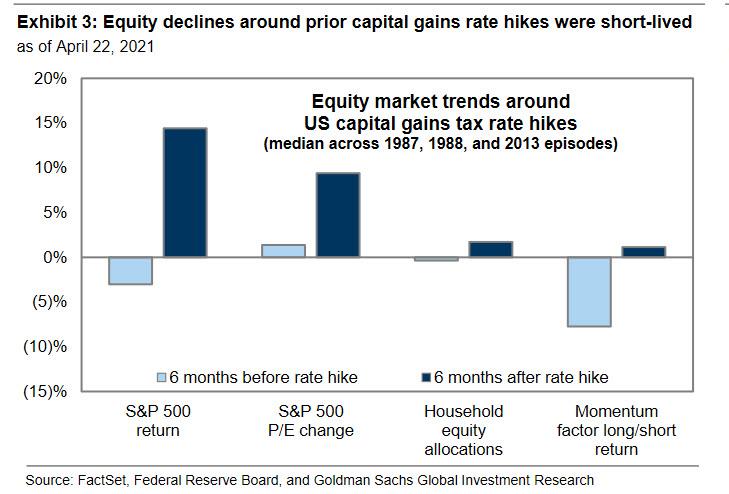
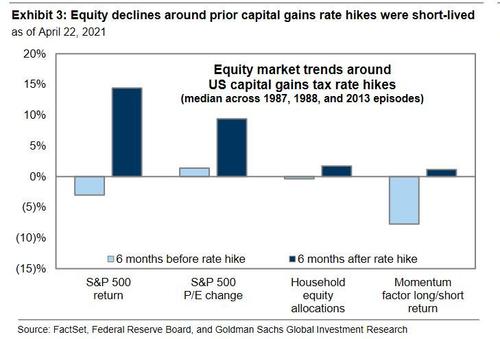
Past capital gains tax hikes have been associated with declines in equity prices and in household equity allocations. Also, high-momentum “winners” that had delivered the largest gains to investors ahead of the rate hike have usually lagged. Tech and Consumer Discretionary sectors have been the largest sources of capital gains within the US equity market during the last 3, 5, and 10 years.

Unsurprisingly, the wealthiest 1% were the biggest net sellers of equities across US households around the last capital gains rate hike in 2013. During the three months prior to the hike, the wealthiest households sold 1% of their starting equity assets, which would equate to around $120 billion of selling in current terms.

And here, some ominous stats: using Federal Reserve data, Goldman estimates the wealthiest households now hold $1 to $1.5 trillion in unrealized equity capital gains. This equates to 3% of total US equity market cap and roughly 30% of average monthly S&P 500 trading volume.

However, as noted above, Kostin writes that the trend of net equity selling and falling stock prices around capital gains rate changes has usually been short-lived and reversed during subsequent quarters, to wit:

In 2013, although the wealthiest households sold 1% of their assets prior to the rate hike, they bought 4% of starting equity assets in the quarter after the change and therefore only temporarily reduced their equity exposures in order to realize gains at the lower rate. Total household equity allocations demonstrated a similar pattern around the two preceding capital gains tax hikes.
Eventually, once the tax-selling is over, Goldman expects an eventual increase in household equity allocations funded, in part, by a continued rotation away from cash since "US households represent the single largest owner of the US equity market, at 35%, and currently have cash allocations close to the 30-year average despite cash yields being substantially below average." Households accounted for 40% of the $1 trillion of total inflows into US money market funds during 1H 2020 ($410 billion) and around 70% of the $180 billion of outflows since then ($120 billion).

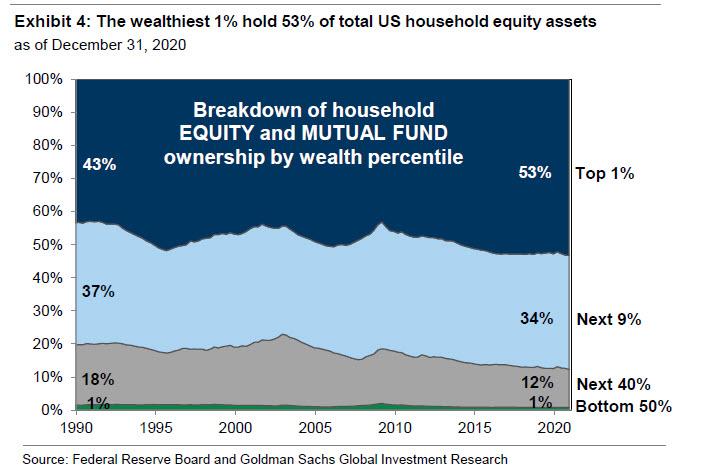
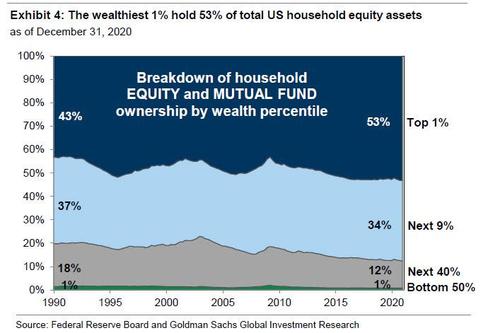
Finally, Goldman estimates that additional household selling of money market funds could exceed $200 billion and that a meaningful amount of that cash will represent equity demand. The bank also forecast net equity buying by households to total $350 billion in 2021 and be driven by the wealthiest 1%. The top 1% – which accounts for 53% of household equity ownership – has bought $2 trillion of shares during the past 30 years vs. $800 billion of net selling by the bottom 99%.
Assuming Goldman is right, this is great news for the top 1%... it's just further testament however that the record class, wealth and income divide between the haves (the 1%) and the have nots (everyone else) is about to get even greater.

https://www.zerohedge.com/markets/good-it-gets-goldman-last-big-bank-turn-bearish-sees-market-dropping-coming-months

I-Mab: Positive Topline Phase 2 Results for Olamkicept in Ulcerative Colitis

  I-Mab (the "Company") (Nasdaq: IMAB), a clinical-stage biopharmaceutical company committed to the discovery, development and commercialization of novel biologics, today announced positive topline results from its regional multi-center, randomized, double-blind and placebo-controlled phase 2 study (NCT03235752) evaluating the efficacy and safety of olamkicept (also known as TJ301) administered intravenously biweekly in patients with active ulcerative colitis (UC).

Olamkicept is the only clinical stage selective IL-6 inhibitor that works through the trans-signaling mechanism. IL-6 is an important driver cytokine in the propagation and maintenance of chronic inflammation in autoimmune diseases, such as UC.

The phase 2 study, one of the first placebo-controlled, proof-of-concept studies of an IL-6 inhibitor in UC, has met both its primary and key secondary efficacy endpoints, demonstrating significantly higher clinical response rates after 12 weeks of treatment in patients receiving 600 mg olamkicept compared to those on placebo (p=0.032). Significantly more patients in the 600 mg olamkicept group achieved clinical remission and mucosal healing than in placebo (p<0.001), two key secondary endpoints of the study. Olamkicept was well tolerated, and with a very acceptable safety profile. Detailed data analysis will be presented at Digestive Disease Week (DDW) 2021 in the U.S. in May and at European Crohn's and Colitis Organisation (ECCO) meeting in July 2021.

https://www.biospace.com/article/releases/i-mab-announces-positive-topline-phase-2-results-for-olamkicept-in-ulcerative-colitis/