Search This Blog

Monday, April 20, 2026

Canada's Prime Minister Doubles Down On Militant Anti-US Rhetoric

 Well before Mark Carney was elected as Canada's Prime Minister in the wake of numerous scandals surrounding Justin Trudeau, critics noted that the candidate represented a far greater threat to Canada's freedom largely because he is far more devious than Trudeau ever was. 

Carney is a central banker and high level World Economic Forum globalist well acquainted with the liberal "Reset" agenda, and it is no mistake that he has taken control of Canada at a time when European elites are pushing for an economic and geopolitical separation from the US.  The plan is obvious - To isolate the US in an effort to stop the spread of conservative and nationalist movements throughout the west.

In other words, the globalists/leftists are trying to build a new empire in a last-ditched scramble to prevent their liberal order from fading away.  Carney pretends as if they are breaking from the old system and starting something new by "calling out" the US.  In reality, it was the US that broke from the liberal system and refused to "go along to get along". 

It was the US that refused to conform to the multicultural agenda, open borders, ESG and DEI politics, the transgender cult and the indoctrination of children with socialist and LGBT ideology, not to mention the fact that so many foreign nations have been feeding off US taxpayer dollars for decades through institutions like USAID.

Vast numbers of their own citizens are rebelling against liberal governments.  Movements to stop the multicultural agenda and mass immigration are gaining momentum. Right-wing political parties are quickly growing, inspired by conservative success against the woke cult in the US.   

The liberals are circling the wagons, and it would seem that Canada is meant to play a key role in this "new order".  Prime Minister Mark Carney has been escalating his anti-US rhetoric since he entered office while threatening to build closer economic partnerships with hostile foreign entities like the CCP in China. 

As we asked after the Liberal Convention in Montreal, are Canadians being primed for an open conflict with the US?  The rhetoric coming from the nation's liberal government is sounding increasingly aggressive, and not just in terms of economic separation.  In his latest "address to The nation", Carney doubled down on his militant position, citing the history of Canada (including the War of 1812) as an ongoing battle against a "predatory" US.

It's fascinating to see a globalist like Carney try to paint the US defense against European influences as if it this was an act of war against Canada (which did not become a country until 1867).  The war of 1812 was instigated by the British Empire after their Royal Navy interfered with US trade, stopping American merchant vessels on the high seas and kidnapping men they claimed were British subjects.  They then forced these American citizens to fight in their war against the French.

Estimates of kidnapped Americans range from 9,000–15,000 between 1793 and 1812. The 1807 Chesapeake-Leopard affair, where a British warship fired on a U.S. Navy frigate and seized sailors, nearly sparked war at the time and became a major flashpoint.  Finally, the British engaged in arming and instigating an insurgency among the native Indians in the Great Lakes region in order to terrorize US settlements. 

Canada was a controlled region of the elitist empire back then, just as it is today.

There is no US invasion of Canada today, but Carney is painting a narrative as if this is an imminent threat.  US tariffs have shaken Canada to its core.  Over 75% of the country's exports are sold in US markets.  Their trade proximity made Canada one of the wealthiest nations in the world per capita and gave them one of the richest middle class populations in 2014-2015.  However, extreme-left wing policies have ruined Canada's economic advantage. 

This was not the Trump Administration's doing, it was their own doing.  Trump's opposition to Canada is partly economic (Trump wants more trade parity), but it is also predominantly ideological.  They are, essentially, a woke/globalist enclave looming on the US border and it is clear that they intend to act as a foothold for the elites in North America. 

Carney's rhetoric only reinforces the suspicion that there is an agenda afoot to isolate the US.  The problem is that Canada is already suffering from an unprecedented economic crisis, with inflation, high taxes and housing shortages crushing their middle class.  The threat is so great that provinces like Alberta are seriously considering secession.  Furthermore, there is no trade network on Earth that can possibly replace the highly lucrative arrangement Canada has had with the US. 

The Prime Minister's efforts to stoke "national unity" among Canadians by painting the US as the "big bad wolf" is actually setting them up for disaster.   

https://www.zerohedge.com/geopolitical/canadas-prime-minister-doubles-down-militant-anti-us-rhetoric

World's Biggest Physical Oil Trader Warns Of Months Of Price Volatility

 By Michael Kern of OilPrice.com

Seasonally lower demand ahead of the peak summer driving season and the continued turbulence in the Middle East could extend the violent oil price swings for months ahead, the top executive of oil trader Gunvor has told the Financial Times.

“It is a little bit of a more challenging, softer period that we need to be careful of,” Gary Pedersen, chairman and CEO of Gunvor Group, told FT in an interview published on Monday.

“Frankly, it could be very choppy,” commented on the oil market Pedersen, who took over the top job at one of the world’s biggest physical oil trading groups after a management buy-out in December 2025.

Before the big shake-up at the group, Gunvor was accused by the U.S. Treasury Department of being a Kremlin puppet and was denied a license to take over the international operations of Russia’s second-largest oil producer Lukoil, which the United States sanctioned last autumn.

The recent violent swings in oil futures prices were partly due to what Gunvor’s new head Pedersen attributed in the FT interview to a “masterclass” in political messaging from U.S. President Donald Trump.

Oil futures prices have sold off sharply several times in recent weeks following various comments from President Trump that a deal with Iran is imminent or the war is “very close to over”.

But oil futures markets haven’t fully priced in the major disruption to physical supply that has crashed with the closure of the Strait of Hormuz and the severely constrained Middle Eastern crude and fuel supply.

Physical crude supplies remain very tight as buyers across the world scramble for replacement of the oil from the Middle East, Gunvor’s Pedersen told FT.

In a sign that buyers are rushing to lock in supply, empty supertankers have left Asia en route to the U.S. via the Cape of Good Hope in one of the biggest queues of vessels ever seen at sea—ships sent to load U.S. crude.

https://www.zerohedge.com/energy/worlds-biggest-physical-oil-trader-warns-months-price-volatility

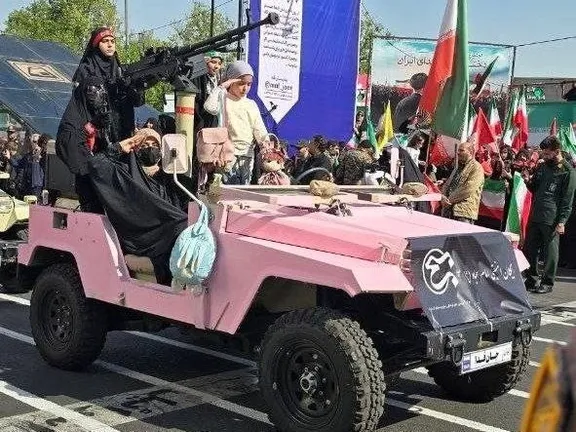
'The politics of pink: how Iran uses cuteness to rebrand violence'


A pink military-style vehicle moves through a street rally in Iran, carrying several women dressed in black chadors and hijabs.

Pink missiles, pink drones and pink firearms. Women with uncovered hair—braids, ponytails, short bobs—stood beside weapons, waved flags and smiled for cameras in scenes broadcast across Iranian media. Tehran appears willing to try almost anything to preserve power.

Critics say the imagery forms part of a new Islamic Republic campaign that pairs missiles with fashion, war with pop culture and force with softness.

Liora Hendelman-Baavur, author of Creating the Modern Iranian Woman, told Iran International the visuals resemble Japan’s “kawaii” culture — imagery built around cuteness — but applied here to rockets and war.

“I think it is trying to make violence look cute,” Hendelman-Baavur said. “It is trying to appeal to the youth, to Gen Z.”

She said the campaign appears aimed at a generation that has filled streets, campuses and online spaces during years of unrest.

“We hear a lot of very aggressive and violent language coming from officials,” she said.

“And we also see it in many of the posters and murals being displayed in Iran. Violence and missiles — with red as the central color — are meant to show they are invincible and victorious. And on the other hand, we have this very light, pinkish, idyllic way of presenting a different reality … to demonstrate a whole different picture of what is really going on.”

A pink-painted missile bearing Persian script sits on display, turning a weapon of war into a piece of stylized propaganda.

The result, she said, is two messages at once: murals, rockets and threats for one audience; pink colors, uncovered hair and festival scenes for another — a duality.

The campaign comes just over 100 days after one of the deadliest crackdowns in modern history, when at least 36,500 people were killed during the bloodiest days of the uprising on January 8 and 9 alone. The Islamic Republic continues to execute political dissidents linked to the January protests.

Any publicity — even negative — is good

For Iranian pop culture expert Siavash Rokni, the scenes are less about change than circulation.

He called the imagery a public relations stunt meant to fill feeds, group chats, broadcasts and headlines with new pictures after months of funeral processions, executions, arrests and mourning.

“With PR stunts, it doesn’t matter if it’s good or bad — what matters is that it circulates,” Rokni said.

He said many Iranians know the difference between staged images and daily life, but viewers abroad may not.

“What worries me isn’t Iranians — it’s people outside Iran who might see this and think everything is normal. That’s where it becomes dangerous.”

Others say the campaign also keeps state control over women at the center of public life. Even without hijab, women’s faces, hair and bodies remain tools in official messaging.

Retreat — for now — on Islamist ideology

It may also point to pressure inside the system itself.

Arash Azizi, author of What Iranians Want: Women, Life, Freedom, told Iran International the Islamic Republic was founded on the goal of building a uniformly Islamist society. If it now loosens one of its core social codes, he said, that carries meaning beyond style.

“They understand that they have to give up on this Islamist ideology,” Azizi said.

He also rejected claims that the war has produced a broad wave of new support for the state.

“There’s no evidence that tons of people were anti-regime before the war and are pro-regime now,” he said.

For now, the pink paint may soften the image, but it does not erase the prisons, the executions, the graves or the anger that still runs beneath the surface of Iran.

https://www.iranintl.com/en/202604201209

Beyond Chips: U.S. And China Enter Robotaxi Race As Physical AI Emerges

 Last week, Goldman analysts led by Mark Delaney laid out a detailed roadmap for clients on how autonomous vehicles could reshape America's highways through the 2030s, with a particular focus on "the impact of AI on profit pools."

In a separate report, Goldman analysts led by Allen Chang covered the rapid expansion of China's robotaxi fleet, highlighting how both superpowers now appear to be locked in a race to automate roads and highways

"We expect a strong ramp up of robotaxis in China, with the robotaxi fleet in China growing from 5k in 2025 to 14k in 2026E (+195% YoY)," Chang began the note.

He pointed out that this update on China's robotaxi and robotruck fleet indicates that "Commercialization is speeding up, with several players achieving city-level break-even."

"We are raising our robotaxi forecasts for 2025-2035E by 7%-25%. By 2035E, robotaxis should account for 36% of all ride-sharing vehicles," Chang said.

The report also introduces forecasts for overseas robotaxi and robotruck markets, highlighting international expansion as an increasingly important revenue driver for Chinese companies, including WeRide, Pony AI, and Baidu.

Chang forecasts that robotrucks could emerge as a long-term growth market, with China's fleet rising from 8,000 in 2026 to 760,000 by 2035.

The overall outlook for AV fleets in China suggests rapid deployment, growing fleet density, and broader global scaling. The analyst noted their stock plays on this emerging trend: robotaxi and robotruck players include WeRide (Initiation), Pony AI, Didi, and Baidu.

Circling back to Goldman analyst Delaney's report on the U.S. robotaxi market last week. He noted that the market is set to top $19 billion by 2030, up from a prior forecast of $7 billion, and continue rising to $48 billion by 2035.

Taken together, the two reports suggest the AI race is no longer confined to data centers and chip stacks. It is now moving into the physical world, where autonomous vehicles, robotaxis, and AI-powered freight networks are emerging as the next major frontier between the two superpowers. On a side note, these AI-powered vehicles can be dual-use and will eventually end up on modern battlefields.

https://www.zerohedge.com/technology/beyond-chips-us-and-china-enter-robotaxi-race-physical-ai-emerges

Viatris recalls extended-release Xanax over dissolution test failure


Viatris, which Pfizer created in 2020, voluntarily withdrew extended-release products made at a plant in Ireland after an analysis revealed an issue that could affect bioavailability.

Viatris has recalled one batch of the anti-anxiety medicine Xanax XR in the U.S. because it failed a test of the rate and extent of drug release.

The company voluntarily initiated the recall after a batch of bottles containing 60 3-mg tablets of the drug failed dissolution specifications. Drugmakers run dissolution tests to assess the conversion of oral dosage forms into solutions. That conversion determines the bioavailability of the active ingredient and thereby affects the efficacy of the drug product.

Viatris found that the dissolution of a batch of extended-release Xanax manufactured in Ireland diverged from the specifications, triggering the Class II recall. The news comes four years after Viatris pulled 110 bottles of Xanax XR from the U.S. market because of out-of-specification results for dissolution. Pfizer, which used to own the drug, recalled 36,000 bottles of immediate-release Xanax in 2012 over dissolution test results.

The FDA approved Xanax XR in 2003, months before Pfizer acquired the asset as part of its $60 billion takeover of Pharmacia. An immediate-release formulation of the active ingredient, the benzodiazepine alprazolam, was already available. However, the older product needed to be taken three to four times a day. Xanax XR is taken once daily.

Alprazolam was off patent and facing generic competition when the FDA approved Xanax XR. Supported by the extended-release formulation, Pfizer grew sales of its Xanax franchise to $350 million in 2008. By then, generic extended-release alprazolam products were competing for market share.

Actavis launched a generic copy of the drug in 2007. Impax Laboratories, which is now part of Amneal Pharmaceuticals, entered the market months after Actavis. Aurobindo Pharma’s generic won FDA approval in 2011.

Xanax XR was part of Pfizer until the drugmaker merged its Upjohn business with Mylan to form Viatris in 2020. Viatris reported $139.9 million in Xanax sales last year. Sales have slipped in recent years, falling from $154.8 million in 2023 to $145 million in 2024.

Viatris’ Xanax XR withdrawal was one of 30 drug recalls in the FDA’s latest weekly enforcement report, which also included five recalls by Teva Pharmaceuticals. The company withdrew about 30,000 packages of the acne medicine isotretinoin across two recalls because they were superpotent or subpotent. Teva recalled isotretinoin in January, but the FDA only classified the action this month.

Teva’s three other recalls stemmed from the use of an unapproved raw material. The FDA listed Actavis Laboratories as the manufacturer of the recalled batches of Teva’s clonidine transdermal system.

https://www.biospace.com/business/viatris-recalls-extended-release-xanax-over-dissolution-test-failure

US says Iranian extradited from Panama on alleged Iran sanctions charges


The US Attorney’s Office for the Western District of Washington said on Monday that an Iranian citizen was extradited from Panama to the United States to face a nine-count indictment in Seattle tied to an alleged scheme to violate sanctions against Iran by shipping goods through China.

Reza Dindar, 44, was indicted by a grand jury in August 2014 and arrested in Panama in July 2025 at the request of the United States, the office said in a statement.

Dindar was due to appear in US District Court in Seattle on Monday for an initial hearing, it said.

“The members of this conspiracy thought they could evade export restrictions by shipping goods through a third country – in this case China,” First Assistant US Attorney Charles Neil Floyd said.

According to the indictment, between 2010 and 2014 Dindar managed a business in Xi’an, China, that allegedly concealed the fact it was procuring US goods for companies in Iran.

Prosecutors said Dindar and co-conspirators used deception in 2011 and 2012 to purchase parts for three military sonar systems from a business in Washington state, claiming they were destined for China while intending to ship them onward to Iran.

Dindar is charged with conspiracy, export violations, smuggling, money laundering and filing false export records.

He faces up to 20 years in prison if convicted.

https://www.iranintl.com/en/liveblog/202604194357

'Iran ‘shadow fleet’ vessels bypass US blockade, Lloyd’s List reports'


At least 26 vessels linked to Iran’s so-called “shadow fleet” have bypassed the US naval blockade despite Washington’s claims that it has turned back shipping bound for the country, according to maritime intelligence reported by Lloyd’s List.

The report cited tracking data showing continued tanker movements tied to Iranian trade since the blockade began.

Among them were several oil and gas tankers carrying Iranian energy exports that departed the Gulf region despite the restrictions, Lloyd’s List reported.

Iran has long relied on a network of ageing or lightly regulated vessels, often operating with obscured ownership or tracking data, to move oil in defiance of Western sanctions.

The report suggests that even under heightened military pressure, elements of that shadow fleet continue to operate.

https://www.iranintl.com/en/liveblog/202604194357