By Michael Every of Rabobank
Friday’s US payrolls were weaker than expected at 29K, another random walk which helped walk soaring bond yields back from the edge of the cliff, at least temporarily. However, far more important things are happening than that report, much as it’s a markets catechism to repeat it.
Europe agreed to US demands to release 50m barrels of its diesel reserves over the next two months, which saw prices dip, also helping yields fall. However, those reserves are not from a government-owned facility but private stocks and were reportedly already available for sale, but Europe is instead opting to buy cheaper US flows. So, the EU move was serious, showing who still asks, ‘How many barrels?’ when the White House asks for a jump in output, yet performative in that truly cheap diesel will remain in short supply. Which geopolitics, not payrolls, will also tell you.
Yemen’s government launched a Saudi-backed offensive to seize all areas held by the Iran-backed Houthis – that means a war and instability around the Red Sea and Bab-el-Mandeb. Egypt, Eritrea, Somalia, and Sudan called on Ethiopia to cease attacks on the separatists in Tigray Addis Ababa accuses them of backing: the risks are of more fighting on the other side of the Red Sea too. Iran is considering Russia's offer to take its 60%-enriched uranium according to one report, and its foreign minister tried to claim asylum in the US before his family was threatened according to a rumor, but Tehran is increasing the range of its missiles and preparing for new US attacks as strikes against tankers in Hormuz increase. The US has also now removed all its B-1 bombers from the UK base just subject to a suspected Iran-linked terror attack amid security concerns, yet the British have, confusingly, bailed all those arrested over it.
Ukraine’s Zelenskyy stated he will step up attacks on Russian oil refineries, but that the US wants to hold trilateral talks with Russia this month. Germany’s Merz visited Kyiv, which Russia attacked again, announcing $1.5bn in aid including interceptor drones and air defence missiles - Ukraine equally believes that Russia has shared its new jet-drone technology with North Korea. The US is also to receive a potash shipment from Belarus as it tries to create a wedge between it and Moscow, and Poland and Romania are meanwhile shunning Kyiv's pleas to help it free grain trapped by the Black Sea’s de facto closure. Worryingly, the White House is now monitoring a suspected plague outbreak in Russia following an accident a bioweapons lab: some reports say three Siberian hospitals nearby have been quarantined.
As the Hong Kong press says, ‘China urged to build 'system' to protect expanding overseas interests’ to “reshape the rules,” the Taipei Times claims the Pentagon is to assign representatives to Taiwan’s Ministry of National Defence, who “would be able to participate directly in defence discussions, including weapons procurement.” That would seem close to a red line for China just after a Trump-Xi summit and ahead of two more meetings alongside Putin before year-end.
In geoeconomics, China claims most of the G20 rejects the US call for its capacity curbs – yet its press notes even allied Russian consumer exporters are facing Chinese competitive pressure, and the Beijing-sympathetic Thailand is seeing protestors slamming Chinese and other foreign companies. Moreover, the UK is expected to impose 45% tariffs on Chinese EVs to avoid ‘Made in Europe’ clashes despite the absence of economic statecraft from British PM Burnham’s relaunch, the Liberal Democrats, Reform, and the Conservative Party’s new mission statement.
Here is the key point I keep stressing: smaller economies will have to adopt the external tariffs set by larger ones as the world fragments. The key questions are how it fragments and who plays what role.

On which, pro-Trump presidential candidate Flavio Bolsonaro leads the incumbent Lula in the first round of Brazil’s election by 47.0% to 45.2%. The margin of that lead combined with the votes for other right-wing candidates suggests to some analysts he is now the clear favourite to get over 50% in the run-off on October 25. At the same time, Bolsonaro's Liberal Party (PL) also just saw the most state governors, senators, and federal deputies elected in parallel elections, giving it the most influence in the next Congress. That has huge implications for Brazil, as Reuters notes how the election winner ‘could reshape its institutions as vacancies mount’.
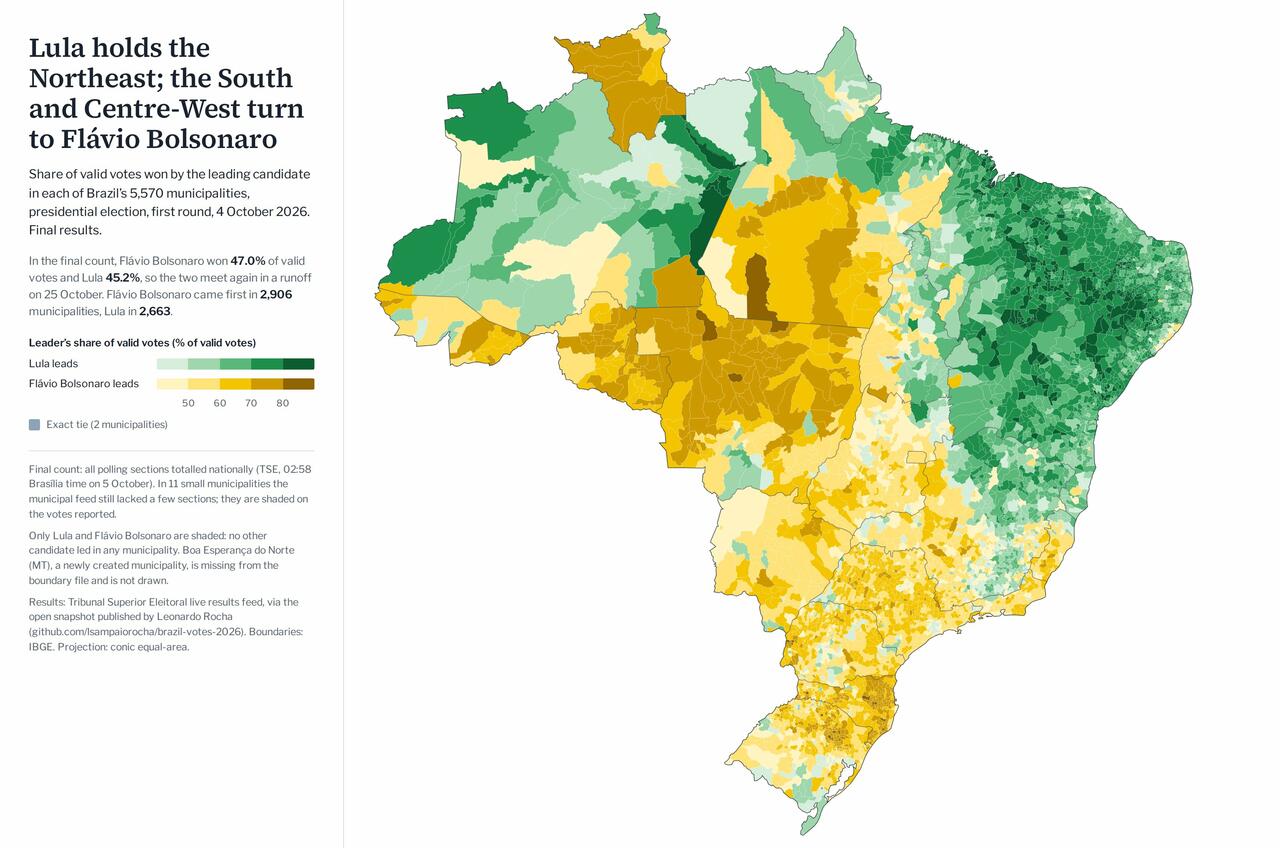
It also has huge global implications. If Brazil ‘flips’, and we are not there yet, it would effectively leave the BRICS with RICS, of which only RC are deeply connected and would see only Nicaragua, Canada, and already-squeezed Cuba of note out of the emerging ‘Donroe Doctrine’ loop given Greenland has been sealed into it – and potentially very much to the AmericaS’ (plural) benefit, which in a more zero-sum world is therefore to others’ detriment. The western hemisphere is after all close to the Middle East in terms of energy production and refining capacity, a giant in agri production, has vast resources of all kinds, and a combined population of around a billion.
Of course, the test would be if the US National Security Strategy is serious about “the goal is for our partner nations to build up their domestic economies, while an economically stronger and more sophisticated Western Hemisphere becomes an increasingly attractive market for American commerce and investment” behind a common external tariff, or if America First is still just cheap labor banana-republic neoliberalism that can be easily outbid on the geopolitical chessboard by others.
Nothing is yet certain, but this could be yet another key if-lines-on-maps-move-so-do-lines-on-screens moment in the making for markets.

No comments:
Post a Comment
Note: Only a member of this blog may post a comment.