Search This Blog

Friday, May 25, 2018

GDPR: US news sites unavailable to EU users over data protection rules

A number of high-profile US news websites are temporarily unavailable in Europe after new European Union rules on data protection came into effect.
The Chicago Tribune and LA Times were among those posting messages saying they were currently unavailable in most European countries.
The General Data Protection Regulation (GDPR) gives EU citizens more rights over how their information is used.
The measure is an effort by EU lawmakers to limit tech firms’ powers.
Under the rules, companies working in the EU – or any association or club in the bloc – must get express consent to collect personal information, or face hefty fines.

Which sites are unavailable?

News sites within the Tronc and Lee Enterprises media publishing groups were affected.
Tronc’s high-profile sites include the New York Daily News, Chicago Tribune, LA Times, Orlando Sentinel and Baltimore Sun.
Its message read: “Unfortunately, our website is currently unavailable in most European countries. We are engaged on the issue and committed to looking at options that support our full range of digital offerings to the EU market.”
Lee Enterprises publishes 46 daily newspapers across 21 states.
Its statement read: “We’re sorry. This site is temporarily unavailable. We recognise you are attempting to access this website from a country belonging to the European Economic Area (EEA) including the EU which enforces the General Data Protection Regulation (GDPR) and therefore cannot grant you access at this time.”
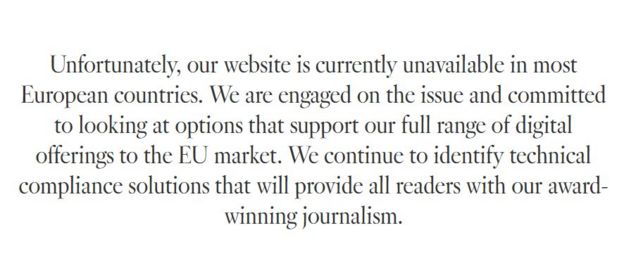
What the LA Times says when you click on its site from certain European countriesImage copyrightLA TIMES
Image captionWhat the LA Times says when you click on its site from certain European countries
CNN and the New York Times were among those not affected. The Washington Post and Time were among those requiring EU users to agree to new terms.

What is GDPR?

Lawmakers in Brussels passed the new legislation in April 2016, and the full text of the regulation has been published online.
Misusing or carelessly handling personal information will bring fines of up to 20 millions euros ($23.4m;£17.5m), or 4% of a company’s global turnover.

Facebook founder Mark Zuckerberg on a television during his testimony to EU lawmakers May 2018Image copyrightAFP/GETTY
Image captionFacebook founder Mark Zuckerberg recently testified to European MPs about data privacy
In the UK, which is due to leave the EU in 2019, a new Data Protection Act will incorporate the provisions of the GDPR, with some minor changes.
All EU citizens now have the right to see what information companies have about them, and to have that information deleted.
Companies must be more active in gaining consent to collect and use data too, in theory spelling an end to simple “I agree with terms and conditions” tick boxes.
Companies must also tell all affected users about any data breach, and tell the overseeing authority within 72 hours.
Each EU member state must set up a supervisory authority, and these authorities will work together across borders to ensure companies comply.
The new chair of the European Data Protection Board, Andrea Jelinek, told the FT they expected cases to be filed “imminently”.
“If the complainants come, we will be ready,” she said.
Ireland’s data regulator Helen Dixon also spoke to the newspaper, saying the country was ready to use “the full toolkit” against non-compliant companies.
Both Facebook and Twitter have their EU headquarters in Ireland.
The new rules come amid growing scrutiny about how major tech companies like Google and Facebook collect and use people’s personal information.
Facebook founder Mark Zuckerberg faced questions from MEPs earlier this week about his company’s collection of data.

Presentational grey line

A data headache

Millions of email inboxes all over Europe filled in recent weeks with messages from anxious companies seeking explicit permission to continue sending marketing material to and collecting personal data from their customers and contacts.
The new rules govern not just the collection and storage but its sale and exploitation for marketing – some companies based in the United States have decided to stop trading in the European Union at least temporarily rather than risk falling foul of the new law.
Members of the European Parliament (MEPs) see themselves as global leaders in a battle to reduce the power of giant internet technology companies and restore a degree of control to citizens and their elected representatives.

Shaping Your Trading and Your Life


So here’s a great question:
What one change in your daily routine will make the greatest difference:  a) in your trading and b) in your life?
How we live our lives shapes our habits and our mindsets.  We cannot live one kind of life and expect to do a different kind of trading.
If we live a life filled with drama or a life filled with inconsistency or a life filled with negative self-talk, that is what we will bring to our trading.  It’s also what we bring to our future.
Who we are in the present and how we live right now shapes who we become.  Each day is a practice session for our future.  If we practice the right things, we develop the right ways.
Too many traders mess up today and reassure themselves that it was all a good learning lesson.
Bullshit.
The learning comes from actively correcting the mess up–and then making that correction a regular part of your trading and your life.
In some measure, be the person today you want to become in the future.  That is climbing the ladder of development rung by rung.  How we act shapes how we experience ourselves.  Our routines create habits and our habits become part of ourselves.
We don’t have to impose discipline if we have developed the right behaviors as habits.

Thursday, May 24, 2018

Eisai, Merck get Aug. 24 FDA date for liver cancer med


Eisai (ESALY). and Merck (MRK) announced that the U.S. Food and Drug Administration has extended the action date for the supplemental New Drug Application for lenvatinib for the potential first-line treatment of patients with unresectable hepatocellular carcinoma. The FDA has indicated that the extension of the Prescription Drug User Fee Act date is needed to allow additional time for review of the application. The agency expects to complete the review on or before August 24, 2018, thus extending the target action date by a standard extension period of three months from the original PDUFA action date of May 24, 2018. Eisai, as the marketing authorization holder, is working closely with the FDA to support the continued review of this application. Lenvatinib is approved by the U.S. FDA for the treatment of locally recurrent or metastatic, progressive, radioactive iodine-refractory differentiated thyroid cancer. Lenvatinib is also approved by the U.S. FDA in combination with everolimus for the treatment of patients with advanced renal cell carcinoma following one prior anti-angiogenic therapy.

Medtronic target upped by Piper


Medtronic price target raised to $96 from $90 at Piper Jaffray. Piper Jaffray analyst Matt O’Brien raised his price target on Medtronic to $96 after its Q4 earnings beat, saying the constant currency revenue growth was evident across geographies and segments, while operating margins expanded by 50bps. The analyst adds that the business has “solid momentum” after consecutive quarters where organic growth topped 6.5%. O’Brien further notes that the “meaningful” product cycle ahead also makes the valuation discount on the stock relative to its peer group “unwarranted”. The analyst keeps his Overweight rating on Medtronic

Payers should rethink Medicare Advantage marketing: Accenture

  • With Medicare Advantage (MA) expected to take on continued importance in the coming years, payers will need to transform their marketing efforts or risk losing millions of dollars, Accenture Consultingsaid in a new report.
  • The report said nearly half of Americans are delaying retirement and don’t plan on enrolling in Medicare until after the age of 65. Plus, slightly more than half of them will shop for a Medicare plan online as they approach eligibility.
  • Accenture said the combination of these two factors show that payers need to “fundamentally rethink how they market to Medicare consumers.”

MA is an increasingly important market for payers, and Accenture said those that move into capturing this audience will have substantial revenue opportunities in the coming years.
Payers view MA as a growth opportunity. The Kaiser Family Foundation expects Medicare will increase to 80 million people by 2030. Now, MA makes up about one-third, but UnitedHealthcare predicts half of all Medicare beneficiaries will have an MA plan eventually.
An average of 10,000 people turn 65 every day, which brings in a new infusion of potential members daily. However, Accenture said many are delaying Medicare rather than signing up immediately. Payers will need to figure out ways to improve conversion rates on those seniors to capture additional revenue or risk losing hundreds of millions in revenue over time.
Accenture said payers are “missing this opportunity by not delivering tools and experiences that address the social realities and digital intensity of consumers aging into Medicare eligibility.”
Accenture estimates that 20% to 40% of prospective Medicare beneficiaries are not ready for the program when they turn 65. They may still work or have coverage through a spouse. Rather than wait until a person is 65, Accenture suggested that payers should engage all consumers before they reach eligibility and find out their retirement plans. That will help outreach efforts once those people are 65 and older.
This can help payers target outreach for that specific person. For example, a payer may send regular information to a person not yet ready for Medicare to keep the prospective member updated. These communications also include a way for that person to sign up when they’re ready. That marketing strategy keeps a person engaged and builds trust with the payer, Accenture said.
Another added benefit to marketing differently and connecting with people comfortable with technology is that people already managing their health are more likely to “do things that keep them healthy, such as track physical activity, monitor blood pressure and monitor cholesterol. These self-managing customers are just the type that a health plan wants in a new value-driven payment world,” Accenture said.

AstraZeneca expands development deal with Bicycle

  • After an initial tie-up in December 2016, AstraZeneca and Bicycle Therapeutics will expand their development deal to include additional targets in the respiratory and cardio-metabolic space.
  • The original collaboration included an undisclosed number of targets and, at the time, Bicycle said it was “eligible for over $1 billion in payments, including an upfront payment, future R&D funding, development, regulatory and commercialization milestones.” The most recent statement says the deal is now valued in “excess of $1 billion.”
  • The expansion increases the number of targets the companies are pursuing and triggers an unspecified milestone payment for Bicycle.

While Bicycle’s own focus is on oncology, the small U.K. biotech has tapped its bicyclic peptide platform to develop therapeutics for its big pharma counterpart. The compounds Bicycle develops are small peptides stretching between nine to 15 amino acids long. The company touts their ability to combine the “specificity and affinity” of antibodies, but in a small molecule form that allows for better solubility and dosing flexibility.
The last few years have been a struggle for AstraZeneca, which has sought to prove itself in oncology while selling off unwanted assets. To that end, the company has made a number of licensing deals that monetize products no longer a part of the company’s core focus.
Most recently, the British pharma sold the rights to the antipsychotic Seroquel (quetiapine fumarate) in several countries outside the U.S. Before that, it spun out six experimental drugs into a standalone biotech that will focus on autoimmune diseases.
AstraZeneca currently has three compounds in its late-stage cardio-metabolic pipeline. Just this past Friday, it won U.S. approval for Lokelma, previously known as ZS-9, for the treatment of hyperkalemia, or high blood potassium. It also has six compounds in Phase 2 and three in Phase 1 in the space, including for type 2 diabetes, coronary artery disease and chronic kidney disease.
Both its cardio-metabolic and respiratory pipelines are significantly smaller than its cancer pipeline. The company has been trying to compete with oncology majors like Merck & Co. and Bristol-Myers Squibb. Yet, the British pharma has had a number of setbacks in the oncology space.
Last month, a combination of its immunotherapies Imfinzi (durvalumab) and tremelimumab failed to hit its primary endpoint in a Phase 3 study of previously treated lung cancer patients.
Prior to that, AstraZeneca disappointed investors when it pushed back the final readout of its MYSTIC study. An earlier analysis from the trial showed the same combo failed to extend progression-free survival in first-line non-small cell lung cancer patients, although the company hopes the study will prove the regimen can extend overall survival.
AstraZeneca will need several of these programs to pan out; the company has been chasing a goal of $45 billion in annual revenues, but only achieved $22 billion for the full-year 2017.

New targets for drug-resistant infections


A decade ago, the bacterium Acinetobacter baumannii was identified as one of the six most common and serious multidrug-resistant pathogens, largely because of its propensity to spread in hospitals, causing infections like sepsis and pneumonia. Scientists have long known that A. baumannii resists treatment with antibiotics by building a capsule to protect itself—they just haven’t been able to figure out exactly how the bug achieves this feat.
A team at Tufts University School of Medicine has published new research that explains how A. baumannii builds this protective coating, allowing it to become more virulent as it continues to evade destruction from antibiotics. The key is a network of molecules that turn specific genes on and off.
The molecular network that the Tufts researchers focused on is called BfmRS. First they genetically altered strains of the bacteria to either activate or cripple the network. When they activated it, they found that BfmRS caused sepsis in mice that was widely resistant to antibiotics.
Then they used RNA sequencing to reprogram A. baumannii’s genes, and in so doing discovered that BfmRS controls genes that influence cell division and the protective envelope around cells, according to a statement.
But the Tufts team also discovered mutations that allowed the bacterium to resist antibiotics without help from BfmRS. The researchers made that discovery by studying one strain of A. baumannii in which BfmRS was deleted. They published their findings in the journal PLOS Pathogens.
The effort to combat multidrug-resistant infections has pulled in scientists from both academia and industry. Among the players are Macrolide Pharma, which raised $20 million in funding and recruited Novartis veteran Mahesh Karande as it CEO in April. In March, Genentech announced it identified an enzyme on the surface of drug-resistant gram-negative bacteria that can be targeted with an antibody, weakening the outer membrane just enough to kill the bug.
The research at Tufts is partially supported by the National Institutes of Health’s National Institute of Allergy and Infectious Diseases, which has been funding a range of research projects under the National Action Plan for Combating Antiobiotic-Resistant Bacteria, launched in 2015.
“We revealed that a single two-protein system controls a global network of proteins that is critical for making A. baumannii a threat,” the authors said in their paper. They believe BfmRS could be directly targeted to battle drug-resistant infections.