Alder announced that the U.S. FDA has accepted for review the Biologics License Application for eptinezumab. Eptinezumab is an investigational monoclonal antibody, administered intravenously, for migraine prevention targeting the calcitonin gene-related peptide and is Alder’s lead commercial candidate. The company submitted its BLA on February 21, and continues to expect to receive a PDUFA action date within 74 days following the submission. If the FDA grants approval of eptinezumab, Alder anticipates a Q1 2020 commercial launch.
Monday, April 22, 2019

OrthoPediatrics announces licensing partnership with CoorsTek Medical
OrthoPediatrics Corp. announced a sublicense agreement with CoorsTek Medical for rights to its Variable-Angle technology that will be commercialized in OrthoPediatrics’ PediFoot system expected to launch later this year.
https://thefly.com/landingPageNews.php?id=2895321
https://thefly.com/landingPageNews.php?id=2895321
Harpoon Therapeutics initiated with an Outperform at Baird
Baird analyst Michael Ulz started Harpoon Therapeutics with an Outperform rating and $25 price target.
Rocket Pharmaceuticals initiated at Baird
Rocket Pharmaceuticals initiated with an Outperform at Baird. Baird analyst Madhu Kumar started Rocket Pharmaceuticals with an Outperform rating and $28 price target.
https://thefly.com/landingPageNews.php?id=2895331
https://thefly.com/landingPageNews.php?id=2895331
Veracyte gets regulatory authorization to offer Envisia Genomic Classifier in NY
Veracyte announced that it has received regulatory authorization from the New York State Department of Health to offer the Envisia Genomic Classifier for patients in the state effective immediately. The genomic test is the first commercially available test to help distinguish idiopathic pulmonary fibrosis from other interstitial lung diseases, without the need for surgery.
Antidepressants Tied to Higher Total Worker Comp Claims, Work Return Delay
A new study in the Journal of Occupational and Environmental Medicine finds that concurrent treatment of chronic pain, depression, and/or anxiety and occupational injuries is associated with large increases in total workers’ compensation claim cost and delayed return to work.
The study, titled “Association of Opioid, Anti-depressant, and Benzodiazepines with Workers’ Compensation Cost: A Cohort Study,” was authored by Dr. Dan Hunt, medical director at AF Group, and Ryan Artuso, senior data scientist in Predictive Modeling for AF Group, in partnership with researchers from the Johns Hopkins University School of Medicine.
This study quantifies the magnitude of the medical resources used to treat patients injured in workplace accidents who have a concurrent diagnosis of pain, anxiety, and/or depression. Previous studies involving the workers’ compensation system have demonstrated a relationship between opioid medication prescription and escalating medical costs as well as increased claim duration. This analysis evaluated the impact of benzodiazepines and antidepressants in combination with opioids on workers’ compensation claim cost and closure rates.
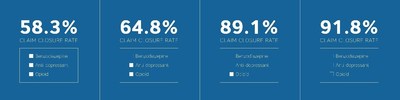
A major finding of the study is the cost difference associated with antidepressant medications. “The overall direction of our findings was expected — injured workers who are experiencing a significant amount of pain or suffering from depression or anxiety will require more medical services than injured workers not experiencing such symptoms or psychosocial disorders,” said Dr. Hunt. “What did surprise us is the increased recovery time and medical costs associated with anti-depressant medications.”
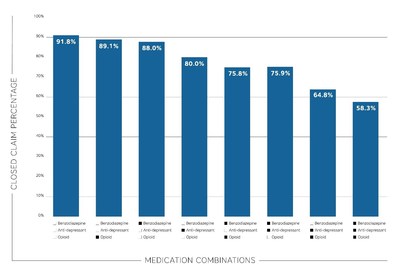
Results showed that the slowest claim closure rate occurred among claimants with prescriptions for all three types of medications (58.3%), followed by claims with both opioid and antidepressant (64.8%) prescriptions. The group without any medications had the highest closure rate (91.8%), followed by the group with only opioid (89.1%) prescriptions.
Even when controlling for age, chronic pain, medical complexity, and claim development (years), antidepressant claims, to a greater degree, were more likely to remain open at the end of the three-year study period. The effect on total paid costs associated with antidepressant prescription was greater in magnitude compared to all other drug classes. This finding is similar to that of a study by Dr. Xuguang (Grant) Taoof Johns Hopkins and others, who observed that antidepressant prescriptions were three times as likely to result in a claim in excess of $100,000.
Researchers from AF Group and the Johns Hopkins University School of Medicine analyzed 22,383 work-related indemnity claims from 2008-2013 in the State of Michigan from AF Group brands. “This information will provide support to physicians who treat workers’ compensation cases to explain to patients and employers that concurrent pain, depression, and/or anxiety requires more resources, which increases the duration and cost of the claim,” commented Artuso.
Sientra approval may indicate FDA ‘comfortable’ with data: Craig-Hallum
Craig-Hallum analyst Alexander Nowak says Sientra has gained 6% after the company gained FDA approval for four new styles of round breast implants, adding that he has not seen the product codes before, but they could be for Sientra’s new line of extra-large, ultra-high profile breast implants. Nowak says FDA approval for these new implants — two types of smooth implants and two types of textured implants — could be viewed as more of a positive than normally, as there has been discussion if textured implants would be removed from the market and says the market may read into this that FDA is comfortable with Sientra’s safety data. He maintains a Buy rating and $23 price target.
Subscribe to:
Posts (Atom)