Search This Blog

Sunday, April 18, 2021

Woodcock on tougher FDA drug reviews: ‘I don’t think so’

 Following a recent string of setbacks for some drug developers, acting FDA commissioner Janet Woodcock said Wednesday that she does not think the FDA is getting more stringent in its reviews of new drugs even as the agency hosts a 3-day advisory committee next week to take a closer look at several accelerated approvals.


“I don’t think so,” Woodcock said when questioned about the tougher stance at a webinar for the Alliance for a Stronger FDA. “I think that what’s happening is that science is moving into fields that typically haven’t seen advances that we’re seeing in other areas, and so I think there is some adjustment that has to be made as people deal with that.”


She noted her experience at the FDA during the HIV epidemic in the 1980s when the FDA took some chances early on with treatments.


“That kind of boldness is predicated on the need being so great that you can take those chances,” Woodcock said. “I think people asking these questions should have more conversations with [newly minted CDER director] Patrizia Cavazzoni and [head of the FDA’s Office of New Drugs] Peter Stein.”


She also noted that CDER was trying to finish a major reorganization just as the pandemic took off, and they haven’t been able to finish that work and to fully staff up.


“I wouldn’t read too much into the tea leaves over this, but it’s worth having more conversations with the center,” she said.


The comments come as SVB Leerink analyst Geoffrey Porges recently said in an investor note that the FDA may be hardening its stance against the industry, particularly with respect to safety issues.


“There is a perception among investors that the FDA has become more active and demanding under new acting commissioner Janet Woodcock,” Porges wrote. “If this is a sea change (rather than a coincidence of timing), then it seems sensible to assume that regulatory applications with any uncertainties or questions have a higher-than-expected risk of being delayed and will be subject to further information requests and advisory committee reviews.”


Woodcock also made clear that the FDA’s inspection backlog of drug manufacturing facilities is a priority. The pandemic has forced the FDA to forgo more than 1,000 of its planned fiscal year 2020 inspections and the agency will likely face a backlog of future inspections for years to come, according to Mary Denigan-Macauley, director of health care at the Government Accountability Office.


“We have our own recoveries to make on facility surveillance and inspections and things that we may not have gotten to,” she said in reference to a question on what the agency will focus on following the pandemic.


The FDA on Wednesday unveiled new guidance on remote inspections, explaining how they will be requested by the FDA and conducted for the duration of the Covid-19 public health emergency at any facility where pharmaceutical products, including biologics, are manufactured, processed, packed or held.


The FDA is also prepping to decide where to spend an additional $500 million from Congress that came as part of Covid-related stimulus funds.


She said a significant amount of those funds will be spent on surveillance in its premarket work and that surveillance must be stepped up across the agency.


“We are also going to invest in supply chain. This pandemic made clear we don’t have enough visibility into supply chains, and much of this is IT-driven,” Woodcock said.


Other major programs at the agency this year include tech and infrastructure modernization projects, initially led by Amy Abernethy, who’s now departing the agency later this month.


And as the next iteration of PDUFA negotiations has indicated, Woodcock also noted, “Cell and gene therapy is the most pressing resource need.” The push comes as INDs for new gene therapies have catapulted from just 32 in 2010 to 161 in 2019, and many more are expected in the coming years.

https://endpts.com/janet-woodcock-on-if-the-fda-is-getting-tougher-on-drug-reviews-i-dont-think-so/

Covid-19 Vaccines and Rare Blood Clots: Women at Greater Risk?

 Scientists are trying to understand why women appear to be more vulnerable than men to a potentially deadly blood-clotting condition reported among a tiny number of recipients of Johnson & Johnson's Covid-19 vaccine.

U.S. health officials called for a pause in the use of the J&J vaccine on Tuesday after six women -- out of roughly seven million people who received the vaccine in the U.S. -- developed blood clots in the brain and other parts of the body within two weeks of vaccination.

The move came after similar clotting problems were reported in at least 140 people in Europe, the majority of them women, who received the Covid-19 vaccine made by AstraZeneca.

At least 34 million in Europe have received the AstraZeneca vaccine, which hasn't been approved for use in the U.S.

J&J said Wednesday that it would delay the rollout of its vaccine in Europe and pause vaccinations in its vaccine trials. A federal committee said Wednesday that more information was needed to determine whether use of the vaccine should resume, be discontinued or limited to certain groups of the population. In a letter published Friday in the New England Journal of Medicine, three J&J scientists said there wasn't enough evidence to say that the company's vaccine caused the six clotting cases.

AstraZeneca said last week that it is working to update its vaccine labels to list blood clots as a rare side effect. The company also said it is working to understand what could explain the events. Some countries have restricted or suspended use of its vaccine.

Scientists said the tiny number of cases of the clotting condition -- and the fact that more women than men may have gotten the AstraZeneca vaccine -- make it hard to draw firm conclusions about whether women are at higher risk. Over time, they said, men may prove to be as vulnerable to the rare condition as are women.

Women are known to have stronger immune reactions to vaccines than men.

"It's a blessing and a curse," Dr. Sabra Klein, a professor of molecular microbiology and immunology at Johns Hopkins Bloomberg School of Public Health, said of women's stronger immune response. It could help explain why Covid-19 tends to be less deadly in women than in men. But it could also underlie women's greater likelihood of experiencing severe side effects after vaccination, as well as their greater risk of autoimmune diseases, in which the immune system attacks the body, she said.

In two studies, published in April in the New England Journal of Medicine, researchers found that the clotting condition seen in some recipients of the AstraZeneca vaccine closely resembled a rare condition called heparin-induced thrombocytopenia, or HIT. The condition, which in rare instances affects people given the blood-thinning drug heparin, involves both abnormal clotting and a drop in levels of clot-forming blood components known as platelets.

A case report of a 48-year-old woman who received the J&J vaccine described a similar phenomenon: low platelet levels and blood clots in both her brain and digestive system.

HIT is triggered by an errant antibody reaction that activates platelets, causing them to clump together to form clots. In the case of the clotting problems following vaccination, the patients didn't receive heparin, just a vaccine. Scientists now are calling the condition vaccine-induced immune thrombotic thrombocytopenia, or VITT.

"When we talk about women being more at risk, my suspicion is that it is...an immunologic reaction and there's some molecule [in the vaccine] that is mimicking heparin," said Dr. Jean Connors, a hematologist at Brigham and Women's Hospital in Boston.

Both the J&J and AstraZeneca vaccines use what's known as viral vector technology, in which genetic instructions for a key component of the novel coronavirus are placed within a harmless virus and injected into the body to trigger an immune response to the actual pathogen.

Theodore Warkentin, an expert on HIT at McMaster University in Ontario, Canada, said his research has shown that women who receive heparin after cardiac or orthopedic surgery are more likely than men to experience the condition.

"It could be that this vaccine effect, which does mimic this adverse drug reaction in many ways -- there could be a female predisposition," said Dr. Warkentin, who is also studying vaccine-linked blood clots.

Some doctors have speculated that women's apparently heightened risk for the clotting disorder following vaccination with the J&J or AstraZeneca vaccines could be explained by pregnancy or the use of birth-control pills. Both pregnancy and the hormones found in birth-control pills can boost the body's clot-making ability.

Of the six women who developed clots after getting the J&J vaccine, however, only one was using the hormones, and none had any known blood-clotting disorders. And the clots that affected the women following vaccination differ from clots seen in the general population, which typically aren't accompanied by a drop in platelet levels.

In a late-stage J&J trial, only one individual had this type of blood-clotting reaction after getting the vaccine, the company said, out of more than 43,000 people who were vaccinated. The clotting disorder wasn't reported among any of the tens of thousands of patients who received the vaccine in the AstraZeneca trials.

https://www.marketscreener.com/quote/stock/JOHNSON-JOHNSON-4832/news/Covid-19-Vaccines-and-Rare-Blood-Clots-nbsp-Are-Women-at-Greater-Risk-32997554/

More than a few empty desks and Purell for an office return

 With vaccination ramping up, companies are planning reopening dates. But don’t expect to be gathering around ye olde water cooler anytime soon.

While you’ve likely already heard of back-to-work trends like flexible days, hot-desking (multiple workers using a single workspace at different times) and temperature checks, there’s a lot more to come as many firms introduce changes to make the office safe and comfortable.

Welcome to the office 2.0.

Tent life

Steelcase has created stylish and versatile work tents as a mainstay for the workplace. The office-environment designer launched them to give an open-concept floor plan dedicated spaces, and they’ve proved to be a huge hit.
“Created by an outdoor-gear expert, the tents are a playful way to bring workers back to the office, borrowing form and function from nature,” said sociologist Tracy Brower, Ph.D., a principal at Steelcase.

Other offerings from the company include desktop pods that can move from desk to desk, a “boundary tent” to separate cubicles or serve as a Zoom background and options for “flex frame” walls that teams can arrange into their own configuration.

The office-environment designer launched them to give an open-concept floor plan dedicated spaces.
Steelcase

Under wraps

You might see a domed station in lieu of your former cube. One of the leaders in the space is MojoDesk, which has created an electric sit-to-stand desk that moves up and down with the press of a button. In addition, it also has a built-in, adjustable privacy dome. Not only is it ergonomically appealing it also features dimmable LED lights.

MojoDesk has created an electric sit-to-stand desk that moves up and down with the press of a button.
MojoDesk

“MojoDome was originally designed to eliminate echo, decrease background noise and offer privacy to reduce distractions,” said Barry Carson, co-founder and president of MojoDesk and parent company Xybix, a top player in ergonomic workstations. “With the added benefit of a physical barrier for built-in social distancing, we anticipate these features will be extremely valuable to those in an open office.”

Take it outside
At New York-based Marx Realty, they believe that bringing a hotel-like aesthetic into offices can promote a sense of calm, making your 9-to-5 feel like a Zen escape. And perhaps nowhere is that more obvious than in outdoor workspaces, such as the Ivy Terrace (above) at their offices at 10 Grand Central in Midtown.

For Craig Deitelzweig, president and CEO of Marx Realty, it’s not just about one-off innovations, but updating the big picture in order to create a relaxing and safe experience for employees and guests.

Marx Realty believes that bringing a hotel-like aesthetic into offices can promote a sense of calm, making your 9-to-5 feel like a Zen escape.
Marx Realty

“Tenants today increasingly demand outdoor space — it has always been a sought-after amenity and has become even more desirable in the age of COVID-19,” he said. “At 10 Grand Central, for example, we frequently see employees eating lunch outdoors, having coffee, working on their computers and engaging in group meetings. We even see lots of employees enjoying a socially distant al fresco glass of wine together.”

Real-time apps
RXR Realty’s $20 billion portfolio ranges from 75 Rockefeller Plaza to the Starrett-Lehigh Building in Chelsea, home to tenants like Ralph Lauren and Martha Stewart. They’ve launched the RxWell by RXR app in partnership with health experts and Microsoft, which monitors social distancing, mask compliance, building capacity and more. The app even tracks cleaning schedules, as it interacts in real time with tenants and visitors.

“Technology-enabled the extraordinary success of the world’s largest and most abrupt work-from-home experiment, but it will also enable the opportunity for workplace innovation,” said the company’s founder and CEO, Scott Rechler.

RXR Realty’s $20 billion portfolio ranges from 75 Rockefeller Plaza to the Starrett-Lehigh Building in Chelsea, home to tenants like Ralph Lauren and Martha Stewart.
RXR Realty

RxWell is available to all 900-plus tenant organizations and 70,000 employees across the RXR commercial portfolio.


Touchless tech
If you’ve been opening door handles with your sleeve for the past year (er, half your life?), you’re not alone, and there’s a whole slew of office designers looking to save you from coat-sleeve hell when it comes time to return to the office.

“Touchless solutions will become mainstream in the coming months, but also hold value in the long term because, in addition to being safer, these technologies are more efficient,” said Brad Sweet, commercial marketing leader at Allegion, a trailblazer in safety and security solutions.

Their automatic operators for doors, contactless readers for credential technologies and mobile credentials for contactless access are gaining traction in healthcare facilities, commercial offices, K-12 schools and higher-education campuses.

Light work
A type of ultraviolet light, UV-C radiation, is a known disinfectant, and that PhoneSoap UV-C gizmo you caved and bought at the onset of the pandemic is going to be in good company at your corporate digs.

UV-C radiation, is a known disinfectant, and that PhoneSoap UV-C gizmo you caved and bought at the onset of the pandemic is going to be in good company at your corporate digs.
AP

“We’re seeing office spaces use UV-C sanitization tech in conference rooms, entryways and HVAC systems,” said Joe Heaney, an air-quality expert and president of Lotus Biosecurity. “As offices reopen, they’re doing so primarily to promote the type of in-person meeting and collaboration that is difficult to accomplish via Zoom, making conference rooms and meeting areas some of the most utilized spaces. UV-C sanitizing ‘robots’ are used before and after meetings on a five- to seven-minute cycle to ensure that the next group entering the space is in a completely sanitized room, with clean air and surfaces.”

Heaney is also seeing the implementation of “sterilockers” — cubbies that use hospital-grade UV-C light, originally designed to sanitize doctors’ white coats. “It wipes out any germs you or someone you are meeting may have inadvertently picked up, say, on the subway or in an elevator,” he said.

Lastly, Heaney said there’s an uptick in UV-C as a method of air purification that has been effectively used in the HVAC systems of hospitals and other high transmission-risk areas for decades. “The efficacy of these systems are up to 99.99 percent when designed properly,” he said.

https://nypost.com/2021/04/18/are-empty-desks-and-purell-enough-to-return-to-the-office/

Printable DNA 'Ink' Takes A Big Step Forward

 When we think of DNA, it is hard to imagine everything the building blocks of life are capable of creating. Now scientists are starting to push the limits of what’s possible. From food to medicine, synthetic biology depends on accurate and reliable DNA synthesis to make multiple products. DNA is such a vital part of many technologies that it has created a billion-dollar DNA synthesis industry. 

Now, Molecular Assemblies, a San Diego-based company that pioneered enzymatic DNA synthesis, has received $24 million in Series A funding to explore the possibilities. The company plans to make commercial access easier to its technology that makes synthesizing DNA faster, cheaper, and more accurate. 

"The Series A financing will support our move to commercialization," says Mike Kamdar, president and CEO of Molecular Assemblies. "We intend to start a key customer program at the end of the year to begin putting our DNA in customers' hands to get their first-hand experience."  

The Power of Enzymatic DNA Synthesis

Synthetic DNA appears in many applications, including life science research, biologic therapeutics and diagnostics, data storage, nanotechnology, and agriculture. From cancer drugs to tastier cell-based meat, synthetic DNA plays a crucial role in many manufacturing processes. 

By using enzymes to make DNA, Molecular Assemblies is transforming an inefficient 30-year-old chemical process into a cleaner, greener, and better process. The old chemical method is inherently limited to short DNA strands that need extensive post-processing to make pure, long strands. Since the process was developed in the 1980s, it has limited the potential uses of DNA synthesis in multiple industries. 

"Our scientists have pioneered a novel, two-step enzymatic DNA synthesis method," says Kamdar. Molecular Assemblies' enzymatic synthesis method uses aqueous (non-toxic) reagents, requires minimal post-synthesis purification and processing, and can scale to longer, higher quality, sequence-specific DNA. Molecular Assemblies and Codexis, a protein engineering company, are working together to engineer and optimize the enzymes involved. Codexis is also one of the investors in this Series A funding. Together, the companies want to increase the commercialization of enzymatic DNA synthesis. 

Making DNA Into an Ink

What if we could make DNA into an ink and put it inside a printer? This is the type of technology that Molecular Assemblies is working on through a partnership with GE Research. The goal is to make DNA ink that can be used for genomics printers to create nucleic acid-based vaccines like mRNA vaccines and other types of therapeutics. 

"We use a clean synthesis process to make the DNA ink for any genomics printer, capable of being deployed anywhere in the world because we do not use hazardous chemicals to synthesize DNA. The DNA would not need to be stitched together to form the end product," says Kamdar.

Molecular Assemblies and GE Research are working on a project that is part of the Defense Advanced Research Projects Agency (DARPA) program called Nucleic Acids On-Demand Worldwide (NOW). Ultimately, the researchers want to make an automated, mobile platform that can generate vaccines anywhere and at any time. 

Considering the current COVID-19 pandemic and predictions about future pandemics, this type of technology is a necessity around the world. Having a mobile, medical manufacturing platform would make producing and packaging DNA- or RNA-based vaccines faster. Molecular Assemblies can produce long, high-quality DNA, which could then be converted to RNA, and optimized for biomedical applications.

Molecular Assemblies' DNA synthesis technology provides an important tool for the DARPA project. Since the DNA is made with non-toxic reagents and requires less purification and processing, it can be used faster to make a vaccine or therapeutic. 

The Future of DNA 

Molecular Assemblies believes that DNA has the potential to become the polymer of the 21st century. If you consider the transformation that plastic polymers created in the previous century, it is possible to envision what could happen if DNA took over as the building block for our industries. 

"DNA is part of every living thing, and the ability to create DNA on demand has specifically driven the biomedical revolution we have today. But the current DNA synthesis method is inherently limited by length, purity, and the use of toxic chemicals. By “greening” DNA synthesis and delivering an even better end product, the potential is endless," says Kamdar. 

Building our material world with synthetic biology could make products cheaper and better. The applications could extend well beyond current industries, such as personalized medicine or cancer research, to new areas. For example, DNA could be used for data storage, nanomachines, or bio-based electronics.

By harnessing the powerful potential of DNA synthesis, multiple industries could be transformed, including synthetic biology. The revolutionary technology can make DNA more affordable and accessible.

https://www.forbes.com/sites/johncumbers/2021/04/15/printable-dna-ink-just-took-a-big-step-forward/

What's Known About Covid-19 Vaccine Blood Clots, And To Diminish Risks

 On Tuesday, the CDC and FDA recommended that states pause the administration of the Johnson & Johnson Covid-19 vaccine after six rare blood clots that were potentially linked to the vaccine were reported. Earlier this week, the European Medicines Association (EMA) reported it was investigating four cases of blood clots related to the Johnson & Johnson vaccine, and the company said in a statement that it would be pausing its rollout into Europe. 

These announcements have come on the heels of  an ongoing controversy over the AstraZeneca vaccine, which has also been paused or restricted in multiple countries after reports of extremely rare blood clots among people who had received it. Both vaccines use a similar technology, which is distinct from the mRNA vaccines developed by Pfizer and Moderna. Here’s what’s known about the blood clotting risks so far, and how public health experts intend to manage these risks to continue the response against the pandemic. 

Though Extremely Rare, It’s Likely The Clots Are Related To The Vaccines

So far,  these blood clots are extremely rare. The risk of a blood clot occurring after the Johnson & Johnson vaccine is so far about one in a million, while the risk from the AstraZeneca vaccine has been found to be closer to 1 in 250,000 in the U.K. Both of these risks are far lower than the risk of getting a blood clot from Covid-19 itself, which one paper found occurs in about 20% of Covid-19 patients. 

But scientists do have good reason to suspect that the clots are linked to the vaccines. The types of clots that have been reported after vaccination are “extraordinarily unusual and bizarre,” says John Kelton, a researcher at McMaster University in Ontario, occurring in parts of the body that aren’t normally known for experiencing clots. The patients that are getting these blood clots also have low numbers of cells that normally help the body to clot when damaged, called platelets. Low platelets usually means that the body can’t form clots — but in these recently vaccinated patients, clots are popping up in seemingly random areas.  

The combination of unusual clots and low platelets is actually one that Kelton first saw about 40 years ago in a disease that’s now called heparin induced thrombocytopenia. It can occur when patients who take heparin, a popular blood thinning medication, spontaneously develop rare blood clots. In rare occasions the same phenomenon has been documented in patients who haven’t taken heparin: low platelets, but unusual clots. It’s an easily identifiable condition, Kelton says, because “this is a very dramatic reaction.” It can also be confirmed through a chemical test. 

Kelton and his team recently received eight samples from patients who had gotten blood clots after getting the AstraZeneca vaccine — and one sample in particular stood out. “It was exactly the syndrome that we’ve seen before,” he says. 

The Clots May Be Related To The Underlying Vaccine Technologies

Though scientists strongly suspect these vaccines may be linked to this extremely rare clotting disorder, they don’t yet know why. Both vaccines work in a similar fashion: they deliver genetic material to cells that instructs them to create a portion of the coronavirus called the spike protein, which stimulates the immune system to produce Covid-19 antibodies. Additionally, both vaccines deliver those genes to patients using a common cold virus, called an adenovirus, that’s been genetically modified to not make people sick. Similar blood clotting has not been observed in either the Pfizer or Moderna mRNA vaccines, which rely on a different technology.

There are several hypotheses for why these adenovirus vaccines might cause clots, says Maria Sundaram, a postdoctoral researcher at theInstitute for Clinical Evaluative Sciences in Ontario. It could be that the negatively-charged particles of viral DNA in the vaccines are breaking apart and attaching to a positively-charged protein in the body called platelet factor 4. This could potentially induce blood clots to form. But, she says, “that doesn’t seem very likely due to the lab studies we’ve been doing.” Another potential explanation is that the body’s immune system could be triggered to attack this type of vaccine because it recognizes it as a foreign entity in the body. 

Still other researchers hypothesize that it’s the adenovirus vector itself that could be causing the clots. While these have been studied for decades, the AstraZeneca and Johnson & Johnson Covid-19 vaccines are the first that  have used the technology on a massive scale of millions of people. The only other adenovirus vaccine that is commercially authorized is one for Ebola, also manufactured by Johnson & Johnson, which has only been given to a few hundred thousand people in West Africa — which may not be enough people for the rare clotting effect to be observed. 

How Public Health Experts And Vaccine Makers Can Reduce These Rare Risks

If it turns out the rare blood clotting is related to the vaccine’s adenovirus vector, says Paul Offit, Director of the Vaccine Education Center at the Children’s Hospital of Philadelphia, “you might be able down the line to alter that vector” in a way that prevents it from causing blood clots. But, Offit says, that could take months or years of more research. 

“If it’s one protein in that vector that’s being produced and you could modify that, maybe,” says Bill Moss, Executive Director of the International Vaccine Access Center at Johns Hopkins. “ But it will really take some more detective work to figure out what components of those vaccines are creating those [clotting] antibodies.” 

Researchers like Kelton are already looking into this by requesting more samples from people who have gotten blood clots after getting vaccinated. “We have got the back half of the reaction — we know how it binds to platelets, we’ve studied that for decades,” he says, “what we don’t know is the front end.”

In the meantime, the CDC’s Advisory Committee on Immunization Practices (ACIP) will hold an emergency meeting on April 14th to discuss whether the Johnson & Johnson vaccine rollout should continue to be paused. They might, like other countries in the EU and Canada, recommend that adenovirus vector vaccines only be given to people who are over a certain age. Most of the patients that have gotten these unusual blood clots are young women, so some nations have ordered that only people ages 55 and older can get the AstraZeneca or Johnson & Johnson vaccine. 

Sundaram and Kelton both add a note of caution about these patient restrictions, however: The age and gender association in clots could be a red herring. Both scientists pointed out that the majority of people who have received these vaccines, particularly in the EU, are teachers and healthcare workers; and the majority of teachers and healthcare workers are young women. “It’s pretty hard to tell,” if age and gender are risk factors for these blood clots, says Sundaram, particularly since the clots appear so rarely.

Luckily when these rare blood clots do occur they are often easily treated, as long as they are caught early enough. The CDC says that if a patient experiences symptoms including severe headache, leg pain, shortness of breath or abdominal pain within three weeks of getting the Johnson & Johnson vaccine, they should contact their healthcare providers. Often, Kelton says, these clots can be treated in the hospital with blood thinners — though he advises these rare patients stay away from heparin. 

Scientists and public health officials  have another  daunting task going forward: communicating to the public that these pauses are actually a good thing, and shouldn’t make people afraid of the vaccine. “These side effects are extremely rare, so you’re not taking a big risk,” Offit says. Meanwhile, “there’s nothing theoretical” about the risks of Covid-19. 

Moss says that numerically, the risk of using these vaccines is much smaller than the reward. “The calculus I think is pretty straightforward,” he says, “the public health messaging is the tricky part. Maintaining trust and confidence is very hard.” 

https://www.forbes.com/sites/leahrosenbaum/2021/04/13/heres-what-scientists-know-about-covid-19-vaccine-blood-clots-and-how-the-risks-can-be-diminished/

With $27M Funding, Tiny Fintech Targets Cigna, Aetna, UnitedHealthcare

 There’s no reason why paying for a root canal should be more complicated than paying for a steak dinner. That’s how it looked, at least, to Paul Aaron, one the first 20 employees at digital payments giant Square and later a product manager at Oscar Health, the direct-to-consumer health insurance upstart founded in 2012. Connecting the dots between these two jobs inspired him in 2018 to build Level, a New York startup hoping to sell employers on more efficient and affordable insurance benefits for their employees.  

“The big insight behind Level was this idea that insurance is just a way to pay for things,” says CEO Aaron, speaking at 6:30 a.m. over a zoom call from Hawaii (he’s keeping East Coast hours). “It's a product that people really depend on, but it's actually pretty confusing and sometimes can feel very unfair to us.”

After launching employer-sponsored dental plans in 2019, Level closed a $27 million Series A round at a valuation north of $100 million in late 2020, previously unannounced until todayLightspeed Venture Partners and Khosla Ventures led the round, joined by First Round Capital FCAP 0.0% and Homebrew. The company added vision coverage in January, is hiring more staff and soon plans to expand into other employee benefits—making benefits better than a salary’s cash component is Level’s “north star,” Aaron says.

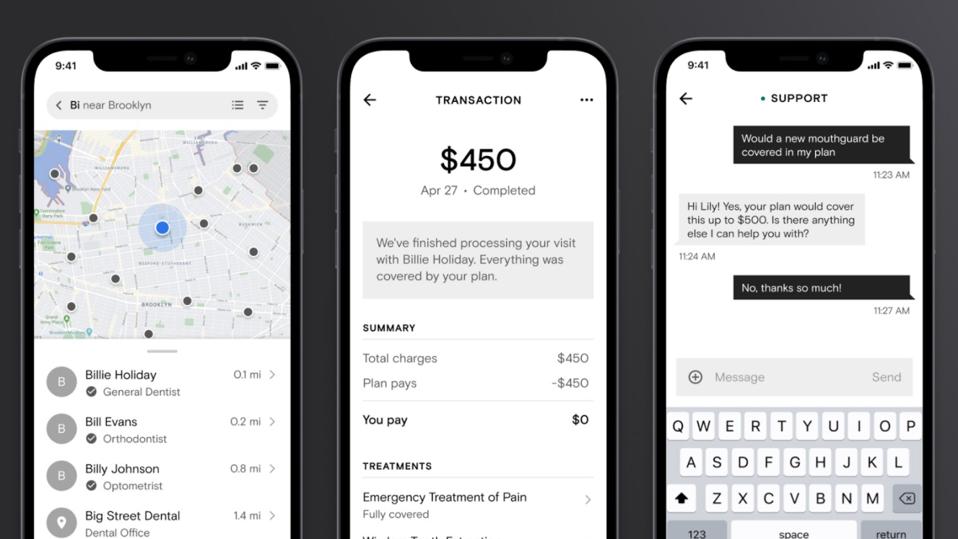
Employees who have access to Level through their work can use its app to search for providers, compare prices for various services, book appointments and handle co-pays then and there, no insurance card or belated paper bills in sight. Claims are typically processed within 4 hours, compared to 30 days or more with some mainstay providers. And while users can see any dentist or optometrist, more than 100,000 providers have an in-network contract (and access to software that tracks patient visits and billing) with Level.

Current customers include several mid-size tech companies like Intercom and Udemy and Level investor First Round.  Aaron says his startup saves employers money by giving them insights into the benefits that their workforces uses, allowing HR teams to customize plans and ultimately pay only for the services they need. Intercom, a business messaging startup, says it saved 20% from its previous dental provider, while adding more benefits—such as coverage for adult orthodontia—for its approximately 600 workers. First Round claims it saved 47% year-over-year after switching to Level’s dental coverage.

The funding announcement also accompanies the launch of a new insurance product underwritten in-house. Unlike most traditional group insurance arrangements, where companies annually forfeit the cost of benefits not used by workers, Level now allows businesses to pay a fixed amount each month and receive a refund at the end of the year for any unused benefit. Critically to companies with tight balance sheets, they will never have to pay for costs beyond the monthly fee. The shift allows businesses as small as two people to adopt Level’s self-funded model historically accessible only to large corporations that could absorb the cost of unexpected, expensive procedures like an emergency surgery. (And luckily for Level’s costs, these hefty bills aren’t as common in dental or vision care.)

Insurance is not the sexiest industry, but it is lucrative. In 2019, U.S. healthcare spending reached $3.8 trillion, more than 17% of the gross domestic product that year, according to the Centers for Medicare & Medicaid Services, and census data indicates that about 55% of the population—more than 180 million people—received employer-sponsored insurance. Venture capitalists have taken note, investing more than $7 billion across 377 “insurtech” deals in 2020—a four-fold dollar-amount increase from 2016, per private markets data provider CB Insights

Level won’t have an easy path, as it takes on giants with footprints to match. Healthcare insurer Cigna CI -0.7% counts more than 17 million global dental customers, Aetna AET 0.0% has 12.7 million dental members and UnitedHealthcare Dental has enrolled more than 13 million Americans in its employer-sponsored, Medicare and Medicaid plans. Its largest rival, though, might be Delta Dental Plans Association. The organization covers more than 80 million participants across the country. [Update: Level claims it is negotiating partnerships with some big insurers.]

At 10,000 employees covered today, Level is barely a blip competitively—but Jana Messerschmidt, a partner at Lightspeed, has given the startup a vote of confidence twice over, having backed Level both personally and professionally. (She first joined the startup’s seed round as an angel investor in 2018 before Lightspeed hired her later that year.) 

“This is one of these companies that has the potential to become Stripe-sized in this new fintech meets insurance tech space,” she says. “There are a lot of things that have to go right for the company for that to happen.”

https://www.forbes.com/sites/elizahaverstock/2021/04/16/with-27-million-in-funding-a-tiny-fintech-takes-aim-at-cigna-aetna-and-unitedhealthcare/

AstraZeneca could have COVID-19 vaccine against variant by end-2021

 A modified version of AstraZeneca's (AZN.L) COVID-19 vaccine tailored to combat a coronavirus variant first documented in South Africa could be ready by the end of 2021, an AstraZeneca official in Austria said in an interview published on Sunday.

Sarah Walters, AstraZeneca's Austria country manager, told the Kurier newspaper that studies, so far, indicating the existing AstraZeneca vaccine was less effective against the more infectious variant first documented in South Africa were "too small to draw final conclusions".

"In the meantime, AstraZeneca and Oxford University have started on modifications to the vaccine for the South African variant and we expect it will be ready by the end of the year, should it be needed," Walters told the Kurier.

Walters blamed challenges - including delivery delays for the AstraZeneca shot in the European Union - on the "complex process" of producing a vaccine, coupled with the extremely high demand arising from the coronavirus pandemic.

"We had to work without keeping a supply in reserve. As a result, we couldn't make up for unexpected events," she said. "We are confident that we will fulfill our commitment to deliver 300 million doses to the European Union this year."

The Kurier interview did not directly address ongoing investigations into health concerns over the AstraZeneca shot. The EU has put a warning label on the vaccine over its possible linkage to extremely rare blood clots, Denmark has completely halted use of the vaccine and Britain has advised people under 30 to get another brand of vaccine. read more

Asked about "thousands" of people in Austria who are cancelling their appointments for AstraZeneca shots, Walters said the company's plan was "to continue to transparently provide information about efficacy and safety to doctors, so that they can adequately inform people" of benefits and risks.

British and European Union medicine regulators have said that the overall benefits of using the vaccine outweigh any risks of rare clotting.

https://www.reuters.com/business/healthcare-pharmaceuticals/astrazeneca-could-have-covid-19-vaccine-against-variant-by-end-2021-austrian-2021-04-18/