Search This Blog

Saturday, April 24, 2021

Temporary Herd Immunity Likely Emerged Early in COVID Epidemic – But Got Destroyed

 Scientists developed a model showing that a fragile, temporary state of immunity emerged during the early epidemic but got destroyed as people changed their social behaviors over time, leading to future waves of infection.

Scientists at the U.S. Department of Energy’s (DOE) Brookhaven National Laboratory and the University of Illinois Urbana-Champaign (UIUC) have developed a new mathematical model for predicting how epidemics such as COVID-19 spread. This model not only accounts for individuals’ varying biological susceptibility to infection but also their levels of social activity, which naturally change over time. Using their model, the team showed that a temporary state of collective immunity — which they termed “transient collective immunity” — emerged during the early, fast-paced stages of the epidemic. However, subsequent “waves,” or surges in the number of cases, are predicted to appear because of changing social behaviors due to pandemic fatigue or variations in imposed mitigations. Their results appeared online on April 8, 2021, in advance of publication in the Proceedings of the National Academy of Sciences

The COVID-19 epidemic reached the United States in early 2020, rapidly spreading across several states by March. To mitigate the spread of the coronavirus, states issued stay-at-home orders, closed schools and businesses, and put in place mask mandates. In major cities like New York City and Chicago, the first wave ended in June. In the winter, a second wave broke out in both cities; indeed subsequent waves of COVID-19 have emerged throughout the world. Epidemics frequently show this common pattern of an initial wave that ends, only to be followed unexpectedly by subsequent waves, but it has been challenging to develop a detailed and quantitative understanding of this generic phenomenon.

Mathematical models of epidemics were first developed almost 100 years ago, but necessarily cannot perfectly capture reality. One of their flaws is failing to account for the structure of person-to-person contact networks, which serve as channels for the spread of infectious diseases.  

“Classical epidemiological models tend to ignore the fact that a population is heterogeneous, or different, on multiple levels, including physiologically and socially,” said lead author Alexei Tkachenko, a physicist in the Theory and Computation Group at the Center for Functional Nanomaterials (CFN), a DOE Office of Science User Facility at Brookhaven Lab. “We don’t all have the same susceptibility to infection because of factors such as age, preexisting health conditions, and genetics. Similarly, we don’t have the same level of activity in our social lives. We differ in the number of close contacts we have and in how often we interact with them throughout different seasons. Population heterogeneity—these individual differences in biological and social susceptibility—is particularly important because it lowers the herd immunity threshold.” 

Herd immunity is the percentage of the population who must achieve immunity in order for an epidemic to end. “Herd immunity is a controversial topic,” said Sergei Maslov, a CFN user and professor and Bliss Faculty Scholar at UIUC, with faculty appointments in the Departments of Physics, Bioengineering, and at the Carl R. Woese Institute for Genomic Biology. “Since early on in the COVID-19 pandemic, there have been suggestions of reaching herd immunity quickly, thereby ending local transmission of the virus. However, our study shows that apparent collective immunity reached in this way will not last.” 

According to Nigel Goldenfeld, Swanlund Professor of Physics at UIUC, and leader of the Biocomplexity Group at the Carl R. Woese Institute for Genomic Biology, the concept of herd immunity doesn’t apply in practice to COVID-19.“People’s social activity waxes and wanes, especially due to lockdowns or other mitigations. So, a wave of the epidemic can seem to die away due to mitigation measures when the susceptible or more social groups collectively have been infected—something we termed transient collective immunity. But once these measures are relaxed and people’s social networks are renewed, another wave can start, as we’ve seen with states and countries opening up too soon, thinking the worst was behind them.”

Ahmed Elbanna, a Donald Biggar Willett Faculty Fellow and professor of civil and environmental engineering at UIUC, noted, transient collective immunity has profound implications for public policy. “Mitigation measures, such as mask-wearing and avoiding large gatherings, should continue until the true herd immunity threshold is achieved through vaccination,” said Elbanna. “We can’t outsmart this virus by forcing our way to herd immunity through widespread infection because the number of infected people and number hospitalized who may die would be too high.”

The nuts and bolts of predictive modeling

Over the past year, the Brookhaven-UIUC team has been carrying out various projects related to a broader COVID-19 modeling effort. Previously, they modeled how the epidemic would spread through Illinois and the UIUC campus, and how mitigation efforts would impact that spread. However, they were dissatisfied with the existing mathematical frameworks that assumed heterogeneity remains constant over time. For example, if someone is not socially active today, it would be assumed that they won’t be socially active tomorrow or in the weeks and months ahead. This assumption seemed unrealistic, and their work represents a first attempt to remedy this deficiency.

“Basic epidemiological models only have one characteristic time, called the generation interval or incubation period,” said Tkachenko. “It refers to the time when you can infect another person after becoming infected yourself. For COVID-19, it’s roughly five days. But that’s only one timescale. There are other timescales over which people change their social behavior.”
Epidemiological Models COVID-19 Graph

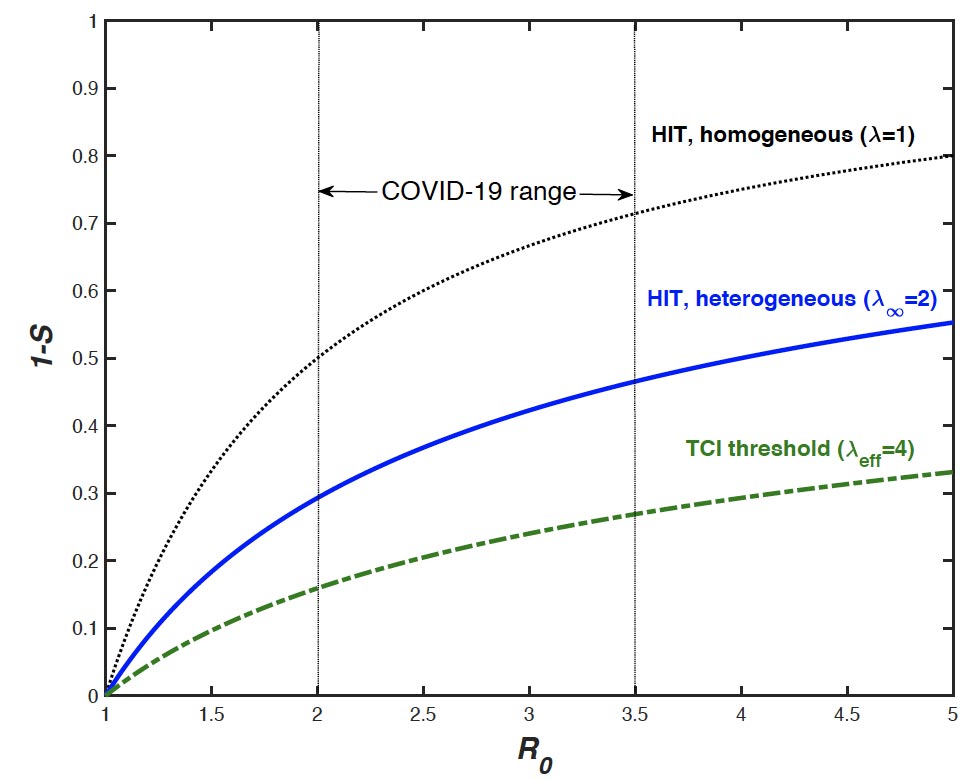
Epidemiological models for homogenous populations–those with little variation among individuals–predict a high value for the herd immunity threshold (HIT). For example, if the reproduction number is three, 67 percent of the population must be infected or vaccinated to reach herd immunity. With heterogeneity that remains constant over time (i.e., static levels of social activity), the HIT drops to about 42 percent. Accounting for variations in social activity over time results in an even lower threshold (~22 percent), giving the false impression that the epidemic is over when really only transient collective immunity (TCI) has been achieved. Over time, TCI wanes. Credit: BNL

In this work, the team incorporated time variations in individual social activity into existing epidemiological models. Such models work by assigning each person a probability of how likely they are to become infected if exposed to the same environment (biological susceptibility) and how likely they are to infect others (social activity). A complicated multidimensional model is needed to describe each group of people with different susceptibilities to disease. They compressed this model into only three equations, developing a single parameter to capture biological and social sources of heterogeneity. 

“We call this parameter the immunity factor, which tells you how much the reproduction number drops as susceptible individuals are removed from the population,” explained Maslov. 

The reproduction number indicates how transmissible an infectious disease is. Specifically, the quantity refers to how many people one infected person will in turn infect. In classical epidemiology, the reproduction number is proportionate to the fraction of susceptible individuals; if the pool of susceptible individuals drops by 10 percent, so will the reproduction number. The immunity factor describes a stronger reduction in the reproduction number as the pool of susceptible individuals is depleted.

To estimate the social contribution to the immunity factor, the team leveraged previous studies in which scientists actively monitored people’s social behavior. They also looked at actual epidemic dynamics, determining the immunity factor most consistent with data on COVID-19-related hospitalizations, intensive care unit (ICU) admissions, and daily deaths in NYC and Chicago. The team were also able to extend their calculations to all 50 U.S. states, using earlier analyses generated by scientists at Imperial College, London.

At the city and state level, the reproduction number was reduced to a larger extent in locations severely impacted by COVID-19. For example, when the susceptible number dropped by 10 percent during the early, fast-paced epidemic in NYC and Chicago, the reproduction number fell by 40 to 50 percent—corresponding to an estimated immunity factor of four to five. 

“That’s a fairly large immunity factor, but it’s not representative of lasting herd immunity,” said Tkachenko. “On a longer timescale, we estimate a much lower immunity factor of about two. The fact that a single wave stops doesn’t mean you’re safe. It can come back.” 

This temporary state of immunity arises because population heterogeneity is not permanent. In other words, people change their social behavior over time. For instance, individuals who self-isolated during the first wave—staying home, not having visitors over, ordering groceries online—subsequently start relaxing their behaviors. Any increase in social activity means additional exposure risk.  As shown in the figure, the outcome can be that there is a false impression that the epidemic is over, although there are more waves to come.

After calibrating the model using COVID-19 data from NYC and Chicago, the team forecast future spread in both cities based on the heterogeneity assumptions they had developed, focusing on social contributions. 

“Generally, social contributions to heterogeneity have a stronger effect than biological contributions, which depend on the specific biological details of the disease and thus aren’t as universal or robust,” explained Tkachenko. 

In follow-on work, the scientists are studying epidemic dynamics in more detail. For example, they are feeding statistics from “superspreader” events—gatherings where a single infected person causes a large outbreak among attendees—into the model. They are also applying their model to different regions across the country to explain overall epidemic dynamics from the end of lockdown to early March 2021.

“Our model can be seen as a universal patch that can be applied to conventional epidemiological models to easily account for heterogeneity,” said Tkachenko. “Predicting future waves will require additional considerations, such as geographic variabilities, seasonal effects, the emergence of new strains, and vaccination levels.” 

Reference: “Time-dependent heterogeneity leads to transient suppression of the COVID-19 epidemic, not herd immunity” by Alexei V. Tkachenko, Sergei Maslov, Ahmed Elbanna, George N. Wong, Zachary J. Weiner and Nigel Goldenfeld, 8 April 2021, Proceedings of the National Academy of Sciences.
DOI: 10.1073/pnas.2015972118

This work was supported by the DOE Office of Science; University of Illinois System Office, the Office of the Vice-Chancellor for Research and Innovation, the Grainer College of Engineering, and the Department of Physics at UIUC; DOE Computational Science Graduate Fellowship; and National Science Foundation Faculty Early Career Development (CAREER) Program. This research was carried out as part of a CFN user program. The Illinois Department of Public Health, through a Data Use Agreement with Civis Analytics, supplied data for the calculations. The calculations were carried out on the Illinois Campus Cluster, a computing resource operated by the Illinois Campus Cluster Program in conjunction with the National Center for Supercomputing Applications, which is supported by funds from UIUC. The findings presenting are those of the researchers and not necessarily those of the funding agencies.

https://scitechdaily.com/model-shows-temporary-herd-immunity-emerged-during-the-early-covid-epidemic-but-got-destroyed/

Travellers using U.S.-Canada land border to avoid quarantine hotels

 Greg Peacock walked across the Rainbow Bridge in Niagara Falls, Ont., and back into Canada with his three puppies in hand, pausing to take some selfies, but he didn't cross here for the view.

He chose this particular point of entry from the United States to avoid the mandatory three-day stay at a quarantine hotel that applies to air travellers entering Canada.

"I don't want to spend three days or whatever it is locked up at a hotel when I'm back in Toronto to do work," he said.

He's one of the many Canadians flying into U.S. airports close to the U.S.-Canada border and crossing by foot or hiring car services to drive them across in order to avoid staying at the quarantine hotels that are mandatory for air travellers. 

Instead of flying directly to Toronto's Pearson International Airport, Peacock flew from Los Angeles to Buffalo, N.Y., took a cab to the border, walked into Canada and took the train to Toronto.

"It takes a little bit longer, but it's an adventure," he said.

Peacock told CBC News that he would quarantine once he got home.

Since the three-day hotel quarantine rule took effect in February, Peacock has walked across the border into Canada twice on his way home from Los Angeles, where his wife lives. (Greg Peacock)

Close to 20,000 crossed by land since Feb. 21

Walking across the border isn't new or illegal, but it does contravene non-essential travel advisories and allows travellers to avoid staying in one of the federally sanctioned quarantine hotels that can cost up to $2,000 for a three-day stay — a requirement for those arriving by air.

The temporary measures and the Canada-U.S. land border closure, which went into effect in March 2020, have both been extended to May 21.

Peacock is not alone. Since the hotel rules came into effect on Feb. 21, nearly 20,000 people crossed the border by land (not including essential workers), according to a CBC News analysis of numbers provided by the Canada Border Services Agency (CBSA).

Whether Canadians return by land or air, if they are not essential workers or otherwise exempt, under federal guidelines, they must quarantine for 14 days, with air travellers spending the first three days at a hotel until they get the result of a COVID-19 test. Land travellers must go directly to their quarantine destination after crossing the border.

Special rules for snowbirds?

Scott and Caryl Rutledge of Toronto opted to fly to Buffalo Niagara International Airport and hire a limousine to take them across the border rather than to fly home from Tampa, Fla., where they have property and spent the last two months

"We've been vaccinated. We showed up with negative COVID tests," Scott Rutledge told CBC News as he and his wife sat in the back of the limousine on the Canadian side of Rainbow Bridge in Niagara Falls.

"We believe ourselves to be 100 per cent healthy so far as COVID is concerned, and so anything else was an unnecessary duplication. It's excessive in the extreme, at least as it applies to us."

The couple paid about $350 Cdn for the trip from the Buffalo airport, plus $200 US each for their COVID-19 tests.

Scott and Caryl Rutledge arrive back in Canada after spending two months in Tampa, Fla., where they own property. The Toronto couple hired a limousine service to take them from the Buffalo airport back home. They both received a COVID-19 vaccine in Florida. (Laura Clementson/CBC)

They said there should be different rules for snowbirds like them.

"I think there should have been two tiers of entry: one for snowbirds — vaccinated people who have been gone for in excess of months — and ... different rules perhaps for people who have gone on a holiday for two weeks. It's a completely different thing," Caryl Rutledge said.

Although land borders are closed to non-essential travel, all Canadian citizens have the right to enter Canada. But like air travellers, they need to present a negative COVID-19 test taken within 72 hours of arriving at the border and have a quarantine plan.

For those who travel from abroad via the United States, a negative test needs to be presented upon arrival in the U.S., according to the U.S. government, and again at the land border when entering Canada.

Travellers are also given a take-home test to be done on the 10th day of their return.

There are no exemptions for those who have already been vaccinated.

After pedestrians cross into Canada, they are escorted into a tent, shown here at the Rainbow Bridge in Niagara Falls. There they are screened and told about COVID-19 protocols. (Greg Bruce/CBC)

Local authorities monitoring quarantine compliance

The CBSA told CBC News that it is not keeping track of Canadians who return to the country after getting a COVID-19 vaccination abroad.

But the Public Health Agency of Canada (PHAC) does keep track of travellers who have tested positive for COVID-19.

From Feb. 22 to April 18, the agency told CBC News, it received 50,905 test results from land travellers on the day they arrived in Canada. Of those, 128, or 0.25 per cent, tested positive for COVID-19.

During the same period for air travellers, the agency said it received 144,177 test results, of which 2,541 — or 1.76 per cent — were positive for COVID-19.

The agency is also monitoring quarantine compliance for both air and land travellers with the help of local law enforcement agencies, the RCMP and third-party security companies.

Between Feb. 21 and April 19, more than 111,000 air travellers and 43,000 land travellers had received a compliance verification visit from a third party, according to PHAC. 

And during the same time frame, both the RCMP and local law enforcement agencies followed up on 13,500 air travellers and 5,900 land travellers — 95 per cent of whom were found to be in compliance with the quarantine orders.

Prices for flights to Buffalo on the rise

In an email to CBC News, Canada's public health agency said that "compliance with the border measures has been high."

CBC News asked for comment from Health Canada on why people travelling by air are required to go to a hotel while those entering the country by land are not but did not get a direct response. 

Health Canada did say in an email that "the government of Canada is continually evaluating the impacts of border measures."

Land border crossings could get more attention in light of Canada's decision Thursday to ban passenger flights from India and Pakistan for 30 days in response to rising COVID-19 case counts and the spread of new variants. 

Airlines seem to have also caught on to the land border loophole. Prices for flights to Buffalo from popular snowbird destinations such as Tampa, Orlando, Fla., Phoenix, Ariz., and Los Angeles have all seen a hike since the quarantine hotel rules went into effect in Canada.

"I felt pretty clever at first, but apparently, more people are catching on," said Peacock, who travels back and forth on a monthly basis to be with his spouse in Los Angeles.

"The flights to Buffalo were packed. The prices are going up."

https://www.cbc.ca/news/canada/border-land-crossings-1.5994627

Ankle exoskeleton enables faster walking

 Being unable to walk quickly can be frustrating and problematic, but it is a common issue, especially as people age. Noting the pervasiveness of slower-than-desired walking, engineers at Stanford University have tested how well a prototype exoskeleton system they have developed -- which attaches around the shin and into a running shoe -- increased the self-selected walking speed of people in an experimental setting.

The exoskeleton is externally powered by motors and controlled by an algorithm. When the researchers optimized it for speed, participants walked, on average, 42 percent faster than when they were wearing normal shoes and no exoskeleton. The results of this study were published April 20 in IEEE Transactions on Neural Systems and Rehabilitation Engineering.

"We were hoping that we could increase walking speed with exoskeleton assistance, but we were really surprised to find such a large improvement," said Steve Collins, associate professor of mechanical engineering at Stanford and senior author of the paper. "Forty percent is huge."

For this initial set of experiments, the participants were young, healthy adults. Given their impressive results, the researchers plan to run future tests with older adults and to look at other ways the exoskeleton design can be improved. They also hope to eventually create an exoskeleton that can work outside the lab, though that goal is still a ways off.

"My research mission is to understand the science of biomechanics and motor control behind human locomotion and apply that to enhance the physical performance of humans in daily life," said Seungmoon Song, a postdoctoral fellow in mechanical engineering and lead author of the paper. "I think exoskeletons are very promising tools that could achieve that enhancement in physical quality of life."

Walking in the loop

The ankle exoskeleton system tested in this research is an experimental emulator that serves as a testbed for trying out different designs. It has a frame that fastens around the upper shin and into an integrated running shoe that the participant wears. It is attached to large motors that sit beside the walking surface and pull a tether that runs up the length of the back of the exoskeleton. Controlled by an algorithm, the tether tugs the wearer's heel upward, helping them point their toe down as they push off the ground.

For this study, the researchers had 10 participants walk with five different modes of operation. They walked in normal shoes without the exoskeleton, with the exoskeleton turned off and with the exoskeleton turned on with three different modes: optimized for speed, optimized for energy use, and a placebo mode adjusted to make them walk more slowly. In all of the tests, participants walked on a treadmill that adapts to their speed.

The mode that was optimized for speed -- which resulted in the 42 percent increase in walking pace -- was created through a human-in-the-loop process. An algorithm repeatedly adjusted the exoskeleton settings while the user walked, with the goal of improving the user's speed with each adjustment. Finding the speed-optimized mode of operation took about 150 rounds of adjustment and two hours per person.

In addition to greatly increasing walking speed, the speed-optimized mode also reduced energy use, by about 2 percent per meter traveled. However, that result varied widely from person to person, which is somewhat expected, given that it was not an intentional feature of that exoskeleton mode.

"The study was designed to specifically answer the scientific question about increasing walking speed," Song said. "We didn't care too much about the other performance measures, like comfort or energy. However, seven out of 10 participants not only walked faster but consumed less energy, which really shows how much potential exoskeletons have for helping people in an efficient way."

The settings that were optimized specifically for energy use were borrowed from a previous experiment. In the current study, this mode decreased energy use more than the speed-optimized settings but did not increase speed as much. As intended, the placebo mode both slowed down participants and boosted their energy use.

Better, faster, stronger

Now that the researchers have attained such significant speed assistance, they plan to focus future versions of the ankle exoskeleton emulator on reducing energy use consistently across users, while also being more comfortable.

In considering older adults specifically, Collins and his lab wonder whether future designs could reduce pain caused by weight on joints or improve balance. They plan to conduct similar walking tests with older adults and hope those provide encouraging results as well.

"A 40 percent increase in speed is more than the difference between younger adults and older adults," said Collins. "So, it's possible that devices like this could not only restore but enhance self-selected walking speed for older individuals and that's something that we're excited to test next."


Story Source:

Materials provided by Stanford University. Original written by Taylor Kubota. Note: Content may be edited for style and length.


Journal Reference:

  1. Seungmoon Song, Steven H. Collins. Optimizing exoskeleton assistance for faster self-selected walkingIEEE Transactions on Neural Systems and Rehabilitation Engineering, 2021; 1 DOI: 10.1109/TNSRE.2021.3074154

Stress test finds cracks in the resistance of harmful hospital bugs

 Research has identified critical factors that enable dangerous bacteria to spread disease by surviving on surfaces in hospitals and kitchens.

The study into the mechanisms which enable the opportunistic human pathogen Pseudomonas aeruginosa to survive on surfaces, could lead to new ways of targeting harmful bacteria.

To survive outside their host, pathogenic bacteria must withstand various environmental stresses. One mechanism is the sugar molecule, trehalose, which is associated with a range of external stresses, particularly osmotic shock -- sudden changes to the salt concentration surrounding cells.

Researchers at the John Innes Centre analysed how trehalose is metabolised by P. aeruginosa to define its role in protection against external stresses.

Combining analytical biochemistry and reverse genetics -- using mutated bacteria lacking key functions -- they show that trehalose metabolism in P. aeruginosa is connected to biosynthesis of the carbon storage molecule glycogen.

Experiments showed that disruption of either trehalose or glycogen pathways significantly reduced the ability of P. aeruginosa to survive on human-made surfaces such as kitchen or hospital counters.

The study found that while both trehalose and glycogen are important for stress tolerance in P. aeruginosa they counter distinct stresses: trehalose helps the bacteria to survive in conditions of elevated salt; glycogen contributes to survival in dry (desiccated) environments.

The findings raise the possibility of targeting the trehalose and glycogen pathways to limit pathogen survival on human-made surfaces.

"We have shown how a dangerous human pathogen Pseudomonas aeruginosa responds to environmental challenges, such as salt stress or drying out. Disrupting the production of certain stress-tolerance sugars in this bug significantly reduces its ability to survive on kitchen and hospital worksurfaces," said corresponding author of the study Dr Jacob Malone.

An unexpected finding was how the bacteria operates different pathways for different stresses, said Dr Malone: "Conventional wisdom says that trehalose was responsible for both phenotypes, but we have shown that trehalose only protects against osmo-stress and glycogen is needed to protect against desiccation. We were also surprised to see such a marked drop in surface survival when we disrupted the pathways in the bugs."

The next step for the research is to understand how trehalose and glycogen metabolic pathways are regulated in P. aeruginosa and closely related species. The group also wants to understand how glycogen accumulation allows the bacteria to survive in dry environments and provide more explanation of how and when different parts of the pathways are turned on and off.

P. aeruginosa is a significant pathogen in animals as well as humans. In humans it primarily affects immunocompromised individuals, where it is a major cause of pneumonia and hospital-acquired infections. Chronic P. aeruginosa infections occur in 80% of adult cystic fibrosis patients, where it is the primary cause of morbidity and mortality.


Story Source:

Materials provided by John Innes CentreNote: Content may be edited for style and length.


Journal Reference:

  1. Stuart D. Woodcock, Karl Syson, Richard H. Little, Danny Ward, Despoina Sifouna, James K. M. Brown, Stephen Bornemann, Jacob G. Malone. Trehalose and α-glucan mediate distinct abiotic stress responses in Pseudomonas aeruginosaPLOS Genetics, 2021; 17 (4): e1009524 DOI: 10.1371/journal.pgen.1009524

MERS DNA vaccine induces immunity, protects from virus challenge in preclinical model

 A synthetic DNA vaccine candidate for Middle East respiratory syndrome coronavirus (MERS-CoV) developed at The Wistar Institute induced potent immune responses and afforded protective efficacy in non-human primate (NHP) models when given intradermally in abbreviated, low-dose immunization regimen. A similar vaccine candidate was previously shown to be safe and tolerable with a three-dose intramuscular injection regimen in a recently completed human phase 1 study and is currently in expanded studies of phase 1/2a trial.

New results were published today in JCI Insight.

"While several vaccine products are being advanced against MERS and other coronaviruses, low-dose delivery and shortened regimes are crucial to rapidly induce protective immunity, particularly during emerging outbreaks, as the current SARS-CoV-2 pandemic has emphasized," said David B. Weiner, Ph.D., Wistar executive vice president, director of the Vaccine & Immunotherapy Center (VIC) and W.W. Smith Charitable Trust Professor in Cancer Research, who led the study.

Researchers evaluated the immunogenicity and protective efficacy of their MERS synthetic vaccine when delivered intradermally using a shortened two-dose immunization schedule compared with intramuscular delivery of higher doses in NHP.

"Given that human efficacy trials for MERS vaccines may be challenging due to the low number of yearly cases, animal models such as our NHP model are valuable as a bridge with human data coming from early-phase clinical trials," said Weiner.

In this study, Weiner and team report robust antibody neutralizing antibodies and cellular immune responses in all conditions tested. A rigorous virus challenge experiment showed that all vaccination groups were protected against MERS-CoV compared to unvaccinated control animals. However, the low-dose regimen with intradermal delivery was more impactful in controlling disease and symptoms than the higher dose delivered intramuscularly in NHP models.

"To our knowledge, this is the first demonstration of protection with an intradermally delivered coronavirus vaccine," said Ami Patel, Ph.D., Caspar Wistar Fellow at the Vaccine & Immunotherapy Center and one of the lead authors of the paper. "Intradermal delivery of synthetic DNA vaccines has significant advantages for rapid clinical development. It can be dose sparing and has higher tolerability in people compared with intramuscular injection. The positive results of this study are important not only for the advancement of this MERS vaccine but also for development of other vaccines."

"Our team is also advancing a COVID-19 vaccine through clinical trials, and we were able to do so in a very short time thanks to our previous experience developing the MERS vaccine," added Weiner.

Importantly, no evidence of adverse effects on the lungs was observed in any of the dosing groups compared to unimmunized control animals. Through the assessment of a large panel of blood cytokines, researchers showed significant decrease in all mediators of inflammation, which further suggests the vaccine prevents the destructive inflammation induced by coronaviruses.

"In the past twenty years, three new coronaviruses have emerged and caused human outbreaks. The current SARS-CoV-2 pandemic has further emphasized the importance of rapid infection control for coronaviruses and other emerging infectious diseases," said Emma L. Reuschel, Ph.D., a staff scientist in the Weiner lab and co-first author on the study. "Vaccine candidates that are simple to deliver, well tolerated, and can be readily deployed in resource-limited settings will be important to achieve control of infection."


Story Source:

Materials provided by The Wistar InstituteNote: Content may be edited for style and length.


Journal Reference:

  1. Ami Patel, Emma L. Reuschel, Ziyang Xu, Faraz I. Zaidi, Kevin Y. Kim, Dana P. Scott, Janess Mendoza, Stephanie Ramos, Regina Stoltz, Friederike Feldmann, Atsushi Okumura, Kimberly Meade-White, Elaine Haddock, Tina Thomas, Rebecca Rosenke, Jamie Lovaglio, Patrick W. Hanley, Greg Saturday, Kar Muthumani, Heinz Feldmann, Laurent M. Humeau, Kate E. Broderick, David B. Weiner. Intradermal delivery of a synthetic DNA vaccine protects macaques from Middle East respiratory syndrome coronavirusJCI Insight, 2021; DOI: 10.1172/jci.insight.146082

Anti-aging compound improves muscle glucose metabolism in people

 A natural compound previously demonstrated to counteract aspects of aging and improve metabolic health in mice has clinically relevant effects in people, according to new research at Washington University School of Medicine in St. Louis.

A small clinical trial of postmenopausal women with prediabetes shows that the compound NMN (nicotinamide mononucleotide) improved the ability of insulin to increase glucose uptake in skeletal muscle, which often is abnormal in people with obesity, prediabetes or Type 2 diabetes. NMN also improved expression of genes that are involved in muscle structure and remodeling. However, the treatment did not lower blood glucose or blood pressure, improve blood lipid profile, increase insulin sensitivity in the liver, reduce fat in the liver or decrease circulating markers of inflammation as seen in mice.

The study, published online April 22 in the journal Science, is the first randomized clinical trial to look at the metabolic effects of NMN administration in people.

Among the women in the study, 13 received 250 mg of NMN orally every day for 10 weeks, and 12 were given an inactive placebo every day over the same period.

"Although our study shows a beneficial effect of NMN in skeletal muscle, it is premature to make any clinical recommendations based on the results from our study," said senior investigator Samuel Klein, MD, the William H. Danforth Professor of Medicine and Nutritional Science and director of the Center for Human Nutrition. "Normally, when a treatment improves insulin sensitivity in skeletal muscle, as is observed with weight loss or some diabetes medications, there also are related improvements in other markers of metabolic health, which we did not detect in our study participants."

The remarkable beneficial effects of NMN in rodents have led several companies in Japan, China and in the U.S. to market the compound as a dietary supplement or a neutraceutical. The U.S. Food and Drug Administration is not authorized to review dietary supplement products for safety and effectiveness before they are marketed, and many people in the U.S. and around the world now take NMN despite the lack of evidence to show clinical benefits in people.

The researchers studied 25 postmenopausal women who had prediabetes, meaning they had higher than normal blood sugar levels, but the levels were not high enough to be diagnosed as having diabetes. Women were enrolled in this trial because mouse studies showed NMN had the greatest effects in female mice.

NMN is involved in producing an important compound in all cells, called nicotinamide adenine dinucleotide (NAD). NAD plays a vital role in keeping animals healthy. Levels of NAD decline with age in a broad range of animals, including humans, and the compound has been shown to contribute to a variety of aging-associated problems, including insulin resistance in studies conducted in mice. Supplementing animals with NMN slows and ameliorates age-related decline in the function of many tissues in the body.

Co-investigator Shin-ichiro Imai, MD, PhD, a professor of developmental biology and of medicine who has been studying NMN for almost two decades and first reported on its benefits in mice said, "This is one step toward the development of an anti-aging intervention, though more research is needed to fully understand the cellular mechanisms responsible for the effects observed in skeletal muscle in people."

Insulin enhances glucose uptake and storage in muscle, so people who are resistant to insulin are at increased risk for developing Type 2 diabetes. But the researchers caution that more studies are needed to determine whether NMN has beneficial effects in the prevention or management of prediabetes or diabetes in people. Klein and Imai are continuing to evaluate NMN in another trial involving men as well as women.


Story Source:

Materials provided by Washington University School of Medicine. Original written by Jim Dryden. Note: Content may be edited for style and length.


Journal Reference:

  1. Mihoko Yoshino, Jun Yoshino, Brandon D. Kayser, Gary Patti, Michael P. Franczyk, Kathryn F. Mills, Miriam Sindelar, Terri Pietka, Bruce W. Patterson, Shin-Ichiro Imai, Samuel Klein. Nicotinamide mononucleotide increases muscle insulin sensitivity in prediabetic womenScience, 2021; eabe9985 DOI: 10.1126/science.abe9985

Bharat Biotech to supply Covaxin to states, hospitals at Rs 600-1,200 per dose


India's Bharat Biotech said on Saturday that it will supply Covaxin directly to state governments at 600 rupees per dose, while it will supply the vaccine directly to private hospitals at 1,200 rupees per dose.

In a tweet, the company said it will develop, manufacture and supply Covaxin to India's central government at 150 rupees per dose. https://bit.ly/2S1W3zC

The company added that more than 50% of its vaccine capacities have been reserved for supply to the central government.

https://www.marketscreener.com/news/latest/India-s-Bharat-Biotech-to-supply-Covaxin-to-states-hospitals-at-Rs-600-1-200-per-dose--33061817/