Search This Blog

Monday, April 26, 2021

Vertex, CRISPR Get Euro Priority Medicines Tag for 2nd Indication

 Vertex Pharmaceuticals Incorporated (Nasdaq: VRTX) and CRISPR Therapeutics (Nasdaq: CRSP) today announced the European Medicines Agency (EMA) has granted Priority Medicines (PRIME) designation to CTX001, an investigational, autologous, ex vivo CRISPR/Cas9 gene-edited therapy for the treatment of transfusion-dependent beta thalassemia (TDT). CTX001 was previously granted PRIME designation for the treatment of sickle cell disease (SCD) in 2020.

PRIME is a regulatory mechanism that provides early and proactive support to developers of promising medicines to optimize development plans and speed up evaluations so these medicines can reach patients faster. The goal of PRIME is to help patients benefit as early as possible from innovative new therapies that have demonstrated the potential to significantly address an unmet medical need. PRIME designation was granted based on clinical data from CRISPR and Vertex’s ongoing Phase 1/2 trial of CTX001 in patients with TDT.

Based on progress in this program to date, CTX001 has been granted Regenerative Medicine Advanced Therapy (RMAT), Fast Track, Orphan Drug and Rare Pediatric Disease designations from the U.S. Food and Drug Administration (FDA) for both TDT and SCD. CTX001 has also been granted Orphan Drug Designation from EMA for both TDT and SCD.

CTX001 is being investigated in two ongoing clinical trials as a potential one-time therapy for patients suffering from TDT and severe SCD.

https://finance.yahoo.com/news/vertex-crispr-therapeutics-announce-priority-123000223.html

EU launches legal action against vaccine-maker AstraZeneca

 The European Union’s executive branch said Monday that it has launched legal action against coronavirus vaccine-maker AstraZeneca for failing to respect the terms of its contract with the 27-nation bloc.

The AstraZeneca vaccine has been central to Europe’s immunization campaign, and a linchpin in the global strategy to get vaccines to poorer countries. But the slow pace of deliveries has frustrated the Europeans and has been blamed in part for holding up the EU’s vaccine rollout.

European Commission spokesman Stefan De Keersmaecker said that Brussels launched the legal action against AstraZeneca last Friday “on the basis of breaches of the advance purchase agreement.”

He said the reason for the legal action was that “some terms of the contract have not been respected” and that “the company has not been in a position to come up with a reliable strategy to ensure a timely delivery of doses.”

AstraZeneca’s contract with the EU foresaw an initial 300 million doses for distribution among member countries, with an option for a further 100 million.

But only 30 million doses were delivered in the first quarter of 2021, and the company says it can provide 70 million in the second quarter, rather than the 180 million it had promised.

AstraZeneca has previously said that its contract with the EU contained vaccine delivery targets, not firm commitments, and that the company was unable to meet them because of early problems with rapidly expanding its production capacity.

Last month, the Commission launched a dispute resolution mechanism aimed at amicably addressing its differences with the company. Brussels said that its focus is to ensure timely deliveries of vaccines.

It since said that its option for extra AstraZeneca doses will not be taken up.

Last week, Commission President Ursula von der Leyen announced that a new vaccine contract is set to be concluded with BioNTech-Pfizer for 1.8 billion doses for the 2021-23 period. She said the deal will ensure doses for booster shots, vaccines adapted to new variants, and, potentially, vaccines for children and teenagers.

Von der Leyen said that the EU, home to around 450 million people, has “already passed 123 million vaccinations” and is on track to have vaccinated 70% of all adults by July. Previously the target had been September.

https://apnews.com/article/world-news-health-business-europe-coronavirus-6738dafd2395b2afc8a9d9000e7a3f61

Zosano to Move Forward with Pharmacokinetic Study After FDA Protocol Review

 Zosano Pharma Corporation (NASDAQ:ZSAN), a clinical-stage biopharmaceutical company, today announced that the company has received feedback from the U.S. Food and Drug Administration (“FDA") Division of Neurology II (the “Division”) on the protocol for the pharmacokinetic (“PK”) study required to support the resubmission of the Qtrypta™ (zolmitriptan transdermal microneedle system) 505(b)(2) New Drug Application (“NDA”).

Separately, Zosano announced that it has established an agreement with Worldwide Clinical Trials (“Worldwide”), one of the industry’s leading global, midsized, full-service contract research organizations, to conduct the study, which is expected to involve 48 healthy volunteers to generate comparative pharmacokinetic and safety data. The company expects the study to begin in June and to be completed with data available in the third quarter of 2021. Subject to positive data, Zosano expects to resubmit its NDA for Qtrypta™ by the end of 2021.

“We believe that this study can be executed quickly and will address the last remaining clinical request from FDA regarding the resubmission of our NDA for Qtrypta™,” said Donald Kellerman, vice president, Clinical Development and Medical Affairs at Zosano. “We look forward to initiating and completing the PK study, ultimately resubmitting our NDA and, if approved, potentially making Qtrypta available broadly as a therapeutic option for patients with debilitating migraines. Worldwide has significant experience with advanced drug delivery systems and we look forward to working with them.”

“We are delighted to collaborate with Zosano to run this important PK study in support of its expected NDA resubmission,” added Mike Mencer, executive vice president and general manager, Early Phase Drug Development for Worldwide. “This mode of drug delivery has great potential. Our mission is to work with passion and purpose every day to improve lives, and, if approved, QtryptaTM would be the only transdermal microneedle patch treatment option available to treat people suffering from migraines. We are excited to be part of this development.”


Vaccitech PLC eyes IPO of up to 6.5M ADSs priced at $16-$18 per ADS

 SEC filing.

https://www.cmlviz.com/stocks/VACC/news/b/2021/04/26/vaccitech-plc-quarterly-sees-ipo-of-up-to-6-5-million-adss-priced-to-be-between-16-and-18-per-ads

Vaccines, Management in Focus as GSK, AstraZeneca Report

 GlaxoSmithKline Plc and AstraZeneca Plc publish quarterly results this week, with Britain's two biggest drugmakers both facing pressure from different quarters.

AstraZeneca was one of the leaders in the global race to develop a COVID-19 vaccine but has faced a series of controversies.

GSK has fallen behind in the vaccines race and will be certain to face questions about its broader strategy after a report that U.S. activist investor Elliott had built up a multi-billion pound stake.

GSK reports on Wednesday, with AstraZeneca due on Friday.

VACCINE FOCUS

AstraZeneca will for the first time break out sales from its coronavirus vaccine, Vaxzevria, which it is working on with Oxford University.

Use began early this year, and AstraZeneca has said it will not profit from the vaccine while COVID-19 is being treated as a pandemic.

Johnson & Johnson last week reported $100 million in sales for its shot.

The two vaccines are embroiled in controversies over possible links to rare blood clots. For AstraZeneca, these events add to a list of problems that have dogged its shot, including doubts over dosing, manufacturing delays and supply cuts.

"Despite vaccine headwinds and headlines, (AstraZeneca) remains a top pick," Leerink analysts said in a note.

AstraZeneca Chief Executive Pascal Soriot and his management's updates on production and safety will overshadow financial results, which are seen beating expectations on wide offerings and a boost from divestments, JPMorgan analysts said.

For its part, GSK, the world's biggest vaccines maker by sales, has focused on supplying its vaccine booster to other COVID-19 shot developers and helping to produce their jabs. Rather than making its own coronavirus vaccine, it is also working on potential treatments.

Updates on GSK's efforts with French partner Sanofi are highly anticipated, after the duo suffered setbacks, delaying their potential vaccine's launch.

CORE BUSINESS

AstraZeneca has said it expects 2021 revenue to rise by a low teens percentage and core earnings to grow to $4.75- $5.00 per share.

GSK has predicted earnings will fall by mid-to-high single digits this year.

This time last year, AstraZeneca and GSK's first quarters benefited from stockpiling.

Updates on AstraZeneca's $39 billion buyout of Alexion, announced in December, will also be sought, as will details on anaemia treatment roxadustat which is under regulatory review for broader use.

GSK has warned of a lower dividend after it splits up next year into two separate companies, one focusing on pharmaceuticals and another on consumer products.

The separation was spearheaded by boss Emma Walmsley to simplify operations. A former head of GSK's consumer business, Walmsley took the top job in 2017 https://www.reuters.com/article/us-gsk-ceo-idUSKCN11Q0IC despite some investor pressure to name an outsider to the role.

Shareholder pressure may increase with the involvement of Elliott. Barclays analysts said in a note that since a split is under way, it was "unclear what incremental steps Elliott may want".

FORECASTS VS EXPECTATIONS

COMPANY PERIOD FORECAST ANALYST REPORTING

EXPECTATIONS

GSK Q1 N/A 7.83 BLN POUNDS APRIL 28

TURNOVER, EPS

21.9 PENCE

(COMPANY

COMPILED)

ASTRAZENECA Q1 N/A $7.01 BLN SALES, APRIL 30

EPS $1.48

(REFINITIV EIKON)

GSK FY EARNINGS TO 33.58 BLN POUNDS N/A

FALL BY TURNOVER, EPS

MID-TO-HIGH 100.5 PENCE

SINGLE DIGITS (COMPANY

COMPILED)

ASTRAZENECA FY REVENUE TO $31.16 BLN SALES, N/A

RISE BY A LOW EPS $5.10

TEENS (REFINITIV EIKON)

PERCENTAGE,

EPS OF $4.75

Indian Vaccine Makers Jack Up Prices As Outbreak Worsens; 1st COVID 'Triple Mutant' IDd

 India's surge in COVID-19 infections and deaths, potentially driven by a convergence of nasty mutant strains, has in the pace of barely a week eclipsed Brazil to account for roughly half of all new COVID-19 cases being reported worldwide, with large numbers likely going uncounted. After being blamed for helping spark the outbreak with large-scale political rallies during an election year, Indian PM Narendra Modi has ordered western social media firms to censor critical posts from rival politicians while hundreds die due to lack of hospital oxygen, including a group of more than 20 victims in western Maharashtra who died due to a preventable oxygen leak.

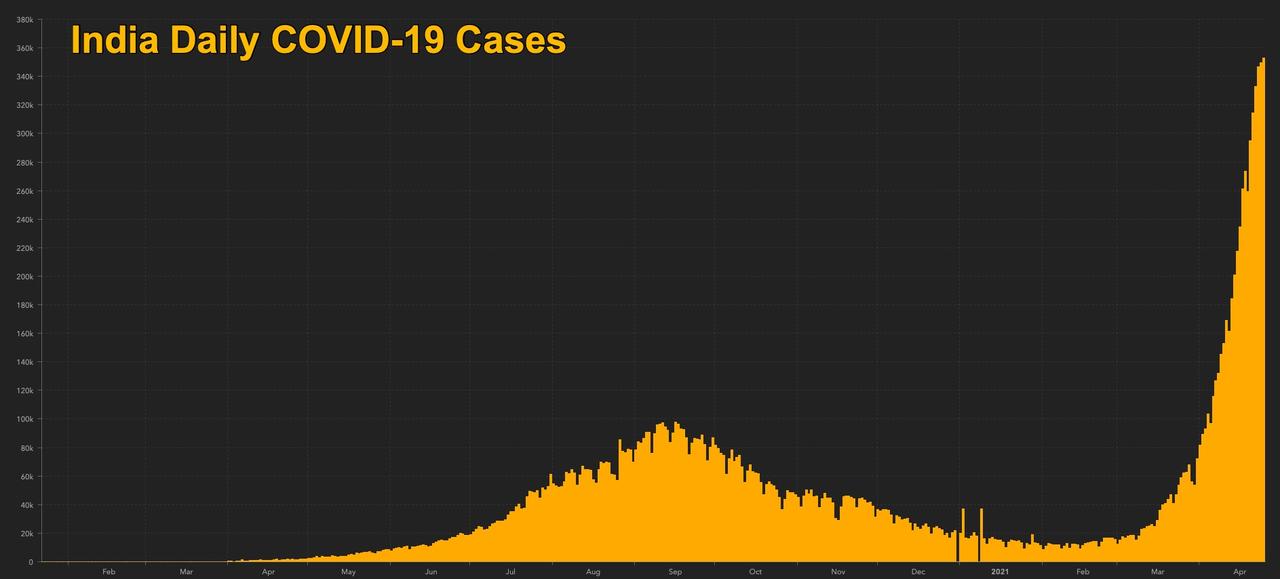
As of Monday morning, India's outbreak showed no signs of abating. The number of confirmed cases has surged to 17,313,163, the second-largest tally in the world after the 32M+ in the US (though experts caution millions more cases have likely gone undiagnosed). On Monday, India reported more than 354K new cases over the past 24 hours, marking the latest in a six-day series of global records for most cases reported in a single day.
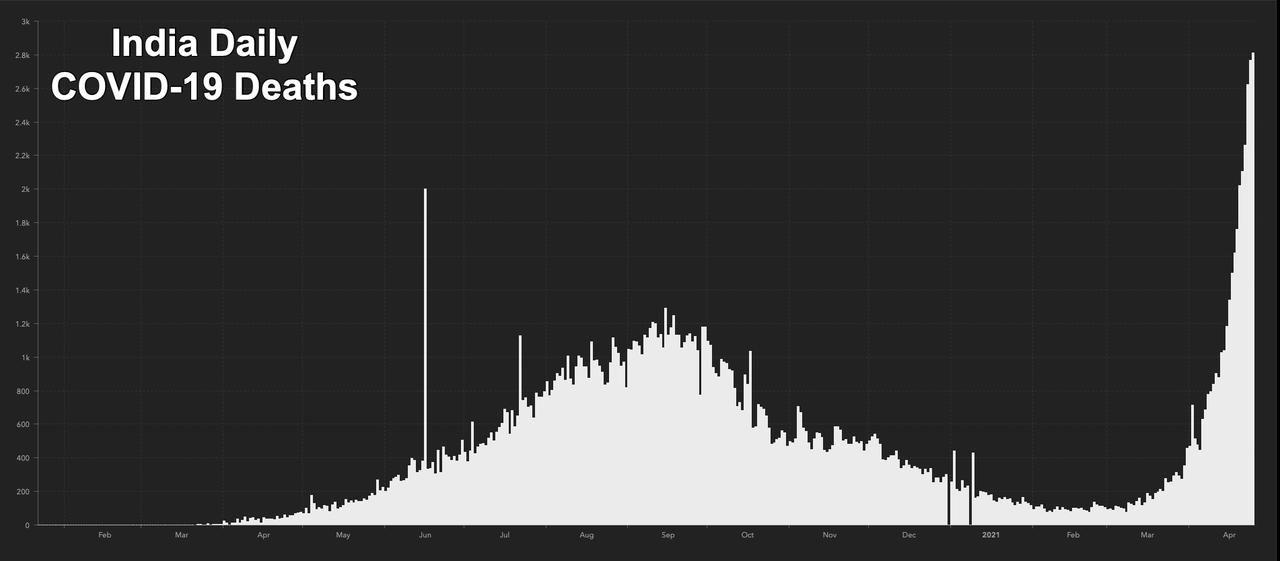
Meanwhile, India has reported more than 2K deaths per day for the last 5 days, with a record 2,812 deaths reported Monday, bringing total deaths to 195,123, the fourth-highest official total in the world after the US, Brazil and Mexico.
Health experts warn about the pernicious rise of mutant strains in the country as strains first isolated in the UK, South Africa and Brazil have all been identified in India. These strains are all believed to be more infectious than the original strain of SARS-CoV-2, the virus that causes COVID-19.

Hospitals in the Indian Capital of New Delhi have been turning away patients due to a lack of oxygen supplies and open beds. Families lucky enough to score a bed for a sick relative often must then find their own supplies of oxygen or medications like remdesivir that are in short supply at hospitals.

Despite its prestigious Serum Institute's critical role in the global vaccine rollout, Indians have secured precious few doses of the vaccine as PM Modi's government initially favored exports over domestic distribution. On Monday morning, as India prepares to expand legal access to any adult over 18, the FT reported that Modi's government is facing a backlash over its vaccine framework, which will require states to purchase jabs directly from domestic manufacturers. Meanwhile, India's vaccination campaign has slowed, with the number of jabs falling to fewer than 3M per day, down from more than 4M.

India will expand its vaccination programme to anyone aged over 18 on Saturday but vaccine manufacturers have been given permission to raise prices significantly.

...

India is the world’s largest vaccine manufacturer. But, after limited uptake in the early weeks of its inoculation campaign, demand has surged and the country is facing shortages. The pace of vaccination has slowed from as many as 4m jabs a day this month to fewer than 3m.

From May 1, the government will continue buying half of India’s monthly vaccine production of about 65m jabs to supply to over-45s. But states and private entities have to procure shots for younger adults at higher prices set by the manufacturers, the Serum Institute of India and Bharat Biotech.

Experts warn that breaking with the centralised Covid-19 vaccine campaigns used elsewhere gives the companies too much power, risks setting off chaotic competition and exacerbating inequities as many citizens are unable to secure vaccines.

"In a pandemic vaccines are a public good...Public goods should be paid through pooled resources by the government. That’s what’s happening around the world," said Chandrakant Lahariya, a public health policy expert in New Delhi.

"By giving a free hand to manufacturers to determine the price...It’s a situation which puts everybody at a disadvantage."

The Serum Institute, which produces the Oxford/AstraZeneca vaccine, said state governments would pay Rs400 ($5.35) and private hospitals Rs600, compared with about Rs150 for the central government. Bharat Biotech, which makes an indigenous jab, will charge Rs600 for states and Rs1,200 for private buyers.

The Serum Institute, which produces the Oxford/AstraZeneca vaccine, said state governments would pay Rs400 ($5.35) and private hospitals Rs600, compared with about Rs150 for the central government. Bharat Biotech, which makes an indigenous jab, will charge Rs600 for states and Rs1,200 for private buyers.

At least one rival politician has written to PM Modi asking him to reconsider this new policy, arguing that vaccine campaigns in the country have seen the most success when the government is the sole buyer of vaccines.

The worsening disaster has prompted the US, UK, Germany and other EU members to pledge to provide emergency supplies including oxygen, ventilators, medical aid and raw materials for vaccine production. Germany, in particular, has classified India as a coronavirus high incidence area and also put the country on a separate warning list for coronavirus variants.

Finally, as the western media latches on to the advent of "double mutant" strains in India (something we reported on weeks ago), a third mutation in the B.1.167 strain first identified in India has now been documented, leading to more calls for faster sequencing of viral genomes. Here's more from India.com.

A report in the Indian Express said that since both the mutations, E484Q and L425R, were located in the virus’s critical spike protein — that binds it to the receptor cells in the body. The mutation should have been studied on an urgent basis, however, the genome sequencing exercise got stalled between November and January due to lack of funds, and disinterest because of the falling Covid curve.

However, now a third mutation in the B.1.167 has been identified now and experts believe that this time, it will be taken seriously.

Experts chided the Indian government for not doing enough to scout for dangerous new mutants: "The whole point of gene sequencing is to remain ahead of the curve, anticipate what new variants of the virus are likely to emerge, how they are likely to behave, and what can be done to contain their spread in the population. More the sequences, greater is our information about them, and more effective our response can be," a scientist associated with the sequencing effort reportedly said.

"Unfortunately, India has been well behind the curve on this front. We have been reacting to the developments, instead of anticipating it," he added.

https://www.zerohedge.com/covid-19/indian-vaccinemakers-jack-prices-outbreak-worsens-1st-covid-triple-mutant-identified

BrainsWay: FDA OKs Three-Minute Theta Burst Depression Treatment

 BrainsWay Ltd. (NASDAQ & TASE: BWAY) (“BrainsWay” or the “Company”), a global leader in advanced noninvasive neurostimulation treatments for mental health disorders, today announced that the U.S. Food and Drug Administration (FDA) granted 501(k) clearance for the Company’s Theta Burst three-minute protocol utilizing its proprietary Deep Transcranial Magnetic Stimulation (Deep TMS) system for the treatment of major depressive disorder (MDD).

“Adding our three-minute treatment protocol to the list of growing solutions available to our provider partners expands the platform nature of this lifechanging technology,” said Hadar Levy, Senior Vice President and General Manager of BrainsWay. “Many patients and providers can benefit from significantly shorter treatment sessions, and our Theta Burst protocol can provide these patients with another option to manage their treatment resistant depression.”

In support of its successful application to the FDA – the Company’s seventh to date – BrainsWay submitted safety and efficacy data from 146 subjects who had received either the standard Deep TMS protocol or the three-minute Deep TMS protocol. Subjects in both groups demonstrated a statistically and clinically meaningful reduction in depression scores, and the results met the equivalence criteria needed for clearance of the shorter treatment.

“The addition of Theta Burst to the available protocols further demonstrates BrainsWay’s commitment to expanding the utility of the BrainsWay Deep TMS system,” said Moria Ankri, Vice President of Research & Development. “This protocol shows that innovation need not be revolutionary or radical to have a positive effect on peoples’ lives. Having a three-minute option for patients has the potential to expand access to care by providing patients with added flexibility in selecting courses of treatment that may fit better with their lifestyle.”