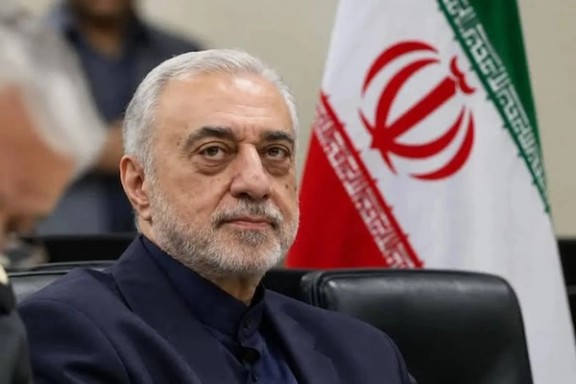
Mehrdad Akhlaghi Ketabchi, a sanctioned veteran of Iran's missile industry with ties to the Revolutionary Guards, became defense minister on Sunday, following his predecessor's killing in the war with the United States and Israel.
Akhlaghi secured 237 votes in favor and 15 against in a virtual parliamentary session attended by 277 lawmakers.
He replaces Aziz Nasirzadeh, who was killed on February 28 during the opening day of joint US-Israeli strikes on Iran. The ministry had since been overseen by acting minister Majid Ebn al-Reza.
Unlike several previous defense ministers who rose through military command positions, Akhlaghi built his career inside Iran's weapons manufacturing establishment, overseeing industrial organizations involved in missile production, aerospace technologies and military procurement.
His name has appeared on international sanctions lists since 2007, reflecting his longstanding involvement in institutions central to Iran's ballistic missile program.
From engineering to missile production
Born on September 10, 1958, in Rasht, northern Iran, Akhlaghi studied chemical engineering at Amirkabir University of Technology before earning a master's degree in strategic management from Malek Ashtar University of Technology, an institution affiliated with the Defense Ministry.
He entered Iran's defense industries in the early 1980s and spent more than four decades in technical, industrial and managerial positions, according to Iranian state-linked media.
Much of his career has involved solid-fuel missile propulsion systems and the management of industrial facilities associated with ballistic missile development.
Solid-fuel propulsion allows missiles to remain stored for extended periods and reduces preparation time before launch, making it a significant component of Iran's missile capabilities.
Akhlaghi previously headed the Shahid Bagheri Industrial Group, a subsidiary of the Aerospace Industries Organization involved in Iran's ballistic missile program.
In November 2014, then-Defense Minister Hossein Dehghan appointed him managing director of the Aerospace Industries Organization, replacing Mehdi Farahi.
He later became head of the Defense Industries Organization, which produces conventional weapons and supplies military equipment to Iran's armed forces.
Akhlaghi's role in the Fateh-110 missile project
Akhlaghi's close relationship with Hassan Tehrani Moghaddam, a founder of the Revolutionary Guards' missile program, was central to his involvement in developing Iran's missile industry.
Akhlaghi worked closely with Hassan Tehrani Moghaddam, widely known as the father of Iran's ballistic missile program. Tehrani Moghaddam oversaw the development of the Revolutionary Guards' missile arsenal before he was killed in a November 2011 explosion at a military facility near Tehran.
Iran's IRGC-linked Tasnim news agency, citing The Eternal Man, a biography by Masoumeh Sepehri, reported that Akhlaghi approved $10 million in equipment purchases and production facilities for the Fateh-110 missile despite uncertainty over whether the project would succeed.
The account, based on an interview with a senior missile designer, describes Akhlaghi's direct involvement in financing infrastructure used to produce missiles for the Revolutionary Guards.
Pezeshkian also referred to Akhlaghi's association with Tehrani Moghaddam during Sunday's parliamentary session, crediting figures such as the two men with developing Iran's military capabilities.
Nearly two decades under international sanctions
Akhlaghi's involvement in Iran's missile industry brought him under international sanctions long before his appointment to the cabinet.
The United Nations Security Council included him in Resolution 1747, adopted on March 24, 2007, identifying him as head of the Shahid Bagheri Industrial Group.
The group had previously been sanctioned over its involvement in Iran's ballistic missile program.
The US Treasury Department also placed Akhlaghi under sanctions in 2008.
US State Department information about his activities identified him as a senior figure in missile-related industrial operations and described his participation in negotiations to purchase equipment for the missile industry.
In 2020, the first Trump administration sanctioned him in connection with his position as director of the Defense Industries Organization.
The European Union has also included Akhlaghi on its sanctions lists, identifying his senior roles within both the Defense Industries Organization and the Aerospace Industries Organization.
Britain imposed sanctions on him in 2023, citing his involvement in activities connected to the development of systems capable of delivering nuclear weapons.
His name was also included in UN sanctions lists following the reimposition of international sanctions in September 2025.
The measures have made Akhlaghi one of the more extensively sanctioned figures to enter Pezeshkian's cabinet, with restrictions linked to his work in institutions involved in missile development and weapons production.
Missile production and air defenses top priorities
Akhlaghi outlined plans to expand weapons production, strengthen air defenses and rebuild military industrial facilities during his parliamentary confirmation session.
His proposed program includes developing new military technologies, improving production efficiency and increasing cooperation with universities and technology companies.
Akhlaghi also proposed shortening the development cycle for certain new defense technologies to a maximum of six months.
The program envisages increasing the share of production outsourced to companies outside the Defense Ministry to 75 percent in the Iranian year beginning in March 2026 and more than 85 percent the following year.
Highly classified weapons production would remain within facilities controlled by the ministry.
Akhlaghi has also identified continued support for armed groups aligned with the Islamic Republic across the region as a ministry priority.
His agenda builds on programs developed under Nasirzadeh, with adjustments intended to address the damage and military requirements arising from the recent wars.
Akhlaghi portrayed Iran's military capabilities as having frustrated US and Israeli objectives during the latest conflict.
"These capabilities have brought the American-Zionist enemy to the point of desperation in the recent war and placed it in a strategic deadlock," Akhlaghi told lawmakers.
His remarks came as the Defense Ministry faces the task of replacing damaged infrastructure and restoring weapons production capacity following months of military confrontation.
Warning to Washington over possible strikes
Akhlaghi also delivered a warning to the United States on the sidelines of Sunday's parliamentary session.
Asked about the possibility of Washington using the GBU-43 bomb, commonly known as the Mother of All Bombs, against Iran, he said the Defense Ministry had prepared measures to respond.
"The US president should be thinking about how to get his forces out of our region alive. If he drops one bomb, he will have to see how many of his troops he will have to take out of the region horizontally (dead)," Akhlaghi told reporters.
The remarks followed warnings by US officials about the possibility of further military action against Iranian facilities.
President Donald Trump has raised the possibility of striking the underground Pickaxe Mountain complex near Natanz, while US Defense Secretary Pete Hegseth has warned of severe military consequences if negotiations with Iran fail.
A sanctioned missile official takes charge after the war
Akhlaghi's appointment follows the war with the United States and Israel, which killed senior Iranian military officials and exposed vulnerabilities in the Islamic Republic's military infrastructure and air defenses.
Pezeshkian told lawmakers that the new minister had the backing of the army, the Revolutionary Guards and other military and security institutions.
The president also referred to Akhlaghi's presence on US sanctions lists and expressed hope that he would remain alive to continue his work.
The decision to appoint an official sanctioned for nearly two decades over his involvement in Iran's ballistic missile program points to the leadership's continued reliance on the same military-industrial establishment that oversaw the development of its missile arsenal.
Akhlaghi now faces the task of rebuilding military production capacity and expanding weapons manufacturing at a time when Iran's missile program remains a major source of confrontation with Washington and European governments.

No comments:
Post a Comment
Note: Only a member of this blog may post a comment.