Search This Blog

Saturday, December 29, 2018

Food Really Does Affect How We Think


There have a been a number of convincing studies in recent years showing that the old adage “you are what you eat” is pretty accurate. But if you weren’t quite convinced to cut back on donuts and choke down some kale, a new study from the University of Illinois might do so: It shows that blood levels of certain molecules that are touted to be healthy—omega-3s, lycopene, B-vitamins, among others—actually correlated not only to cognitive function but also to how the brain functions.
“The basic question we were asking was whether diet and nutrition are associated with healthy brain aging,” said study author Aron Barbey in a statement. “And instead of inferring brain health from a cognitive test, we directly examined the brain using high-resolution brain imaging.” (He and his team did have the participants carry out cognitive tasks, which is important, and discussed below.)
The study was published this week in the journal NeuroImage.
The researchers measured blood levels of nutritional biomarkers in the blood of 115 healthy participants (aged 65-75), including omega-3 and omega-6 fatty acids, lycopene (found in highest concentrations in tomatoes and watermelon), folate (in leafy greens), carotenoids (in red, yellow, and orange veggies), riboflavin, vitamin B12, and vitamin D. The team chose these because they represent many of the healthy compounds from the Mediterranean diet.
They scanned the participants’ brains to view high-resolution images of neural networks, including how the various networks were connected in each participant, and found a correlation between having higher blood levels of many of the nutrients of interest and having better connectivity in certain brain regions. In particular, higher levels of omega-3s, omega-6s and carotene were linked to better network efficiency.
“Efficiency has to do with how information is communicated within the network,” Barbey said. “We looked at ‘local efficiency’ – how well information is shared within a spatially confined set of brain regions – and also ‘global efficiency,’ which reflects how many steps are required to transfer information from any one region to any other region in the network. If your network is more efficiently configured, then it should be easier, on average, to access relevant information and the task should take you less time.”

The team also had the participants take tests to measure cognition, overall intelligence, memory, and executive function—and they were able to correlate these scores with brain connectivity and levels of the nutritional biomarkers. Omega-3, omega-6, lycopene, carotenoids, and vitamins B and D all correlated to aspects of cognition, and most were also connected to brain function.
For instance, omega-3s were linked to general intelligence andto connectivity in the fronto-parietal network, which governs goal-directed behaviors and attentional focus. Omega-6 fatty acids and lycopene were linked to executive function and to the dorsal attention network. (Additionally, lycopene and omega-3s and -6s were linked to several tests of memory function, vitamins B and D to executive function, and carotenes were linked to intelligence scores.)
“Our study suggests that diet and nutrition moderate the association between network efficiency and cognitive performance,” said Barbey. “This means that the strength of the association between functional brain network efficiency and cognitive performance is associated with the level of the nutrients.”
In other words, the connection between cognition and brain activity can at least partially be explained by the levels of biomarkers in the blood.
The study has a couple of limitations—one being that most participants were white, educated, and in good health. They study would need to be repeated in a more diverse population before drawing more solid conclusions. Additionally, a big caveat is that it’s only correlational, meaning that we don’t know which came first, the brain/cognitive health or the good nutrition/blood biomarkers. There could be reverse causation going on here, so that people who were smarter to begin with ate foods that were healthier, which then showed up in their blood. To really know whether causation was play, you’d have to assign people to eat healthily or poorly over time, which might have some ethical issues.
Still, the study confirms what others have in the past—that eating well may well keep the brain healthy and, in so doing, boost cognition. There are lots of reasons why this is logical, and researchers have laid out many of the biochemical mechanisms behind it, from how lycopene may reduce inflammation to how omega-3s help keep neurons’ membranes more permeable. And plenty of studies have illustrated the flip-side: That unhealthy foods (especially sugar) is linked to reduce brain volume, and poorer cognition.
While science continues to map out all the connections, it’s probably wise to do what we’ve been told for ages—eat well when you can, but don’t beat yourself up if occasionally you can’t.


5 Things To Look Out For In Cancer Research In 2019


2018 was a remarkable year for cancer research, with great strides made in diagnosing and treating various types of cancer as well as important breakthroughs looking at the health of cancer survivors. What can we expect to see from cancer research in 2019? As a cancer research scientist, here are the top five topics that I’ll be looking out for.
1. Immunotherapy. Who will respond, who won’t respond and why?
Immunotherapy is now seemingly everywhere, with several therapies approved for various cancer types, including CAR T-cells and immune checkpoint inhibitors and several more in development such as tumor infiltrating lymphocyte (TIL) therapy. TILs successfully cleared all tumorsfrom a woman with metastatic breast cancer, in a research breakthrough which was one of the most reported in 2018.
Over 2,500 trials are now registered worldwide, but as the use of immunotherapy grows, there are still major questions to be answered. One particularly important to the use of immune-checkpoint blocking drugs such as those which target PD-1 or CTLA-4 is ‘why do some patients respond whereas others do not?’ Several research teams worldwide are currently grappling with this question, which is unlikely to have a single, clear answer, but I expect to see much more research published on this in 2019, which will hopefully start to benefit patients by identifying who will and won’t respond to these expensive drugs.

2. Liquid biopsy tests. More clarity on precisely what they do and more evidence that they do it accurately.
The liquid biopsy industry has exploded in 2018, perhaps unsurprising given the market is expected to be worth over $2 billion annually by 2022. The promise is that eventually, we should be able to diagnose cancer with a simple blood test, earlier, more cheaply and even more accurately than we currently do and even use these tests to monitor response to cancer treatment and when and if a tumor returns.  As a cancer research scientist, the number of research papers, presentations at top conferences and news releases by the dozens of companies currently developing these technologies can make it a little overwhelming to figure out what is going on.
In 2018, two of the top liquid biopsy tests on the market had their efficacy called into question with researchers from Johns Hopkins suggesting that the two competing tests gave different results with the same patient samples. A claim which was then challenged by representatives from both companies.
Liquid biopsy tests undoubtedly have huge potential and may indeed live up to their hype, but currently, the field is a little messy and difficult to understand for scientists, patients and oncologists who are not specialists. The American Society for Clinical Oncology (ASCO) issued a statement in March of this year essentially concluding that for most liquid biopsy tests there is currently not enough evidence to recommend their use in either the diagnosis or monitoring of cancer. Hopefully, 2019 brings greater clarity about how these tests can fit into the diagnosis and care of people with cancer and ASCO will be able to review their stance accordingly.
3. More focus on the side-effects of cancer treatment.
As a cancer survivor myself and an advocate for more research into what happens to cancer survivors past the ‘all clear,’ 2018 has been a remarkable year for research into the numerous and often disabling side-effects cancer survivors experience. For decades, cancer research has understandably been mainly focused on making sure as many people survive the disease as possible, but now with millions of cancer survivors in the world, a new research field looking at what actually happens to cancer survivors as a result of their treatments is growing at considerable speed.
From a study which hopes to have found a solution to male infertility after childhood cancer treatment to work showing that some women with early-stage breast cancer can have less radiotherapy without compromising their chance of survival, 2018 was a good year for cancer survivorship research. The highlight, in my opinion, was work from Stanford University scientists that may have figured out why ‘chemo brain’ happens, one of the most commonly-reported side-effects that cancer survivors experience. Even better, the scientists suggest that it may be treatable.
4. Cancer and the microbiome.
The microbiome has been one of the most talked about topics in medicine in 2018 and shows no sign of slowing down. Amidst the predictable flurry of supplements, fad-diets and blog posts giving scientifically-questionable advice telling you how to cherish and nurture your own gut flora, plenty of solid, evidence-backed research has been published showing that the microbiome is potentially involved in multiple sclerosisinflammatory bowel disease and even Alzheimer’s disease. But what about cancer?
There are already several studies published showing that the microbiome can influence the response to chemotherapy drugs and even in some cases cause the production of toxic breakdown products of the drug. Earlier this month, work published in Nature Communications showed how a particular bacterial strain common in the human microbiome could influence the immune system to drive the progression of a currently incurable type of blood cancer called multiple myeloma. The study raised the possibility that targeting these bacteria with drugs could halt or slow the disease.
5. Organoids, the new secret weapon in personalized cancer medicine.
Back in November 2017, I wrote about how organoids, tiny lab-grown organs made from patient tissue samples would revolutionize the treatment of cancer by allowing researchers to test drugs on patient tumors before deciding which to give the patient. Several pharmaceutical and biotechnology companies have large-scale programs to commercially develop these technologies for using organoids in drug screening for patients and the increasing accessibility of organoid growing kits from companies which supply academic and hospital research laboratories mean research papers are coming out thick and fast.
But, organoids are by no means a perfect way to test new drugs yet. For example, it is easy and quick to make organoids from certain tumor types-such as colorectal, but very difficult from others such as brain tumors. Organoids grown in the lab also don’t have a blood supply, nor are they connected to other body systems which may influence the response of a patient to anti-cancer drugs. But researchers are making progress in organoid development all of the time, figuring out better ways to make and culture them so they more accurately reflect the tumor they were originally made from.  Expect to see them playing an increasing role in designing personalized medicine approaches for cancer patients as well as being involved in more lab-based cancer breakthroughs.

Abiomed Sells $600M Of Pencil-Size Heart Pump. Some Doctors Have Big Questions


Lisa Cardillo, then 36, and her husband were celebrating their 15th wedding anniversary and had just checked into a bed-and-breakfast when she felt a burning, stabbing pain in her chest. She was having a heart attack.
Cardillo’s heart stopped in the emergency room when she got to the hospital in Grand Rapids, Michigan. Within minutes, doctors used a defibrillator to restart it, but her heart was too weak to push blood to the rest of her body. They put a tiny pump, 6 inches long and shaped like a bent stick, into the left ventricle of her heart. After a few days her heart recovered, and the pump, brand name Impella, was taken out. A year later, “I feel like I’m back to 100%,” she says. “You would not even know what I’ve been through.”
Stories like that demonstrate how Abiomed sells five varieties of the $23,000 Impella pumps. (The price also includes care and support.) The Danvers, Massachusetts, company reported net income of $112 million on revenue of $594 million in its March 31 fiscal year, almost all of it from Impella. Michael R. Minogue, Abiomed’s chief executive, tells how in 2016, when enough patients had been treated to fill Fenway Park, a patient and his doctor threw out the first pitch at a Red Sox game.
“My best day in the office is seeing patients,” says Minogue, a West Point grad with an engineering degree. “And on my worst day I pull out my book with all the patients’ stories and I read it.”
The stories are great. But some doctors, even ones who use the device, think the evidence the company cites to support its use isn’t strong enough. For patients like Lisa, “the Impella may not be of any value,” says David Brown, a cardiologist at Washington University in St. Louis. “In the history of medicine, when we’ve assumed things work without adequately testing them, we frequently have felt foolish because when it was ultimately tested it was found not to work so well.” Robert Yeh, a cardiologist at Beth Israel Deaconess Medical Center, vividly remembers patients who he suspects would have died if not for the Impella, yet he says he lacks definitive proof of the pump’s value.

Short-Term Support

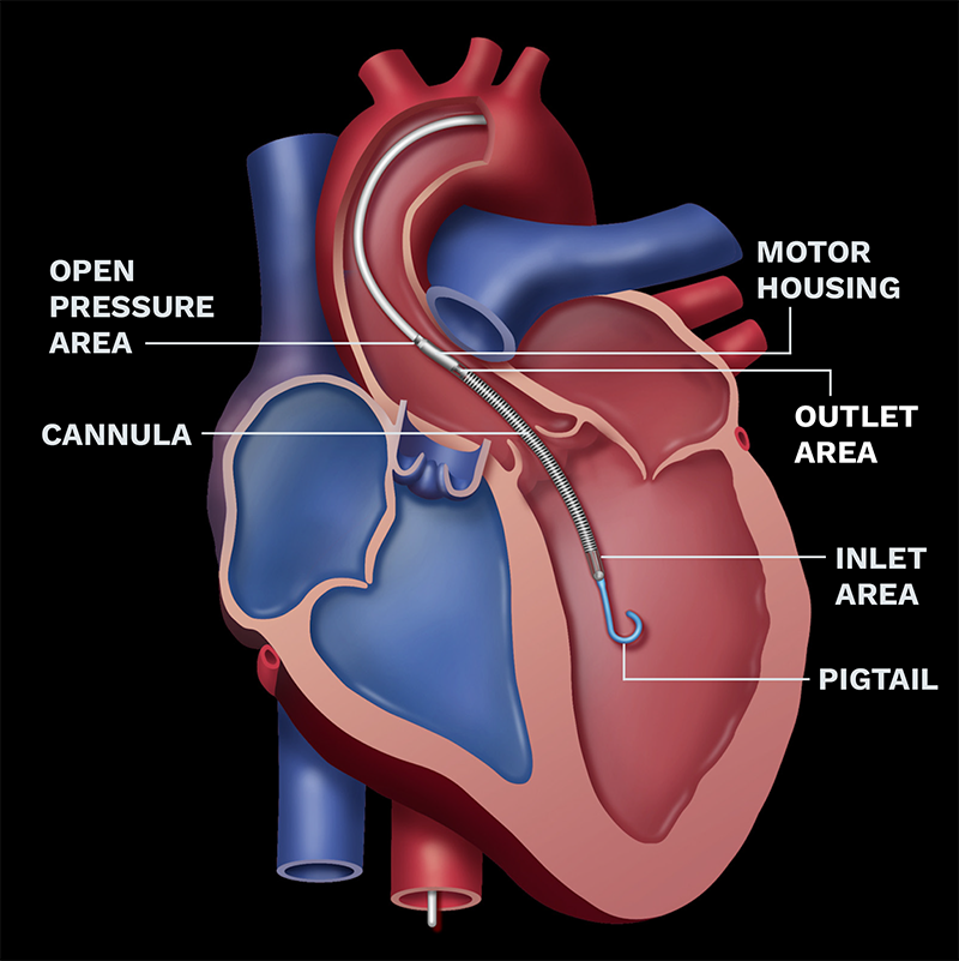
The Impella pump takes in oxygenated blood from the left ventricle and expels it into the aorta to flow to the rest of the body.
ABIOMED
Proof would require a controlled trial, with some patients randomly getting the pump and others not. Such a trial, says Minogue, has been impossible in the U.S., since doctors won’t play Russian roulette with their patients. Wall Street doesn’t care about trials. Abiomed’s market value of $14 billion is 74 times trailing earnings.
Abiomed was founded in 1981 to develop an artificial heart. That device was approved in 2006 but was rarely used and is no longer for sale. Minogue, a Bronze Star veteran of the Gulf War, arrived in 2004 after 11 years at General Electric.

The artificial heart, Minogue says, was “a science fiction product.” Another device, a partly external heart pump, generated $30 million in sales at its peak.
What he wanted was something that could help the heart pump and recover, without having to replace the damaged organ. He found it in the Impella, a device made by a German firm and used on patients in Europe. In 2005 he bought the startup, which had nearly gone bankrupt, for $2 million in cash, $45 million in Abiomed stock and $29 million in payments that would be owed if the device reached the market.
Good move. Since Minogue joined the company, Abiomed’s revenue has climbed sixteenfold and its share price thirtyfold.
The Food & Drug Administration cleared Impella for the U.S. in 2008 for temporary heart support, and sales growth has been in the double digits since 2014. “I challenge you to find me a story with those same growth characteristics,” says Raj Denhoy, a medical device analyst at Jefferies who has been following Abiomed for many years.
The pump looks like a striped gray pen with a pigtail on the pointed end. It is inserted into a patient’s heart via a wire threaded up from the groin and remains connected to a bedside console. It’s meant to pump blood out to the body continuously, not mimicking the heart’s pumping motion. Once the heart recovers, the pump comes out. Different versions of the Impella can support the right or left side of the heart.
About half of Impella sales are for use during procedures to open up blocked arteries with tiny metal tubes called stents. For this use Abiomed conducted a randomized studycomparing Impella with another device in 448 patients and received approval from the FDA in 2015. The other half of sales is for patients who have had a heart attack and aren’t getting enough blood to their bodies. For this use, the main study, comparing Impella with a balloon device, comprised only 26 patients. There was also data from hundreds of patients who had received the device as part of their care but were not part of a controlled study. That earned Abiomed an FDA approval in 2016.
Not good enough, says Will Suh, a cardiologist at the University of California, Los Angeles. “The highest-quality evidence is lacking.” He still uses the Impella, because he believes he’s seen it work in certain situations, but points out it can cause bleeding complications. “I’m amazed at such an expensive device being used without a little bit stronger evidence,” says Martha Gulati, chair of cardiology at the University of Arizona.
If Abiomed doesn’t have the data doctors want, Minogue says, it’s not for lack of trying. He says the last of the seven times Abiomed has attempted a U.S. trial, in 2008, 58 hospitals participated but only one patient enrolled. “It is a very difficult, logistical and ethical thing to do,” he says. “Would you want a family member randomized?” Hospitals in Denmark and Germany are enrolling patients in a randomized controlled trial, but that isn’t expected to be completed until 2023.
Part of the reason it’s so hard is because often patients’ hearts have stopped and “you really can’t get consent ahead of time,” says William O’Neill, a cardiologist and Abiomed consultant at Henry Ford Hospital in Detroit who was an early adopter of Impella. His study of 104 patients treated with the Impella shows 77% survived to leave the hospital, versus a 50% historical survival rate. Clyde Yancy, chief of cardiology at Northwestern University’s Feinberg School of Medicine, says it’s all about selecting the patients who have the best chance of being helped. “The Impella is definitely a step forward. It’s less than a perfect device, but better than what we have had before.”
Minogue, as you’d expect, has an answer to complaints that his company’s device is too expensive. He pulls a red plastic charity band on his wrist given to him by an Impella patient. The white lettering has come off from wear. “Jessica, she’s 32,” he says. “She’s back home now with her own heart. In the case of Howard, he was 68 and he’s five years out. I can go on. I mean, all these stories.”

CDC heart disease statistics

610,000 people die of heart disease in the U.S. in a year
370,000 people die of coronary heart disease (that’s the biggest subgroup of the 610k)
735,000 people have a heart attack in the U.S. in a year
525,000 of those are having a first heart attack
210,000 of those are having a repeat heart attack
In an investor presentation, Abiomed specified which patients it thinks are eligible for its products:
121,000 people each a year who undergoing procedures to open up blocked arteries with stents, particularly cases in which doctors might otherwise consider the procedure too risky to do
100,000 people each year whose hearts aren’t pumping enough blood to the rest of their bodies, such as after a heart attack

Saudi Arabia Unveils Plans To Create Massive Red Sea Wellness Destinations

Red Sea Project
SAUDI KINGDOM PUBLIC INVESTMENT FUND
The Saudi Kingdom Public Investment Fund recently announced plans for a new luxury development on the coast of the Red Sea. Led by luxury hospitality expert Nicholas Naples, the Amaala Project is one of Crown Prince Mohammed bin Salman’s major development projects to create a tourist destination on the Kingdom’s northwestern coast. The goal is to create a new destination for luxury tourism which focuses on recovery, health, and treatment while developing the tourism sector of Saudi Arabia.
Amaala ProjectSAUDI KINGDOM PUBLIC INVESTMENT FUND
Amaala is focused on several categories: Wellness, healthy living and sports; art and culture; and sea, sun and lifestyle with the resort being planned over three sites within the Prince Mohammed bin Salman Natural Reserve on the northwestern coast of Saudi Arabia. The development will include more than 2,500, hotel rooms as well as 700 luxury villas with plans to open the first part of the development at the end of 2020 with completion by 2028.
Red Sea project
SAUDI KINGDOM PUBLIC INVESTMENT FUND
The project plans, however, could be postponed indefinitely in the wake of foreign capital boycotts following the death of journalist Jamal Khashoggi. At risk are several previously announced major projects in the area including the massive NEOM City in Tabuk to compete with Silicon Valley and the spectacular Red Sea Project reef destination resort.
Billionaire Richard Branson announced he would be suspending his planned $1 billion investment into the fund until further notice. “I had high hopes for the current government in the Kingdom of Saudi Arabia and its leader Crown Prince Mohammed bin Salman and it is why I was delighted to accept two directorships in the tourism projects around the Red Sea. I felt that I could give practical development advice and also help protect the precious environment around the coastline and islands,” he said.
He continued, “What has reportedly happened in Turkey around the disappearance of journalist Jamal Khashoggi, if proved true, would clearly change the ability of any of us in the West to do business with the Saudi Government. We have asked for more information from the authorities in Saudi and to clarify their position in relation to Mr. Khashoggi.”
Amaala Project coastline
SAUDI KINGDOM PUBLIC INVESTMENT FUND
Development plans will continue however for the new Amaala project and according to Nicholas Naples “Amaala represents a unique and transformational luxury experience where full-fledged wellness tourism is integrated alongside a curated mix of arts, culture, and sports offerings that are individually tailored for the ultra-luxury lifestyle, including the availability of a fashion scene, healthy-living services, and year-round sea expeditions.”
Aerial rendering of Amaala Project
SAUDI KINGDOM PUBLIC INVESTMENT FUND
Amaala plans to feature stunning futuristic architecture and high-end luxury in both hotels and private villas as well a retail village and an academy of the arts with cultural events and performances. The area offers up amazing scenery, mountain landscapes, and diving with perfectly clear coral reefs. A large marina and superyacht club will also be offered.
In addition, the previously announced Red Sea Project will be a luxury resort destination located across 50 untouched islands within a lagoon along the Western coast of the Kingdom of Saudi Arabia, between the cities of Umluj and Al Wajh.  Home to environmentally protected coral reefs, mangroves, and several endangered marine species, the destination also includes numerous dormant volcanoes.
Nabatean ruins of Madain Saleh
GETTY
The Red Sea project’s nature reserve is inhabited by rare wildlife including Arabian leopards, wolves, wildcats, and falcons. Tourists will also be able to visit the ancient ruins at Mada’in Saleh, which is also Saudi Arabia’s first UNESCO World Heritage site. Hot air balloon tours will also be established over the ruins to create a tourist attraction similar to Cappadocia in Turkey and finally, a new mountaineering development called Wadi Al Disah is being created on the southwest Tabuk region within a valley of palm trees and freshwater springs to eventually offer spectacular climbing sites around the Nabataean tombs.
Villa rendering at Red Sea Project
SAUDI KINGDOM PUBLIC INVESTMENT FUND

The Ten Biggest Private Equity Deals In Healthcare In 2018


As 2018 was a banner year for venture capital funding in the healthcare sector, it was also a record for private equity deals. 715 private equity deals had closed as of mid-December for a combined value of $103.72 billion, according to PitchBook. In 2017 there were 709 deals worth $88.87 billion, and 651 deals worth $70.5 billion in 2016. That’s up from 413 deals worth $31.52 billion in 2013.
The Healthcare Research Institute of Pricewaterhousecoopers expects the trend to continue in 2019, as private equity investments have increased across the economy and the healthcare sector is in a phase of management teams looking to sell parts of a company that aren’t deemed essential to its main business. “We’ve seen a high level of divestitures, offloading a lot of non-core assets, and private equity has been there to be great partner,” says Karen Young, PwC’s U.S. pharma and life sciences leader. But the growth is from firms that have been in and around the industry making more bets, not from new players getting involved, she thinks. “They’re looking to become more of a collaborator in the industry versus just a banker, and I think that’s what’s driving a better relationship, as well as better outcomes on those transactions with higher values,” Young says.
2018’s biggest private equity deals in healthcare include such collaborations as health insurer Humana’s $4.1 billion partnership with firms TPG Capital and Welsh, Carson, Anderson & Stowe to buy Kindred Healthcare, which provides home health services and operates facilities for long-term acute care and rehabilitation. But it also includes more traditional deals such as controversial emergency room outsourcing company Envision Healthcare’s going private.
Here’s the rundown of the top ten, according to PitchBook:
  1. Envision Healthcare; $9.9 billion; Kohlberg Kravis Roberts
  2. Athenahealth; $5.7 billion; Veritas Capital, Evergreen Coast Capital
  3. LifePoint Health; $5.6 billion; Apollo Global Management, ATP Private Equity Partners, RCCH HealthCare Partners
  4. Kindred Healthcare; $4.1 billion; Welsh, Carson, Anderson & Stowe, TPG Capital, Humana
  5. American Medical Response; $2.4 billion; Air Medical Group Holdings, Kohlberg Kravis Roberts, Ardian, Koch Equity Development
  6. Sound Physicians; $2.15 billion; Revelstoke Capital Partners, Athyrium Capital Management, Summit Partners, Silversmith Capital Partners
  7. Lifescan; $2.1 billion; Platinum Equity
  8. Curo Health Services; $1.4 billion; TPG Capital, Welsh, Carson, Anderson & Stowe, Humana
  9. Juice Plus; $1.235 billion; Altamont Capital Partners
  10. Analogic; $1.1 billion; Altaris Capital Partners

Gilbert Foundation to Pursue Gene Therapy for Neurofibromatosis


The Gilbert Family Foundation, a charitable organization founded by Quicken Loans chairman Dan Gilbert and his wife Jennifer, is making its first foray into gene therapy research.
The foundation will spend $12 million in an initiative to develop new treatments that target the underlying genetic abnormalities in neurofibromatosis type 1 (NF1), a disorder that can result in bone and cartilage disorders called skeletal dysplasias, as well as the formation of nervous system tumors, potentially leading to disfigurement, cancer, and blindness. There are currently no FDA-approved treatments to prevent or stop the tumors associated with the disease.
“We want to develop drugs and other innovations capturing the most advanced technologies for genetic diseases,” says YooRi Kim, the foundation’s scientific officer. Proposed treatments the foundation will investigate include gene replacement, gene editing, RNA editing, exon skipping, and nonsense mutation suppression.
“Nobody has explored gene therapy for NF1, so we’ll look at different approaches to see what will work during the first three years,” she adds.
In addition to advancing gene therapy innovation, the Gilberts have a very personal reason for launching the initiative. Their son, Nick, was diagnosed with NF as a toddler.
Kim says the Gilbert Family Foundation put out a global call for researchers in the field who were willing to work collaboratively and remotely, eventually assembling a team of eight. The foundation’s NF1 researchers will mostly work out of the University of Alabama, Duke University, the University of Massachusetts, and Paris Descartes University, although more sites may be added later.
“Collaboration is a key element of what we’re trying to foster,” Kim explains. She expects the research to be a long process; after three years of initial feasibility work, the next phase of the initiative will involve identifying a “high risk, high reward” therapy that works on NF1. “[Gene therapy] is new technology that has shown promise in other diseases, so now we want to see if it works for NF,” she says.
If the research goes well and a promising drug therapy is developed, Kim says the foundation is “open to downstream partnerships to make the drug available to the patient community—we’re not in the business of making drugs ourselves.” Beginning early next year, the foundation will begin talking to genetic technology and pharmaceutical companies “to discuss the lay out of the handover if that’s what we want to do,” she says.
Kim says that NF is typically treated with repurposed cancer drugs that address tumor predisposition. “Now it’s 2018 and there are so many great, new therapies—the Gilberts are very interested in bringing alternative approaches and thinking to NF. We hope we can add to the ongoing research landscape.”
The Gilbert Family Foundation was established in 2015 after a $150 million investment. The foundation divides its work between NF research and efforts to revitalize the city of Detroit, Kim says.

RiverVest Venture Closes $184M Fund for Backing Healthcare


RiverVest Venture Partners, a St. Louis, MO-based venture capital firm with additional offices in San Diego, CA, and Cleveland, OH, has raised $184.4 million for its fourth fund dedicated to investing in healthcare companies.
Since its launch, RiverVest has invested in 47 companies working to develop new drugs and medical devices. Nearly half of the businesses in its portfolio have either been acquired or gone public, according to RiverVest.
Among the notable exits was San Diego’s Lumena Pharmaceuticals, which Irish pharmaceutical giant Shire (NASDAQ: SHPG) bought for more than $260 million in 2014. At the time, Lumena’s chairman was RiverVest managing director John McKearn.
RiverVest has also backed Mirum Pharmaceuticals, a new biotech headed by former Lumena CEO Mike Grey. Mirum recently debuted with $120 million in new funding to advance two investigational liver disease drugs.
Other big exits for RiverVest include San Carlos, CA-based Allakos (NASDAQ: ALLK), which raised $127.8 million this year in an initial public offering; Fort Worth, TX-based ZS Pharma, which had an IPO before AstraZeneca bought it out for $2.7 billion in 2015; and Houston,TX-based Idev Technologies, which sold to Abbott Laboratories (NYSE: ABT) for $310 million in 2013.
RiverVest has so far invested in eight companies out of its new fund, three of which it founded or co-founded, McKearn said in a prepared statement.
RiverVest said its second and third funds have each returned more than 20 percent annually to limited partners as of Sept. 30. That would put those funds’ performance in the top 5 percent of all venture funds started in the same time period, according to Cambridge Associates’ U.S. Venture Capital Index. The index, which includes data from 1981 and later, tracks more than 1,500 institutional venture capital funds.
RiverVest co-founder and managing director Jay Schmelter said the fund credits its success to a focus on developing biopharma and medical device products for high, unmet medical needs while finding a buyer or being ready for an IPO within three to five years of the initial investment.
The firm said that as of Sept. 30, it had about $753 million worth of assets under management.