Search This Blog

Sunday, December 30, 2018

14 best-performing stocks of 2018


Investing is way, way easier when done in hindsight. Aside from enormous sums of money, what do you really get from trying to pick stocks before they make big gains when it’s so much easier to know how successful a stock will be after it already is a hit?
Still, looking at past performance can be a key part of building a successful strategy for the future. And with that in mind, here’s a look at the top-performing stocks from the S&P 500 for this year. Who knows? Perhaps digging into the top stocks of 2018 will help you pick the right ones for 2019.

14. Intuitive Surgical Inc. (ISRG)

Opening price on Jan. 2: $367.89
Closing price on Nov. 8: $540.02
Percent gain: 46.79 percent
What $1,000 invested would be worth now: $1,467.90
Intuitive Surgical makes the da Vinci Surgical System, a robotic surgery system that a surgeon can control from a console. It allows surgeons to perform complex, minimally invasive surgeries with accuracy and precision. This expensive stock has been worth the investment: It has gained over 45 percent thus far in 2018.

13. NetApp, Inc. (NTAP)

Opening price on Jan. 2: $55.50
Closing price on Nov. 8: $82.84
Percent gain: 49.26 percent
What $1,000 invested would be worth now: $1,492.60
NetApp is a cloud computing company that has spent most of 2018 delivering a string of better-than-expected earnings reports. Its most recent two quarterly reports beat analyst expectations by an average of almost 17 percent.

12. Amazon.com, Inc. (AMZN)

Opening price on Jan. 2: $1,172
Closing price on Nov. 8: $1,754.91
Percent gain: 49.74 percent
What $1,000 invested would be worth now: $1,497.40
Apparently, there were plenty of people who looked at Amazon’s $1,000-plus share price at the start of the year and thought to themselves, “Wow, what a bargain!” At least, enough people that the shares have shot up almost 50 percent since that point. And that’s after counting the nearly 15 percent drop the company experienced after hitting a 52-week high of over $2,000 a share in early September.

11. Illumina, Inc. (ILMN)

Opening price on Jan. 2: $224.78
Closing price on Nov. 8: $339.55
Percent gain: 51.06 percent
What $1,000 invested would be worth now: $1,510.60
Genetics company Illumina provides gene-sequencing solutions and it increased its overall value by more than a half in 2018. The company reported its highest sales ever for its genomic-sequencing systems in late October, and then it bought its biggest competitor — Pacific Biosciences — in early November.

10. Boston Scientific Corporation (BSX)

Opening price on Jan. 2: $24.94
Closing price on Nov. 8: $38.44
Percent gain: 54.13 percent
What $1,000 invested would be worth now: $1,541.30
Medical device maker Boston Scientific is putting together a healthy year: The stock added 54.13 percent to its market value in just 10 months. The company — which specializes in cardiology products — might have left investors needing to adjust their pacemakers after reading the ticker tape as it built its share price month after month through a string of solid earnings reports.

9. Under Armour, Inc. (UA)

Opening price on Jan. 2: $13.45
Closing price on Nov. 8: $20.74
Percent gain: 54.2 percent
What $1,000 invested would be worth now: $1,542
The huge gains in Under Armor stock have likely been immensely satisfying to anyone who bought the stock at the beginning of 2018. But longtime stockholders might be less enthused — following a sharp drop in 2016, shares plummeted even further in 2017 and have yet to fully recover.

8. HCA Healthcare (HCA)

Opening price on Jan. 2: $88
Closing price on Nov. 8: $141.63
Percent gain: 60.94 percent
What $1,000 invested would be worth now: $1,609.40
HCA Healthcare operates acute care hospitals and surgical services, providing healthcare services for a wide variety of patients at its 179 hospitals and 120 freestanding surgical centers. And, based on its earnings and stock performance in 2018, it’s been doing a bang-up job at it, adding over 60 percent to its market value since the start of the year as admissions continue to rise.

7. Netflix, Inc. (NFLX)

Opening price on Jan. 2: $196.10
Closing price on Nov. 8: $317.92
Percent gain: 62.12 percent
What $1,000 invested would be worth now: $1,621.20
There was nothing “chill” about what stock in Netflix did in 2018. A 60-plus percent gain in just 10 months has shares well over $300 apiece as the company continues to stream money into the accounts of its shareholders.

6. Chipotle Mexican Grill, Inc. (CMG)

Opening price on Jan. 2: $290.90
Closing price on Nov. 8: $478.30
Percent gain: 64.42 percent
What $1,000 invested would be worth now: $1,644.20
Tortillas might be unleavened, but one thing that did rise this past year was stock in the fast-casual food chain. Of course, the company’s big 2018 has a lot to do with its poor performance in preceding years. The company reached highs of nearly $750 a share in late 2015 before the stock was rocked by E. coli scandals.

5. Advance Auto Parts, Inc. (AAP)

Opening price on Jan. 2: $100.90
Closing price on Nov. 8: $172.45
Percent gain: 70.91 percent
What $1,000 invested would be worth now: $1,709.10
“Advance” is just what this stock has done all year, growing steadily on the back of strong earnings results and growing sales. Had you invested $1,000 at the start of the year, you would currently be sitting on over $1,700 worth of stock.

4. Fortinet, Inc. (FTNT)

Opening price on Jan. 2: $43.76
Closing price on Nov. 8: $77.91
Percent gain: 78.04 percent
What $1,000 invested would be worth now: $1,780.40
If you read this and thought, “Oh, yes, that’s really popular with the kids these days,” you’re thinking of the video game “Fortnite.” Different thing. Though, maybe more young people should be taking an interest in integrated cybersecurity solutions, if only for the ballooning stock values. The company’s most recent earnings report might offer a clue as to why: a double-digit year-over-year increase in revenue and improving margins.

3. TripAdvisor, Inc. (TRIP)

Opening price on Jan. 2: $34.61
Closing price on Nov. 8: $66.93
Percent gain: 93.38 percent
What $1,000 invested would be worth now: $1,933.80
Ironically, the one trip this company should have advised you to take in 2018 was with this stock as it rocketed up the charts. Of course, it remains inadvisable for customers to make stock picks based on a travel adviser’s advice, but investing in this company would have been a smart move at the start of the year: You would have almost doubled every dollar you invested by early November.

2. Advanced Micro Devices (AMD)

Opening price on Jan. 2: $10.42
Closing price on Nov. 8: $21.20
Percent gain: 103.45 percent
What $1,000 invested would be worth now: $2,034.50
At the start of the year, you wouldn’t have needed to break a $20 bill to buy a share of semiconductor company Advanced Micro Devices. That is no longer the case, as AMD stock has more than doubled in value since then. The stock actually peaked at over $30 a share in September only to slump through October. However, the stock rallied following the announcement that its chips were being used by Amazon’s cloud computing division.

1. ABIOMED, Inc. (ABMD)

Opening price on Jan. 2: $188.13
Closing price on Nov. 8: $413.85
Percent gain: 119.98 percent
What $1,000 invested would be worth now: $2,199.80
This company’s name sounds like an answer to the question, “Which type of med?” And it answered emphatically in 2018, leading the S&P 500 year-to-date with a gain of almost 120 percent. Investors at the start of the year could have more than doubled their money in 10 months. The company — which makes heart pumps — delivered another earnings beat in early November that reversed a recent downtrend.

Reversing hearing loss by regrowing hairs


Humans are unable to reverse the effects of hearing loss, but a biological process found in other animal species may hold the key to reversing this widespread problem.
How the brain interprets sounds is a relatively simple process.
First, a sound enters the ear via soundwaves. It then moves down the ear until it hits the eardrum.
Next, the eardrum vibrates and sends these vibrations to bones in the middle ear, which then boost them.
Eventually, hair-like cells in the inner ear or cochlea pick up these vibrations and transform them into electrical signals that the brain can process.
Age or excessive exposure to loud noise can damage the cochlea, resulting in permanent hearing loss. According to the World Health Organization (WHO), hearing loss affects more than 400 millionpeople around the world today.
Some people experience more severe loss than others, and traditional treatment involves devices such as hearing aids. The effectiveness of these depends on the individual.
However, scientists have long known that animals such as fish and birds are able to keep their hearing intact by regenerating the sensory hair cells found in the cochlea. In fact, mammals are the only vertebrates that are unable to do this.

Testing the inner ear

In 2012, Dr. Patricia White’s laboratory identified a group of receptors responsible for this regeneration process. The researchers called this group the epidermal growth factor, or EGF, which switches on support cells in the auditory system of birds. These support cells then spark the production of new sensory hair cells.
Now, in a new study that they have published in the European Journal of Neuroscience, Dr. White — together with researchers from the University of Rochester and the Massachusetts Ear and Eye Infirmary — show how they tried to recreate this process in mammals.
They pinpointed a specific receptor called ERBB2, which is in support cells inside the cochlea, and trialed three different methods that could use these receptors to activate the pathway.
The first involved a series of experiments where they used a virus to target the ERBB2 receptors in mice. For the second, the researchers genetically modified mice in an attempt to activate ERBB2. The last experiment saw them use two drugs that they knew could produce a response in ERBB2.

The regeneration process

The scientists were able to regrow the all-important sensory hair cells in mammals for the first time.
Their findings show that activating ERBB2 started a process that led to the production of cochlear support cells. This then resulted in stem cells transforming into the sensory hair cells. These cells also integrated with nerve cells, which is necessary for hearing.
Dr. White believes that scientists could use her findings to form a new and innovative kind of therapy for hearing loss in humans. “The process of repairing hearing is a complex problem and requires a series of cellular events,” she says.
“You have to regenerate sensory hair cells and these cells have to function properly and connect with the necessary network of neurons. This research demonstrates a signaling pathway that can be activated by different methods and could represent a new approach to cochlear regeneration and, ultimately, restoration of hearing.”
Scientists will have to do further research into the use and process of EGF receptors in order to carry out any kind of human trial. However, this new discovery could be the start of an improvement to millions of lives.

Will Acute Migraine Get Its Due in 2019?


By many standards, 2018 was a banner year for migraine prevention. A novel class of drugs designed to prevent migraine by inhibiting calcitonin gene-related peptide (CGRP) was launched, with the FDA approving three anti-CGRP treatments: erenumab (Aimovig), fremanezumab (Ajovy), and galcanezumab (Emgality). But treatments to shut down acute migraine remain unsatisfactory.
Will that change in 2019? We asked four headache specialists to weigh in.
“In the next period, providers caring for patients with migraine will see two completely novel classes of acute migraine therapies: gepants and ditans,” predicted Peter Goadsby, MBBS, of King’s College London in England and the University of California, San Francisco.
The gepant drugs — rimegepant and ubrogepant — are oral CGRP receptor antagonists for acute migraine treatment. Both have completed phase III trials and “both have shown effectiveness for the two endpoints the FDA requires: 2-hour pain freedom in comparison to placebo and 2-hour relief of the most bothersome migraine symptom,” said Stewart Tepper, MD, of the Geisel School of Medicine at Dartmouth College in Hanover, New Hampshire.
Their efficacy is gentle and modest, “more like the slow-acting triptans,” Tepper noted. And the gepants are well-tolerated without any plausible basis for producing medication overuse issues, Goadsby added.
But this novel class of drug presents an unusual question: if a patient is using one of the new CGRP inhibitors for migraine prevention, will gepant drugs work?
“That is an unknown at the moment,” Goadsby said. But given the popularity of the new preventive drugs — over 100,000 patients have received the CGRP receptor inhibitor erenumab (Aimovig) since it was approved in May, for example — it’s a likely question to be investigated.
Also completing successful phase III trials in 2018 was the first “ditan” for acute migraine treatment — lasmiditan, a serotonin 5-HT1Freceptor agonist. In November, drugmaker Eli Lilly reported the company had filed a new drug application for lasmiditan with the FDA.
“The presumed mechanism of action of lasmiditan is to terminate migraine in the brain stem and prevent processing of the migraine centrally,” Tepper explained. That may be why lasmiditan appears to have central nervous system adverse effects, including dizziness and drowsiness.
“These side effects are of concern for a drug that will be used repeatedly over many years by otherwise healthy young people — mostly women — who need to drive and work,” said Elizabeth Loder, MD, MPH, of Brigham and Women’s Hospital in Boston.
Both lasmiditan and gepants “clearly are better than placebo, but they have not, as far as I am aware, been compared head-to-head with other commonly-used treatments,” Loder pointed out. “It seems unlikely, looking at the effect sizes in the trials, that they are more effective than existing treatments, including some inexpensive over-the-counter treatments.”
Neither lasmiditan nor gepants are associated with vasoconstriction, Tepper stated: “These drugs will not be contraindicated in patients with known vascular disease.”
But marketing campaigns for them may overstate the cardiovascular dangers of triptans, Loder observed: “This could potentially scare people away from triptans, many of which are generic and inexpensive, to new higher-priced drugs whose safety advantages are mostly speculative.”
And the new drugs have other caveats, she added: long-term safety remains to be demonstrated by widespread use in thousands of people and safety in pregnancy is uncertain, which is “a major consideration for a treatment that will be used mostly by women of childbearing age,” she said.
Other treatment possibilities in 2019 may include innovative neuromodulation therapies like the Nerivio Migra device, a wireless armband that uses smartphone-controlled electrical stimulation controlled to block migraine pain signals. In a pivotal trial, Nerivio Migra met its primary endpoints and in November, device maker Theranica Bioelectronics announced it had filed for FDA approval.
“Remote electrical stimulation and hand stimulation devices are especially attractive options given that they are portable, relatively discreet devices that may be used while the patient is at work or performing other daily activities,” noted Amaal Starling, MD, of the Mayo Clinic in Scottsdale, Arizona.
These techniques offer patients with contraindications to standard oral or injection therapies a non-drug treatment option, Starling said. And emerging neuromodulation therapies show promise: “I expect the innovation of treatment devices to continue to grow as we learn more about migraine and other headache disorders,” she added.

Texas judge agrees to keep Obamacare in place while his ruling is appealed


The Texas judge who ruled Obamacare unconstitutional earlier this month agreed Sunday to stay his decision from taking effect until it can be appealed.
Federal Judge Reed O’Connor said he didn’t believe 17 state attorneys general, led by California’s Xavier Becerra, would prevail in their challenge of his blockbuster ruling.
“But because many everyday Americans would otherwise face great uncertainty during the pendency of appeal, the Court finds that the December 14, 2018 Order declaring the Individual Mandate unconstitutional and inseverable should be stayed,” he wrote in the 30-page order.
O’Connor struck down former President Barack Obama’s signature health-insurance law on grounds that it became “invalid” when Congress voted last year to eliminate the tax penalty for anyone without coverage.
The decision came one day before the end of the program’s annual six-week enrollment period.
It threatened to cancel health-insurance coverage for about 20 million Americans, and also end popular provisions that guarantee insurance to people with pre-existing conditions and allow children to remain on their parent’s policies until they turn 26.
In a tweet posted Sunday evening, Becerra vowed to fight to preserve Obamacare.
“A federal court in #Texas granted what we asked for in a Dec. 17 motion but at the end of the day, we’re working to keep #healthcare affordable and accessible to millions of Americans, so we march forward!” he wrote.

How ‘Dry January’ is the secret to better sleep, saving money and losing weight


New research from the University of Sussex shows that taking part in Dry January — abstaining from booze for a month — sees people regaining control of their drinking, having more energy, better skin and losing weight. They also report drinking less months later.
The research, led by Sussex psychologist Dr Richard de Visser, was conducted with over 800 people who took part in Dry January in 2018. The results show that Dry January participants are still drinking less in August. They reported that:
  • drinking days fell on average from 4.3 to 3.3 per week;
  • units consumed per drinking day dropped on average from 8.6 to 7.1;
  • frequency of being drunk dropped from 3.4 per month to 2.1 per month on average.
Dr Richard de Visser, Reader in Psychology at the University of Sussex, said:
“The simple act of taking a month off alcohol helps people drink less in the long term: by August people are reporting one extra dry day per week. There are also considerable immediate benefits: nine in ten people save money, seven in ten sleep better and three in five lose weight.
“Interestingly, these changes in alcohol consumption have also been seen in the participants who didn’t manage to stay alcohol-free for the whole month — although they are a bit smaller. This shows that there are real benefits to just trying to complete Dry January.”
The University of Sussex research showed that:
  • 93% of participants had a sense of achievement;
  • 88% saved money;
  • 82% think more deeply about their relationship with drink;
  • 80% feel more in control of their drinking;
  • 76% learned more about when and why they drink;
  • 71% realised they don’t need a drink to enjoy themselves;
  • 70% had generally improved health;
  • 71% slept better;
  • 67% had more energy;
  • 58% lost weight;
  • 57% had better concentration;
  • 54% had better skin.
Dr Richard de Visser’s findings come from three self-completed online surveys: 2,821 on registering for Dry January; 1,715 in the first week of February; and 816 participants in August.
A new YouGov poll undertaken for Alcohol Change UK showed that one in ten people who drink — an estimated 4.2 million people in the UK — are already planning to do Dry January in 2019.
Dr Richard Piper, CEO of Alcohol Change UK, said:
“Put simply, Dry January can change lives. We hear every day from people who took charge of their drinking using Dry January, and who feel healthier and happier as a result.
“The brilliant thing about Dry January is that it’s not really about January. Being alcohol-free for 31 days shows us that we don’t need alcohol to have fun, to relax, to socialise. That means that for the rest of the year we are better able to make decisions about our drinking, and to avoid slipping into drinking more than we really want to.
“Many of us know about the health risks of alcohol — seven forms of cancer, liver disease, mental health problems — but we are often unaware that drinking less has more immediate benefits too. Sleeping better, feeling more energetic, saving money, better skin, losing weight… The list goes on. Dry January helps millions to experience those benefits and to make a longer-lasting change to drink more healthily.”
Signing up for Dry January increases the chance that you’ll get the most out of the month. You can download Try Dry: The Dry January App to track your units, money and calories saved, plus many more features. Or you can sign up at dryjanuary.org.uk for regular support emails with tips and tricks from experts and others like you.
Story Source:
Materials provided by University of SussexNote: Content may be edited for style and length.

Biotech Stocks Facing FDA Decision In January 2019


Starpharma
Starpharma
Starpharma’s (SPHRY.OB) New Drug Application for VivaGel BV is under priority review by the FDA – with a decision expected in early January.
VivaGel BV is a non-antibiotic, water-based vaginal gel for the treatment of bacterial vaginosis and prevention of recurrent bacterial vaginosis.
The global market for bacterial vaginosis treatment is estimated to be roughly US$750 million, and about US$1 billion for prevention of recurrent bacterial vaginosis.
The product is already approved in Europe and Australia. VivaGel BV is licensed to Mundipharma in Europe, and to Aspen Pharmacare in Australia where it is marketed under the brand name Fleurstat.
Antibiotics like Flagyl, Cleocin oral or vaginal suppositories, vaginal gel MetroGel-Vaginal, and Solosec are some of the other approved medications for bacterial vaginosis.
In the U.S., VivaGel BV is licensed to ITF Pharma.
Starpharma is entitled to receive up to US$101 million from ITF Pharma in regulatory approval and commercialization milestones in addition to escalating double-digit royalties on sales.
SPHRY.OB closed Friday’s (Dec.21, 2018) trading at $9.55, down 3.44%.

The $35 billion race to cure a silent killer that affects 30 million


  • The race is on in the pharmaceutical industry to develop drugs to treat a form of fatty liver disease called nonalcoholic steatohepatitis, also known as NASH.
  • Industry experts estimate the global market for these new drugs is $35 billion.
  • The U.S. is spending $5 billion annually in health-care costs related to the disease, which include chemotherapy, transplants, tests and hospitalizations, reports the Center for Disease Analysis.
  • The National Institutes of Health estimates as many as 12 percent of U.S. adults have this disease, or 30 million people.
At the Mayo Clinic in Jacksonville, Florida, the liver transplant group is busy handling an onslaught of patients who have come from all over the country in hopes of a chance at life. For many, a liver transplant is their last hope, after being diagnosed with a deadly disease sweeping the nation at epic proportions. People crowd the unit and undergo scores of testing and evaluation in an effort to get on the hospital’s coveted transplant list. It’s a program with a 94 percent survival rate after liver transplant, one of the highest in the nation.
For many the culprit is a serious form of fatty liver disease called nonalcoholic steatohepatitis, also known as NASH. An outgrowth of the obesity epidemic in the Western world and around the globe, it causes scarring and inflammation that can lead to liver cirrhosis, cardiac and lung complications, liver cancer and death. Yet few people know about it.
Across the United States, millions of people of all ages suffer from this silent killer that slowly morphs from nonalcoholic fatty liver disease, a condition that now affects 89 million in the U.S., according to the Center for Disease Analysis. The National Institutes of Health estimates as many as 30 million people, or 12 percent of U.S. adults, now have NASH.
The effects of the disease — which include fibrosis, ascites (fluid accumulation in the abdomen), bleeding varices in the esophagus and liver cancer — are devastating. “By 2020 NASH will overtake hepatitis C as the No. 1 cause of liver transplantation in the U.S.,” says Dr. Maria Yataco, a gastroenterologist who is conducting research on NASH and liver disease at the Mayo Clinic in Jacksonville.
What is even scarier is the fact that liver specialists are seeing patients that are younger and younger with this disease due the rising obesity rates. “Today we are seeing people in their 20s and 30s with NASH,” says Dr. Leona Kim-Schluger, a hepatologist and professor at the Recanati/Miller Transplantation Institute at Mount Sinai Hospital in New York. “There is even NASH in the pediatric population.”
“Right now it is estimated the U.S. is spending $5 billion annually in health-care costs related to the disease, which include chemotherapy, transplants, tests and hospitalizations,” says health-care economist Home Razavi, managing director of the Center for Disease Analysis, who is working with ministers of health around the world to gather data and help them develop a national health strategy for NASH. “But the costs will rise to $18 billion by 2030 if this disease goes unchecked.”
In spite of the large U.S. patient population at risk, the CDC has not addressed the crisis, and there is no FDA-approved treatment available, experts point out.
Even worse, signs of the disease are asymptomatic, so a person often is not diagnosed with NASH until it advances to a late stage, when cirrhosis begins to ravage the body, according to Dr. Laurent Fischer, senior vice president and head of global drug development at Allergan.
By that point the only option is a transplant to avert death. That’s because physicians typically do not screen for fatty liver disease as part of the annual physical they give patients when they analyze for other life-threatening conditions, like heart disease, diabetes, breast and colon cancer.
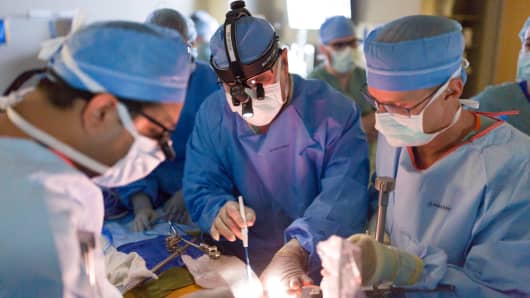
Surgeons perform a liver transplant procedure at The Mayo Clinic
Source: The Mayo Clinic
Surgeons perform a liver transplant procedure at The Mayo Clinic
Wayne Gagne a 67-year-old locomotive engineer in Nashua, New Hampshire, can attest to that. Now on hospice care, he found out he had NASH totally by accident in 2011 after going to the emergency room at his local hospital for heart problems. There doctors did a battery of tests to diagnosis his issues, including an ultrasound of his abdomen, and found he had the disease. “By then he had cirrhosis of the liver, and his only option was a transplant,” says his wife Gigi. But his heart condition precluded him from being a candidate.
“Routine checkups never revealed he had NASH,” Gigi recalls, “all the blood tests of his liver enzymes were fine, so no one knew. We just thought if he lost weight and had a healthy life style he would be OK.”
Since then Wayne has suffered with a host of complications including acities, varices in his esophagus and severe muscle loss and muscle cramps. His heart condition is worsening, another complication from NASH.
Stories like this abound. Many people fall through the cracks with no diagnosis. That’s what happened to Evans Kavallines in Lake Mary, Florida. His gastroenterologist told him he had a fatty liver in 2015, but he thought nothing of it, since he was in good health. It wasn’t until seven months ago that he reached a tipping point and his health began to slide. The 71-year-old got ascites, varices in his esophagus and severe muscle cramps. Three months later he was diagnosed with liver cancer at Mount Sinai Hospital after his family decided to take him to its Recanti/Miller Transplant Institute in New York City for evaluation.
“I feel like my hometown doctors let me down,” he says, now grateful to be on the liver transplant lists at both Mount Sinai and the Mayo Clinic in Florida. “For the most part, the medical community is not addressing this horrible disease, testing for it or offering any treatment.”
But that could change in the not-too-distant future. The race is on in the pharmaceutical industry to develop drugs to treat NASH.
“After successfully eradicating hepatitis C with a whole new class of blockbuster direct-acting antiviral drugs — i.e. Gilead Sciences‘ Sovaldi and Harvoni — this is the next big frontier in liver disease to conquer,” says Veronica Miller, professor at the UC Berkeley School of Public Health and executive director of the Liver Forum. The nonprofit is a global initiative for collaborative research among Big Pharma, physicians, regulators and academia that is trying to fast-track drug development in NASH on all continents.
Industry experts estimate the global market for these new drugs is $35 billion. Several drugs are in late-stage testing, and dozens more are in the global pipeline. BioMedtracker, a product from business intelligence firm Informa, counts 55 NASH drugs in clinical trials: 19 at Phase 1, 33 at Phase 2 and four at Phase 3.
According to medical experts, obesity and Type-2 diabetes are the major causes of NASH, but the disease can also be triggered by high accumulation of triglycerides, carbohydrates and high-fructose corn syrup.
Scientific research from the National Institutes of Health shows that “fructose is a weapon of mass destruction” that increases fatty liver disease and is poorly absorbed by the gastrointestinal tract and almost entirely metabolized by the liver, since cells don’t use fructose for energy.

Leading the drug discovery effort

Right now four companies are leading efforts to commercialize a drug to reverse the effects of NASH: Intercept Pharmaceuticals, Gilead Sciences, Allergan and French biotech GENFIT. All are in Phase 3 clinical trials.
The first to make a significant breakthrough in 2016, Intercept already has a drug called Ocaliva (obeticholic acid) that has been approved by the FDA to treat another liver disease, called primary biliary cholangitis, an autoimmune disease that can lead to cirrhosis that primarily affects women. The drug works by targeting the farnesoid X receptor, a key regulator of bile acid, inflammatory, fibrotic and metabolic pathways involved with digestion and liver function.
“It is a molecule 100 times more potent than human bile acid that amplifies the liver’s ability to regenerate,” says Dr. Mark Pruzanski, president, CEO and director of Intercept. “What we’re doing is trying to build a future without liver cirrhosis so people can avoid transplants.”
The company now is in its Phase 3 trial to evaluate the safety and effectiveness of obeticholic acid or OCA for people with advanced-stage NASH. It hopes the interim analysis of the trial will be completed in the first half of 2019. “It’s the population with the highest unmet need,” said Dr. Pruzanski, who notes he hopes after providing the FDA with the findings he can get accelerated approval for the drug.
“After successfully eradicating hepatitis C with a whole new class of blockbuster direct-acting antiviral drugs — i.e. Gilead Sciences’ Sovaldi and Harvoni — this is the next big frontier in liver disease to conquer.”-Veronica Miller, executive director of the Liver Forum
Gilead Sciences, which was the first to market Hep C drugs and capture a first-to-market advantage, is now in a late-stage study for Selonsertib in hopes it could become the first drug to win approval for treating NASH next year. It could follow up with other NASH drugs — FXR agonist GS-9674 and ACC inhibitor GS-0976. The company is hopeful that one of the combos of the drugs it is studying will advance to Phase 3 clinical trials in 2019.
Allergan is in Phase 3 of a global clinical trial of its drug, Cenicriviroc, which helps reduce fibrosis in NASH patients It has enrolled 2,000 patients to evaluate the effectiveness of the drug.
GENFIT is currently evaluating a drug called Elafibranor, which it claims reverses NASH to prevent fibrosis progression while giving patients cardioprotective benefits. It works by aiding proteins that maintain liver homeostasis and helps stop the main cells responsible for liver fibrosis. Elafibranor is currently being evaluated in a clinical Phase 3 study Resolve-It so it can get marketing approval based on the analysis of 1,000 patients after 72 weeks of treatment.

Partnering to fast-forward innovation

As efforts in drug development heat up, many companies are joining forces in the quest for treatments and a cure.
A good example is the collaboration between Pfizer and Novartis to bring together their NASH therapies in a bid to find treatments to slow the disease. The two drug titans have a clinical development agreement that includes a study combining Tropifexor, a multi-modal drug that fights inflammation, fibrotic scarring and fat accumulation and one or more Pfizer experimental medicines for the treatment of NASH aimed at steatosis, or fat accumulation in the liver.
“NASH is a complex disease difficult to treat with a single drug or compound,” says Eric Hughes, global development unit head, immunology, hepatology and dermatology. “We believe combination therapy will be the best way to tackle this condition.”
At the same time, Novartis is doing research to help the large population of people with late stage NASH and cirrhosis. It has an exclusive licensing agreement with Conatus Pharmaceuticals, a biotech focused on liver disease, to help fund the development and commercialization of a drug called Emricasan. The drug originally invented in 1998 by Idun Pharmaceuticals is a pan-caspase inhibitor that helps stop cell death and reduces inflammation associated with the disease.
“The goal is to prove the drug can stabilize the liver and then reverse the progression of cirrhosis,” says Steve Mento, president and CEO of Conatus. “The liver is one of the few organs that can regenerate. If you can stabilize it the liver can repair itself.”
Right now scientists and pharmacists are optimistic that a breakthrough in the field is just a few years away. “I think the first wave of new drugs and treatments may come two to three years from now,” says Weidong Zhong, PhD., president and CEO of Terns Pharmaceuticals, a start-up incubated by Lilly Asia Ventures focused on developing drugs to treat NASH and cancer. Dr. Zhong should know. He is an industry veteran who played critical roles in Hep C drug discovery at Gilead, Novartis and Schering-Plough.
“This is a major global problem, especially in China. In the past 20 years, obesity rates are soaring there and 43 percent of the population now has fatty liver disease,” Zhong said.
He believes a global cooperative effort among regulators, drug companies and academia is needed to fast-track a cure. The world is waiting.