Iranian Foreign Minister Abbas Aragchi has newly proposed to the US side a seven-day roadmap aimed at ending the war, while the top Iranian delegation is still in New York City engaged in deep diplomacy on the sidelines of the UN General Assembly.
Aragchi is said to be planning to stay through the weekend while waiting on a US response to the plan. So far it seems Tehran hasn't backed down from its core conditions, and its roadmap proposal is said to closely parallel the 14-point Memorandum of Understanding that was signed by President Trump back in June, but which has since completely collapsed. The plan is new but is still being largely seen as just repackaged.
"Araghchi stressed that Iran was ready to begin putting the plan into effect as soon as Washington agreed to it," Al Jazeera reports.
Interestingly, also last night Iranian President Masoud Pezeshkian told journalists, "We don't want it to get to the midterm elections." He added: "We wish Americans to return to the MoU before the midterms." Here's where things stand in terms of Iran's position being represented in New York:
- Iran's Foreign Minister Araghchi said the Strait of Hormuz can reopen if certain conditions are met by the US and that it would be better to implement before the Midterms, according to a Sky reporter.
- IRGC spokesperson warned in the event of another attack, Iran's method of defence will change including geography of the confrontation, the type of equipment and weapons used, and targets in defensive operations in line with new conditions.
This contradicted Trump's words given to the UN General Assembly during his speech. He said "They’re waiting to see how I do in the midterm election."
White House spokesperson Anna Kelly had in follow-up to Trump's address said, "The President is courageously ensuring that such an evil country never possesses a nuclear weapon, which will make the entire world safer and more stable."
Iran has said it will not be 'bullied' - but Pezeshkian appears to be offering something on the nuclear front alongside this seven-day roadmap overture, or at least according to a future timeline assuming a ceasefire is agreed to.
He explained in a Fox interview that in accord the framework of international law, Iran could give eventually up highly enriched uranium. But he was also fundamentally using the moment to highlight who is not a signatory to the Nuclear Nonproliferation Treaty - Israel.
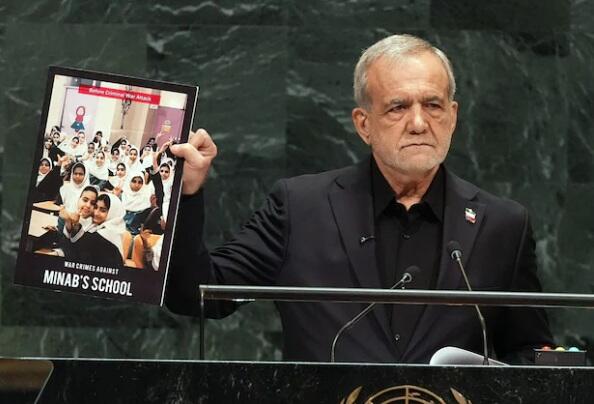
Pezeshkian further said it was up to the United States to choose when the war would end. "It's America that must choose whether it wants to end this or not," Pezeshkian said in response to a question by Fox's Bret Baier.
Tehran has meanwhile said it is ready to escalate, and even spread the war beyond the Persian Gulf region, into the Indian Ocean for example (where the UK-US have the Diego Garcia base).
Further UNGA Highlights
Recap of some of the highlights from the UN this week, via Middle East Eye:
The US-Israeli war on Iran and the Israel-Palestine conflict continued to occupy prime positions on the fourth day of the UN General Assembly. Somali President Mohamed Hassan Sheikh Mohamud said his country was "suffering" as a result of the US-Israeli war, which has driven up the price of energy and food. Meanwhile, European Union Council president said the EU supports efforts to “find a solution to the conflict". He added that "freedom of navigation in the Strait of Hormuz must be preserved without conditions and without hindrance".
Crown Prince of Kuwait Sabah Al Khaled condemned the "illegal Iranian aggression" in his address to the UN Security Council on Thursday. Kuwait was one of the Gulf states hardest hit by Iran in retaliation for the US-Israeli war on the Islamic Republic. Kuwait is home to tens of thousands of US troops and military bases. US facilities in Kuwait were attacked along with civilian sites like Kuwait airport and energy infrastructure.
Israeli Prime Minister Benjamin Netanyahu gave a pugnacious speech at the United Nations General Assembly, attacking everyone from New York City Mayor Zohran Mamdani to Turkish President Recep Tayyip Erdogan and the leaders of Western Europe, as he tried to counter Israel’s growing international isolation.
Meanwhile, hundreds of protesters took up positions around the UN headquarters before Netanyahu's arrival and continued protesting while he spoke inside. Support for Palestinian statehood and disappointment over the ongoing attacks on Gaza were repeatedly brought up during the event.
Vice President of Yemen Abdullah Abdulkader al-Alimi-Bawzer condemned the Houthis in his address to the UN General Assembly and tried to rally the global community to help fight the group. He said the government of Yemen had supported a peace initiative backed by the governments of Saudi Arabia and Oman, while the Houthis rejected it and "instead escalated their actions in the Red Sea and Bab el-Mandeb to serve an Iranian agenda".
Overnight Developments Recap
via Newsquawk
- Iran Foreign Minister Araghchi said Iran presented a proposal to US through mediators this week to reopen the Strait of Hormuz and restart negotiations towards a final deal, while it called for US to meet certain conditions within 7 days, according to CNN.
- Iranian President Pezeshkian said in Fox News interview that Iran does not want a nuclear bomb. They reached an agreement with the US President that was signed, and are still ready to move forward based on the same principles, adds it wasn't Iran that closed the Strait of Hormuz and it was open. They didn't seek war and that it was imposed on them, while they don't seek war but will defend themselves. They didn't start the war but will respond decisively.
- Iranian President Pezeshkian said Iran is ready for an agreement with the US and makes demands only within the framework of international law and could give up highly enriched uranium if it reaches an agreement with the US, according to TASS.
- Iran's President Pezeshkian said Tehran wants to revive its ceasefire memorandum of understanding with the US before the November midterm elections, saying Iran does not want talks delayed until after the vote. said:. Iran is open to inspections of its nuclear facilities and denies that Tehran is seeking to assassinate President Trump or his family.
- Iran's Foreign Minister Araghchi said the Strait of Hormuz can reopen if certain conditions are met by the US and that it would be better to implement before the Midterms, according to a Sky reporter.
- IRGC spokesperson warned in the event of another attack, Iran's method of defence will change including geography of the confrontation, the type of equipment and weapons used, and targets in defensive operations in line with new conditions.
- Iranian Brigadier General Sheikh said "we seek to expand our capabilities and reconsider our tactics and technologies", via Al Mayadeen.
- Sources say a return to the June 18 memorandum of understanding between Iran and the US is no longer sought by either side, with both seeking amendments to some clauses, further complicating negotiations, Al-Akhbar reported.
- Pakistan's Defence Minister said intensive efforts are underway to establish a mechanism for ending the conflict as quickly as possible and reopening the Strait of Hormuz, according to Tasnim.