Over 100 cases of alleged human rights violations and environmental abuses by Chinese-invested companies involved in mineral mining supply chains were identified in a recent report from the Business & Human Rights Resource Centre in London, England.
Indonesia was the worst culprit with 27 recorded abuse allegations. Peru had the second-most abuse allegations (16) followed by the Democratic Republic of the Congo (12), Myanmar (11) and Zimbabwe (7).
More than two-thirds of the allegations (69) related to human rights abuses against local communities. Over half of the recorded incidents (54) involved a negative impact on the environment. More than a third of the allegations (34) had to do with workers’ rights with a majority of them focused on health and safety risks in the workplace.
Despite the large number of recorded abuse allegations, less than 18% of the companies mentioned in the report (7 out of 39) have published human rights policies, “suggesting there is significant room for improvement in both policies and practices,” according to the study’s authors. Of the 22 companies within the critical mineral mining sector that were approached regarding these abuses, only four organizations actually responded to the allegations.
The Business & Human Rights Resource Centre provided three key recommendations that could greatly contribute to “rapid and successful energy transitions:” fair labor negotiations, human rights/social protections and shared prosperity to build trust and stability within the industry.
“As demand for transition minerals to fuel green technologies remains a global priority, the scope for human rights infringements by mining companies and their investors remains a major concern,” the report’s authors wrote. “Commitment to these principles has never been more important.”
The report analyzed 102 allegations of human rights and environmental abuses related to Chinese overseas investments between January 2021 and December 2022. In the study, the term allegation refers to publicly reported incidents of abuse by a company, civil society action against a company or attacks against human rights defenders. Impacts were organized into six categories of abuse: environmental impacts (E), local communities and attacks against civil society organizations (LC), impacts on workers (W), governance and transparency (G), security issues and conflict zones (S) and the COVID-19 pandemic (C).
College COVID vaccine mandates remain some of the most coercive mandates ever declared. While most colleges have now rescinded their mandates, some colleges refuse to let go, and Santa Clara University in California is one of the most oppressive.
In late April 2021, after most incoming freshmen had committed, SCU announced that all students were required to get COVID vaccines for fall enrollment or after full approval, whichever was later.
Then by mid-summer, SCU announced that students would be required to receive the vaccine even if it remained authorized only for emergency (EUA) and despite the fact that the CA Health and Safety Code codifies the Nuremberg Code. Section 24172 states
“(t)here is, and will continue to be, a growing need for protection for citizens of the state from unauthorized, needless, hazardous, or negligently performed medical experiments on human beings. It is, therefore, the intent of the Legislature, in the enacting of this chapter, to provide minimum statutory protection for the citizens of this state with regard to human experimentation and to provide penalties for those who violate such provisions.”
SCU (and many other CA colleges and universities) are in direct violation of this Code for removing informed consent by mandating EUA medical treatments.
Despite lack of efficacy or adequate safety data for this overwhelmingly healthy young adult population, in December 2021, SCU mandated the booster, midway through the academic year when students would have no choice but to comply or leave tens of thousands of dollars behind. SCU’s three-dose requirement remained through the 2022-23 school year.
In complete disregard for the end of the emergency declarations, in early April 2023, when most universities like nearby Stanford were announcing the end of their COVID vaccine mandates, SCU updated its requirement for incoming freshmen.
On May 8th, one week after the fall 2023 enrollment deadline, SCU quietly updated its COVID vaccine policy to require one bivalent dose for incoming freshmen (but not returning students) regardless of how many COVD vaccines they had previously taken. SCU backdated this announcement to May 1st thinking no one would take notice, but in private emails from incoming students learned that some were furious. We encouraged them to withdraw and accept another offer.
On May 31st, SCU updated its policy again. They now require either three previously taken monovalent doses or one bivalent dose for all community members. As with the University’s previous mandates, SCU offers no religious exemptions and limited medical exemptions for students even in the most extreme of circumstances as explained below. Faculty and staff, however, are permitted to request exemptions.
SCU’s policy is determined by its opaque “COVID-19 team,” believed to be led by campus physician Dr. Lewis Osofsky, who also holds several positions at Santa Clara County Medical Association (SCCMA). SCCMA partners with the Santa Clara County Public Health Department (SCCPH) to maximize COVID-19 vaccinations. Santa Clara County is one of the most vaccinated counties in the country, with more than a third having received the bivalent booster, twice the national average, and 88.5 percent having received the primary series.
Osofsky’s positions in the SCCMA include chair of the Professional Standards and Conduct committee, tasked with promoting high ethical standards for physicians and investigating disputes involving unethical conduct. This is ironic, as Osofsky is believed to be a driving force behind SCU’s ethically-indefensible mandate. Medical ethics would require, at a minimum, both transmission prevention and a proven benefit for students. An antibody increase from vaccines, with no established antibody level correlate of protection, wanes in mere weeks, and cannot support the ethics of a mandate. In fact, a recent study demonstrated that the “greater the number of vaccine doses previously received the higher the risk of COVID-19.”
It is alleged that Osofsky has improperly denied student medical exemptions. In a March 2022 lawsuit filed against SCU, Harlow Glenn, one of the student plaintiffs, claims that she had serious adverse reactions to her primary series COVID vaccines, including an emergency room visit due to leg paralysis and abnormal bleeding. According to the complaint, Osofsky refused to grant her a medical exemption for the required booster and actively interfered with her doctor-patient relationship by contacting her private doctors to persuade them to retract their medical exemption documentation.
Such aggressive tactics are nothing new for Osofsky, as he apparently employs them against patients in his private pediatric practice. Parents have complained in online reviews that Osofsky’s office forced vaccines and didn’t listen to their concerns. As it turns out, Blue Cross Blue Shield pays pediatricians in private practice a $40,000 bonus for every 100 patients under the age of 2 that they fully vaccinate, if at least 63 percent of the patients are fully vaccinated (including the annual flu vaccine).
Osofsky’s roles with SCCMA, which is in partnership with the SCCPH whose goal is to maximize COVID vaccination, as well as his aggressive private practice approach to vaccination, have likely played a large role in SCU’s continued COVID vaccine mandates.
On June 14, 2023, attorneys for the plaintiffs filed their opening brief against SCU in the Sixth Appellate District in California. It is expected that SCU will oppose the appeal and insist on its right to demand that students submit to EUA boosters to “protect the campus community.”
Protect the community? That justification went out the window long ago when CDC Director Rochelle Walensky admitted that the COVID vaccine did not prevent infection or transmission.
Recently released documents confirmed that Walensky actually knew this information in January of 2021, well before colleges announced COVID vaccination requirements.
Given that the emergency is officially over, and the shots have proven to be both ineffective and in some cases harmful, now more than ever, SCU must defend the science and ethics behind their refusal to drop them.
In the absence of such transparency, we are left to assume that Osofsky, along with SCCMA and SCCPH, must be using SCU students as mere pawns to achieve their unscientific and authoritarian vaccination goals and quotas
A pre-print review of autopsy data of more than 300 post-Covid-19 vaccination deaths was removed by the Lancet within 24 hours of its initial submission, according to cardiologist Dr. Peter McCullough, the paper’s leading author and prominent COVID vaccine skeptic.
"The government narrative is still that people do not die after COVID-19 vaccination. Now we have the largest series of autopsies, and the autopsies really are incontrovertible," he told the Epoch Times.
The paper was uploaded to the Lancet's pre-print website on July 6, only to be taken down with a note implying that the study violated the medical journal's "screening criteria."
"Pre-print servers go through a check to make sure all the elements of the paper are there, but it is not peer-reviewed by external doctors. And the preprint server simply offers people a chance to look at the data themselves and decide," McCullough told the Times Jan Jekielek. "I think that’s perfectly fair to look at the tables, look at the figures."
"Obviously, we struck a very important gap in knowledge and the world needed to know the results."
The paper was co-authored by Yale epidemiologist Dr. Harvey Risch and their colleagues at the Wellness Company, a Florida-based medical group.
The study looked at 678 published papers, 44 of which contained the 325 autopsy cases. They then used a "blind adjudication" process by which three physicians independently review all the deaths and determine whether the Covid-19 vaccine caused, or contributed significantly, to the deaths.
"We use the standard called PRISMA, where we searched for every paper possible. We sorted through hundreds and hundreds of manuscripts because deaths can be reported as different clinical syndromes are coming out after the vaccine," said McCullough.
"There were deaths where there was an auto accident or a suicide. There were some cases in nursing homes where people are on hospice and it looked like they were in their last days of life. We just couldn’t attribute it to the vaccine," he added. "But the striking cases were people who were perfectly healthy, who had no other medical problems. The only new thing in their life was a vaccine, and then they died with an obvious syndrome like a blood clot, or heart damage, or myocarditis."
"This is important because when these papers were originally published, the authors didn’t know the full breadth of safety profiles of the vaccine," McCullough continued. "Initially there were some autopsies from Germany [where] people died of blood clots shooting to lungs. The authors concluded that it wasn’t vaccine because at that time they didn’t know the vaccine causes blood clots, but we do now."
To that end, a total of 240 deaths (73.9 percent) were identified as directly due to or significantly contributed to by COVID-19 vaccination.
The most implicated organ system in COVID-19 vaccine-associated death was the cardiovascular system (53 percent), followed by the hematological system (17 percent), the respiratory system (8 percent), and multiple organ systems (7 percent), according to the paper. The mean time from vaccination to death was 14.3 days, with most deaths occurring within a week from the most recent jab.
Without further detail from Lancet, it is hard to tell exactly in which way the study’s methodology might have failed to support its conclusions. On the other hand, Dr. McCullough said they used standard methodology and did reach realistic results. -Epoch Times
"We didn’t come up with an unrealistic number. We didn’t come up with 100 percent or zero percent of deaths were due to vaccines. We came up with a reasonable number that’s defensible," he said. "In the supplemental tables, people can go through every case and decide if they agree or disagree, and that’s fair. That should be up on the pre-print server so the world can see it."
"The main thing people want is they want access to the data. They simply don’t want data censored off of the internet," he added. "We should have grand rounds on this. We should have broad internet discussions on it. People maybe want to discuss specific cases—maybe the authors [of the 44 papers] themselves want to look at it."
UPS Inc. should be prepared to lose as much as 30% of diverted volume should the Teamsters strike the company by the end of the month and a work stoppage last for a decent duration, a leading parcel consultant said Monday.
UPS handled about 18.6 million parcels in the U.S. per day in the first quarter. Under a contingency plan, it expects to handle 4 million parcels on its own. The balance of about 14.6 million parcels, most of which would be ground deliveries, would be subject to diversion.
Satish Jindel, president of consultancy ShipMatrix, said in a communique to FreightWaves that the 30% of volume that could be lost would be equivalent to more than 4 million parcels a day.
Because there are about 80,000 package car drivers and each driver delivers about 230 parcels per day, the diverted volume, if it never returns to UPS could result in 4,300 lost driver jobs and those of a few thousand package handlers for every 1 million packages diverted, he said.
Unlike the last Teamster strike in 1997, there is plenty of competition for diverted volume. For example, FedEx Corp whose ground unit didn’t exist back then, is delivering on-time performance for air and ground on par with UPS, according to Jindel. This will give shippers more confidence to keep diverted volumes with FedEx, he said.
On Sunday, the U.S. Postal Service launched “Ground Advantage” with two-to-five-day transit times comparable to FedEx and UPS. Jindel envisioned a scenario in which large shippers divert lightweight parcels under 5 pounds that can fit in a mailbox to the Postal Service and the heavier parcels to FedEx.
The potential damage to UPS and its unionized workers behooves both sides to return to the table and resume negotiations, Jindel said. Talks collapsed last week reportedly over an inability to come to terms on part-time wages. No new talks are scheduled. The current contract expires July 31.
“Being very tough in negotiations is analogous to stretching a rubber band,” Jindel wrote. “No one knows the full limit before it snaps and then one has to start all over again with a new set of conditions.”
Separately, for the minority of Teamsters union members at UPS who don’t favor a strike should a contract not be agreed to in three weeks, the National Right to Work Legal Defense Foundation on Monday issued some advice.
All UPS employees can resign their membership in the union and continue to do their jobs, according to a legal notice issued by the foundation. “If you don’t support the union you can send the union a letter resigning your membership at any time,” the notice said.
In addition, employees who resign their membership — or who are already nonmembers — have the right to work even if the union orders a strike. “Union officials can — and often do — fine union members thousands of dollars for working during a strike,” the notice said. “So you should seriously consider resigning your union membership before you return to work during a strike, which is the only way to avoid fines and discipline.”
Employees working in a “right-to-work” state, where union membership and financial support are voluntary, can resign their membership and opt out of all union financial support, according to the notice.
Employees not working in a state with those protections have the right to opt out of paying dues for union politics and may be able to avoid other union financial support, according to the notice. In non-right-to-work states, unions can still only mandate that employees pay dues as a condition of employment if the union and management have finalized a union monopoly bargaining contract that contains a valid forced-dues clause, the notice said.
About 97% of UPS’ members have voted to authorize a strike if a contract is not reached by July 31. The Teamsters represent 340,000 UPS employees, many of them part-timers.
A new Chinese study of over 300,000 people found that anemia was linked to a 56% higher risk of dementia. What's more, a new study from the University of Kansas found that iron can become "sequestered" in the brains of Alzheimer's patients, creating a deficiency that could then make the disease get worse faster.
According to the Cleveland Clinic, having iron-deficiency anemia means that your body doesn't have enough iron to make hemoglobin, a substance in your red blood cells to send oxygen through your system. It develops when your body uses up iron faster than it can be made, or when iron flow starts to slow down. Losing blood through internal bleeding, heavy menstruation, or frequent blood tests can cause iron-deficiency anemia. Pregnancy, breastfeeding, bone marrow diseases, autoimmune conditions, and not getting proper nutrition can all contribute as well. In fact, not eating enough is often how older people develop the condition.
There are a number of ways anemia could harm the brain and speed up cognitive dysfunction.
"Alzheimer's disease results in the death of nerve cells with deterioration of memory, thinking skills, and changes in behavior and personality," said Allison B. Reiss, MD, an associate professor of medicine at NYU Long Island School of Medicine in Mineola, NY, and a member of the Alzheimer's Foundation of America's Medical, Scientific and Memory Screening Advisory Board. "Lack of iron can interfere with processes in the brain that affect neurotransmitters and the formation of myelin, a protein that forms a protective layer of insulation around nerves."
The Alzheimer's Association lists being age 65 or older, having a family history of Alzheimer's, having a head injury, or having poor heart health as major risk factors for the disease. Yet anyone can have anemia, and everyone should think in terms of Alzheimer's prevention. Here's everything you need to know about anemia and Alzheimer's, and the connection between the two.
Trouble learning, speaking, reading, writing, and doing math
Problems with logic and concentration
Changes in sleeping
A hard time dealing with new situations
Not recognizing familiar people
Having delusions, hallucinations, paranoia, or behaving in inappropriate ways
Being restless, upset, or having crying spells
Saying the same thing over and over, or moving repetitively
Muscle twitches
Severe Alzheimer's symptoms may include:
Not being able to communicate
Not being aware of where you are or what you have recently done.
Loss of appetite or loss of weight
Problems with feet, skin, or teeth
Trouble swallowing
Making sounds like moans, grunts, or groans
Sleeping more
Having seizures
Losing bowel and bladder control
What Are the Symptoms of Anemia?
According to the Mayo Clinic, symptoms of iron-deficiency anemia include:
Major fatigue and weakness
Skin that's pale
Feeling lightheaded or weak, or having headaches
Chest pain, feeling short of breath, or feeling like your heart's beating fast
Cold extremities or brittle nails
A swollen, painful tongue
Craving unusual things to eat, like ice
Losing your appetite
How Is Anemia Linked to Alzheimer's?
One established theory is because of iron's essential function in providing the brain with oxygen, if iron is low, this could cause brain decline.
"The brain relies on good blood circulation to receive nutrition and oxygen. Nerve cells have a high requirement for oxygen. If a person has severe anemia, their red blood cells may not be carrying sufficient oxygen to the brain, and this will cause hypoxia (not enough oxygen for tissues) and damage the brain, especially if the hypoxia continues over a long period," said Reiss. "If a person already has dementia of any type, AD, or early stages such as mild cognitive impairment, anemia can make the symptoms worse and accelerate the destructive process. Anemia can cause changes to small blood vessels in the brain that compromise the ability of oxygen to reach all structures."And other factors can be at play, too.
"Anemia also reduces cerebral metabolism of glucose, the mechanism for energy production in the brain, and poor metabolism in the brain is a known feature of AD," Reiss said.
Inflammatory molecules in some types of anemia could also make Alzheimer's get worse faster.
"The connection of anemia to Alzheimer's is not necessarily the anemia itself, but rather the inflammation it can cause," said Kyle Womack, MD, a professor of neurology in the Division of Aging and Dementia at Washington University School of medicine in St. Louis. "Anemia may not start the cascade that causes Alzheimer's, but could be involved with the impairment."
Certain types of iron deficiency, such as anemia of inflammation, can stop your body from using stored iron to make healthy red blood cells.
If You Have Anemia, Should You Get Screened for Alzheimer's?
Israeli researchers reported that the more severe anemia an elderly person has, the higher the risk of dementia and a decline in thinking skills. Still, this study points out that mild cases of anemia should be caught so that treatment might reverse dementia risk.
"If a patient has anemia, and that person – or more commonly, a family member of that person – notices their behavior seems to be a little off, it's important to tell that person's [doctor]," Womack said. "Very often, a person with Alzheimer's will not know their behavior is changing. In such a case, anemia could be acute, so it's very important not to completely put blinders on about this – you need to act promptly."
Getting a full physical workup is vital, and cardiac testing should be an essential part of an evaluation. "Heart health and brain health are very much intertwined, and anemia can cause a lot of damage to the heart and cardiovascular system which, in turn, can be unhealthy for the brain and lead to worsening of dementia," said Reiss.
A patient should also be tested to find out if, and/or how, they are losing blood.
The good news: Treatment for anemia can be easy. Your doctor can revamp your diet so you're eating iron-rich foods such as more meat, fish, poultry, leafy greens, beans, yeast-filled bread products, and iron-enriched cereal, pasta, and bread. Iron supplements can also make a big difference in correcting anemia, and potentially stopping cognitive damage.
As Reiss sums it up: "While there is no cure for AD, treating anemia and implementing lifestyle changes to optimize brain health may be helpful."
Sources
Allison B. Reiss, MD, associate professor of medicine, NYU Long Island School of Medicine ,Mineola, NY; member, Medical, Scientific and Memory Screening Advisory Board, Alzheimer's Foundation of America.
Kyle Womack, MD. professor of neurology, Division of Aging and Dementia, Washington
In early June, Elon Muskwroteon Twitter that it “won’t be long before there are class-action lawsuits by shareholders against the company and board of directors for destruction of shareholder value,” referencing the rise of corporate wokeism and so-called “environmental, social, and governance,” or ESG policies.
The prospect held out by Musk is one that, according to former Assistant Secretary of State and experienced litigator and congressional counsel Robert Charles, could indicate a coming flurry of lawsuits against individual board members and directors for breaching their fiduciary duty to shareholders. In an interview with AMAC Newsline, Charles said that the recent spate of boycotts against woke corporations such as Anheuser-Busch and Target are not enough on their own, and litigation should also be on the table.
Shareholders should “pierce the corporate veil,” Charles said, by taking aim at members of the corporate boards themselves—arguing that in some cases, board members should be held personally liable for violating their legal obligation to act in the best financial interests of their shareholders.
As Charles explained, that process begins with a company’s Directors & Officer’s (D&O) insurance policy. “The board of directors is directly accountable to the owners of the company—and that includes the shareholder,” he said. “The irony is, having looked at many D&O insurance policies over the years… I would bet you two to one that there is not a protection in some of these policies” for directors who decide to use the pulpit of their companies to pursue their own ideological goals.
“As a shareholder, you have a right to knowledge about how the company is operating—because you are the party to whom the fiduciary duty is owed,” Charles said. “So, the first thing is: counsel for shareholders, or shareholders, should get a hold of the D&O insurance policies and study them… and see whether they realistically do or don’t protect the directors of the company from personal liability for acting in a way that is realistically interpreted as inconsistent with the way they acted previously, which was to make money for the investor.”
“The second thing is, then, to set out a colorable claim—or multiple claims—against both the company and the directors who have taken it upon themselves to essentially divert your resources into a political act that falls outside the bounds of reasonable expectations of an investor,” Charles continued. Although he noted that companies could make the legal defense that shareholders granted them consent to exercise their own judgment on behalf of the public good, Charles stressed that there are limits to a company’s freedom, comparing a company’s duty to its shareholders to a game of bowling.
“You can’t have a director bowl in the opposite direction or keep guttering the ball if the goal is to hit the pins. And so the bottom line here is if these directors—or any one of them—is vocal in board meeting minutes about the fact that they want to divert money to their personal political agenda, and this is not really being articulated to the investors, then I think you could make the [legal] argument that there’s been a breach of trust—that there’s been a breach of fiduciary duty.”
The next step, Charles said, comes down to finding the best jurisdiction to bring the case. “All you really have to do at that point is find the right jurisdiction that is sympathetic to shareholders, and then file to see if you can get some accountability on the part of these directors personally for their behaviors,” he explained.
Should these lawsuits succeed, Charles said, one of two things is likely to happen. “Once you get one or two directors to resign—or one or two directors to be held personally liable… there’s either going to be a rush by these corporate counsels to go get ESG integrated into their policies,” which could upset shareholders, or “you’re going to find [the companies] having to pay huge amounts of money” because they have breached their fiduciary duty to shareholders.
Though Charles emphasized that this approach has not yet been tested in the legal arena, he suggested it is likely worth trying—and even if initially legally unsuccessful, it could make a splash in corporate boardrooms. “Once one or two companies [or directors] gets sued that way,” Charles said, it could open up a Pandora’s box that sends corporate wokeism into a tailspin.
While Charles made clear that, at present, there is likely no “open-and-shut” case that would allow shareholders to hold left-wing companies and directors to account in a surefire way, carefully pursuing this innovative legal strategy could finally begin the process of restoring a politically neutral corporate culture.
The sudden prospect of shareholders targeting the private wealth of corporate bigwigs is sure to grab their attention. “I think the interesting part is that it really will cause A-frame decision-making on the part of these firms,” Charles said. “They will either decide that actually making money is what they were incorporated for… or, they will have to rewrite their D&O policies—which is going to cost them a lot of money—to avert lawsuits based on people disappointed in the way they’re behaving.”
Charles concluded: “Basically, what this boils down to is… a constant effort to keep accountable those in positions of authority”—and an effort to maintain trust that our nation’s centers of power are working to advance the cause of liberty rather than encroach upon it.
The future of American freedom could very well depend upon a restoration of this trust—and as the fight for freedom continues, shareholders will have a vital role to play.
When I learned that an alleged shoplifter was stabbed to death Thursday by a drugstore clerk in Times Square, I was surprised only that the killing had happened at the CVS at Broadway and 49th Street, not at the Duane Reade at Broadway and 50th Street. Over more than three years, since New York’s criminal-justice “reforms” collided with pandemic dislocations, this stretch of Broadway and the surrounding blocks and subway stations have become a magnet for disorder and danger. That a nearby resident—me—must weigh up the relative dangers of shopping at or even walking by one store rather than the other says a lot about New York’s deterioration.
The numbers show that supposedly minor shoplifting has become a crisis, one stemming from changes to New York criminal law and in how New York prosecutes that law. In 2019, the New York legislature and then-governor Andrew Cuomo reformed state criminal-justice laws to ensure that virtually no repeat shoplifters, whether suspected or convicted, go to jail awaiting trial. In 2022, new Manhattan DA Alvin Bragg said that no matter what the law said, he wouldn’t prosecute shoplifting, anyway. A person who “shoplifts and makes a minimal threat to a store employee while leaving . . . pose[s] no genuine risk,” he directed staffers upon taking office.
Since then, petty theft has exploded in New York’s Midtown North precinct, where both the Duane Reade and the CVS are located. In 2019, for the first half of the year, Midtown North recorded 979 petit larcenies (generally, shoplifting of minor items). By last year, they had reached 1,161, and this year, they are at 1,331.
That’s a 36 percent increase over four years, which is alarming enough—but it also far understates the case. For the first half of this year, for example, the NYPD’s supposedly handy CompStat map shows exactly one petit larceny at the Duane Reade corner of Broadway, and exactly one at the CVS corner of Broadway a block south, on June 6 and February 3, respectively.
These numbers defy reality. Conservatively speaking, a petit larceny happens at each of these locations at least once a day; more realistically, the rate is likely closer to hourly.
Moreover, the numbers can’t show how this shoplifting amnesty has contributed to Midtown West’s decline in public safety, public order, and just plain livability over the past few years. Until last year, the northern area of Times Square was home to three competing drugstores. Until early 2020, all three were unremarkable, serviceable locations. They were ubiquitous chain drugstores: a Rite Aid at Eighth Avenue and 50th Street, a decades-old mainstay; the Duane Reade a block east, another longtime fixture; and the CVS, the newest addition, a block south. You went in, grabbed what you wanted off the shelf, whether it be toothpaste or nail clippers, exchanged pleasantries with the clerk while paying, and left. Maybe you just ran in to use the ATM to get cash.
Early in the pandemic, going to the Rite Aid, the store closest to me (almost directly underneath my home), stopped being an unremarkable experience. The store started locking everything up. I had to ask the clerk to unlock the deodorant, then the toothpaste. Maybe the store had always had a security guard, and maybe, like most retailers before 2020, it hadn’t; I had never noticed either way. Now, there he was, firmly and conspicuously stationed at the sliding doors.
His presence wasn’t enough to deter mass shoplifting. By early 2022, the store, plagued by profit-killing theft, had shuttered. It remains a half-block empty hulk, a vast space outside of which vagrants can panhandle and sleep unmolested by commercial activity. One of its glass doors is now covered by a formidable metal security gate.
After the Rite Aid closed, the Duane Reade at 50th and Broadway became the drugstore closest to my house, 450 feet away. Walgreens, which owns Duane Reade, a 63-year-old New York institution, is doing its best, and the clerks at the Duane Reade are friendly and polite under trying circumstances.
But this store, too, has become a no-go zone. It’s not uncommon—or, at least, it wasn’t last year, when I gave up on going there—to see two shoplifters simultaneously going about their business, casually stealing energy drinks or ice cream to resell. Sometimes, the security guard would, understandably, just watch; sometimes, he would say something like, “You know you’re not supposed to be doing this”; sometimes, he would head off a presumably known repeat thief before he entered the store.
It’s a good idea, as a customer, to give shoplifters a wide berth. They tend toward paranoia, even if you have no intention of attempting to make a citizen’s arrest or calling 911. They’ll snarl or mutter at perceived witnesses nearby. You may have to wait a few minutes in their presence while the clerk unlocks some item that you want to buy.
Even try to use the ATM just inside the store, and you’ll notice someone lurking behind you, calculating the risk-benefit analysis of whether he’ll get away with grabbing your cash. Experience this often enough, and you’ll stop using the ATM.
It’s even gotten iffy just to walk by the Duane Reade: a disorderly environment creates danger, and vice versa. The building housing the store has been covered in scaffolding for years—long predating the pandemic—despite no apparent construction going on, and despite city laws governing how long scaffolding can stay up.
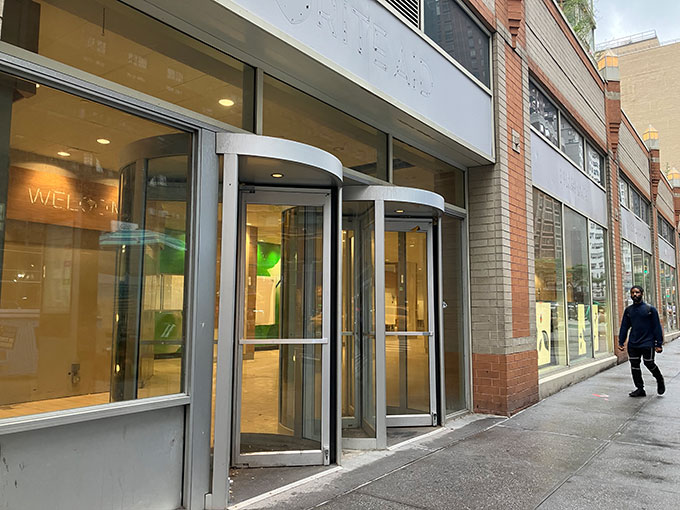
Just three days after a killing stemming from disorder, New York allows that disorder to fester, with illegal vendors blocking the CVS entrance. (Photo courtesy of the author)
The scaffolding provides a handy shelter for the shoplifting crowd, for illegal vendors of counterfeit luxury pocketbooks and watches, and for other vagrants. Last weekend, a man sat underneath, nodding off in a discarded office chair; another lay slumped on the sidewalk. The area is constantly littered with trash, either discarded by vagrants or dumped from nearby trash cans as scavengers look for something valuable. The vagrants, all men, argue with each other, with the Duane Reade guard, and with other area denizens.
The criminals now attracted to the area can become violent. A year and a half ago, I walked through the aftermath of a non-fatal stabbing at this corner, when a street vendor suffered injury as he fought back against an armed robber. Bloody clothes added to the area litter. This past Sunday, when I took pictures of this disorder from several feet away, a counterfeit-goods vendor approached me, tried to grab my phone, and snarled at me to leave (I did).
The subway stations nearby now serve as arrival and departure conduits for those attracted to Times Square’s rich pickings of drugstores—thieves to earn cash, drug dealers to buy drugs with such cash. The stations have become more violent. Earlier this year, a drug addict randomly attacked a man at the 50th Street E train stop.
And last Thursday, all this resulted in a death, ironically at the one area drugstore that has managed, throughout the chaos, to maintain a clean, pleasant, orderly environment. Since the Rite Aid closed and after several bad experiences in the Duane Reade, I have used the CVS at 49th Street every time, even though it is farther away. It has seemed more like a normal, pre-2020 drugstore.
A near block-long former Rite Aide, closed by rampant theft, sits empty at Eighth Avenue and 50th Street. (Photo Courtesy of the author)
Last Thursday, though, just after midnight, 50-year-old Charles Brito entered the CVS, allegedly stealing energy drinks. In doing so, Brito repeatedly punched a 46-year-old store clerk, Scotty Enoe, according to Enoe’s account. Enoe stabbed him to death. Now, Enoe, a gainfully employed man who reached middle age with no criminal record, faces a murder rap. He sits at Rikers Island on a $100,000 bail request.
His case is just the latest in at leastfourkillings over late spring and early summer in which the accused killer has claimed self-defense in a violent incident stemming from supposedly minor disorder. In two of these cases, grand juries have agreed with the self-defense claims, declining to indict the accused killers; a third defendant, Daniel Penny, who killed Jordan Neely, a severely mentally ill and disruptive homeless man, on a subway in May, awaits trial.
New York City could have prevented all four of these crimes by doing what it used to do: policing disorder before it escalates to violence.
Brito, the deceased individual in the CVS case, was well known to police and prosecutors. Days before his stabbing death, police had arrested him for shoplifting at a different CVS; he was stealing $125 of items, most likely to resell. This year, Brito had repeatedly stolen small items from Manhattan CVS stores, only to be released, either on low or no bail. In January, Brito violently snatched a purse from a woman walking on Sixth Avenue in Midtown, but he was set to serve no jail time in a plea bargain in that case. The 49th Street CVS at which Brito met his grim end was familiar to him; Enoe’s lawyer claims that Brito had repeatedly threatened employees when they tried to prevent him from stealing.
Progressive architects of New York’s post-2019 criminal-justice regime, from state lawmakers to DA Bragg, claim that they want to keep minority men out of prison. Now, one is dead, and another sits in a failing jail, hoping that a grand jury refuses to indict him for murder. This is progress?