Search This Blog

Wednesday, July 12, 2023

Secretly Stealing Everything': Google Hit With Lawsuit Over New AI Data-Scraping Privacy Policy

 by Savannah Fortis via CoinTelegraph.com,

A week after Google updated its privacy policy to allow data scraping for AI training purposes, the company faces a class-action lawsuit...

Google is now facing a lawsuit following its recent privacy policy update that accuses the tech giant of misusing large amounts of data, including copyrighted material, in artificial intelligence (AI) training. 

The class-action lawsuit was filed on July 11 by eight individuals who claim to represent “millions of class members” — internet users and copyright holders — who have had their privacy and property rights violated in light of Google’s recent updates to its privacy policy.

In its opening statement, the plaintiffs accuse Google of “harvesting data in secret” to build its AI products without consent.

“It has very recently come to light that Google has been secretly stealing everything ever created and shared on the internet by hundreds of millions of Americans.”

Google’s privacy policy changes now allow it to take publicly available data for artificial intelligence (AI) training purposes.

The lawsuit points out that Google’s decision not only violates rights, but gives it an “unfair advantage” compared with its competitors, which lawfully obtain or purchase data to train AI. Ryan Clarkson of Clarkson Law Firm, the plaintiffs’ attorney, said in a statement that:

“Google must understand, once and for all: it does not own the internet, it does not own our creative works, it does not own our expressions of our personhood, pictures of our families and children, or anything else simply because we share it online.”

The plaintiffs argued that “publicly available” does not and has never entailed that it is “free to use for any purpose.”

According to the lawsuit, Google could potentially owe upward of $5 billion in damages. It also requested a court order requiring Google to obtain users’ explicit permission first. 

This includes allowing users to opt out of its “illicit data collection,” along with the ability to delete already existing data or provide “fair compensation” to owners of the data.

Earlier this week, author and comedian Sarah Silverman, together with two other authors, filed a lawsuit against ChatGPT maker OpenAI and Meta for their use of copyrighted work without permission in AI training. 

Prior to that, OpenAI was hit with another lawsuit for alleged data scraping.

https://www.zerohedge.com/technology/secretly-stealing-everything-google-hit-lawsuit-over-new-ai-data-scraping-privacy-policy

Fresenius started at Buy by Goldman

 Target 56 euros

https://www.marketscreener.com/quote/stock/FRESENIUS-MEDICAL-CARE-AG-436087/news/Goldman-starts-FMC-with-Buy-Target-56-euros-44317031/

Quality of new cars has never been worse: "They are being developed too fast"

 Research institute J.D. Power revealed that there have never been so many technical problems with new cars as there are now. Business AM asked for an explanation from Jorrit van der Valk of Menquiry.


The gist: Car brands are in a competition where they sometimes move too fast. While in the United States these developments are already more readily available to consumers, in Europe, in particular, legislation lags behind.

  • "Often car brands want to be vanguard with new updates and new models. But also particularly with their technology. Some come out with a fully , others with an advanced lane departure system where the car can change lanes but also still stop at traffic lights," van der Valk says. "These things are being developed a little too quickly because brands want to outdo each other like an arms race. And that doesn't always go well."
  • "Tesla has a full self-driving package. That's a 10,000 euro option. Your car then stops at traffic lights and takes turns on the highway itself. Only: it's a beta, so you're a beta tester for Tesla. Those kinds of systems are so terribly complicated."
  • "In the United StatesGeneral Motors works with Super Cruise. Those are satellite-read roads, especially interstates and highways, on which the car can really drive all by itself. It's an option on the Chevy Tahoe, for example. We definitely don't know that here in Europe yet."
  • "It will be some time before we will use fully self-driving cars in Europe. That has to do not only with , but also with the legislations, both national and European. There are political debates to be had about that first. Because imagine having different rules in each country about what is and is not allowed," van der Valk points out.

Merck gives €500k prize to pandemic early warning system

 The developer of a sensor designed to continuously monitor indoor spaces for pathogens that could cause pandemics has been given a €500,000 prize by Germany’s Merck KGaA in the company’s annual Future Insight competition.

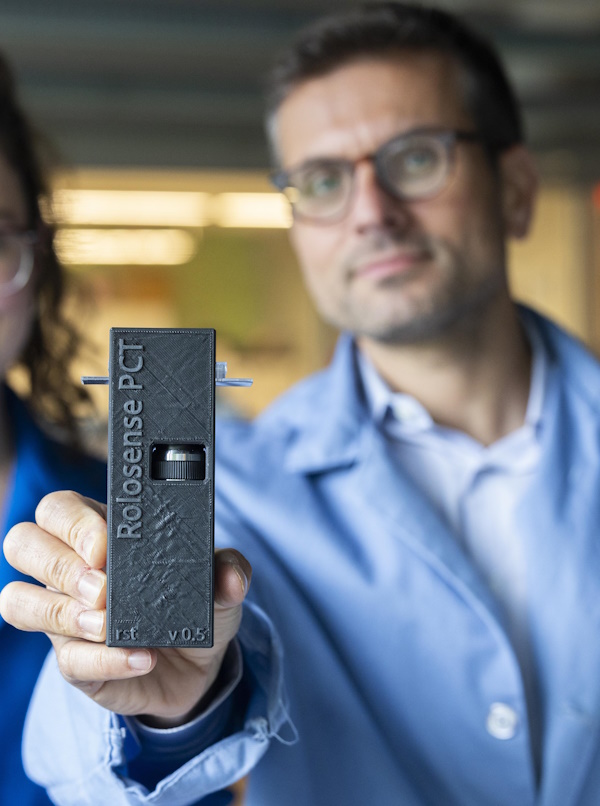
The award to Khalid Salaita, professor of chemistry at Emory University in the US, will go towards the next stage of research into the Rolosense technology, which has already been shown to detect SARS-CoV-2 and influenza A in early testing.

According to Salaita, it has the potential to help mitigate or possibly even prevent a future pandemic. Theoretically, it could be programmed to simultaneously screen for a wide group of viral pathogens within a breath sample or from indoor air.

“Our ultimate goal is to develop automated viral air sensors that function similar to smoke detectors,” said Salaita. “These sensors could be located in busy locations like airports, hospitals, and schools to continuously monitor aerosolised particles for viruses.”

Rolosense prototype device
Prototype Rolosense device

Rolosense is based on micron-scale, low-cost ‘DNA motors’, which can sense chemical or genetic information in the environment, process the signal, and generate a response and were first described by Salaita’s lab in 2015.

The motors are made from DNA-coated spherical particles that move in response to a stimulus, with the resulting readout detectable using a smartphone camera in minutes, with no sample preparation required.

The motors can be programmed to look for pathogens, but have myriad other potential applications, including other forms of biosensing like medical diagnostics, molecular computing, creating synthetic cells, and testing molecular structure-function relationships at the nanoscale.

“The importance of being prepared has been a key lesson from the COVID-19 pandemic,” said BelĂ©n Garijo, Merck’s chairman and chief executive.

“There are many promising collaborations to build an inclusive global framework for pandemic preparedness, but we still lack an effective early warning system to detect potential threats before it is too late,” he added. “The pioneering work of Khalid Salaita could help fill this urgent gap in our global defences.”

The Salaita lab researchers said their goal is to have viable products available to provide rapid ways to detect airborne viral pathogens within five years.

Some scientists estimate that the world could face a pandemic or serious outbreak at least once every five years from here on, with some warning that we are no better prepared for a pandemic than we were before COVID-19.

https://pharmaphorum.com/news/merck-gives-eu500k-prize-pandemic-early-warning-system

Merck asks court for summary judgment in lawsuit against administration

 A major American pharmaceutical company fighting the Biden administration's drug pricing scheme is digging its heels in and wants a court to rule on the case without a trial.

Merck & Co. first filed a lawsuit last month against the Department of Health and Human Services (HHS) and Centers for Medicare and Medicaid Services (CMS) to challenge the Drug Price Negotiation Program established last year when Congress passed the Inflation Reduction Act (IRA).

Merck says the program doesn't involve real price negotiations and forces manufacturers to either negotiate a lower price with the government or be subjected to a staggering tax.

"The Program … uses the threat of enormous monetary penalties to compel manufacturers to provide Medicare beneficiaries with 'access' to their drugs at whatever discounted price the Government, in its unreviewable discretion, selects," Merck alleged.

"It then disguises those forced transfers as the product of a negotiated agreement, to deceive the public into thinking the manufacturers have 'agreed' that these prices are ‘fair,' and thereby to conceal the reality of the Program’s radical central-planning approach (and concomitant harms to future innovation)."

On Tuesday, the New Jersey-based company filed a motion for summary judgment that asked the court to rule on the "undisputed" fact that the program violates both the First and Fifth amendments of the Constitution.

A motion for summary judgment is a request to the court to decide on the case without a trial.

placeholder

Merck says that despite the program's name and efforts by the government to say it engages in good faith negotiations with the company to lower costs for consumers, the "program involves no genuine negotiations and no voluntary agreements."

"This is not 'negotiation.' It is tantamount to extortion," the company argued.

Merck said the program violates the takings clause of the Fifth Amendment of the Constitution because it "uses coercive sanctions to seize discounted goods for the pecuniary benefit of the Government."

The company also argued it violates the First Amendment by forcing the company to say that prices are fair.

"[C]onscripting companies to conceal unpopular price-setting is exactly the parroted orthodoxy that the First Amendment’s compelled-speech doctrine is meant to forbid. If the Government wants to justify turning American drug innovators into the equivalent of public utilities, it must do so using its own voice, not by forcing the industry to feign agreement," the filing said.

The White House has maintained the government will win the lawsuit and that "there is nothing in the Constitution that prevents Medicare from negotiating lower drug prices," according to White House press secretary Karine Jean-Pierre.

But legal scholar Josh Blackman at South Texas College of Law Houston says the program is "likely unconstitutional."

"The federal government cannot force the pharmaceutical companies to 'sell' their patented drugs. This new top-down government mandate borders on extortion and is likely unconstitutional. Now, the court will have an opportunity to see if the federal government can forcibly reorder pricing in the marketplace," Blackman said.

The motion was filed in federal court in Washington, D.C.

https://www.foxbusiness.com/politics/merck-battles-bidens-drug-price-scheme-radical-central-planning-extortion

Centene cut to Peer Perform by Wolfe

 From Outperform

https://finviz.com/quote.ashx?t=CNC&p=d

Elevance cut to Peer Perform by Wolfe

 From Outperform

https://finviz.com/quote.ashx?t=ELV&p=d