Independent investigative journalist Nick Shirley spent the better part of a year investigating alleged fraud at nonprofits accused of diverting taxpayer funds meant for immigrant services. California responded by passing a law that makes it harder to look at those nonprofits at all. Now he is suing to have that law thrown out.
Shirley filed a federal lawsuit against the state of California on September 4, arguing that Assembly Bill 2624, nicknamed the Stop Nick Shirley Act, violates his First Amendment rights by restricting his ability to investigate and report on immigration-related service organizations. Critics gave the bill a blunter name months ago.
Gov. Gavin Newsom signed AB 2624 last month. The law, which doesn’t take effect until October 1, 2027, expands California's existing Safe at Home program, a shield the state originally built for domestic violence survivors, to cover nonprofit employees who help people navigate the immigration system.
Anyone who distributes information or images of a covered worker under circumstances the law defines as inciting violence or threats faces a penalty of $4,000.
“Now, in a world where we all want more transparency and not less, it is more critical than ever that we do not just sit back and do nothing,” Shirley asked in a video posted to X announcing the lawsuit.
“That is why I am filing this lawsuit against the State of California. Because why would they create a law that pushes for less transparency when all we want is more transparency, especially when it comes to our tax dollars being defrauded? And why specifically make immigration support service providers a protected class inside of California?”
Under the law, a worker at a covered organization, or an entity acting on their behalf, can submit a written demand blocking publication of certain identifying information about them.
Shirley and other critics say that provision hands anyone under scrutiny a built-in kill switch for the story, and thus any accountability for fraud.
According to the bill’s language, "A program participant or an individual entity or organization authorized to act on their behalf may make a written demand to a person, business or association to not publicly post or publicly display, disclose, or distribute on the internet the personal information or image of the program participant," he said, reading from the statute.
"California has decided to push for less transparency and create laws that penalize citizens and journalists for looking into potential fraud inside 'immigration support services providers,'"Shirley wrote in the X post announcing the suit.
Shirley traces the bill's origin to January 31, when he announced that he was in California investigating alleged fraud.
Days later, Newsom said the San Diego Somali community felt "under siege" from what he called "right-wing provocateurs," a comment Shirley says was about him. On February 5, California Attorney General Rob Bonta held a news conference dismissing the fraud allegations, calling them "reckless, false, outrageous, and ridiculous."
Fifteen days later, Assemblywoman Mia Bonta, who happens to be married to the attorney general, introduced AB 2624.
"They needed the Stop Nick Shirley Act, AB 2624, to protect the fraud and stop people from exposing these locations inside of immigration support providers," he said.
The bill's text defines immigration support service providers broadly enough to include legal services, healthcare, and nonprofits generally, and one of the organizations that helped push the legislation has itself pulled in tens of millions of taxpayer dollars for immigration legal work in the state. Shirley's history with this beat predates the California fight.
Shirley's lawsuit does not seek monetary damages.
“We're not suing for a single dollar,” he explained. “We're suing simply on the fact that they're taking away your First Amendment, right with this new law. In fact, I might spend months, I might spend years fighting this lawsuit for so long, think about it for so long. These corrupt politicians have been able to push and shove us around and receive no consequences for their actions.”
Yemen’s government forces said they retook positions and repelled Houthi infiltration attempts across several fronts amid renewed fighting.
The military’s media center said troops regained positions in al-Kadha, west of Taiz, and established new positions south of Hodeidah following a Houthi attack from three directions in the al-Barh area.
Government forces also repelled an infiltration attempt on the al-Dhabab front in Taiz, with the military claiming more than 20 Houthi fighters were killed or wounded.
The National Pharmacy Association (NPA) is calling on the NHS and police to respond more robustly to what it says is escalating crime against pharmacies, warning that the current response is inadequate and disproportionate. The NPA represents around 6000 independent community pharmacies across the UK.
While reports of thefts from pharmacies are part of a wider trend of escalating retail crime, shop thefts, and town centre antisocial behaviour, the NPA said that pharmacies were in a particularly vulnerable position. As "the front door to the NHS," pharmacies are highly accessible to patients.
They often have extended opening hours compared with neighbouring shops, business premises, or primary care facilities. Their stock includes valuable prescription medicines and some controlled drugs.
Why Pharmacies Are More Vulnerable
This means pharmacies are at higher risk for law-breaking, especially burglaries and break-ins with attempted thefts of prescription medicines, and regular shoplifting. Staff members are more vulnerable to aggressive or violent behaviour, including assaults. Pharmacies are not like other shops on the high street, the NPA said.
An NPA survey of around 400 pharmacies across the UK found that in the last year, 89% had experienced shoplifting, 11% had experienced burglaries involving attempted theft of prescription medicines, and 21% reported criminal damage. In addition, 78% had seen staff harassment, 35% had seen staff members assaulted, and 3% had witnessed sexual assaults on staff.
Most Say Police Response Is Inadequate
Almost 1 in 3 pharmacies had chosen not to report incidents to the police, largely citing concerns about response time. Of those who did report crimes, 93% said they received an "insufficient response," and many told the NPA that reports of shoplifting were not prioritised.
Some said they were offered only a crime reference number for low-value items, with one pharmacy being told that they would be contacted within 2 weeks. One anonymous contributor commented that staff continually dealt with abuse from members of the public, who often acknowledged that their frustration lay with other healthcare providers, "but as we are the most accessible profession, we bear the brunt."
Even though pharmacies receive around 90% of their income from the NHS, they receive no funding for security improvements. Pharmacies often have to resort to providing their own security measures, and NPA members noted that spending on costly entry and exit systems, security staff, and panic alarms came at the expense of investing in new services for patients.
The NPA is calling on the NHS to provide security arrangements and funding for pharmacies as it does for GPs, and for police to provide a stronger response and prioritise pharmacy-related crimes.
NPA Chair Olivier Picard said in a press release that the survey results were "very worrying" and showed the lack of support for pharmacies when they report what can be long-running, costly, and serious crimes to the police. The association was concerned that police did not have the resources to tackle such crimes adequately.
"Pharmacies are not like ordinary shops on the high street,” he said. “Not only do they provide a vital health service to their patients, but they also stock prescription medicines. Theft of medication from a pharmacy, such as strong pain relief or benzodiazepines, could have serious consequence for someone’s health."
At a recent party, synthetic chemistJohn Moses, PhD, ended up next to a clinician. He asked her how the fight against antibiotic-resistant infections was going. She described the situation as "devastating."
John Moses
"She's really up against it and doesn't have options," Moses said. His lab — part of the Cancer Center at Cold Spring Harbor Laboratory in New York — builds molecules through click chemistry reactions. One of those molecules, synthesized during a project that didn't originally have a connection to infectious disease, restored vancomycin's ability to kill vancomycin-resistant Enterococcus faecium (VREfm), one of two species under the VRE umbrella.
E. faecium colonizes the gastrointestinal tract of immunocompromised patients, particularly transplant recipients and those undergoing chemotherapy. It forms biofilms on catheters, heart valves, and intestinal epithelium, making it difficult to clear once established. Many of its strains are resistant to vancomycin, often the last reliable antibiotic standing between a vulnerable patient and a bloodstream infection that precludes life-saving procedures — an outcome often fatal.
But a recent study published in Nature Communications, led by teams at Scripps Research in La Jolla, California, and in Cold Spring Harbor, with Moses and chemist Howard Hang as senior authors, shows how to combat this protean pathogen. Using click chemistry, a class of fast, highly reliable reactions that snap molecular components together like modular building blocks, Moses's group had built a library of hundreds of small molecules. The Scripps team screened them against SagA and identified a compound called pghi-4 that disables the enzyme, so the old, workhorse drug can bind again.
"I think we can re-engineer antibiotics, existing antibiotics, and endow them with new function," Moses said, referring to the broader strategy of using click chemistry to modify or supplement drugs already in clinical use rather than starting from scratch.
The need for a solution is growing. Antimicrobial resistance contributes to millions of deaths worldwide. Against VREfm, the shelf is nearly bare. Linezolid is the only widely available FDA-approved antibiotic for the infection, and it has limitations that make many clinicians hesitant to rely on it for severe bacteremia. "Most clinicians use other drugs that are not even approved for that indication," said Cesar A. Arias, MD, MSc, PhD, chief of the Division of Infectious Diseases at Houston Methodist Hospital in Texas, who was not involved in the study. "But you don't have any other choices."
It's harder to know whether vancomycin's restored potency is large enough to matter, whether VREfm will find a way around it, and whether a compound like this can survive the economics of antibiotic development.
Stripping a Bacterium's Armor
Vancomycin works by binding to a specific peptide target on a bacterial cell wall and physically jamming its intricate construction. The cell wall is held together by cross-linking peptide chains. The drug grabs onto the end of a short peptide chain, D-alanine-D-alanine, that anchors the cross-links, and forms hydrogen bonds. The bonds effectively cap the wall so it can no longer be properly assembled. Pressure builds up inside the bacterium. Eventually, it bursts through the unfinished wall.
But resistant strains of bacteria make a single chemical substitution at that target, replacing D-alanine with D-lactate, and through resultant chemical changes, the drug is repulsed by its target. Vancomycin's ability to bind plummets 1000-fold.
E. faecium carries virulence factors that degrade host proteins and tissue, and its aggregation machinery allows it to pass resistance genes directly between cells, accelerating the spread of resistance within a patient and across a hospital.
The clinical predicament runs deeper than a single failed drug. Enterococci are intrinsically resistant to cephalosporins, trimethoprim-sulfamethoxazole, and other common antibiotics, which means clinicians start with a narrow set of options even before resistance enters the picture. Once vancomycin fails, the shelf contracts further, and resistance is now creeping intodaptomycin and linezolid — drugs once considered reliable last-resort agents.
Madison Stellfox
"You may only have one or two options left," said Madison Stellfox, MD, PhD, an assistant professor of infectious diseases at the University of Pittsburgh School of Medicine, who was not involved in the study. A significant share of patients, especially transplant recipients and those on immunosuppressive therapy, develop recurrent infections, cycling back every few months with fewer weapons each time.
But the team at Scripps had figured out a simple solution to the bacterium's defense mechanism: Delete the gene for the enzyme SagA, which the bacterium relies upon to reshape its cell wall and bury binding sites for vancomycin. When the Scripps team deleted the gene for it to stop its production by the bacteria, those vancomycin binding sites stayed exposed and the drug regained potency, even in strains still carrying the resistance machinery. Without SagA, the bacterium's grip on resistance loosened, enough for vancomycin to find its footing again.
A Chemistry Expedition
That was one half of the solution, according to Moses: "What they didn't have was a chemical way to knock it out."
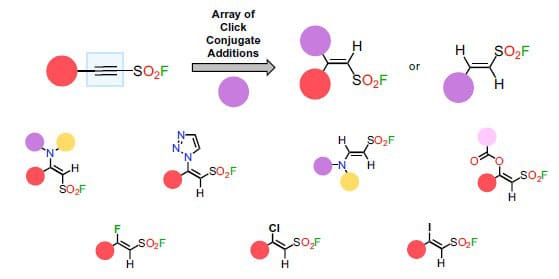
After all, deleting a gene in a petri dish doesn't count as therapy. The Scripps team needed to deliver a molecule. Across the country, three dozen miles east of New York City, Moses's group had been developing a click chemistry platform that generates structurally diverse small molecules by attaching different molecular modules to a shared reactive hub. The resulting library held more than 600 compounds.
The Scripps team screened them against SagA. Five hits emerged from the screen, all from one chemical family — β-chloro alkenyl sulfonyl fluorides originally synthesized as part of a click chemistry library Moses built with Nobel laureate K. Barry Sharpless to find covalent inhibitors of an enzyme involved in cystic fibrosis, not infectious disease. The most active compound, pghi-4, disables SagA by bonding covalently to the enzyme's active site, though the adduct is not permanent; it degrades over hours as hydrolysis products accumulate.
A single molecular hub (top left) generates structurally diverse compounds through click chemistry reactions. The chlorine-bearing family (Cl, bottom row) is the class from which pghi-4 was identified.
In a mouse model of VREfm sepsis, neither vancomycin nor pghi-4 cleared bacteria from the spleen or liver when given alone. But when the two were co-administered — vancomycin at a clinical dose of 100 mg/kg and pghi-4 at 25 mg/kg, with a second dose at 24 hours — the combination significantly reduced both bacterial burden and weight loss over 48 hours.
"We didn't design [pghi-4], the molecule came from a chemical expedition," Moses said. "I could never have predicted the SagA inhibition, not in a million years. But should we limit it to what humans can predict?"
Moses's group had already taken one pass at vancomycin resistance. A 2023 PNAS paper described vancomycin dimers connected through a continuously rearranging carbon cage, "almost like putting a Rubik's cube in between two vancomycins." Bacteria could barely develop resistance against them.
But this SagA inhibitor project is a different wager: leave the drug untouched but take away the bacterium's defense.
"It's not an antibiotic itself, but it's an antibiotic booster," said Stellfox.
In a checkerboard assay, the combination reduced vancomycin's minimum inhibitory concentration (MIC) by up to eightfold in VREfm strain ERV165. Across a broader panel of genetically distinct clinical isolates, the effect was consistent but variable in magnitude.
A critical question is whether the target exists broadly enough to matter. The team screened 559 E. faecium genomes across 99 sequence types and found SagA in every one. "That strengthens the idea that this could be used in most E. faecium infections without having to pre-test," Stellfox said.
On the distance remaining before this reaches patients, Stellfox described a vast landscape to traverse. If one starts at an MIC of 256, a really high number, with the need to drop down to an MIC of 2, "That's a lot of road [to cover]," she said. Additionally, after that massive reduction, the bacteria still qualify as resistant by clinical standards.
Arias saw the same gap but drew a different conclusion from it. The broth microdilution assay used to measure MIC, he said, is a "test that was developed more than 100 years ago to deploy antibiotics in a person, in which the organism is in a different medium, in a different environment, in front of an immune system."
The damage also extends beyond the bloodstream. When VRE dominates the gut microbiome, the resulting dysbiosis is independently associated with worse outcomes in immunocompromised patients, Arias said. A treatment that could clear the organism systemically might address both threats at once.
The findings add to a growing body of evidence that single agents are not enough for severe enterococcal infections, Stellfox said. "Whether that's two antibiotics or something like this, which is more of like an adjuvant," she said, "that seems to be the way we're heading."
An Abyss Between Bench and Bedside
There are deeper questions. SagA is not essential to the bacterium's survival. Delete it, and VREfm still lives. The target is exploitable only because of the kinetics of cell wall remodeling, not because the organism itself really depends on it.
"Knowing the bug the way I know it, it is highly likely that there are many ways to bypass that," Arias said. "But still, it's worth the effort to try to understand at the molecular level a different target that we hadn't thought about before."
The mouse experiments carry their own caveat. Treatment was administered simultaneously with infection, which doesn't replicate the chronology of somebody who is infected and then treated at a later time.
"Can you infect the mice and then rescue them 48 hours later?" Stellfox asked.
Arias went further: Animals in the peritonitis model often die from the inflammatory response, not the bacterial burden itself. A rat endocarditis model, where immune clearance barely reaches the site, would be a "much more stringent model," he said.
Finally, from here to the patient, Arias described the gap as "an abyss." The compound needs safety testing, pharmacokinetics, and delayed-treatment models before it can move toward human trials.
But the harder problem may be structural. "These are the only drugs in medicine where you develop the drug and people don't want to use it, because they may lose it," he said. Clinicians hoard effective antibiotics to preserve them. Pharmaceutical companies see short treatment courses and slim reimbursement. "They are not investing in these drugs anymore," Arias said.
Moses has his own reasons for staying in the fight. His mother died not from cancer but from a bacterial infection that followed it. His father survived a severe infection only narrowly.
Asked what should change, he did not talk about molecules. Governments should fund antibiotic research the way they fund national defense, he said, because the standard market incentives will never work. "We don't expect industry to lose money on it."
Until that happens, the next advance may look less like a pipeline and more like what produced pghi-4: two labs separated by thousands of miles teaming up to scour a library of compounds built for a multitude of purposes, with serendipity doing the rest. "Without [Howard Hang] having access to my library, and us having access to Howard's expertise, we probably would never have figured this out," Moses said. "Serendipity is still important in science."
Arias reports honoraria from UpToDate and salary support from the American Society for Microbiology. Moses reports no relevant financial relationships. Stellfox reports an investigator-led research grant from Cumberland Pharmaceuticals/Apotex Inc.Disclosure information for study authors is available in the original study publications.
Alternative for Germany (AfD) leader Alice Weidel said on Sunday, after her partywon a regional election in the state of Saxony-Anhalt, that she expects "early federal elections" and incumbent Chancellor Friedrich Merz "replaced before Christmas."
"We ran on a clear platform of representing the interests of our country—not those of Ukraine or any other country. And I can tell you this: if we receive the mandate to govern at the federal level and assume governmental responsibility, we will cut all unnecessary spending. We will control our borders. We will deport all those required to leave the country and all criminals. We will close the borders." Weidel said, according to CNN anchor Frederik Pleitgen.
Merz's ruling Christian Democratic Union of Germany (CDU) suffered a severe electoral loss in Saxony, securing only 16.7% to AfD's 45%, with the latter party close to creating an absolute majority in the state.
City Hall’s latest lefty pushto fast-track tenant repairs through housing court ignores landlords, who are forced to file up to 120,000 claims annually over unpaid rents and face yearslong eviction delays, critics say.
The Mamdani administration last week announced a “Housing Court Fast Track” plan to accelerate its cases against building owners involving such issues as vacate orders, hazardous conditions and elevator outages, citing monthslong backlogs in the court system.
But the fast-track directive only deals with one side of the equation, leaving landlords still grappling with tens of thousands of unpaid rent cases against their tenants — legal procedures that account for nearly 80% of all housing court proceedings in the five boroughs.
“It’s almost like, you know, you’ve got an HOV lane for the tenants … and you’ve got the traffic backed up for miles for the owners,” said landlord lawyer Deborah Riegel of Rosenberg & Estis.
“I think that’s part of his agenda — I mean, he’s made it clear he doesn’t believe in private ownership,” Gojcaj told The Post.
She cited one particular debacle for her employer in which a tenant installed an illegal washing machine in one of its Bronx apartment complexes that crashed through the ceiling into the apartment below, sending the unit’s downstairs neighbor to the emergency room.
As of this month, that tenant owes approximately $30,000 in arrears and remains in her apartment with the illegal washing machine, Gojcaj claimed, despite multiple attempts to litigate the violations in housing court.
The mayor’s newly minted fast-track plan ensures city-initiated claims involving repairs that landlords are required to make according to the Housing and Preservation Department will have a scheduled court appearance within five days or less of filing.
About 10,000 to 15,000 HP cases are filed in housing court yearly, with a current average 10- to 20-day appearance wait time.
“This fast-track will accelerate the cases that are both the most egregious and the most complex,” Mamdani said last week in announcing the new policy.
“Cases where at least one-third of units in a building are subject to an open vacate order, where families have been forced from their homes. Cases where at least one-third of the units have an open and immediately hazardous violation for essential services, like a lack of heat, hot water, electricity or gas,” he said.
By contrast, landlords file as many as 120,000 unpaid rent cases yearly, and they can take up to 50 days for a first appearance.
Gojcaj said her firm has multiple active cases in housing court – some of which have been going on for more than years – including involving one tenant who hasn’t paid rent since 2022, owing the company over $71,000 in back rent.
“She’s not getting evicted because the judge won’t let us issue a warrant, which by the way takes six months to get processed,” Gojcaj said.
As for the washing-machine outrage, “We have so many cases where this happens, and then the tenants just leave, leave an owner with, you know, $60,000 or $70,000 …. we have cases where tenants have left owing over $100,000 in rent. There’s no recourse,” she said.
Riegel said the backlogs in housing court exploded during the COVID-19 pandemic when landlords were temporarily barred from filing eviction notices until January 2022.
The moratorium – which did not include HP violation cases – caused the backlog of housing court appearances to stretch from an average of up to six months to 15 months or more.
“Even pre-COVID housing court was not great, but it wasn’t the delays that we were at now,” said Ann Korchak, president of the Small Property Owners of New York.
Korchak argued that the city already has many tools available to it to deal with negligent landlords – and worries the new program will further delay property owners from collecting unpaid rent.
“Even if just one of the tenants is not paying for two or three or six months – which not is uncommon — [it] can really really sink the finances of your building,” she said.
A rep for the Housing and Preservation Department told The Post in a statement, “Safety always comes first: the Unified Court System’s fast track applies to buildings with immediately hazardous conditions.
“We’re grateful for their action to speed the most urgent cases, and we look forward to continuing to work with the UCS to improve Housing Court for all New Yorkers.”
The Miami-Dade County Sheriff blasted a proposal that would temporarily transform Miami into a real-life version ofGrand Theft Auto 6’sVice City.
Sheriff Rosie Cordero-Stutz, a self-described “tough-on-crime” Republican, slammed Miami-Dade’s Democratic Mayor Daniella Levine Cava for a potential marketing tie-in with the game’s creator, Rockstar Games.
“Grand Theft Auto is a video game franchise built around criminal activity — we need to seriously consider the message we send when our own government promotes a fictional identity centered around many of those same crimes,” the sheriff said.
Miami-Dade County Sheriff Rosie Cordero-Stutz, a Republican, blasted a proposal by the mayor to temporarily transform Miami into a real-life version of Grand Theft Auto 6’s fictional version known as Vice CityAFP via Getty Images “Its fictional world includes murder, robbery, drug trafficking, carjacking, violence against law enforcement, and other conduct that the men and women of the Miami-Dade Sheriff’s Office work every single day to prevent,” Cordero-Stutz added.
As part of the plan, dubbed GTA VI × MDC, Miami — described as “the real-world inspiration for Vice City” — would be transformed using “approved GTA VI characters or visual references,” if approved, according topublic records.
Miami’s Sheriff has slammed Mayor Daniella Levine Cava for a proposed marketing collaboration pitched by the municipality in June to Rockstar Games that would turn Miami into the fictional Vice City.Rockstar Games
Some of the ideas pitched by the city to the gaming developer include renaming Miami International Airport to Vice City International and the Port of Miami to Port Gellhorn — which serve as the locations’ in-game counterparts — and installing Vice City-labeled sewer and stormwater manholes.
The city even went as far as proposing a Vice City Motor Fest event, which would “combine classic cars, customized vehicles, lowriders, motorcycles, tropical graphics, and local entertainment within a controlled, family-appropriate setting,” according to the pitch.
Police Commissioner Juan Carlos Bermudez, a Republican weighing a 2028 challenge to Levine Cava for her seat as mayor, also weighed in and attacked his political foe over the proposal, saying that he “cannot believe” the city is “even considering temporarily rebranding important county assets.
Jason, one of the characters from “GTA 6,” shooting at police.Rockstar Games / YouTube
“We should be promoting the Miami-Dade we have worked so hard to build, not a fictional version of our community defined by crime and violence,” Bermudez said.
The marketing plan hasn’t been approved, according to the mayor’s office.
“Nothing has been formally agreed to or approved, and any idea would have to go through the appropriate review and approval process,” Carlos Suarez, a spokesperson for the mayor, told PCGamer.
Lucia, a character from “GTA 6,” flipping-off the cops as the couple flee from police after robbing a store in the game’s trailer.Rockstar Games / YouTube But discussions were still ongoing.
“Given Miami-Dade’s clear influence on the game, we think there could be a unique opportunity to generate revenue for the County while showcasing Miami-Dade to a massive audience,” Suarez added.
Fans of the series have attacked the sheriff and commissioner online, calling them the “fun police” and saying the city could miss out on potential revenue by shooting down the deal.