In 1912, German veterinarians puzzled over the case of a feverish cat
with an enormously swollen belly. That is now thought to be the first
reported example of the debilitating power of a coronavirus.
Veterinarians didn’t know it at the time, but coronaviruses were also
giving chickens bronchitis, and pigs an intestinal disease that killed
almost every piglet under two weeks old.
The link between these pathogens remained hidden until the 1960s,
when researchers in the United Kingdom and the United States isolated
two viruses with crown-like structures causing common colds in humans.
Scientists soon noticed that the viruses identified in sick animals had
the same bristly structure, studded with spiky protein protrusions.
Under electron microscopes, these viruses resembled the solar corona,
which led researchers in 1968 to coin the term coronaviruses for the
entire group.
It was a family of dynamic killers: dog coronaviruses could harm
cats, the cat coronavirus could ravage pig intestines. Researchers
thought that coronaviruses caused only mild symptoms in humans, until
the outbreak of severe acute respiratory syndrome (SARS) in 2003
revealed how easily these versatile viruses could kill people.
Now, as the death toll from the COVID-19 pandemic surges, researchers
are scrambling to uncover as much as possible about the biology of the
latest coronavirus, named SARS-CoV-2. A profile of the killer is already
emerging. Scientists are learning that the virus has evolved an array
of adaptations that make it much more lethal than the other
coronaviruses humanity has met so far. Unlike close relatives,
SARS-CoV-2 can readily attack human cells at multiple points, with the
lungs and the throat being the main targets. Once inside the body, the
virus makes use of a diverse arsenal of dangerous molecules. And genetic
evidence suggests that it has been hiding out in nature possibly for
decades.
But there are many crucial unknowns about this virus, including how
exactly it kills, whether it will evolve into something more — or less —
lethal and what it can reveal about the next outbreak from the
coronavirus family.
“There will be more, either out there already or in the making,” says
Andrew Rambaut, who studies viral evolution at the University of
Edinburgh, UK.
Bad family
Of the viruses that attack humans, coronaviruses are big. At 125
nanometres in diameter, they are also relatively large for the viruses
that use RNA to replicate, the group that accounts for most newly
emerging diseases. But coronaviruses really stand out for their genomes.
With 30,000 genetic bases, coronaviruses have the largest genomes of
all RNA viruses. Their genomes are more than three times as big as those
of HIV and hepatitis C, and more than twice influenza’s.
Coronaviruses are also one of the few RNA viruses with a genomic
proofreading mechanism — which keeps the virus from accumulating
mutations that could weaken it. That ability might be why common
antivirals such as ribavirin, which can thwart viruses such as hepatitis
C, have failed to subdue SARS-CoV-2. The drugs weaken viruses by
inducing mutations. But in the coronaviruses, the proofreader can weed
out those changes.
Mutations can have their advantages for viruses. Influenza mutates up
to three times more often than coronaviruses do, a pace that enables it
to evolve quickly and sidestep vaccines. But coronaviruses have a
special trick that gives them a deadly dynamism: they frequently
recombine, swapping chunks of their RNA with other coronaviruses.
Typically, this is a meaningless trading of like parts between like
viruses. But when two distant coronavirus relatives end up in the same
cell, recombination can lead to formidable versions that infect new cell
types and jump to other species, says Rambaut.
Recombination happens often in bats, which carry 61 viruses known to infect humans; some species harbour as many as 121.
In most cases, the viruses don’t harm the bats, and there are several
theories about why bats’ immune systems can cope with these invaders. A
paper published in February argues that bat cells infected by viruses
rapidly release a signal that makes them able to host the virus without
killing it2.
Estimates for the birth of the first coronavirus vary widely, from
10,000 years ago to 300 million years ago. Scientists are now aware of
dozens of strains3,
seven of which infect humans. Among the four that cause common colds,
two (OC43 and HKU1) came from rodents, and the other two (229E and NL63)
from bats. The three that cause severe disease — SARS-CoV (the cause of
SARS), Middle East respiratory syndrome MERS-CoV and SARS-CoV-2 — all
came from bats. But scientists think there is usually an intermediary —
an animal infected by the bats that carries the virus into humans. With
SARS, the intermediary is thought to be civet cats, which are sold in
live-animal markets in China.
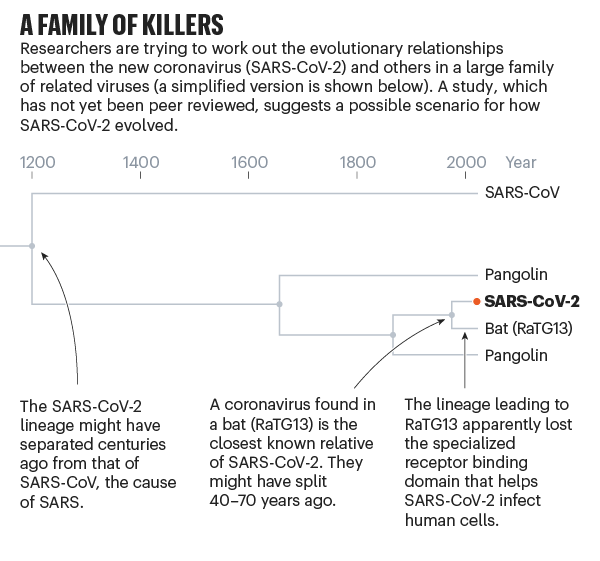
The origin of SARS-CoV-2 is still an open question (see ‘Family of
killers’). The virus shares 96% of its genetic material with a virus
found in a bat in a cave in Yunnan, China4
— a convincing argument that it came from bats, say researchers. But
there’s a crucial difference. The spike proteins of coronaviruses have a
unit called a receptor-binding domain, which is central to their
success in entering human cells. The SARS-CoV-2 binding domain is
particularly efficient, and it differs in important ways from that of
the Yunnan bat virus, which seems not to infect people5.
Complicating matters, a scaly anteater called the pangolin showed up
with a coronavirus that had a receptor-binding domain almost identical
to the human version. But the rest of the coronavirus was only 90%
genetically similar, so some researchers suspect the pangolin was not
the intermediary5. The fact that both mutations and recombinations are at work complicates efforts to draw a family tree.
But studies released over the past few months, which have yet to be
peer-reviewed, suggest that SARS-CoV-2 — or a very similar ancestor —
has been hiding in some animal for decades. According to a paper posted
online in March6,
the coronavirus lineage leading to SARS-CoV-2 split more than 140 years
ago from the closely related one seen today in pangolins. Then,
sometime in the past 40–70 years, the ancestors of SARS-CoV-2 separated
from the bat version, which subsequently lost the effective receptor
binding domain that was present in its ancestors (and remains in
SARS-CoV-2). A study published on 21 April came up with very similar
findings using a different dating method7.
These results suggest a long family history, with many coronavirus
branches in bats and possibly pangolins carrying the same deadly
receptor binding domain as SARS-CoV-2, including some that might have
similar abilities to cause a pandemic, says Rasmus Nielsen, an
evolutionary biologist at the University of California, Berkeley, and
co-author of the second study. “There is a need for continued
surveillance and increased vigilance towards the emergence of new viral
strains by zoonotic transfer,” he says.
Two open doors
Although the known human coronaviruses can infect many cell types,
they all mainly cause respiratory infections. The difference is that the
four that cause common colds easily attack the upper respiratory tract,
whereas MERS-CoV and SARS-CoV have more difficulty gaining a hold
there, but are more successful at infecting cells in the lungs.
SARS-CoV-2, unfortunately, can do both very efficiently. That gives
it two places to get a foothold, says Shu-Yuan Xiao, a pathologist at
the University of Chicago, Illinois. A neighbour’s cough that sends ten
viral particles your way might be enough to start an infection in your
throat, but the hair-like cilia found there are likely to do their job
and clear the invaders. If the neighbour is closer and coughs 100
particles towards you, the virus might be able get all the way down to
the lungs, says Xiao.
These varying capacities might explain why people with COVID-19 have
such different experiences. The virus can start in the throat or nose,
producing a cough and disrupting taste and smell, and then end there. Or
it might work its way down to the lungs and debilitate that organ. How
it gets down there, whether it moves cell by cell or somehow gets washed
down, is not known, says Stanley Perlman, an immunologist at the
University of Iowa in Iowa City who studies coronaviruses.
Clemens-Martin Wendtner, an infectious-disease physician at the
Munich Clinic Schwabing in Germany, says it could be a problem with the
immune system that lets the virus sneak down into the lungs. Most
infected people create neutralizing antibodies that are tailored by the
immune system to bind with the virus and block it from entering a cell.
But some people seem unable to make them, says Wendtner. That might be
why some recover after a week of mild symptoms, whereas others get hit
with late-onset lung disease. But the virus can also bypass the throat
cells and go straight down into the lungs. Then patients might get
pneumonia without the usual mild symptoms such as a cough or low-grade
fever that would otherwise come first, says Wendtner. Having these two
infection points means that SARS-CoV-2 can mix the transmissibility of
the common cold coronaviruses with the lethality of MERS-CoV and
SARS-CoV. “It is an unfortunate and dangerous combination of this
coronavirus strain,” he says.
The virus’s ability to infect and actively reproduce in the upper
respiratory tract was something of a surprise, given that its close
genetic relative, SARS-CoV, lacks that ability. Last month, Wendtner
published results8
of experiments in which his team was able to culture virus from the
throats of nine people with COVID-19, showing that the virus is actively
reproducing and infectious there. That explains a crucial difference
between the close relatives. SARS-CoV-2 can shed viral particles from
the throat into saliva even before symptoms start, and these can then
pass easily from person to person. SARS-CoV was much less effective at
making that jump, passing only when symptoms were full-blown, making it
easier to contain.
These differences have led to some confusion about the lethality of
SARS-CoV-2. Some experts and media reports describe it as less deadly
than SARS-CoV because it kills about 1% of the people it infects,
whereas SARS-CoV killed at roughly ten times that rate. But Perlman says
that’s the wrong way to look at it. SARS-CoV-2 is much better at
infecting people, but many of the infections don’t progress to the
lungs. “Once it gets down in the lungs, it’s probably just as deadly,”
he says.
What it does when it gets down to the lungs is similar in some
respects to what respiratory viruses do, although much remains unknown.
Like SARS-CoV and influenza, it infects and destroys the alveoli, the
tiny sacs in the lungs that shuttle oxygen into the bloodstream. As the
cellular barrier dividing these sacs from blood vessels break down,
liquid from the vessels leaks in, blocking oxygen from getting to the
blood. Other cells, including white blood cells, plug up the airway
further. A robust immune response will clear all this out in some
patients, but overreaction of the immune system can make the tissue
damage worse. If the inflammation and tissue damage are too severe, the
lungs never recover and the person dies or is left with scarred lungs,
says Xiao. “From a pathological point of view, we don’t see a lot of
uniqueness here.”
And as with SARS-CoV, MERS-CoV and animal coronaviruses, the damage
doesn’t stop with the lungs. A SARS-CoV-2 infection can trigger an
excessive immune response known as a cytokine storm, which can lead to
multiple organ failure and death. The virus can also infect the
intestines, the heart, the blood, sperm (as can MERS-CoV), the eye and
possibly the brain. Damage to the kidney, liver and spleen observed in
people with COVID-19 suggests that the virus can be carried in the blood
and infect various organs or tissues, says Guan Wei-jie, a
pulmonologist at the Guangzhou Institute of Respiratory Health at
Guangzhou Medical University, China, an institution lauded for its role
in combating SARS and COVID-19. The virus might be able to infect
various organs or tissues wherever the blood supply reaches, says Guan.
But although genetic material from the virus is showing up in these
various tissues, it is not yet clear whether the damage there is being
done by the virus or by a cytokine storm, says Wendtner. “Autopsies are
under way in our centre. More data will come soon,” he says.
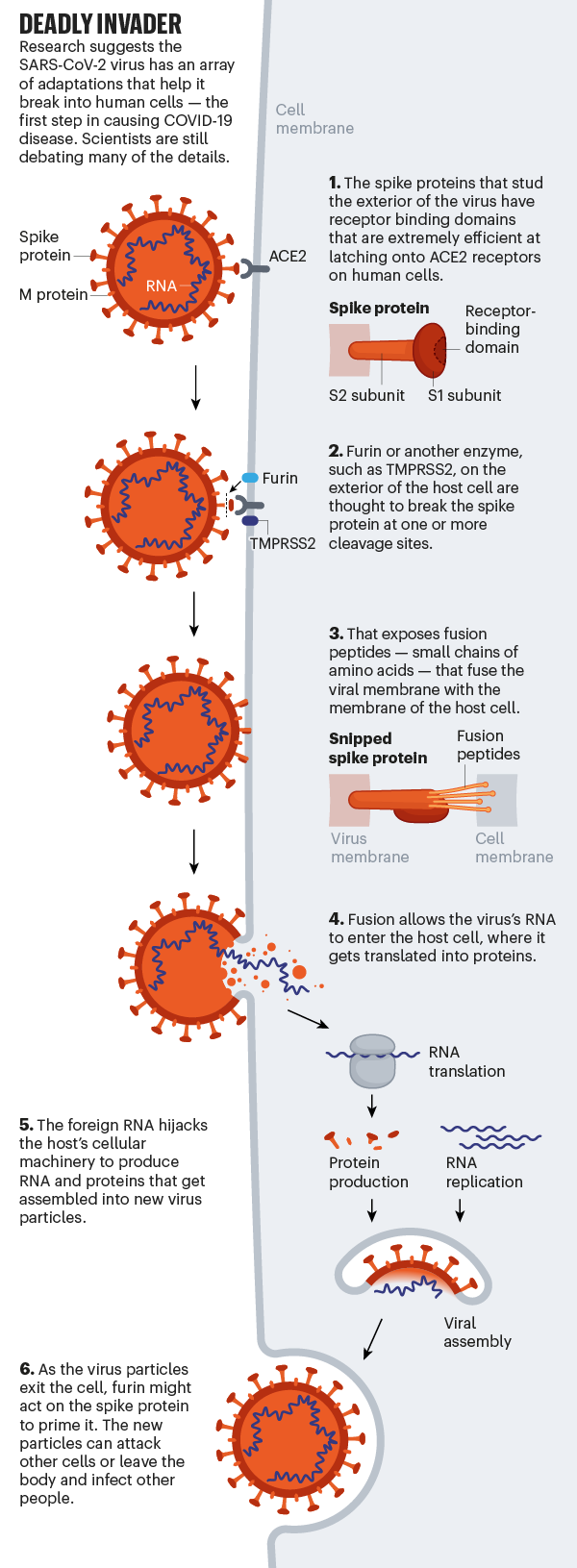
Whether it infects the throat or the lungs, SARS-Cov-2 breaches the
protective membrane of host cells using its spike proteins (see ‘Deadly
invader’). First, the protein’s receptor-binding domain latches on to a
receptor called ACE2, which sits on the surface of the host cell. ACE2
is expressed throughout the body on the lining of the arteries and veins
that course through all organs, but it is particularly dense on the
cells lining the alveoli and small intestines.
Although the exact mechanisms remain unknown, evidence suggests that
after the virus attaches itself, the host cell snips the spike protein
at one of its dedicated ‘cleavage sites’, exposing fusion peptides —
small chains of amino acids that help to pry open the host cell’s
membrane so that the virus’s membrane can merge with it. Once the
invader’s genetic material gets inside the cell, the virus commandeers
the host’s molecular machinery to produce new viral particles. Then,
those progeny exit the cell to go and infect others.
Power spikes
SARS-CoV-2 is uniquely equipped for forcing entry into cells. Both
SARS-CoV and SARS-CoV-2 bind with ACE2, but the receptor-binding domain
of SARS-CoV-2 is a particularly snug fit. It is 10–20 times more likely
to bind ACE2 than is SARS-CoV9.
Wendtner says that SARS-CoV-2 is so good at infecting the upper
respiratory tract that there might even be a second receptor that the
virus could use to launch its attack.
Even more troubling is the fact that SARS-COV-2 seems to make use of
the enzyme furin from the host to cleave the viral spike protein. This
is worrying, researchers say, because furin is abundant in the
respiratory tract and found throughout the body. It is used by other
formidable viruses, including HIV, influenza, dengue and Ebola to enter
cells. By contrast, the cleavage molecules used by SARS-CoV are much
less common and not as effective.
Scientists think that the involvement of furin could explain why
SARS-CoV-2 is so good at jumping from cell to cell, person to person and
possibly animal to human. Robert Garry, a virologist at Tulane
University in New Orleans, Louisiana, estimates that it gives SARS-CoV-2
a 100–1,000 times greater chance than SARS-CoV of getting deep into the
lungs. “When I saw SARS-CoV-2 had that cleavage site, I did not sleep
very well that night,” he says.
The mystery is where the genetic instructions for this particular
cleavage site came from. Although the virus probably gained them through
recombination, this particular set-up has never been found in any other
coronavirus in any species. Pinning down its origin might be the last
piece in the puzzle that will determine which animal was the stepping
stone that allowed the virus to reach humans.
End game
Some researchers hope that the virus will weaken over time through a
series of mutations that adapt it to persist in humans. By this logic,
it would become less deadly and have more chances to spread. But
researchers have not yet found any sign of such weakening, probably
because of the virus’s efficient genetic repair mechanism. “The genome
of COVID-19 virus is very stable, and I don’t see any change of
pathogenicity that is caused by virus mutation,” says Guo Deyin, who
researches coronaviruses at Sun Yat-sen University in Guangzhou.
Rambaut, too, doubts that the virus will become milder over time and
spare its host. “It doesn’t work that way,” he says. As long as it can
successfully infect new cells, reproduce and transmit to new ones, it
doesn’t matter whether it harms the host, he says.
But others think there is a chance for a better outcome. It might
give people antibodies that will offer at least partial protection, says
Klaus Stöhr, who headed the World Health Organization’s SARS research
and epidemiology division. Stöhr says that immunity will not be perfect —
people who are reinfected will still develop minor symptoms, the way
they do now from the common cold, and there will be rare examples of
severe disease. But the virus’s proofreading mechanism means it will not
mutate quickly, and people who were infected will retain robust
protection, he says.
“By far the most likely scenario is that the virus will continue to
spread and infect most of the world population in a relatively short
period of time,” says Stöhr, meaning one to two years. “Afterwards, the
virus will continue to spread in the human population, likely forever.”
Like the four generally mild human coronaviruses, SARS-CoV-2 would then
circulate constantly and cause mainly mild upper respiratory tract
infections, says Stöhr. For that reason, he adds, vaccines won’t be
necessary.
Some previous studies support this argument. One10
showed that when people were inoculated with the common-cold
coronavirus 229E, their antibody levels peaked two weeks later and were
only slightly raised after a year. That did not prevent infections a
year later, but subsequent infections led to few, if any, symptoms and a
shorter period of viral shedding.
The OC43 coronavirus offers a model for where this pandemic might go.
That virus also gives humans common colds, but genetic research from
the University of Leuven in Belgium suggests that OC43 might have been a
killer in the past11.
That study indicates that OC43 spilled over to humans in around 1890
from cows, which got it from mice. The scientists suggest that OC43 was
responsible for a pandemic that killed more than one million people
worldwide in 1889–90 — an outbreak previously blamed on influenza.
Today, OC43 continues to circulate widely and it might be that continual
exposure to the virus keeps the great majority of people immune to it.
But even if that process made OC43 less deadly, it is not yet clear
whether something similar would happen with SARS-CoV-2. A study in
monkeys showed that they retained antibodies to SARS-CoV-2, but the
researchers only reported on the first 28 days after infection, so it is
unclear how long the immunity lasted12. Concentrations of antibodies against SARS-CoV also dropped significantly over a two- to three-year period13.
Whether those lowered levels would be enough to prevent infection or
reduce severity has not been tested. Cats, cows, dogs and chickens do
not seem to become immune to the sometimes deadly coronaviruses that
infect them, leaving veterinarians over the years to scramble for
vaccines. Despite all the questions about whether people retain any
immunity to SARS-CoV-2, some countries are promoting the idea of giving
survivors ‘immunity passports’ to allow them to venture out without fear of being infected or infecting others.
Many scientists are reserving judgement on whether the tamer
coronaviruses were once as virulent as SARS-CoV-2. People like to think
that “the other coronaviruses were terrible and became mild”, says
Perlman. “That’s an optimistic way to think about what’s going on now,
but we don’t have evidence.”
In disaster movies, there is usually a make-or-break moment when the
hero turns desperation into triumph with one incredible act. As we
Americans watch our own real-life disaster movie called “Covid-19”
unfold, we too look toward a proverbial Hail Mary solution that will let
us return to normal. We are told by expert after expert that things
won’t return to normal until we have a fully effective vaccine or drug
remedy, and we despair when neither appears imminent. In lieu of a
medical miracle, we are told we must wait for extensive testing and
tracing capabilities before we can ease draconian restrictions on our
economic and social lives.
The all-or-nothing approach to solving problems makes for great
theater. It does not, however, bear much resemblance to how actual big
problems are solved in society, business, or science. Big problems
typically get tackled through a series of small solutions, each of which
on its own may not seem particularly important, but that together can
have a huge impact.
While the U.S. policy approach to Covid-19 should continue to support
big breakthrough initiatives like vaccine and drug development and
building massive test and trace capacity, we should not ignore the
potential cumulative impact of the many small things we already know how
to do or might try that together could make a big dent in the
current crisis. Most are things we are already being told to do (like
fastidious hand-washing). Each probably just makes a small difference.
But when harnessed together in a comprehensive program aimed at
implementing them more rigorously, they could potentially make a big
enough difference to get our economy and society functioning sooner
rather than later. Getting a majority of our population, businesses, and
government entities on board with these actions is the key challenge
facing our public- and private-sector leaders.
What if we greatly improved the hygiene of public spaces —
particularly public transportation, shopping areas, and restrooms —
through extensive and vigorous cleaning? New York City just announced
that it will clean its subway cars, commuter trains, and buses every
night instead of every 72 hours. What if that were every eight hours or
every four hours? What if showing up for work when sick was no longer a
sign of being a dedicated trouper but was frowned upon? What if
workplaces and schools found creative ways to reduce the physical
proximity of employees through more telecommuting and staggered shifts,
which would also make public transportation less crowded? What if
wearing a mask in public became the social norm? What if we improved our
testing capacity week by week? What if more people were willing to use
apps to identify “hotspots” (even imperfectly)?
I am not suggesting these are the only things we might do, or that
this particular set of actions on its own is the right one. Experts in
public health can probably identify a dozen other small steps that can
chip away at infection rates. My point is that to make a big dent in the
Covid-19 crisis, we need to be thinking about a big set of “small”
solutions rather just a small set of “big” solutions.
Medical developments, too, are often cast as all-or-nothing
propositions. But here, too, reality is more complex. Big improvements
in health care outcomes typically come from many incremental
improvements. A vaccine doesn’t have to be 100% effective to make a big
dent in a disease. (Remember, the flu vaccine typically reduces risks by
40% to 60%,
not 100%.) The same is true for drugs. It is hard to think of any drug
that is 100% effective for all patients. Many drugs lead to only small
marginal improvements in patient outcomes. But if a disease is prevalent
enough, such small improvements translate into many lives saved. And
let’s remember, many improvements in medical outcomes have nothing to do
with technology or drugs; they come from better patient management
practices. Figuring out when the best time to intubate a patient or
whether to put them on their stomach rather on their back is unlikely to
make headlines, but it can lead to better outcomes. You don’t
necessarily need game-changing drugs or technology to change the game;
you just need a lot learning about what works and doesn’t in practice.
Fast learning from experience will be critical.
The big challenge with the “many small solutions” approach is that it
requires very broad participation and compliance across society and
active engagement across public- and private-sector institutions. For
instance, the vast majority of the population must be willing to change
its behavior — always wearing masks in public, religiously washing
hands, avoiding going out when sick, picking up the phone when called by
a contact tracer, agreeing to comply with self-quarantine rules, using
apps that help track hotspots, and so forth. Businesses must be willing
to adopt new work schedules, new work arrangements, and new ways to
protect workers and customers. Schools would need to alter schedules and
activities to avoid crowding. Governments would have to invest in
extensive cleaning of public spaces and in a test-and-trace
infrastructure.
A big advantage of the “many small solutions” approach is that it
lends itself to constant updating and continuous improvements as better
information becomes available about what is working and what is failing.
But to exploit this potential advantage, we need good information. Most
importantly, we need leaders capable of responding to new information
and convincing broad swaths of society to adapt. Everyone can be and
must be an innovator today.
Many of the specific things I have suggested above have been
criticized by various experts for not being enough. I would agree that
nothing I have mentioned above by itself is going to put much of dent in
the Covid-19 pandemic. But if we consider the cumulative impact of such
steps, we could see real progress much sooner than anticipated. We can
wait for the magic moment to arrive when the hero saves the day, or we
can act now in whatever ways we can. I know which real-life movie I want
to be in. Gary P. Pisano
is the Harry E. Figgie Jr. Professor of Business Administration and the
senior associate dean of faculty development at Harvard Business
School. He is the author of Creative Construction: The DNA of Sustained Innovation. https://hbr.org/2020/05/we-shouldnt-wait-for-a-breakthrough-in-the-covid-19-pandemic
Despite what the World Health Organization and Dr. Anthony Fauci tell you, a new study has concluded that if 80% of Americans were to wear a mask, COVID-19 infections would drop by more than 90%.
The day before yesterday, 21 people died of COVID-19 in Japan.
In the United States, 2,129 died. Comparing overall death rates for the
two countries offers an even starker point of comparison with total
U.S. deaths now at a staggering 76,032 and Japan’s fatalities at 577. Japan’s population is about 38% of the U.S., but even adjusting for population, the Japanese death rate is a mere 2% of America’s. This comes despite Japan having no lockdown,
still-active subways, and many businesses that have remained
open—reportedly including karaoke bars, although Japanese citizens and
industries are practicing social distancing where they can. Nor have the Japanese broadly embraced contact tracing,
a practice by which health authorities identify someone who has been
infected and then attempt to identify everyone that person might have
interacted with—and potentially infected. So how does Japan do it?
So what is Japan doing differently?
“One reason is that nearly everyone there is wearing a mask,” said UC Berkeley computer scientist De Kai, the chief architect of an in-depth joint study with Hong Kong University.
Kai’s study suggests that every one of us should be wearing a mask – be it homemade, surgical, scarf or bandana, like the Japanese are doing along with other (mostly East Asian) countries.
The mask debate, of course, has been raging for weeks in the States and globally. Pro-maskers assert that the widespread use of face coverings can diminish the spread of COVID-19. Some
anti-maskers, including various politicians and public health
officials, have insisted that there is no proof of the efficacy of face
guards. According to some activists, a blanket mask mandate
places a limit on individual liberty and even one’s right to free
speech. (Pro-mask advocates are fighting back with #masks4all and
#wearafuckingmask Twitter campaigns). Representatives of the World Health Organization have also been sounding rather anti-mask,
fretting that many people won’t wear masks properly, thereby risking
infection, or that masks will give people a false sense of security and
encourage risky behavior, such as partying up close and personal—none of
which seems to have played out, as far as we know, in Japan or Hong
Kong or other mask-wearing places. Adding to the brouhaha has been the
shortage of medical masks for doctors, nurses, bus drivers, and the guy
who delivers burritos to your door. –Vanity Fair
“I felt like this was pretty urgent,” said De Kai – the son of
Chinese immigrants who was born in St. Louis. “I saw the country where I
grew up, where my family lives [now mostly in the Bay Area], about to
face this pandemic without knowing much about something as simple as
wearing a mask to protect themselves and others.”
Kai built a forecasting computer model called the masksim simulator,
which uses sophisticated models used by epidemiologists to track
outbreaks of various pathogens such as SARS, Ebola and COVID-19, and
simulate the effect of wearing masks on infection rates. It incorporates
randomness and unpredictability inherent to human behavior, such as
when an infected person decides to drop everything and take off to the
beach for a dose of Vitamin D. Kai’s team also added their own
variables, such as how effective different masks are at blocking aerosolized droplets of coronavirus.
Along with the masksim site, the team is also releasing a study that describes their model in detail as well as their contention that masksim’s forecasts support a growing body of pro-mask evidence. “What’s most important about wearing masks right now,” said Guy-Philippe Goldstein, an economist, cybersecurity expert, and lecturer at the Ecole de Guerre Economique in Paris—and a masksim
collaborator, “is that it works, along with social distancing, to
flatten the curve of infections as we wait for treatments and vaccines
to be developed—while also allowing people to go out and some businesses
to reopen.”
While all models have limitations and are only as good as their assumptions, this one is “a very thorough model and well done,” said William Schaffner,
an infectious disease specialist at Vanderbilt University, who reviewed
the De Kai team’s paper. “It supports a notion that I advocate along
with most other infectious disease experts: that masks are very, very
important.” Jeremy Howard, founding researcher at fast.ai and a distinguished research scientist at the University of San Francisco, also assessed the paper. “It’s almost overkill how careful they were with this modeling,” said Howard, who also coauthored and spearheaded a study last month (recently submitted to the journal PNAS) that reviewed dozens of papers assessing the effectiveness of masks. –Vanity Fair
Bausch + Lomb has bought US and Canadian rights to a
potential biosimilar competitor to Novartis’ Lucentis
from Germany’s Stada, as the blockbuster approaches the end of its
patent protected period next month. Bausch + Lomb is part of Bausch Health Companies, formerly known as Valeant, which has rebranded in an effort todistance itself from a disastrous pricing scandal a couple of years ago. Under the terms of the agreement, Bausch + Lomb will make a “mid-single million” dollar payment, plus further milestone payments if the drug is approved in the US. Stada and Xbrane will
also be entitled to a share of gross profits from sales of the product
by Bausch + Lomb and will share equally in the proceeds they receive. The companies aim to develop the biosimilar for all of the currently approved indications for Lucentis in both the US and Canada. Lucentis (ranibizumab) was first approved in the US in 2006 for
wet age-related macular degeneration, and since then has racked up a
host of other indications including diabetic macular oedema, and diabetic retinopathy. Novartis’ Q1 figures showed sales of $487 million, down 6% on a constant currency basis compared with the same period last year. But it is still the company’s fourth largest drug in terms of sales and the Swiss pharma has produced a follow-on drug, Beovu, which does not need to be injected as frequently. The US patent on Lucentis expires next month and Bayer’s big rival Eylea is also set to lose its patent protection this year, opening up the market to cheaper rivals. Biosimilars are biologic drugs that are shown to be as safe and
effective as the originator, although there may be slight differences
as they are manufactured in cells rather than using industrial processes. STADA CEO Peter Goldschmidt said: “We are convinced that the
biosimilar ranibizumab has strong commercial potential in North America. “With its deep relationships with eye care professionals in
North America, and an effective salesforce already in place to promote
their comprehensive pharmaceuticals portfolio, we believe that Bausch +
Lomb is the ideal partner to broaden access to this ophthalmic treatment
in North America.”
Alzheimer’s disease (AD) is a neurodegenerative disorder
that causes cognitive decline, memory loss, and inability to perform
everyday functions. Hallmark features of AD—including generation of
amyloid plaques, neurofibrillary tangles, gliosis, and inflammation in
the brain—are well defined; however, the cause of the disease remains
elusive. Growing evidence implicates pathogens in AD development, with
herpes simplex virus type I (HSV-1) gaining increasing attention as a
potential causative agent. Here, we describe a multidisciplinary
approach to produce physiologically relevant human tissues to study AD
using human-induced neural stem cells (hiNSCs) and HSV-1 infection in a
3D bioengineered brain model. We report a herpes-induced tissue model of
AD that mimics human disease with multicellular amyloid plaque–like
formations, gliosis, neuroinflammation, and decreased functionality,
completely in the absence of any exogenous mediators of AD. This model
will allow for future studies to identify potential downstream drug
targets for treating this devastating disease.
The U.S. Department of Health and Human Services (HHS) said on
Saturday it would allow state health departments to distribute Gilead
Sciences Inc’s remdesivir drug to fight COVID-19, and the United States
would receive about 40% of the drug maker’s global donation.
Gilead has committed to supply approximately 607,000 vials of
remdesivir over the next six weeks in the United States, and the U.S.
state health department will distribute the doses to appropriate
hospitals in their states, HHS said.
Gilead’s drug has shown promise in helping patients infected with
COVID-19, the illness caused by the novel coronavirus, and is being
closely watched on how the limited supply is distributed.
Last Friday, the U.S. Food and Drug Administration gave emergency use
authorization for the drug for patients with severe COVID-19, clearing
the way for broader use in more hospitals around the United States. Data
has shown Gilead’s antiviral drug remdesivir helped to reduce hospital
stays for COVID-19 patients.
Gilead Chief Executive Dan O’Day said in late April that Gilead would
donate 1.5 million doses and work with the U.S. government on
distribution.
On Saturday, HHS said the 1.5 million doses were a global figure and that 607,000 would be distributed through the agency.
The allocation by Gilead Sciences to the United States was finalized on May 3, HHS said.
The U.S. is sending the drug remdesivir to local agencies in Illinois, Iowa, Connecticut, Maryland, Michigan and New Jersey.
Gilead did not immediately respond to a request for comment.
The Infectious Disease Society of America (IDSA) on Thursday said it
is asking for more information on the federal government’s plan for
deciding how and where to distribute the drug. The federal government
began distributing the drug this week but doctors across the country,
particularly in COVID-19 hotspots like New York and Boston, became
concerned after being denied their request to obtain the new therapy,
IDSA president Dr. Thomas File told Reuters on Thursday. The IDSA on
Wednesday called on the Trump Administration to explain how it will
ensure equitable distribution of remdesivir to states and hospitals
based on COVID-19 cases and hospitalization rates.
More than 3.96 million people have been reported to be infected by
the novel coronavirus globally and 273,974 have died, according to a
Reuters tally, as of 1315 GMT on Saturday. https://www.reuters.com/article/us-health-coronavirus-gilead-sciences/u-s-to-allow-states-to-distribute-gileads-remdesivir-to-fight-covid-19-idUSKBN22L0SM
You’re sick, perhaps very sick, so you head to the local emergency
department fearing the onset of COVID-19. But what symptoms most clearly
point to a need for urgent care?
Based on a review of more than 1,000 patients who’ve already sought care for respiratory illnesses since the coronavirus
was declared a pandemic in March, researchers at Harvard Medical School
are offering up a new list of symptoms to watch out for.
First of all, fever isn’t necessarily at the top of the list.
“Fever is not a reliable indicator” of COVID-19, said a team led by
Pieter Cohen. He’s an associate professor of medicine at Harvard and a
physician with the Cambridge Health Alliance, in Boston.
Often, people who show up at hospital ERs with respiratory symptoms
have only slightly elevated body temperatures, the researchers noted.
They added that other symptoms are often more specific to COVID-19.
“COVID-19 may begin with various permutations of cough without fever,
sore throat, diarrhea, abdominal pain, headache, body aches, back pain
and fatigue. It can also present with severe body aches and exhaustion,”
Cohen’s group explained in a Harvard news release.
Another key sign of coronavirus illness: A loss of the sense of smell within the first few days of symptom onset.
And what really sets more serious cases of COVID-19 apart is something that’s almost never seen in influenza or other respiratory illnesses: severe shortness of breath.
“In serious COVID-19, shortness of breath is a critical differentiator from other common illnesses,” Cohen’s group said.
Shortness of breath—a feeling that you can’t fill your lungs with air
as you normally do—almost never appears within the first day or two of
the onset of other symptoms. But it “can appear four or more days after
onset of other symptoms,” the team added.
Shortness of breath can also occur in an anxiety-induced panic attack, and of course the fear that you might have COVID-19 could spur such an attack.
But the shortness of breath that is indicative of clinical COVID-19 manifests somewhat differently, the research team said.
First of all, “anxiety-induced shortness of breath occurs rapidly,
seemingly out of the blue, while COVID-19 shortness of breath tends to
develop gradually over a few days,” the researchers noted. And when
shortness of breath comes from a panic attack, it typically occurs when a
person is at rest or trying to fall asleep.
In contrast, COVID-19 shortness of breath “gets worse with physical
exertion, including performing simple daily activities like walking,
climbing stairs or cleaning,” the researchers said.
Shortness of breath tied to COVID-19 is a real warning sign that a
person might need to seek medical help because of a dangerous dip in
oxygen levels in the blood. “Blood oxygen levels can drop precipitously
with exertion, even in previously healthy people,” the team said.
Doctors can quickly monitor blood oxygen levels using a simple
finger-clip device called a pulse oximeter. Once COVID-19 shortness of
breath has been diagnosed, these patients might be released back home,
but will still require “very close monitoring and frequent follow-up to
check how the shortness of breath is evolving, and whether a patient may be deteriorating and may need to go to the hospital,” the team said.
“Early recognition and proper triage are especially important given
that, in the first days of infection, people infected with [the new
coronavirus] may experience symptoms indistinguishable from a variety of
other acute viral and bacterial infections,” Cohen added.
Cohen’s team published their findings April 20 in the Mayo Clinic Proceedings journal. The study is based on more than 1,000 patients seen at a COVID-19 outpatient clinic in Boston.
Reading over the new report, New York City emergency medicine
physician Dr. Robert Glatter said, the findings “mirror the clinical
picture of patients that I continue to see.”
Some patients come to his department at Lenox Hill Hospital without
any drop in blood oxygen, but with “fatigue, muscle aches [and] often
loss of smell,” Glatter said. These patients are still able to eat and
drink and they’re typically discharged back home.
“There is also a subgroup of stable patients—with mild symptoms and
mild hypoxia [low blood oxygen]—who, after careful evaluation, can be
safely discharged and monitored in the home-setting with pulse oximetry
and frequent telemedicine follow-up to check for progression of
symptoms,” he added.
“But most important, we must pay close attention to those patients
who experience worsening and new symptoms—chiefly difficulty breathing
or chest discomfort up to a week after onset of symptoms, along with
fever— who then present for re-evaluation in the emergency department,”
Glatter said.
It’s these patients who are most at risk for the onset of a “cytokine
storm”—a very dangerous condition where the immune system’s response to
the new coronavirus runs amuck.
When blood oxygen levels fall too low, these patients may require hospital admission, Glatter said.
So, “it’s important to look at all aspects of patients’ concerns
along with their chief complaint when they present to the emergency
department—chiefly the timeline and course of their symptoms—when
evaluating patients who may be at risk for complications and progression
of COVID-19,” Glatter said. https://medicalxpress.com/news/2020-05-symptoms-severe-covid-doctors-issue.html