A new Iranian oil trading network has been entrusted with selling millions of barrels of sanctioned crude even though its members still owe billions of dollars from earlier sales, according to documents obtained by Iran International and Oil Ministry sources.
One document, a confidential letter from the Supreme National Security Council’s protection unit to the Oil Ministry, raises concerns over the ministry’s decision to hand large volumes of crude to four trusted intermediaries, known as trustees, on credit and at steep discounts.
The crude was allocated after a new oil sales team took control in July, according to the letter.
The former chief executive of Naftiran Intertrade Company (NICO) had identified the intermediaries as carrying large debts and failing to return billions of dollars from previous oil sales, the document says.
The ministry nevertheless offered the intermediaries a discount of $8.50 per barrel, a level the confidential letter described as unusual.
The documents and two Oil Ministry sources point to Mohammad Javad Bavand, a former Revolutionary Guards intelligence official appointed to oversee oil trading, as a central figure in the new arrangement.
Disputed cargo tied to sanctioned tankers
A second confidential document records a closed Oil Ministry meeting on June 28 concerning Iranian crude exported to China aboard three sanctioned tankers linked to Hossein Shamkhani, also known as Hector, an oil trader and son of Ali Shamkhani, a former adviser to slain Supreme Leader Ali Khamenei.
Two million barrels of crude were shipped through a front company aboard the tanker Lily to China’s Dongjiakou port on March 24, according to the document.
The owner of Lily subsequently took control of the cargo, citing a financial dispute with Panel Good Wholesalers, the company involved in the shipment, the document says.
Lily belongs to a shipping network and shadow fleet controlled by Hossein Shamkhani that has been sanctioned by the US Treasury. Dubai-registered Panel Good Wholesalers is also one of Shamkhani’s companies used for oil trading.
Oil trader Mohammad Hadi Momenin recovered the two-million-barrel cargo at NICO’s request and stored it in tanks at Dongjiakou, participants at the June meeting were told, according to the document.
Momenin then sought $33 million in compensation from the Iranian oil company, including $27 million for the loss in value of the tanker Covenio following US sanctions and $6 million for charter costs involving another tanker, Jaya.
Bavand instructed Momenin to return ownership of the cargo to the Oil Ministry and, through one of Momenin’s companies, charter Covenio for one year at $90,000 per day, according to the meeting record.
Both Covenio and Jaya belong to Shamkhani’s sanctioned shadow fleet.
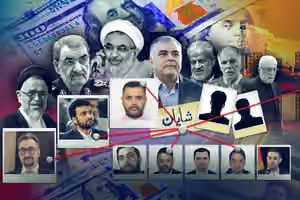
Iran International reported three weeks ago that Momenin was a member of an Intelligence Ministry network known as the Shayan network. Momenin, born in 1989, has failed to return about $2 billion in Iranian oil proceeds, according to Iran International’s previous investigation.
Five traders form Bavand’s network
Momenin is one of five trustees in an oil trading network assembled by Bavand following his return to the Oil Ministry, two ministry sources told Iran International.
Another member is Mostafa Niazazari, the fifth defendant in the corruption case involving former senior judiciary official Akbar Tabari.
Niazazari was accused in the case of giving Tabari 15,000 square meters of land as a bribe. After fleeing to Canada, he returned to Iran four years ago and has since resumed oil trading while residing in a European country.
Niazazari is the son of Kioumars Niazazari, a former Intelligence Ministry director-general in Mazandaran province.
Two businessmen known for importing essential commodities have also joined Bavand’s network after entering the oil trade during the tenure of former NICO chief executive Saeed Sadeghi, according to the Oil Ministry sources.
Hassan Afrashtehpour, also known as Dariush and the owner of Afra Holding, has for years controlled imports of some essential commodities. An Iranian court sentenced him to 25 years in prison for economic corruption in 1997, but he was released four years later.
Masoud Modallal, a major importer of cooking oil and animal feed who has faced large banking debts, is another member of the network, the sources said.
Modallal previously received $985 million in preferential-rate foreign currency for essential-goods imports and owed 5.75 trillion rials to Sarmayeh Bank and 7.82 trillion rials to Pasargad Bank.
Modallal shifted his focus toward oil trading after Iran ended preferential currency allocations, according to the sources.
The fifth member is Ali Bayandorian, a trader sanctioned by the United States six years ago over what Washington described as financing for the Revolutionary Guards’ Quds Force.
Bayandorian uses a network of companies registered in Iran and Southeast Asia to sell oil and petrochemical products outside conventional markets, according to the sources.
Together, the five traders make up what the Oil Ministry sources described as Bavand’s new trustee network.
The two confidential documents obtained by Iran International show members of this network continuing to receive Iranian oil despite outstanding proceeds from previous sales.
From Guards intelligence to oil sales
Bavand studied at Imam Sadiq University, known for combining Islamic studies with modern social sciences, and until 2021, served as deputy to Mostafa Ahadi, the economic deputy of the Revolutionary Guards Intelligence Organization.
Ahadi is a nephew of Ali Akbar Hosseini Mehrab, a security official whose name has appeared in major Iranian corruption cases, including the Crescent gas dispute.
Bavand entered a Supreme National Security Council committee in 2018 following the US withdrawal from the nuclear agreement and Washington’s restoration of sanctions on Iranian oil.
The council created a working group to manage oil sales designed to bypass the restrictions, alongside a security committee composed of representatives from Iranian military and intelligence organizations.
The Revolutionary Guards Intelligence Organization sent Bavand, then deputy head of its economic division, to the security committee.
Bavand built a network of trusted oil intermediaries during his time on the committee, including Majid Azami, chief executive of Sepehr Energy Jahan Nama Pars, Majid Taj, brother of Iranian Football Federation president Mehdi Taj, and trader Hamed Kachoui.
Iran’s oil sales structure changed further after Ebrahim Raisi became president in 2021 and his government authorized the armed forces to participate formally in oil trading.
The Revolutionary Guards subsequently sent Bavand to the Oil Ministry, where he took responsibility for trading oil under sanctions.
A significant part of the problems involving trustees and unreturned oil proceeds emerged during that period.
Following Raisi’s death, Oil Minister Mohsen Paknejad initially entrusted management of sanctioned oil sales to officials with previous links to Shayan, an Intelligence Ministry official involved in fuel operations.
Bavand returned to the Oil Ministry following Shayan’s removal.
Paknejad appointed Bavand special assistant to the oil minister for supervision of oil trading after the previous NICO chief executive was removed following disclosures concerning trustees and unreturned oil proceeds.
Bavand is also related to Hossein Taeb, the former head of the Revolutionary Guards Intelligence Organization, who is currently the commander of the Basij paramilitary unit, and a figure close to Supreme Leader Mojtaba Khamenei.
Bavand now plays a central role in decisions over sanctioned oil sales and has assembled a new group of trusted intermediaries.

The documents show that traders carrying large outstanding debts from earlier oil sales have again been entrusted with millions of barrels of Iranian crude, placing Bavand and his network at the center of the system used to sell Iran’s oil under sanctions.

No comments:
Post a Comment
Note: Only a member of this blog may post a comment.